Wednesday, April 22nd 2026

AMD Launches the Ryzen 9 9950X3D2 Dual Edition Processor
Today, AMD released the AMD Ryzen 9 9950X3D2 Dual Edition processor, the first processor that brings dual AMD 3D V-Cache technology to the desktop, unlocking a new level of performance for developers, creators and gamers.
Built for demanding developers, the AMD Ryzen 9 9950X3D2 Dual Edition processor combines high-performance "Zen 5" core technology with dual 2nd Gen AMD 3D V-Cache technology across all 16 cores, delivering 208 MB of total cache for expanded cache capacity and low latency. The result is exceptional responsiveness, increased throughput and flexibility to power next-generation development and creation workflows.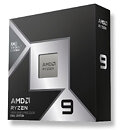 Innovation Pushes Forward
AMD redefined gaming performance in 2022 with the introduction of the Ryzen 7 5800X3D processor, the world's first X3D processor with AMD 3D V-Cache technology. The Ryzen 9 7950X3D followed that breakthrough as the first 16-core processor with AMD 3D V-Cache technology.
AMD evolved the design with second-generation AMD 3D V-Cache technology, repositioning the stacked cache beneath the processor cores to help lower temperatures, support higher sustained frequencies and improve efficiency.
Now AMD advances that legacy with the Ryzen 9 9950X3D2 Dual Edition processor. It marks the next step in AMD's continued innovation for next-generation applications.
"I'm excited to introduce the Ryzen 9 9950X3D2 Dual Edition, the world's first desktop processor with AMD 3D V-Cache on both chiplets, delivering an incredible 208 MB of on-chip memory," said Jack Huynh, senior vice president and general manager, Computing and Graphics Group, AMD. "This is the next evolution, and with a simple drop-in upgrade on AM5, we're delivering the absolute best performance for world-class gaming and content creation."
Built for Developers and Creators
The Ryzen 9 9950X3D2 Dual Edition processor is engineered to accelerate complex compile times, large-scale simulations and memory-intensive workflows. With dual 2nd Gen AMD 3D V-Cache technology delivering 208 MB of total cache, the processor is designed to keep more data closer to the cores, which can reduce memory bottlenecks and enable faster iteration cycles.
Powered by "Zen 5" architecture and built on a 4 nm process, it provides the sustained performance required for demanding creation and development environments. Compared to the previous generation, the Ryzen 9 9950X3D2 Dual Edition processor shows average uplifts of 5% to 8% in creator workloads including DaVinci Resolve and Blender, and in massive source code builds including Unreal Engine and Chromium. By combining expanded cache capacity with high core counts and advanced architecture enhancements, the Ryzen 9 9950X3D2 Dual Edition gives developers the performance headroom needed to build, test and deploy next-generation applications with greater speed and confidence.
"Alienware is the first to bring the AMD Ryzen 9 9950X3D2 Dual Edition to market, and the Area-51 is the platform we built to make the most of it—combining AMD's dual 3D V-Cache architecture with Alienware's thermal engineering to deliver a level of processing performance that creators and gamers haven't had access to before," said Matt McGowan, Head of Product, Alienware. "This is the most powerful Alienware desktop we've ever built with AMD."
Pricing and Availability
AMD Ryzen 9 9950X3D2 Dual Edition processors are available starting today at leading retailers for $899 (SEP) and in systems from original equipment manufacturers (OEM), including the Alienware Area-51 Desktop.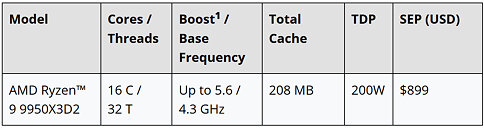
Source:
AMD
Built for demanding developers, the AMD Ryzen 9 9950X3D2 Dual Edition processor combines high-performance "Zen 5" core technology with dual 2nd Gen AMD 3D V-Cache technology across all 16 cores, delivering 208 MB of total cache for expanded cache capacity and low latency. The result is exceptional responsiveness, increased throughput and flexibility to power next-generation development and creation workflows.

AMD redefined gaming performance in 2022 with the introduction of the Ryzen 7 5800X3D processor, the world's first X3D processor with AMD 3D V-Cache technology. The Ryzen 9 7950X3D followed that breakthrough as the first 16-core processor with AMD 3D V-Cache technology.
AMD evolved the design with second-generation AMD 3D V-Cache technology, repositioning the stacked cache beneath the processor cores to help lower temperatures, support higher sustained frequencies and improve efficiency.
Now AMD advances that legacy with the Ryzen 9 9950X3D2 Dual Edition processor. It marks the next step in AMD's continued innovation for next-generation applications.
"I'm excited to introduce the Ryzen 9 9950X3D2 Dual Edition, the world's first desktop processor with AMD 3D V-Cache on both chiplets, delivering an incredible 208 MB of on-chip memory," said Jack Huynh, senior vice president and general manager, Computing and Graphics Group, AMD. "This is the next evolution, and with a simple drop-in upgrade on AM5, we're delivering the absolute best performance for world-class gaming and content creation."
Built for Developers and Creators
The Ryzen 9 9950X3D2 Dual Edition processor is engineered to accelerate complex compile times, large-scale simulations and memory-intensive workflows. With dual 2nd Gen AMD 3D V-Cache technology delivering 208 MB of total cache, the processor is designed to keep more data closer to the cores, which can reduce memory bottlenecks and enable faster iteration cycles.
Powered by "Zen 5" architecture and built on a 4 nm process, it provides the sustained performance required for demanding creation and development environments. Compared to the previous generation, the Ryzen 9 9950X3D2 Dual Edition processor shows average uplifts of 5% to 8% in creator workloads including DaVinci Resolve and Blender, and in massive source code builds including Unreal Engine and Chromium. By combining expanded cache capacity with high core counts and advanced architecture enhancements, the Ryzen 9 9950X3D2 Dual Edition gives developers the performance headroom needed to build, test and deploy next-generation applications with greater speed and confidence.
"Alienware is the first to bring the AMD Ryzen 9 9950X3D2 Dual Edition to market, and the Area-51 is the platform we built to make the most of it—combining AMD's dual 3D V-Cache architecture with Alienware's thermal engineering to deliver a level of processing performance that creators and gamers haven't had access to before," said Matt McGowan, Head of Product, Alienware. "This is the most powerful Alienware desktop we've ever built with AMD."
Pricing and Availability
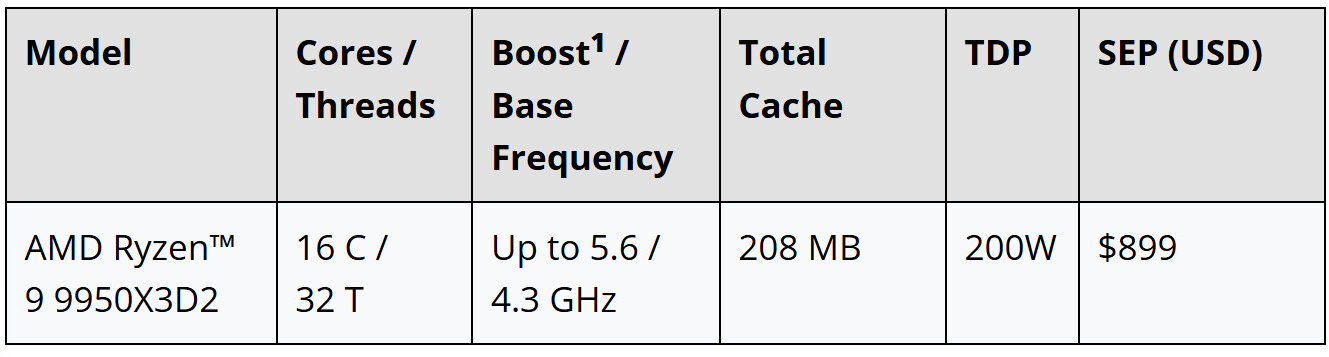
AMD Ryzen 9 9950X3D2 Dual Edition processors are available starting today at leading retailers for $899 (SEP) and in systems from original equipment manufacturers (OEM), including the Alienware Area-51 Desktop.
131 Comments on AMD Launches the Ryzen 9 9950X3D2 Dual Edition Processor
Also because it was on my mind and I don't hear it often I think the bigger penalty might be if by some chance your thread does get moved across a CCD, and data needs to be loaded from RAM back into the cache, there is the real performance hit. I think that applies to threads sharing data but it's a bit beyond my technical expertise quite frankly so I would leave it to the experts to explain that better and correct me if needed.
Just a small case where Inter-CCD latency doesn't matter. For example if I want to 7zip 300GB of data I want to use all 32 cores (4 CCD's) because using any less it will simply take longer and I don't want to wait that long.
The only weirdness I've seen was Space Marine 2 with my 7950X3D, when the game occasionally loaded more than 50% of the CPU (shader caching or asset loading, I assume). In those situations, the game dropped to unplayable sub-10 FPS for a few seconds. This doesn't happen with my 7800X3D.
This is also a sample size of one, but since the situation exists, I can't say that inter-CCD communication is never a problem.
This is why I sold the CPU and reverted back to the 7800X3D. What's the point in having a multitasking beast in my system if I can't multitask with it?
It doesn't really matter what mental gymnastics you employ to twist this while trying to insert "fanboyism" (lol) in the equation, the numbers are numbers. And that's aside from the fact that the best AMD could do recently is 9070XT, so your theory falls flat on its face.
Seriously, somebody who clearly fancies themselves a "complex creature" should really do better than that :)
Tech fora have been littered for years with cries to AMD to release a SKU with dual V-cache.
AMD has repeatedly said that such SKU would not bring big benefits.
Cries continued. AMD finally released such SKU.
Now that we have this SKU, in toxic comments some people are not happy either.
It's usually from those who never use, need or even buy one.
Top of the line CPUs have always been priced disproportionately high for a small performance delta. If you pay twice as much for a GPU you expect roughly twice the performance, if you pay twice as much for a CPU and you expect twice the performance you’re going to have a big surprise.
www.intel.com/content/www/us/en/content-details/913918/intel-advanced-vector-extensions-10-2-intel-avx10-2-architecture-specification.html
Page 18 details how support across P-cores and E-cores will be.
"This ISA will be supported on all future processors, including Performance cores (P-cores) and Efficient cores (E-cores).".
"Intel® AVX10/512 − Converged implementation support on all Intel® processors to include all the existing Intel® AVX-512 capabilities such as EVEX encoding, 32 vector registers and eight mask registers at vector lengths 128, 256, and 512."Page 20 specifically clarifies all of this like:The table in page 21 should be an easy way to understand what is supported in each version as of now.
On the other hand, 270K+ is the mainstream CPU, which Intel does not earn much money on, as it is discounted. Their margins on this one are tiny or next to zero. They would have never offered such deal had they had more healthy situation in desktop market with Arrow Lake generation. We all know what happened with Arrow Lake...
Jokes aside, it's "total nonsense" obviously, which is why my GPU analogy makes perfect sense. We've always been told that paying for 4090/5090 is idiocy, even though you actually get something to show for it and their resale value either remains very high or actually increases. But saying that a halo AMD CPU is a damp squib and that buying it might not be the best move? Nah, we can't have that.
(btw this is an opinion from a "hater" whose last 4 CPUs were AMD branded)
The reason a halo 5090 seems so “wild” is because the GPU right below it in the hierarchy (5080) has half the shaders a 5090 does.
If your work involves frequent back-ups of large files it seems a reasonable choice for a new build.
If you want the best of the best, this is it.
Halo = as much as you want, apparently, according to the logic presented. no backtracking, reasons, and all that. :P Halllllllllllllllllloooooooooooooooooo, Halo.
Just think of that vanity that will be had if you are rocking one of these bad boys for that price, at least, for a tiny while, NEXT, CONSUME. :roll:
The only reason why a 4090 or 5090 holds its resale value is because there has been zero change in price to performance ratio in GPUs lately, especially the Nvidia side. What you got for X dollars 5 years ago is exactly what you get for it today. This is a feature of the current economy and the stagnating PC landscape, and not a good thing at all. Historically, halo tier products always lost their value the fastest because the advancements between generations were great.
Minecraft does for world generation and chunk loading, but not for the main game thread itself, and having more cores available generally means a more stable experience there. But we must also remember the game is quite RAM heavy, so having lots of RAM as well as faster RAM may help too, especially in newer game versions with newer Java versions (old versions don't really care above 8-10GB, and you would start losing performance above 12-14GB because of how old Java runs).
A lot of recent-ish MMORPGs scale beyond 8 cores, mainly for accurate tracking of every player/entity positions and actions in real-time.
Phantasy Star Online 2: New Genesis for example asks for an i9-10900 (10c/20t) as recommended CPU and it looks like it doesn't benefit from HyperThreading. Playing it on a laptop with a Ryzen 5 5600H and RTX 3060 Laptop GPU, I'm entirely CPU bound at 1080p High/Ultra and 1440p Medium/High, at around 70-110fps in normal scenarios. I'm also CPU-limited and engine-limited before being GPU-limited at 1440p Max with a 14700KF and 5070 Ti in 90% of scenarios even when not using DLSS.
There are probably some more games of different genres that could use more than 8 cores for valid reasons than what I've cited above. The main issue though is that CPUs with dual CCDs are still bound to inter-CCD communication latency.