Wednesday, April 22nd 2026

AMD Launches the Ryzen 9 9950X3D2 Dual Edition Processor
Today, AMD released the AMD Ryzen 9 9950X3D2 Dual Edition processor, the first processor that brings dual AMD 3D V-Cache technology to the desktop, unlocking a new level of performance for developers, creators and gamers.
Built for demanding developers, the AMD Ryzen 9 9950X3D2 Dual Edition processor combines high-performance "Zen 5" core technology with dual 2nd Gen AMD 3D V-Cache technology across all 16 cores, delivering 208 MB of total cache for expanded cache capacity and low latency. The result is exceptional responsiveness, increased throughput and flexibility to power next-generation development and creation workflows.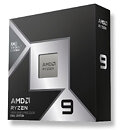 Innovation Pushes Forward
AMD redefined gaming performance in 2022 with the introduction of the Ryzen 7 5800X3D processor, the world's first X3D processor with AMD 3D V-Cache technology. The Ryzen 9 7950X3D followed that breakthrough as the first 16-core processor with AMD 3D V-Cache technology.
AMD evolved the design with second-generation AMD 3D V-Cache technology, repositioning the stacked cache beneath the processor cores to help lower temperatures, support higher sustained frequencies and improve efficiency.
Now AMD advances that legacy with the Ryzen 9 9950X3D2 Dual Edition processor. It marks the next step in AMD's continued innovation for next-generation applications.
"I'm excited to introduce the Ryzen 9 9950X3D2 Dual Edition, the world's first desktop processor with AMD 3D V-Cache on both chiplets, delivering an incredible 208 MB of on-chip memory," said Jack Huynh, senior vice president and general manager, Computing and Graphics Group, AMD. "This is the next evolution, and with a simple drop-in upgrade on AM5, we're delivering the absolute best performance for world-class gaming and content creation."
Built for Developers and Creators
The Ryzen 9 9950X3D2 Dual Edition processor is engineered to accelerate complex compile times, large-scale simulations and memory-intensive workflows. With dual 2nd Gen AMD 3D V-Cache technology delivering 208 MB of total cache, the processor is designed to keep more data closer to the cores, which can reduce memory bottlenecks and enable faster iteration cycles.
Powered by "Zen 5" architecture and built on a 4 nm process, it provides the sustained performance required for demanding creation and development environments. Compared to the previous generation, the Ryzen 9 9950X3D2 Dual Edition processor shows average uplifts of 5% to 8% in creator workloads including DaVinci Resolve and Blender, and in massive source code builds including Unreal Engine and Chromium. By combining expanded cache capacity with high core counts and advanced architecture enhancements, the Ryzen 9 9950X3D2 Dual Edition gives developers the performance headroom needed to build, test and deploy next-generation applications with greater speed and confidence.
"Alienware is the first to bring the AMD Ryzen 9 9950X3D2 Dual Edition to market, and the Area-51 is the platform we built to make the most of it—combining AMD's dual 3D V-Cache architecture with Alienware's thermal engineering to deliver a level of processing performance that creators and gamers haven't had access to before," said Matt McGowan, Head of Product, Alienware. "This is the most powerful Alienware desktop we've ever built with AMD."
Pricing and Availability
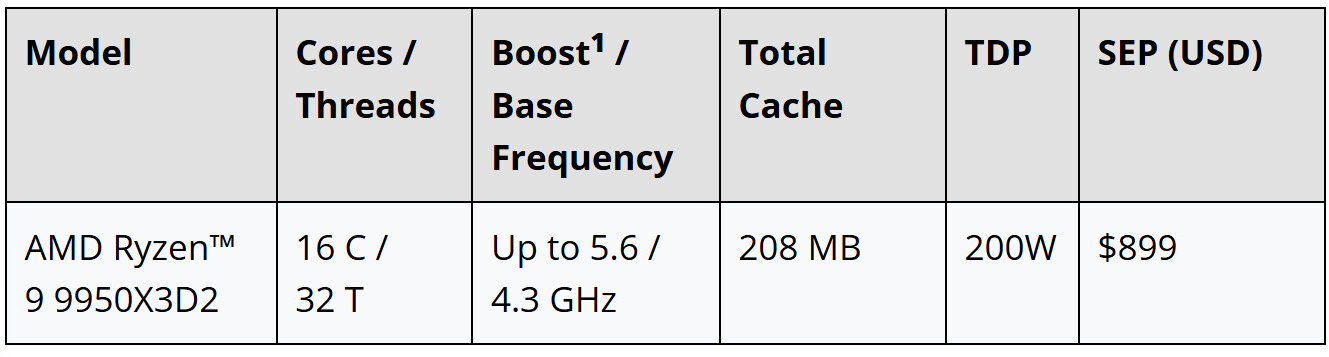
AMD Ryzen 9 9950X3D2 Dual Edition processors are available starting today at leading retailers for $899 (SEP) and in systems from original equipment manufacturers (OEM), including the Alienware Area-51 Desktop.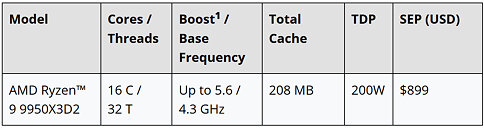
Source:
AMD
Built for demanding developers, the AMD Ryzen 9 9950X3D2 Dual Edition processor combines high-performance "Zen 5" core technology with dual 2nd Gen AMD 3D V-Cache technology across all 16 cores, delivering 208 MB of total cache for expanded cache capacity and low latency. The result is exceptional responsiveness, increased throughput and flexibility to power next-generation development and creation workflows.

AMD redefined gaming performance in 2022 with the introduction of the Ryzen 7 5800X3D processor, the world's first X3D processor with AMD 3D V-Cache technology. The Ryzen 9 7950X3D followed that breakthrough as the first 16-core processor with AMD 3D V-Cache technology.
AMD evolved the design with second-generation AMD 3D V-Cache technology, repositioning the stacked cache beneath the processor cores to help lower temperatures, support higher sustained frequencies and improve efficiency.
Now AMD advances that legacy with the Ryzen 9 9950X3D2 Dual Edition processor. It marks the next step in AMD's continued innovation for next-generation applications.
"I'm excited to introduce the Ryzen 9 9950X3D2 Dual Edition, the world's first desktop processor with AMD 3D V-Cache on both chiplets, delivering an incredible 208 MB of on-chip memory," said Jack Huynh, senior vice president and general manager, Computing and Graphics Group, AMD. "This is the next evolution, and with a simple drop-in upgrade on AM5, we're delivering the absolute best performance for world-class gaming and content creation."
Built for Developers and Creators
The Ryzen 9 9950X3D2 Dual Edition processor is engineered to accelerate complex compile times, large-scale simulations and memory-intensive workflows. With dual 2nd Gen AMD 3D V-Cache technology delivering 208 MB of total cache, the processor is designed to keep more data closer to the cores, which can reduce memory bottlenecks and enable faster iteration cycles.
Powered by "Zen 5" architecture and built on a 4 nm process, it provides the sustained performance required for demanding creation and development environments. Compared to the previous generation, the Ryzen 9 9950X3D2 Dual Edition processor shows average uplifts of 5% to 8% in creator workloads including DaVinci Resolve and Blender, and in massive source code builds including Unreal Engine and Chromium. By combining expanded cache capacity with high core counts and advanced architecture enhancements, the Ryzen 9 9950X3D2 Dual Edition gives developers the performance headroom needed to build, test and deploy next-generation applications with greater speed and confidence.
"Alienware is the first to bring the AMD Ryzen 9 9950X3D2 Dual Edition to market, and the Area-51 is the platform we built to make the most of it—combining AMD's dual 3D V-Cache architecture with Alienware's thermal engineering to deliver a level of processing performance that creators and gamers haven't had access to before," said Matt McGowan, Head of Product, Alienware. "This is the most powerful Alienware desktop we've ever built with AMD."
Pricing and Availability
AMD Ryzen 9 9950X3D2 Dual Edition processors are available starting today at leading retailers for $899 (SEP) and in systems from original equipment manufacturers (OEM), including the Alienware Area-51 Desktop.
131 Comments on AMD Launches the Ryzen 9 9950X3D2 Dual Edition Processor
Another example is Space Marine 2, which went into a few seconds of horrible stutterfest while loading assets using more than 8 cores on my 7950X3D, which doesn't happen on my 7800X3D (that's why I sold the former and swapped back). So yes, the game does technically use more than 8 cores from time to time when available, but the experience is largely dependent on the core types, architecture, performance, the interconnect, etc. even in just this one game.
TL,DR: There's much more to a CPU than a combination of ST/MT performance.
But I think we're describing a similar issue. The game is trying to use as many cores as possible in certain situations, even if the core config, or the inter-core latency ends up hurting more than it helps. Like I said, the experience was far worse on the 7950X3D than it is on the 7800X3D.
That's when RT/PT can come into the debate because these calculations are as intensive on the CPU as it is on the GPU. Most singleplayer games using more than 8 cores in my opinion wouldn't need to use more than 8 cores, they're just badly multithreaded/spreaded across all cores.
It's also why the 5900X, but most notably 7900X and 9900X (given their performance level) are bad buys in some cases because they're basically 6-core CPUs if you need to keep games/software on a single CCD. AMD will need to try another approach if they can't fix that CCD communication latency issue for the next generation.
A heterogeneous Zen 6 CCD has 12 cores = 24 Zen 6 threads = 24 Intel cores without SMT.
¿Do we really think games will need 16 or 24 threads/nucleus?
NO
Try running Cinebench single and multi. You won't get 16x performance in MT on an 8-core CPU even at the same clock speed. A core is still just a core regardless of multithreading.
As I said before, a 16-core CPU has more than enough power for gaming; the higher you set the screen resolution above 1080p, the harder the GPU has to work. The most demanding games are those with 70 players online simultaneously, regardless of the screen resolution.
When it comes to actual productivity and high-performance computing (HPC), we need to understand how these systems work and their operating principles.
There are programmes where you can assign a 256-thread or 256-core processor, yet the programme will never be able to utilise all those threads or cores due to limitations imposed by the software’s developers.
When we delve into scientific computing, what really matters is the heterogeneity of the cores – they should be as physically similar as possible.
Here are two ways of handling tasks that are not suitable for non-heterogeneous CPUs.
I am referring to Intel desktop CPUs with P, M and Core i cores
Point 1
The greater the number of simultaneous heterogeneous threads, the sooner the final result of that group of tasks is achieved, as parts of the process yield identical results that are automatically transferred to the other threads, whose tasks no longer need to calculate that portion of the process.
They start with an advantage.
Point 2
Tasks are tackled using brute-force computing, where a single task can utilise between 4 and 32 threads collectively, drastically speeding up a result that would otherwise take, say, ‘a few days to a few hours’
This can only be achieved with heterogeneous chips where all threads or cores are identical
Point 3
Validation of whether the tasks have produced correct results.
The same task is run in a double- or triple-blind manner across multiple threads or even on different CPUs to validate that the final information or result is correct.
As we shall see, these three parts cannot be carried out on chips that are not heterogeneous, with all cores being identical.
When we say it’s an 8-core SMT / 16-thread processor, this means it can run 16 different tasks at the same performance speed because each thread acts like an individual core in current Intel processors.
When the CPU has 16 P, M and E cores, the performance in MHz varies per thread and therefore the completion time is longer or shorter depending on the power of each core, but it can no longer perform much of what was mentioned above.
A CPU with 16 SMT cores/32 threads can handle 32 different tasks.
A CPU with 24 cores without SMT simply has each core as a single thread (not dual) and can handle 24 tasks.
All SMT processors support AVX-512; all non-SMT CPUs do not support AVX-512.
In reality, having P, M and e-cores is not a significant advancement in desktop computing today, as desktop systems are not subject to the same power constraints as laptops.
Read what I put about generation worth upgrading to, Zen 4 to Zen 5 upgrade was lackluster, 7600x to 9600x and such showed very little improvements and more of a refresh level performance boost. AMD hasn't increased performance on the AM5 platform worth upgrading to from previous gen in the same tier.
Stacked as in beefed up L3 cache like someone muscular stacked, not like stacking blocks.
www.microcenter.com/search/search_results.aspx?N=&cat=&ntt=270k+plus
In addition, you might have heard about artificial scarcity. If the volume is low in some parts of the world, that doesn't mean that a product is popular, by any stretch of imagination.
As I said, Q2 earning will show any tangible evidence. Q1 revenues showed $500 million drop in client revenues despite Panther Lake launch.Not really. It's a different picture with different SKUs, and on different OS. You really need to learn more nuanced look into things rather than painting with big brush, where you lose important details.
For example, I bought 7600X for one system instead of 9600X, for reasons you mentioned. However, for another system I bought 9800X3D instead of 7800X3D. Zen5 X3D model has way more superior productivity performance than Zen4 cousin, in addition to 10% in gaming. I didn't care much for gaming uplift, but I needed a bit more juice in applications without needing to buy CPUs with two CCDs.
Also, not everyone wants to stay in the same tier. People go from 6 to 8 cores, from 12 to 16, from vanilla to X3D, swapping motherboard instead, etc.There are many ways to upgrade AM5 platform. Buying a new CPU is just one of things one could do.
Both Zen4 and Zen5 generations serve the same purpose, to move as many AM4 owners to the new platform, and to gain as many people disappointed with Intel offers in recent years. Both tasks have been very successful. We see material evidence of this in multiple ways, from changing market share to earnings.
Upgradability drives CPU prices up, so it ends up being pointless.
It's like saying that more ice-cream sells on beaches during hot days. This superficial observation sounds reasonable, but it's not. It doesn't ask questions about other reasons than weather, such as new flavours on offer, more people on beaches, attractive discounts 2-for-1, etc.Not really. You are not asking additional questions. You have no idea about context of upgrade by specific owners. Few ever upgraded from 1700 platform to 1851, mostly because gaming performance was worse than on Raptor Lake. Hence sales of Arrow Lake plummeted badly in last 18 months. It's highly doubtful that lower prices of Plus refresh and EOL platform would make a bigger difference during period of abnormal RAM prices and Nova Lake being around the corner.
Besides, 5800X3D seems to have aged a tad better for gaming than 12900K, and much better when compared with DDR4 performance of i9. There is no question about it. So, it's not only about keeping motherboard. There is RAM too.
Those willing to buy a one-off PC on 1851 platform with Plus CPUs, and aiming to keep it for 4-5 years are more than welcome to do so. It's a good purchase. However, it's misleading to say that 1851 is 'the most upgradable platform'. Total nonsense.
This is it's gaming performance relative to the 7700x.
tpucdn.com/review/amd-ryzen-7-7700x/images/relative-performance-games-1280-720.png
Aging better than the 12900k is a joke I'd assume so I'm not responding. Good one though
Just because amd has 3 tiers of cpu's doesn't mean intel isn't as good because they don't segregate their cpus like AMD
If anything the newer 400 desktop APUs models are a bit of a downgrade, as you only get a Radeon 860M with the Ryzen 7 models which is worse performing than the 780M, and similarly so lower model than the predecessor in the Ryzen 5 ones (Radeon 760M vs 840M). That level down of the integrated graphics in the tiers actually is a thing AMD did to most mobile AI 300 and AI 400 (it's just a direct refresh) models except for the highest ends one that did get a Radeon 880M and 890M (Ryzen 9 and mostly H and HX ones for the 890M).
www.techspot.com/review/2796-amd-ryzen-8700g/
In Tom's Hardware review, it is ~83% faster than 5700G
www.tomshardware.com/pc-components/cpus/amd-ryzen-7-8700g-cpu-review/3
And 285K with 4 Xe cores?
In TechPowerUp review, its iGPU is only ~44% faster than 5700G, and it's barely able to beat...yes, use your eyes...8500G.
www.techpowerup.com/review/intel-core-ultra-9-285k/23.html
So, 4 Xe cores on Arrow Lake S are nowhere close to iGPU on 8700G. Forget about it. Jesus...what a troll.Irrelevant for the topic discussed above. Besides, one could buy an entire PC with 8700G for $700, with 32GB of RAM in Microcenter. Good luck doing that with Arrow Lake and enjoying its formidable iGPU...
www.3dmark.com/spy/61204747
Did anyone make claims about CPU performance? No.
Perhaps read again what exactly the other member claimed.I don't believe they would release any statements. They sent review samples to a dozen of outlets, less than usual, but still. The world moved on.You don't, which is fine. Millions of others do buy gaming CPUs, which significantly contributed to changes in desktop market share in last three years. If you are curious to find out why this change has been going on, you might want to ask several questions to be able to understand the world around you.
With the Intel iGPU of course you do get lower performance in most games and some Intel driver weirdness in some games, but you do get more consistent non gaming performance and support as well as XMX cores for some computing or things like XeSS and with the full lanes of a desktop chip. With the Zen 4 desktop APUs you can get better graphics rasterization raw performance specially in a lot of games, but then you sacrifice CPU performance and get severly cut down usable PCIe lanes and RDNA 3 in non gaming usages is very so-so, specially for computing or LLVM related computing. To the point that I was making is that up to what compromises one prefers both can do a fine work, because AMD desktop APUs aren't as nice as they used to be in the past (AMD cuts a lot more down in these mobile chips nowdays) and because RDNA 3 and RDNA 3.5 do have clear architecture design flaws in the current market workflows to properly compete in some aspects against competitors in general right now in 2026 that are only getting more obvious with time and AMD so-so current support for RDNA 3, which is why I have said many times that in the near future in mobile they do need to move on from keep bundling CPUs with RDNA 3.5 graphics.
About price, from Microcenter to make a direct comparision to your example.
The point again was that in the current market situation and with the current products for anyone interested in a system that will see exclusively integrated graphics usage for a bit more intense cases than basic uses, they are all more compromised in various ways than it was the case in the past, so up to everyone to choice what's better in such cases.