Wednesday, April 29th 2026

Blind Test Shows Gamers Prefer NVIDIA DLSS 4.5 Over AMD FSR 4.1

Back in February, ComputerBase conducted a large blind test comparing in-game screenshots generated using the latest upscaling technologies: AMD's FSR 4.0 and NVIDIA's Deep Learning Super Sampling 4.5. The testing has since been updated, and community votes have been processed, revealing that AMD's updated upscaling technology, FSR 4.1, shows significant improvement over FSR 4.0. However, it still trails behind NVIDIA's DLSS 4.5 in visual quality. In the latest ComputerBase testing, the following games were upscaled using FSR 4.0, FSR 4.1, and DLSS 4.5: Year 117 - Pax Romana, ARC Raiders, Assassin's Creed Shadows, Call of Duty: Black Ops 7, Kingdom Come 2: Deliverance, Resident Evil Requiem, and The Last of Us Part I. In all of these games, the ComputerBase review concluded that DLSS 4.5 was the top performer, a view confirmed by the community in a separate blind test vote.

Similar to the previous test, the ComputerBase team conducted the comparison using videos labeled with three options, without revealing which rendering method was used, to ensure a fully blind test. This resulted in a community verdict with two notable outcomes. First, NVIDIA's DLSS 4.5 remains the leader in image quality, with 6 out of 7 games showing the best results using DLSS 4.5. The only game where AMD's FSR upscaling came out on top was Resident Evil Requiem, where DLSS 4.5 placed second behind FSR 4.1. Overall, DLSS 4.5 is seen as providing sharper visual details and more consistent frame generation compared to AMD's FSR upscaling.

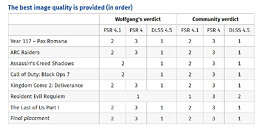
However, it's important to note that AMD has made significant improvements from FSR 4.0 to the latest FSR 4.1 version, nearly matching NVIDIA's technology and even surpassing it in one game. This indicates that AMD is on a promising path of improvement, and future FSR versions might achieve visual parity with NVIDIA's current DLSS 4.5 technology. Gamers are increasingly preferring DLSS 4.5 outputs over native rendering, and future techniques like neural rendering will elevate this further. Revisiting this testing in the future will be intriguing to see how neural rendering is perceived and which platform integrates it best.
Source: ComputerBase
Add your own comment

92 Comments on Blind Test Shows Gamers Prefer NVIDIA DLSS 4.5 Over AMD FSR 4.1

#1
lexluthermiester
I would go along with the flow on these results. However, FSR 4.1 looks and performs really well and it's a close second IMHO.
Posted on Reply
#2
Philaphlous
Old eyes here but I can't perceive a difference between FSR and native in BF6. Maybe if I was on 120 or 240hz I'd notice a difference but for 4K 60 I'm not seeing much of a difference at all... it's butter smooth for me...even with a 9060XT
Posted on Reply
#3
ymdhis
It would be more interesting if there was also an option for "no upscaling", see how that compares to DLSS/FSR.
Posted on Reply
#4
Kwadratowicz
Trrrryt
ymdhisIt would be more interesting if there was also an option for "no upscaling", see how that compares to DLSS/FSR.
In today’s world it could be that without upscalers and other shenanigans the game of tests could look worse on native, cause of the game developers targeting at launch specific workarounds to just get it working at lowest cost possible.
Posted on Reply
#5
Chomiq
ymdhisIt would be more interesting if there was also an option for "no upscaling", see how that compares to DLSS/FSR.
You'd be surprised by results if the alternative was native with TAA enabled, also known as Vaseline filter.
Posted on Reply
#6
ProZoid88
ChomiqYou'd be surprised by results if the alternative was native with TAA enabled, also known as Vaseline filter.
With how games are undersampled today, dlss/fsr 4 is going to beat almost all aa.
Posted on Reply
#7
Event Horizon
I'm in the group that is satisfied with either one when it comes to upscaling.
Posted on Reply
#8
xPalis
Is this a duplicate ? Im sure something similar was already posted
Posted on Reply
#9
TheinsanegamerN
xPalisIs this a duplicate ? Im sure something similar was already posted
That was addressed in the first sentence of the article:

"Back in February, ComputerBase conducted a large blind test comparing in-game screenshots generated using the latest upscaling technologies: AMD's FSR 4.0 and NVIDIA's Deep Learning Super Sampling 4.5."
Posted on Reply
#10
RejZoR
FSR 4 has become so good now I just don't care which is the best in zoomed in pixel peeping mode. I've been using FSR 4.1 in Performance mode to really crank performance to max at low load and image has been really good in Marvel Rivals and Overwatch. FSR3 looked like vomit in Performance. So, that alone tells the progress.
Posted on Reply
#12
Chomiq
When I was still on Nvidia DLSS was at a level of sharpness that could only be explained by some baked in sharpening going in the background that user has no control over, something that AMD was caught doing in the early FSR implementations. Either way, to me a lot depends on the way the final image looks in motion, especially for very small elements visible in the distance which often causes ghosting/trailing, something that happens both on AMD and Nvidia. I'm surprised that they haven't included XeSS in the comparison.
Posted on Reply
#13
BoxCutter
Fake pixels wars stupidity explodes my brain.
Posted on Reply
#14
john_
Personally, I find the initial test biased, even manipulated—if not completely rigged. When FSR 4.0 is widely considered slightly superior to DLSS 3, and DLSS 3 is clearly superior to native resolution, yet this 'blind test' ranks native above FSR 4.0, that’s when you realize there’s a problem. They likely realized themselves that their results made no sense, which is probably why they removed the native option. It was exposing them.
Regarding the new test, they might be trying to fix the impression left by the first one—not for the sake of FSR, but for their own objectivity. Seeing DLSS 4.5 come out on top isn't surprising, as everyone agrees that Nvidia is one or even two steps ahead in upscaling.
However, what I imagine the test fails to mention is by how much it is ahead. For example, if I run a poll asking 100 people which number is larger, A=98 or B=97, obviously A will be the clear winner. But if I hide the actual numbers and simply state that the majority chose A, whoever reads the results will effectively be misled, as they will assume that A is significantly larger than B.
Posted on Reply
#15
TheinsanegamerN
john_Personally, I find the initial test biased, even manipulated—if not completely rigged. When FSR 4.0 is widely considered slightly superior to DLSS 3, and DLSS 3 is clearly superior to native resolution, yet this 'blind test' ranks native above FSR 4.0, that’s when you realize there’s a problem. They likely realized themselves that their results made no sense, which is probably why they removed the native option. It was exposing them.
Regarding the new test, they might be trying to fix the impression left by the first one—not for the sake of FSR, but for their own objectivity. Seeing DLSS 4.5 come out on top isn't surprising, as everyone agrees that Nvidia is one or even two steps ahead in upscaling.
Or its just a different set of tests. The same games used to test DLSS3 likely dont support DLSS4.5.
john_However, what I imagine the test fails to mention is by how much it is ahead. For example, if I run a poll asking 100 people which number is larger, A=98 or B=97, obviously A will be the clear winner. But if I hide the actual numbers and simply state that the majority chose A, whoever reads the results will effectively be misled, as they will assume that A is significantly larger than B.
This is running on the assumption that nvidia was always set as option A, which we have no evidence for. How do we know that FSR wasnt always the first choice?
Posted on Reply
#16
Prima.Vera
Why wasn't TSR included? I always wondered how TSR compares to DLAA, since the quality seems identical....
Posted on Reply
#17
JustBenching
They are both good nowadays, it's more of an epeen measurement at this point. The glaring issue with fsr 4 is... well, us RDNA2 peasants (and the rDNA3 peasants) didn't get it
Posted on Reply
#18
john_
TheinsanegamerNThis is running on the assumption that nvidia was always set as option A, which we have no evidence for. How do we know that FSR wasnt always the first choice?
I don't know where you read what you're assuming, but you certainly didn't read it in my post.

What I'm saying is that while the test does rank FSR 4.0, FSR 4.1, and DLSS 4.5 in a specific order, I assume — since I haven't read the full article — that there is no commentary mentioning just how significant the differences perceived by the respondents actually were.
Posted on Reply
#19
obsidian24776
Its hardly a scientific study, more like an opinion poll. I can't find any detail on the numbers of participants (could be due to translation).
Posted on Reply
#20
evernessince
I will call into question the editorial remarks (at least of the translation):

"FSR Upscaling 4.1 is an upgrade over the previous FSR Upscaling 4.0. But it’s only a minor one. In some games, there’s a clearly noticeable difference, while in others, there’s no change at all. The good news is that the new version never delivers worse results than the old one. In some areas, yes. But never in the big picture. Therefore, FSR Upscaling 4.1 should be used across the board. A downgrade to the older version is not necessary, at least in the games tested. However, FSR Upscaling 4.1 does not come close to the very high standard of Nvidia’s competing DLSS 4.5—the improvement in image quality is simply too small. The upgrade from DLSS 4 to DLSS 4.5 was more significant, and the resulting performance loss is often considered a worthwhile trade-off. So while Radeon RX 9000 buyers do get an upgrade, after a year of RDNA 4, AMD is now further behind DLSS 4.5 in terms of quality than it was relative to DLSS 4 at the launch of FSR Upscaling 4.0. That really shouldn’t happen to someone who’s already trailing behind."

The fact that they are using such conclusive language on such a small sample size (averages 175 answers) on a completely open poll with an accompanying article that has 1 paragraph and change per subjective test says to me that there is either a great deal of ignorance in terms of the certainty of different types of data or bias. It's the same language they use throughout too, despite the fact that they provided no methodology, their poll is open and without any safeguards, the same size is small, and that the author very clearly is giving their opinion throughout and not trying to be objective.

Even on a very basic level, the author doesn't seem to realize the class represented isn't "gamers" or "PC Owners", that would require them to poll outside of their website and to have a methodology for unbiased polling. The class being represented is ComputerBase users, not gamers, PC users, or anything broad like that. Of course with serious caveats as well, almost no steps were taken to ensure submissions are valid, results are true to the userbase, or that selection and ordering bias don't have an effect (order of entries in the poll doesn't even appear to be randomize. This means question order bias did influence the results). Not saying their opinion or the poll is invalid but the lack of rigor and understanding as to why these kinds of things are considered the very lowest in terms of scientific confidence don't install anywhere near the overt confidence the author expresses.

What the author doesn't say is that often in the poll, the difference between DLSS 4.5 winning and "All are equal" or the FSR option is often extremely close. They don't acknowledge that fact and their table doesn't represent it either.

DLSS is better but DLSS also leans into the old showroom trick of cranking up sharpness. The actual presentation of FSR is objectively more neutral. Does it "not come close to the very high standard of Nvidia's competing DLSS 4.5"? That is an opinion and one that would seem to run contrary to the consensus. That's not what the people in the study are saying, the author is injecting that into the article, basically using the poll results as authority to steer a narrative while ignoring the actual results.

These articles are getting boring, because frankly this kind of "news" piece did not have much effort put into to begin with and TPU repeating it, twice now, it just pointless clickbait farming engagement.
obsidian24776Its hardly a scientific study, more like an opinion poll. I can't find any detail on the numbers of participants (could be due to translation).
An opinion poll with a very opinionated author steering the results.
Posted on Reply
#21
obsidian24776
evernessinceI will call into question the editorial remarks (at least of the translation):

"FSR Upscaling 4.1 is an upgrade over the previous FSR Upscaling 4.0. But it’s only a minor one. In some games, there’s a clearly noticeable difference, while in others, there’s no change at all. The good news is that the new version never delivers worse results than the old one. In some areas, yes. But never in the big picture. Therefore, FSR Upscaling 4.1 should be used across the board. A downgrade to the older version is not necessary, at least in the games tested. However, FSR Upscaling 4.1 does not come close to the very high standard of Nvidia’s competing DLSS 4.5—the improvement in image quality is simply too small. The upgrade from DLSS 4 to DLSS 4.5 was more significant, and the resulting performance loss is often considered a worthwhile trade-off. So while Radeon RX 9000 buyers do get an upgrade, after a year of RDNA 4, AMD is now further behind DLSS 4.5 in terms of quality than it was relative to DLSS 4 at the launch of FSR Upscaling 4.0. That really shouldn’t happen to someone who’s already trailing behind."

The fact that they are using such conclusive language on such a small sample size (averages 175 answers) on a completely open poll with an accompanying article that has 1 paragraph and change per subjective test says to me that there is either a great deal of ignorance in terms of the certainty of different types of data or bias. It's the same language they use throughout too, despite the fact that they provided no methodology, their poll is open and without any safeguards, the same size is small, and that the author very clearly is giving their opinion throughout and not trying to be objective.

DLSS is better but DLSS also leans into the old showroom trick of cranking up sharpness. The actual presentation of FSR is objectively more neutral. Does it "not come close to the very high standard of Nvidia's competing DLSS 4.5"? That is an opinion and one that would seem to run contrary to the consensus. That's not what the people in the study are saying (it's incapable of doing so as they didn't provide a scale in the poll). The author is injecting that into the article, basically using the poll results as authority to steer a narrative.

These articles are getting boring, because frankly this kind of "news" pieces did not have much effort put into to begin with and TPU repeating it, twice now, it just pointless clickbait farming engagement.


An opinion poll with a very opinionated author steering the results.
Indeed, and opinion polls are almost always about shaping opinion, rather than measuring it.
Posted on Reply
#22
john_
evernessincethe author very clearly is giving their opinion throughout and not trying to be objective
In other words it's just something that looks like a forum post from a person with clear preference to a certain brand, disguised as an objective study.

I guess ComputerBase shouldn't be considered an objective site, when they allow biased opinions to be presented to their readers as facts.
JMO of course.
Posted on Reply
#23
evernessince
john_In other words it's just something that looks like a forum post from a person with clear preference to a certain brand, disguised as an objective study.

I guess ComputerBase shouldn't be considered an objective site, when they allow biased opinions to be presented to their readers as facts.
JMO of course.
Yes, the rigor appears to be equivalent to if you were to open a poll in the TPU forums yourself. Heck I've put more effort into benchmarking windows version and providing the results, only I didn't provide such strong editorial opinions alongside them because I'm aware of the variables that can go into that sort of thing that increase the margin of error.
Posted on Reply
#24
TheinsanegamerN
john_I don't know where you read what you're assuming, but you certainly didn't read it in my post.
It was from your post. You brought up the bias of using a and b, and stated the test ran afoul of this issue. The only way that comment is relevant is if you believe that DLSS ranks higher then FSR because DLSS was the first image showed, which is an assumption with no proof behind it.
john_What I'm saying is that while the test does rank FSR 4.0, FSR 4.1, and DLSS 4.5 in a specific order, I assume — since I haven't read the full article — that there is no commentary mentioning just how significant the differences perceived by the respondents actually were.
Well no, it doesn't, because the test was not asking that question. It was only asking which they thought looked better.
evernessinceThese articles are getting boring, because frankly this kind of "news" piece did not have much effort put into to begin with and TPU repeating it, twice now, it just pointless clickbait farming engagement.
So here's a question: if this kind of news piece is "pointless clickbait farming engagement", and you are bored of it and desire change, why did you then proceed to click on the article and leave a novel of a comment, thus justifying this supposed clickbait farm?

One would think if you desired change you wouldn't give the engagement farm exactly what it wanted.
Posted on Reply
#25
john_
TheinsanegamerNIt was from your post. You brought up the bias of using a and b, and stated the test ran afoul of this issue. The only way that comment is relevant is if you believe that DLSS ranks higher then FSR because DLSS was the first image showed, which is an assumption with no proof behind it.
I guess you never understood what I wrote in the first post. What is interesting is that while I am explaining you what I meant, you keep insisting in your wrong interpretation.
TheinsanegamerNWell no, it doesn't, because the test was not asking that question. It was only asking which they thought looked better.
Which is an important question. Because when the author is coming out and he is adding his own bias in the conclusion, it makes 98 look like being much bigger than 97. Which is what I meant in my example that you insist on keep reading it wrong.
Posted on Reply
Add your own comment
Nov 25th, 2026 09:14 CST change timezone

New Forum Posts

Popular Reviews

TPU on YouTube

Controversial News Posts