Thursday, May 7th 2026
PCIe 8.0 Targets 1 TB/s Bandwidth and May Need a New Connector
PCI-SIG has released a small update on its upcoming PCIe 8.0 standard, with the draft milestone reaching version 0.5. Perhaps the most intriguing aspect of this draft update is not the performance itself, but the exploration of a new connector technology to support this high-bandwidth protocol. Last year, we learned that PCI-SIG plans to implement a 256.0 GT/s raw bit rate and 1 TB/s of bidirectional bandwidth in the x16 lane configuration. We had assumed that the protocol would continue using the familiar connector technology seen in previous PCIe updates. However, it turns out that the current connector might be a limiting factor, prompting the search for a replacement for the traditional PCIe electrical connection.
The traditional PCIe connector is a copper-based link with up to 16 lanes connecting graphics cards to a slot. In a full x16 lane configuration, the PCIe generation supported by the motherboard provides the best performance, offering the maximum bandwidth the platform can deliver. However, with a 256 GT/s raw bit rate, the connector provides about 1 TB/s of bidirectional bandwidth, which is eight times faster than the current PCIe 5.0 platform used with modern GPUs and CPUs. This indicates that the current physical layer facilitating communication between a GPU and a motherboard is nearing saturation with the advent of PCIe 8.0, necessitating the consideration of an alternative connection method.
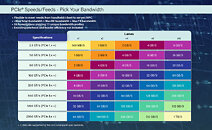
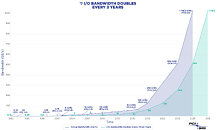 PC enthusiasts need not worry, as the standard is on track for final installment by 2028, suggesting that consumer PCs will likely adopt it in the next decade. Consumer GPUs have only recently transitioned from PCIe 4.0 to PCIe 5.0, with NVIDIA moving to PCIe 5.0 in the RTX 50-Series "Blackwell" from PCIe 4.0 in the RTX 40-Series "Ada Lovelace." This means that by the time consumer GPUs require PCIe 8.0, the entire ecosystem will likely adapt seamlessly in the following years. Initially, only server GPUs are expected to adopt this standard when AMD, Intel, and NVIDIA transition to the new standard. Below are some design goals that PCIe 8.0 aims to achieve in the final v1.0 specification:
Source:
PCI-SIG
The traditional PCIe connector is a copper-based link with up to 16 lanes connecting graphics cards to a slot. In a full x16 lane configuration, the PCIe generation supported by the motherboard provides the best performance, offering the maximum bandwidth the platform can deliver. However, with a 256 GT/s raw bit rate, the connector provides about 1 TB/s of bidirectional bandwidth, which is eight times faster than the current PCIe 5.0 platform used with modern GPUs and CPUs. This indicates that the current physical layer facilitating communication between a GPU and a motherboard is nearing saturation with the advent of PCIe 8.0, necessitating the consideration of an alternative connection method.


- Delivering a 256.0 GT/s raw bit rate and up to 1.0 TB/s bidirectionally via x16 configuration
- Evaluating new connector technology
- Ensuring latency, FEC, and reliability targets are met
- Maintaining backward compatibility with previous generations of PCIe technology
- Improving bandwidth through protocol enhancements
- Reducing power consumption through additional techniques
37 Comments on PCIe 8.0 Targets 1 TB/s Bandwidth and May Need a New Connector
I'm interested to see if by "Maintaining backward compatibility with previous generations of PCIe technology" they also mean the physical compatibility. If yes, will it be something like we had with USB 3.0 connectors, A, B and micro types (there was no mini type connector for USB 3.0 and onward), that were backward compatible with USB 2.0 plugs and which were abandoned to C type in newer USB4 specifications of the standard?
I'm more inclined to think it will be a different physical connector, but only time will tell what they come up with.
so in theory I could cram up to 16x5090 on one system with bifurcation ? :D
Just speculating, cause I'm to poor even for one 5090, but idea of having 16x5090 is fun :D (9,6 kW for gpus only :D ) so 3*230V*16A = 3*3680W=11.040 kW should be enough :P
that's for 3 phases 120v @ 25amps good 17KW so you can add a decent fan and maybe even a raptorlake cpu
Gen 6 will come with AM6 and post-1954, around 2030, then Gen 7 in late 2030s.
Client market simply doesn't need as much bandwidth as data center.
What could go wrong, right NVIDIA?
Cable management will be a pain in the posterior with 6AWG, but at least it won't melt at 50A. :laugh:
You could have whole 'blades' with a full PC on them plugging into these.
user level systems will get to use the PCIe standard but servers will get the PCIe standard
I am betting they will use X connectors for this, or, I suppose external boxes, and have that connected via fiber