Monday, June 22nd 2026
Consumer DRAM Shortages Extend to DDR2 Products with Contract Prices Expected to Continue Rising in 3Q26
TrendForce's latest research reveals that structural tightening in mature-node DRAM supply is forcing consumer DRAM buyers to adopt legacy memory products to secure larger supply allocations. This has triggered a new wave of demand for procuring older-generation DRAM components, driving continued price momentum across legacy products such as DDR2 and DDR3.
Following strong gains in 1Q26, TrendForce estimates DDR2 contract prices will rise by approximately 55-60% in 2Q26, followed by a further 35-40% increase in 3Q26.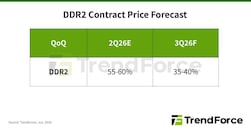 TrendForce notes that on the supply side, the three major DRAM suppliers continue to prioritize advanced-node production to support growing demand for HBM and server DRAM driven by AI infrastructure investments. As a result, wafer allocations for DDR4 and other mature-node products have been reduced, forcing buyers of consumer DRAM, such as DDR4, to seek support from Taiwanese DRAM suppliers.
Companies such as Nanya and Winbond have gained substantial pricing leverage as demand significantly exceeds the bit output available from Taiwanese vendors. Given limited supply, these suppliers have strategically reduced production of lower-margin products and shifted capacity toward higher-value offerings to improve profitability.
Continued shortages of consumer DRAM components and rapidly rising contract prices have prompted some OEMs and ODMs to downgrade memory specifications to control system costs. In some cases, DDR4 designs are being replaced with DDR3 solutions, while certain DDR3-based products are being redesigned to use DDR2.
Customers are aiming to secure more reliable supply allocations by adopting lower-capacity configurations or older memory generations. Consequently, supply shortages in consumer DRAM are cascading down through successive technology generations.
Winbond gradually exits DDR2 production while ESMT expands capacity
Key suppliers of DDR2 components include Winbond and ESMT. However, Winbond is gradually reducing DDR2 production and reallocating capacity toward higher-margin products such as DDR3, DDR4, and LPDDR4. This transition is expected to tighten DDR2 supply conditions further.
In contrast, ESMT plans to maximize DDR2 production within its existing wafer allocation at PSMC, concentrating resources on this segment to enhance profitability and help offset the supply gap created by Winbond's withdrawal from the DDR2 market.
Source:
TrendForce
Following strong gains in 1Q26, TrendForce estimates DDR2 contract prices will rise by approximately 55-60% in 2Q26, followed by a further 35-40% increase in 3Q26.

Companies such as Nanya and Winbond have gained substantial pricing leverage as demand significantly exceeds the bit output available from Taiwanese vendors. Given limited supply, these suppliers have strategically reduced production of lower-margin products and shifted capacity toward higher-value offerings to improve profitability.
Continued shortages of consumer DRAM components and rapidly rising contract prices have prompted some OEMs and ODMs to downgrade memory specifications to control system costs. In some cases, DDR4 designs are being replaced with DDR3 solutions, while certain DDR3-based products are being redesigned to use DDR2.
Customers are aiming to secure more reliable supply allocations by adopting lower-capacity configurations or older memory generations. Consequently, supply shortages in consumer DRAM are cascading down through successive technology generations.
Winbond gradually exits DDR2 production while ESMT expands capacity
Key suppliers of DDR2 components include Winbond and ESMT. However, Winbond is gradually reducing DDR2 production and reallocating capacity toward higher-margin products such as DDR3, DDR4, and LPDDR4. This transition is expected to tighten DDR2 supply conditions further.
In contrast, ESMT plans to maximize DDR2 production within its existing wafer allocation at PSMC, concentrating resources on this segment to enhance profitability and help offset the supply gap created by Winbond's withdrawal from the DDR2 market.
70 Comments on Consumer DRAM Shortages Extend to DDR2 Products with Contract Prices Expected to Continue Rising in 3Q26
We're stuck with older tech while new factories get spun up for AI. Maybe we should just go back to DDR-400 or even EDO RAM.
Asking for a friend...
I am so old.
Come on, that is nonsense.
What they are doing is, they destroy the PC Market on purpose, by artificially increasing the Price of Components in such a way, that people can no longer afford having a PC!
Why? To force everyone in a subscription for everything. Especially for AI, Gaming, Office ect.
What they have to prevent is, that people have capable hardware in their home, to run AI LOCALLY!
Because that would totally DESTROY their AI-Data-center Business!
And that is the real reason why a 32 GB DDR5 Ram-kit cost now 600 Bucks, instead of 60.
"You will own NOTHING" - WEF
Death to the "ai" circular investment scam!
Stupid AI race//
Most DDR2 stuff on the market is dumped by the bucket and allocated for OLD production servers that gobble so much power they're not even fit to run websites.
The only reason my box sticks around is because I have a genuine need for a 24/7 accessible network storage device with a minimalist 15W CPU on a boxer mobo.Raise one generation, raze another.
Gaaah! @Hecate91 and @Dirt Chip beat me to it.
To quote a smart person: The old Google is smarter than any AI (LLM) on the market. But would you call Google an AI or ‘clever’? At the end of the day, it’s all just statistics and probability.
The energy crisis has worsened.
The problems of environmental pollution, the overexploitation of natural resources, and CO₂ emissions/global warming have, if anything, become more acute.
Cancer still hasn’t been cured, and even something as straightforward as Ebola poses challenges for medicine.
It is more likely that we will be visited by aliens than that AI will bring about a positive change in any of the issues mentioned above within the next 10 years. (Leaving aside the Terminator theory, of course.)
It would be an interesting thing to just not buy into the scam at all and refuse to pay for tech with AI forced into it.I think the whole promise for AI curing diseases was a massive lie to gaslight for what AI is really for, control over the population while datacenters collect data and profile people faster.
Emissions no longer matter when the tech bros and those in power are making money, consuming millions of gallons water, using gas turbine generators to power LLM's, while we're told to conserve water and not use an air conditioner.
It's starting to become clear that the use of computers in schools is making students perform very poorly.
woulnd't be all that surprised computers and tablets will be banned to the dedicated IT lessons.
Sounds like sour grapes to me.We all suffer the effects. Even if you never use AI we are forced to suffer from AI generated code, AI images, AI search results, and cranked up prices of tech.Nobody claimed ddr2 was going into AI data centers. Can we please engage our brain instead of getting emotional for a minute?
All memory comes from the same foundries. If they cannot meet demand, then prices go up. It's that simple.