Thursday, June 25th 2026
AMD's FSR 4.1 Performance on RDNA 3 Notably Slower than FSR 3.1
AMD recently released FSR 4.1 for its RDNA 3 GPUs, which demonstrated a handy performance increase over native rendering on RDNA 3, but a recent comparison by German outlet, ComputerBase, has revealed that there are noticeable performance regressions when comparing FSR 4.1 to FSR 3.1 on RDNA 3 GPUs. The publication tested FSR 4.1 and FSR 3.1 on the AMD Radeon RX 7900 XTX, RX 7800 XT, and RX 7600, and FSR 4.1 on the Radeon RX 9070 XT. In geometric mean results of nine tested games, the 9070 XT scores an identical frame rate to the RX 7900 XTX in 4K native resolution, but the RDNA 3 flagship scores 52.6 FPS when using FSR 4.1 Quality settings, compared to 56.5 FPS on the 9070 XT—a 7% performance penalty. Looking at FSR 4.1 Performance, the gap grows, with the 7900 XTX serving 65.2 FPS in the test, while the 9070 XT scores 71.9 FPS, making the 7900 XTX 9% slower than the 9070 XT at FSR 4.1 compute.
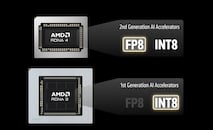
The comparison between FSR 4.1 and FSR 3.1 on RDNA 3 is where it becomes even more interesting, with the geometric mean reflecting an 11% performance penalty for FSR 4.1 in Quality mode and a 14.5% regression in Performance mode. AMD previously explained in an interview with TechPowerUp that there were notable differences between the implementation of FSR 4.1 on RDNA 4 and RDNA 3, specifically that the older hardware uses 8-bit integer (INT8) data, while the RDNA 4 implementation uses the built-in FP8 support in the 2nd-generation AI accelerators in RDNA 4 GPUs. Despite this, AMD claims that it aimed for quality parity across different RDNA generations, which may partially explain the bigger performance penalty on RDNA 3 GPUs. FSR 4.1 support has yet to make it to RDNA 2 GPUs, with official support for the RX 6000-series graphics cards planned for early 2027, so we have yet to see what sort of performance penalty will be incurred there, however, AMD also commented that supporting that older hardware is even more complex, since there are no dedicated AI accelerators. This means RX 6000 GPUs will need to rely on Stream Processors to compute FSR 4.1 upscaling.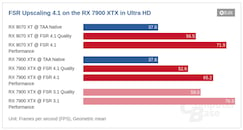
 The performance gap is similar in the less premium GPUs, with FSR 4.1 Performance underperforming FSR 3.1 Performance by 9% on the RX 7800 XT and FSR 4.1 Quality coming in with a 7% performance regression. The RX 7600 tells a similar story, showing a 7% difference between FSR 3.1 Quality and FSR 4.1 Quality and a 9% gap between FSR 4.1 and FSR 3.1 in Performance mode.
Source:
ComputerBase
The comparison between FSR 4.1 and FSR 3.1 on RDNA 3 is where it becomes even more interesting, with the geometric mean reflecting an 11% performance penalty for FSR 4.1 in Quality mode and a 14.5% regression in Performance mode. AMD previously explained in an interview with TechPowerUp that there were notable differences between the implementation of FSR 4.1 on RDNA 4 and RDNA 3, specifically that the older hardware uses 8-bit integer (INT8) data, while the RDNA 4 implementation uses the built-in FP8 support in the 2nd-generation AI accelerators in RDNA 4 GPUs. Despite this, AMD claims that it aimed for quality parity across different RDNA generations, which may partially explain the bigger performance penalty on RDNA 3 GPUs. FSR 4.1 support has yet to make it to RDNA 2 GPUs, with official support for the RX 6000-series graphics cards planned for early 2027, so we have yet to see what sort of performance penalty will be incurred there, however, AMD also commented that supporting that older hardware is even more complex, since there are no dedicated AI accelerators. This means RX 6000 GPUs will need to rely on Stream Processors to compute FSR 4.1 upscaling.


189 Comments on AMD's FSR 4.1 Performance on RDNA 3 Notably Slower than FSR 3.1
I said AMD has significantly improved their drivers since RX6000, back when it was an actual shitshow to use them; they don't have more problems than NvidAI drivers nowadays, whereas RTX drivers seem to have actually declined in quality from all the AI generated code in them...
also I don't have any issues with LACT and it's not like NvidAI has any alternative of their own in Linux, LACT also handles NvidAI GPUs
At the end of the day, Amd is the one everyone loves to hate, specially the leather jacket man loving fanboys, who have way too much spare time on their hands and give themselves the trouble of picking empty Amd gpu boxes from the dumpster, then posting pictures of it on this forum to prove their point. Still pointless when the FSR4 support on Rx 7/6K fiasco does not affect you. The reason I know that is 'cause someone had to dm me.
NVIDIA would have had to develop a second version of FG specifically for Ampere and Turing, but that isn't part of NVIDIA's culture.
AMD is getting more backlash because they've painted themselves as the opposite of Nvidia for years. FSR 4 being available on every gen wasn't supposed to be a "maybe, eventually" but yes from day one.
Think of it as the scrutiny that Apple gets whenever their perfectly integrated ecosystem, their hardware software/hardware tight optimisation, their above average build quality is acting out. People are very quick to call them out.
The community is generally better at making sure that a company is faithful to what it pretends to be than asking them to change. NVIDIA has always been a bit of an ***hole, while they know how to make good tech, you don't really expect them to be generous with it.
Regardless of what Amd painted itself to be, the running joke here is that the folks complaining the most are the ones sitting on top tier Nvidia gpus, specially when it doesn't affect them and when their favorite company is known for anti consumer and gatekeeping behavior.
Spending R&D money on a different back-end for DLSS FG for an arch that's already waaay past its profitability window is a nice thing to do, but everything that I've seen from Nvidia lately tells me that they aren't about to spend money that won't translate into direct benefits.Those aren't the words of a guy looking to change the company practice for the better, but someone who wants to double down on what they've always been doing: make their walled garden even harder to leave, which happens to be what a lot of people dislike about them.
The hypocrisy and double standards of people sitting on the other side of the fence is honestly hillarious. People in glass houses shouldn't be throwing stones, yet here we are.
Then again I'm not surprised anyone would excuse them because of it, like Apple they're seen as a "premium" brand and any amount of criticism gets a double standard.
The performance gap with FSR4.1 is being spun as a bad thing here, yet with DLSS4.5 it was nothing but positive, despite older cards missing out on features that are part of the software. AMD finally released FSR4.1 for RDNA3 and the clickbait tech sites still want to stir up anger.You have a 4090, you're not affected either lol.
As I said before, for AMD it's also a matter of brand perception. "Good guy AMD" isn't something that purely came from the community; AMD has openly mocked Nvidia for their practice several times, and implied that they can do better. There's a video on their YouTube channel of them smashing a GeForce after sending a fixer into a guy's house to fix his gaming setup. They've been feeding from the Nvidia hate. They've been less obvious about it in recent times after being stuck in the GCN hell for so long, and failing to compete beyond the mid-range
Here is what an AMD rep said when they started the uprising campaign. So, yeah, FSR 4 being locked, failing to give some level of " futureproofing" to a fairly recent architecture would have been a betrayal of the brand.
Meanwhile, Nvidia's market share rose to the moon even after pulling one of the nastiest moves with GPP, and gaslighting people by saying that they didn't understand it after being forced to cancel it after a deep investigation, and the tech community as a whole, including YouTubers calling them out on their BS. They are aware that being the bad guy doesn't affect their sales in a meaningful manner.
Lastly, that FSR 4 performance drama looks to be endemic to TPU. I've been on Reddit on Videocardz, and most comments that I'm seeing are saying that the trade-off is acceptable, or it's been a non-event in other communities that didn't even bother to report on those findings.
Here is an article talking about the same thing but with a positive tone:
www.club386.com/amd-fsr-4-1-doubles-radeon-rx-7900-xtx-cyberpunk-2077-performance/
The reason no one talks about it nowadays it's because it's a done deal. We've had access to it for a long time and customers were educated on how to use this new technology to best suit their needs.
Why the need to portray AMD as a victim?
That's in stark contrast to what happens in the gpu market, where the fanboys only want Amd to compete, as long as it gets them cheaper Nvidia stuff, whilst hiding behind the "we care about giving people the choice" narrative.
I'll refrain from further engaging in this conversation. It's getting tone-deaf.
Have a great friday. I know I will.
Xx
The moment that AMD wasn't clear about whether or not they would pull an Nvidia for FSR 4, people freaked out, and they have been pressured several times, even by the media, to clarify things.
When Intel is yet again announcing a new socket, there's barely any fight against it. It's expected from them now, even if in the distant past they had sockets with great longevity. Several years of not backing down eventually pull the fight out of people.
But boy, do I remember the whole Ryzen 5000 not working on the 300 chipset, and to a lesser extent how some Threadripper owners were stuck with a single generation. TR was too niche, but even after AMD explained that they limited the compatibility of Zen 3 on AM4 because too many board partners fucked up, people would not let that go. And I'm talking about Ryzen owners, not Intel trolls.
I begrudgingly upgraded my 1700x to a 3700x because I thought that access to Zen 3 was blocked. I wasn't happy, but I understood. It took several years before my board gained Zen 3 compatibility.
If AMD ever decides one day to stick with a non-consumer-friendly decision time and time again, I assure you that people will eventually stop making that big of a big deal about it. At some point, people understand that this is just how said company is running things. It's like the push for subscription. When Adobe started it, the initial outrage was real. Now it's a business model that's annoying, but it's the new default that's been adopted by many.
God Friday to you as well!I will just say that it's ultimately a discussion about the moral character of a company, but in that case, what Nvidia does is more an annoyance than harm to the customers. I don't think that there is a legal ground to make Nvidia do its best to enable optional features, features that are QoL rather than performance improvement. FG doesn't make something unplayable playable. You only get smooth motion for your high refresh rate screen, and you already need to have a nice playable frame rate to begin with. Games don't require native FG to launch.
I have an analogy from another industry: some professional printers have white ink. Ideally, white ink should be used with tanks, not cartridges, because a tank can have a mixer that makes sure that the white pigment doesn't stay at the bottom when the ink stays still for a while. Otherwise, you need to manually shake the cartridge every day, which doesn't work as well when you are away from the printer for several days. And some of those printers cannot be turned off because they need self-maintenance to avoid clogging. So you won't get any white pigment in the machine after a few maintenance cycles. You'll have to do a procedure to get the pigment back into the pipes.
But Epson, Mimaki, Roland, HP, industry leaders in the sector, are all using cartridges because they make more money that way. You need to buy Chinese printers if you want tanks, but they come with their own set of drawbacks for a professional.
Nobody likes cartridges, but we know that this is how the industry rolls, so we deal with it. It's more annoying, but that doesn't make those printers unusable. Legally, those brands aren't doing anything wrong. If profits over QoL, but we can't sue them for that, no harm has been done; no regulation's been broken. We are just annoyed. But those are still very good printers with tons of documentation and a large support network. The outrage quickly fades its wasted energy when you can't "fix it".
If not using, then I wonder if it'd be any faster using WMMA instead.
I also own an HP ink tank multifunctional, the scanner died some time ago (it outputs just some garbled mess), recurrent clogs are the least of my worries, the thing has so many problems... unfortunately it's the only color printer I have for the time being. Good thing I almost never need to use it.
radeon/comments/1ucf9vx/fsr_411_int8_has_leaked_through_proton
That explains why it's also working on RDNA2, but then we're left to wonder why AMD is not officially releasing it for the older gen as well.
More and more comparison content cropping up since the release of 4.1 for RDNA3 which I'm enjoying. It's nice to see what when backed into a corner they didn't just package and release the ~12month old leaked version, they've made good effort to salvage some PR and put some work into tuning and optimising it. It makes me wonder if something similar can be achieved for RDNA2. Buy the time it comes out, it looks like I'll have a 6900XT to play around with too. Perhaps testing multiple generations of respective upscaling on the 3080 and 6900XT will be a fun little adventure.
But hey it's only been explained with multiple legitimate, reasonable reasons dozens of times now, we can't understand it for you.Perhaps not reported [enough] and it is up to moderator discretion, so some may let things slide where others wouldn't (or of course, the opposite).