Thursday, June 25th 2026
AMD's FSR 4.1 Performance on RDNA 3 Notably Slower than FSR 3.1
AMD recently released FSR 4.1 for its RDNA 3 GPUs, which demonstrated a handy performance increase over native rendering on RDNA 3, but a recent comparison by German outlet, ComputerBase, has revealed that there are noticeable performance regressions when comparing FSR 4.1 to FSR 3.1 on RDNA 3 GPUs. The publication tested FSR 4.1 and FSR 3.1 on the AMD Radeon RX 7900 XTX, RX 7800 XT, and RX 7600, and FSR 4.1 on the Radeon RX 9070 XT. In geometric mean results of nine tested games, the 9070 XT scores an identical frame rate to the RX 7900 XTX in 4K native resolution, but the RDNA 3 flagship scores 52.6 FPS when using FSR 4.1 Quality settings, compared to 56.5 FPS on the 9070 XT—a 7% performance penalty. Looking at FSR 4.1 Performance, the gap grows, with the 7900 XTX serving 65.2 FPS in the test, while the 9070 XT scores 71.9 FPS, making the 7900 XTX 9% slower than the 9070 XT at FSR 4.1 compute.
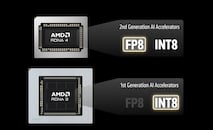
The comparison between FSR 4.1 and FSR 3.1 on RDNA 3 is where it becomes even more interesting, with the geometric mean reflecting an 11% performance penalty for FSR 4.1 in Quality mode and a 14.5% regression in Performance mode. AMD previously explained in an interview with TechPowerUp that there were notable differences between the implementation of FSR 4.1 on RDNA 4 and RDNA 3, specifically that the older hardware uses 8-bit integer (INT8) data, while the RDNA 4 implementation uses the built-in FP8 support in the 2nd-generation AI accelerators in RDNA 4 GPUs. Despite this, AMD claims that it aimed for quality parity across different RDNA generations, which may partially explain the bigger performance penalty on RDNA 3 GPUs. FSR 4.1 support has yet to make it to RDNA 2 GPUs, with official support for the RX 6000-series graphics cards planned for early 2027, so we have yet to see what sort of performance penalty will be incurred there, however, AMD also commented that supporting that older hardware is even more complex, since there are no dedicated AI accelerators. This means RX 6000 GPUs will need to rely on Stream Processors to compute FSR 4.1 upscaling.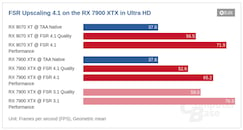
 The performance gap is similar in the less premium GPUs, with FSR 4.1 Performance underperforming FSR 3.1 Performance by 9% on the RX 7800 XT and FSR 4.1 Quality coming in with a 7% performance regression. The RX 7600 tells a similar story, showing a 7% difference between FSR 3.1 Quality and FSR 4.1 Quality and a 9% gap between FSR 4.1 and FSR 3.1 in Performance mode.
Source:
ComputerBase
The comparison between FSR 4.1 and FSR 3.1 on RDNA 3 is where it becomes even more interesting, with the geometric mean reflecting an 11% performance penalty for FSR 4.1 in Quality mode and a 14.5% regression in Performance mode. AMD previously explained in an interview with TechPowerUp that there were notable differences between the implementation of FSR 4.1 on RDNA 4 and RDNA 3, specifically that the older hardware uses 8-bit integer (INT8) data, while the RDNA 4 implementation uses the built-in FP8 support in the 2nd-generation AI accelerators in RDNA 4 GPUs. Despite this, AMD claims that it aimed for quality parity across different RDNA generations, which may partially explain the bigger performance penalty on RDNA 3 GPUs. FSR 4.1 support has yet to make it to RDNA 2 GPUs, with official support for the RX 6000-series graphics cards planned for early 2027, so we have yet to see what sort of performance penalty will be incurred there, however, AMD also commented that supporting that older hardware is even more complex, since there are no dedicated AI accelerators. This means RX 6000 GPUs will need to rely on Stream Processors to compute FSR 4.1 upscaling.


189 Comments on AMD's FSR 4.1 Performance on RDNA 3 Notably Slower than FSR 3.1
He says it's great. Wish I could try on my RDNA 2 and confirm :D
gpuopen.com/learn/using_matrix_core_amd_rdna4/
From what others have tested, the performance penalty on RDNA 2 is pretty similar to RDNA 3.For RDNA 4 FSR 4.1 with FP8 does use WMMA instructions, but the INT8 version for RDNA 3 does not and just uses the regular DP4a path, so it's not using any "exclusive technology".
I certainly won't apologise for advocating for gamers and holding a billion dollar copro to account. What a great outcome for RDNA3 because of the people willing to say it rather than say AMD shouldn't do it.
On FSR 3, I noticed some "grainy" moments......I don't see that on FSR 4.
Much clearer image.
Steve tries to be more balanced and he is the reason why HUB is still considered somewhat credible. But I can understand Nvidia fans hating him for having the nerve to put an RTX 5060 Ti next to an RTX 9070 XT with that petty excuse of those two cards having the same price.
And yes, Steven is totally objective. He makes price to performance comparisons only when it suits him :D
An opinion is like an a-hole. Everybody has one, but nobody cares. And a reviewer is just a normal person like you and me.
And obviously im joking about him trying to get a job at AMD. Im just trying to show John how silly and ridiculous I sound, in a vain attempt to make him realize his post feels the same way. Alas, it ain't happening I guess. Too deep into the anti
nvidiangreedia rabbit holeI don't judge based on those videos because I haven't watched them. Here's one I watched:
To sum it up, "FSR 4.1 is a great improvement, but MBWARHH RDNA 2, MBWARHH RDNA 4 future questionable, MBWARHH AMD multibillion $ company how they can't get it right, they're spitting in your face MBWARHH Nvidia so much better". Very positive indeed. Thanks, Tim.
So out of the 10 or videos he made being super impressed with FSR 4, you picked the one that he - for good reason - complained about it not being backported and you concluded he is trying to get a job at nvidia. Very balanced take my man. What's that? He released a video yesterday blasting nvidia and it's prices titled "Nvidia Stops Offering Good Value GPUs to Gamers". That can't be the case, he is trying to get a job in ngreedias HQ.
The objective fact is Nvidia has stopped offering value across the lineup, especially when you can get a 9070xt for the same or less than a 5060ti.
Although Tim still had to go on about "but CUDA, AI and features blah blah". But realistically at the massive price difference, who cares? If you genuinely need any of that you probably have the budget for a 5090 anyway.
1. I don't have time for 30-odd minute talking head videos, and
2. It's a summary, exactly what I need to get up to speed.
I never expect praise for something that's not to be praised. But I expect him to talk about the technology in a technology video, and not his feelings about product support.
I find it interesting that he took the time to slag AMD off for not supporting FSR 4 on RDNA 2 specifically even though it's common knowledge that RDNA 2 lacks any kind of AI hardware. It's also interesting that he compares this to Nvidia that supports DLSS on all cards with Tensor cores (what a suprise), while he conveniently omits the fact that there's no multi frame gen on 40-series and older, and no frame gen on 30-series and older cards despite the hardware being there.
So basically, he devotes time to criticise AMD on whatever he feels like, then compares to Nvidia based on half information that he carefully selected to make Nvidia look better in the comparison.
So where is all the positivity you're talking about?
Again, I posted you 4 videos with his conclusions about FSR 4, all of them were extremely super positive, saying how it looks better than DLSS 3 the majority of the time (especially at 4k) and that it has much less of a performance hit than DLSS 4. His entire comment section was talking about FSR 4 not being supported. I guess all of them were nvidia shills trying to find a job at nvidia
And this is why I can't take this crap seriously. Any person that doesn't suffer from NDS would be agreeing that it was a **ck move to not backport FSR. Period. Instead we have people playing defense. Why, god knows. What could you possibly gain by FSR not being backported to my GPU? I don't get it. What's your end goal? You are saying you are not shilling for AMD but no way a normal person would walk into a thread and say "when you bought RDNA 2 FSR 4 didn't exist therefore yadayada'. That is insane. And before you jump on to your usual what about nvidia, ive never seen anyone use that argumentation for nvidia. Ever. AMD apologists come up with this ridiculous arguments exclusively.
I don't care about comments under an influencer video, so don't even bring that up. If Tim is frothing about lack of RDNA 2 support without explanation, of course comments will follow suit.Why would AMD be obliged to backport a tech to an architecture that lacks hardware to run it natively? Old card doesn't run new tech is nothing new. Unlike Nvidia about FG, they even gave a valid technical explanation, which you obviously don't care about. You just want DX12 with path tracing on your Geforce 2 GTS. Sure, cool.
Still, they are doing the backport, which is not an obligation, but a plus. Interestingly, everybody is quiet about Nvidia not supporting FG on older hardware despite the hardware actually being there (unlike RDNA 2's AI cores).
Seeing you how you distort reality to push Nvidia at every post you do, I only have one question.
Tim, is this you?