Thursday, June 25th 2026
AMD's FSR 4.1 Performance on RDNA 3 Notably Slower than FSR 3.1
AMD recently released FSR 4.1 for its RDNA 3 GPUs, which demonstrated a handy performance increase over native rendering on RDNA 3, but a recent comparison by German outlet, ComputerBase, has revealed that there are noticeable performance regressions when comparing FSR 4.1 to FSR 3.1 on RDNA 3 GPUs. The publication tested FSR 4.1 and FSR 3.1 on the AMD Radeon RX 7900 XTX, RX 7800 XT, and RX 7600, and FSR 4.1 on the Radeon RX 9070 XT. In geometric mean results of nine tested games, the 9070 XT scores an identical frame rate to the RX 7900 XTX in 4K native resolution, but the RDNA 3 flagship scores 52.6 FPS when using FSR 4.1 Quality settings, compared to 56.5 FPS on the 9070 XT—a 7% performance penalty. Looking at FSR 4.1 Performance, the gap grows, with the 7900 XTX serving 65.2 FPS in the test, while the 9070 XT scores 71.9 FPS, making the 7900 XTX 9% slower than the 9070 XT at FSR 4.1 compute.
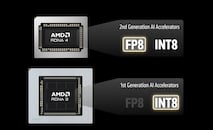
The comparison between FSR 4.1 and FSR 3.1 on RDNA 3 is where it becomes even more interesting, with the geometric mean reflecting an 11% performance penalty for FSR 4.1 in Quality mode and a 14.5% regression in Performance mode. AMD previously explained in an interview with TechPowerUp that there were notable differences between the implementation of FSR 4.1 on RDNA 4 and RDNA 3, specifically that the older hardware uses 8-bit integer (INT8) data, while the RDNA 4 implementation uses the built-in FP8 support in the 2nd-generation AI accelerators in RDNA 4 GPUs. Despite this, AMD claims that it aimed for quality parity across different RDNA generations, which may partially explain the bigger performance penalty on RDNA 3 GPUs. FSR 4.1 support has yet to make it to RDNA 2 GPUs, with official support for the RX 6000-series graphics cards planned for early 2027, so we have yet to see what sort of performance penalty will be incurred there, however, AMD also commented that supporting that older hardware is even more complex, since there are no dedicated AI accelerators. This means RX 6000 GPUs will need to rely on Stream Processors to compute FSR 4.1 upscaling.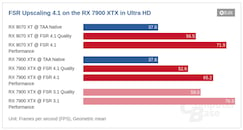
 The performance gap is similar in the less premium GPUs, with FSR 4.1 Performance underperforming FSR 3.1 Performance by 9% on the RX 7800 XT and FSR 4.1 Quality coming in with a 7% performance regression. The RX 7600 tells a similar story, showing a 7% difference between FSR 3.1 Quality and FSR 4.1 Quality and a 9% gap between FSR 4.1 and FSR 3.1 in Performance mode.
Source:
ComputerBase
The comparison between FSR 4.1 and FSR 3.1 on RDNA 3 is where it becomes even more interesting, with the geometric mean reflecting an 11% performance penalty for FSR 4.1 in Quality mode and a 14.5% regression in Performance mode. AMD previously explained in an interview with TechPowerUp that there were notable differences between the implementation of FSR 4.1 on RDNA 4 and RDNA 3, specifically that the older hardware uses 8-bit integer (INT8) data, while the RDNA 4 implementation uses the built-in FP8 support in the 2nd-generation AI accelerators in RDNA 4 GPUs. Despite this, AMD claims that it aimed for quality parity across different RDNA generations, which may partially explain the bigger performance penalty on RDNA 3 GPUs. FSR 4.1 support has yet to make it to RDNA 2 GPUs, with official support for the RX 6000-series graphics cards planned for early 2027, so we have yet to see what sort of performance penalty will be incurred there, however, AMD also commented that supporting that older hardware is even more complex, since there are no dedicated AI accelerators. This means RX 6000 GPUs will need to rely on Stream Processors to compute FSR 4.1 upscaling.


189 Comments on AMD's FSR 4.1 Performance on RDNA 3 Notably Slower than FSR 3.1
Anybody who has paid attention to the market for the past year can see AMD offers better value across the lineup with the exception for the extremely high end where money is no object, features are about the same if all you care about is games, which would be most people buying a gaming card. Drivers have been stable, quite a bit more stable when comparing them to the history of Blackwell drivers and the various issues there.
Hahaha
As a hardware enthusiast, you should do better than to parrot public opinion.So what do you buy for £600? A 9070 XT or a 5060 Ti? Come on, man...
In the current market it makes no sense to buy a 5060Ti over a 9070XT, unless you have piles of money you want to burn, or you absolutely need to have CUDA, then again at that point why would you settle for a x60 tier card. I never said the customer was wrong either, but if we're going by that logic several YT channels pointing out the market in 2026 would be saying the customers are wrong too. And in reality the jacket man has played the market rather unfairly using proprietary features and handing bags of money to game studios to implement those features, especially well before average consumer hardware is ready for any of these features.
This also correlates with the usage of those GPUs for non-gaming scenarios, as I had posted in another thread:But for purely gaming I'd agree with you, a 9070xt makes way more sense than a 5060ti, with both at the same price.
Also you can't just use marketing selectively when it suits you. People are idiots when they prefer nvidia for their GPU, but they are goddamn nuclear scientists (the very same people, right?) when they pair it with an AMD cpu!! Yeah, totally unbiased opinion there champ
And to answer @igormp as well, that is exactly what applies. If you look into it a bit, you'll see that the optimizations Nvidia makes nowadays concern almost exclusively RTX cards—and more specifically, technologies like DLSS Super Resolution, Frame Generation, Ray Tracing, and Nvidia Reflex. The only difference compared to AMD is that Nvidia embeds two drivers into a single file: the one meant for RTX cards and the legacy/maintenance driver for GTX cards.
As for FSR, as Spock from Star Trek would say, "I didn't lie, I exaggerated." And that’s exactly what’s happening with FSR. An exaggeration regarding the shortcomings in the image quality it delivers, and an exaggeration regarding how much attention a gamer actually pays to those while playing. Regarding FSR 4, reviewers have already reverted to "factory settings", praising the latest versions of DLSS, and soon they’ll be pushing DLSS 5 in such a way that an RTX 5050 will look like a better purchase than an RX 9060 XT 16GB, and an RTX 5060 Ti 16GB like a better buy than an RX 9070 XT. And the crowd in here will be backing that exact view. The fun part here is that I am positive about DLSS 5, when even some Nvidia fans aren't.
You keep saying reviewers are pushing DLSS and similar nonsense - even against evidence to the contrary. You just ignore the evidence cause you don't care. I literally posted 4 articles from the biggest gaming websites all blasting DLSS 5 and yet here you are repeating the same thing. Over and over. LIke truth doesn't matter to you. What the hell man, seriously? What the actual hell! Why are you doing this?
FSR 4 was received super positively by everyone, including (of course) amdunboxed.
As my final point in this topic: there's nothing wrong with overspending on a hobby for its own sake. Carpe Diem and all. But to recommend others to do so, or to represent it as an objectively financially sound decision is malice that I cannot go by. On a forum like this, it is the duty of every hobby builder to recommend parts that make sense for the person asking, and not to promote ones that validate our own spending habits. As such, my criticism is about products, prices and product recommendations, not the owners (unless they're uneducated nobs who listen to influencers without thinking on their own, but I assume the present company doesn't fall in this category).
Now, shall we end the off topic spamming once and for all? :)
I've seen some YT vids of Forza Horizon 6 and Asetto Corsa with DLSS5 mods, it does look good in those games. (I know the diehard Nvidia fans are going to use this against me saying why am I not calling it slop.) But it baffles me as to why Nvidia chose a basketball game to show off their latest feature, not a open world racing game where you can clearly see better car reflections and improved environment detail, or a racing game with excellent weather effects.Dear Justbenching, this reads like some high horse riding stuff and doesn't do you any favors, this is the exact koolaid drinking fanboying nonsense others were talking about.
Reviewers have been pushing DLSS for years as the best thing ever while zooming in still images by 200X and saying oh look how terrible FSR is, spend the extra money for DLSS, that was happening even until recently until Nvidia cards climbed in price to over 30-40% higher than the competing cards from AMD, any reviewer would be ridiculous to recommend a card based on pixel peeking with a 40% price difference. Of course any reputable tech site called DLSS5 slop, Nvidia chose to show off the tech that way, I can't blame any of them for not liking game characters being turned into Instagram models.
And if FSR4 was negatively reviewed by HW Unboxed, why are you calling them "amdunboxed"? Make it make sense.A marketshare split is meaningless to anybody that buys what they need, not blindly following the marketing, and it's rather meaningless because I have no doubt a good chunk of that marketshare includes AI sales.
You can't use marketing selectively when it suits you, this isn't about CPU brands. When someone recommends a 5060Ti over a 9070XT for the same price for gaming, I can't take them seriously and question what their agenda is.
Jeez.