Thursday, June 25th 2026
AMD's FSR 4.1 Performance on RDNA 3 Notably Slower than FSR 3.1
AMD recently released FSR 4.1 for its RDNA 3 GPUs, which demonstrated a handy performance increase over native rendering on RDNA 3, but a recent comparison by German outlet, ComputerBase, has revealed that there are noticeable performance regressions when comparing FSR 4.1 to FSR 3.1 on RDNA 3 GPUs. The publication tested FSR 4.1 and FSR 3.1 on the AMD Radeon RX 7900 XTX, RX 7800 XT, and RX 7600, and FSR 4.1 on the Radeon RX 9070 XT. In geometric mean results of nine tested games, the 9070 XT scores an identical frame rate to the RX 7900 XTX in 4K native resolution, but the RDNA 3 flagship scores 52.6 FPS when using FSR 4.1 Quality settings, compared to 56.5 FPS on the 9070 XT—a 7% performance penalty. Looking at FSR 4.1 Performance, the gap grows, with the 7900 XTX serving 65.2 FPS in the test, while the 9070 XT scores 71.9 FPS, making the 7900 XTX 9% slower than the 9070 XT at FSR 4.1 compute.
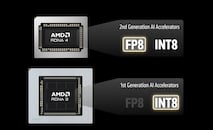
The comparison between FSR 4.1 and FSR 3.1 on RDNA 3 is where it becomes even more interesting, with the geometric mean reflecting an 11% performance penalty for FSR 4.1 in Quality mode and a 14.5% regression in Performance mode. AMD previously explained in an interview with TechPowerUp that there were notable differences between the implementation of FSR 4.1 on RDNA 4 and RDNA 3, specifically that the older hardware uses 8-bit integer (INT8) data, while the RDNA 4 implementation uses the built-in FP8 support in the 2nd-generation AI accelerators in RDNA 4 GPUs. Despite this, AMD claims that it aimed for quality parity across different RDNA generations, which may partially explain the bigger performance penalty on RDNA 3 GPUs. FSR 4.1 support has yet to make it to RDNA 2 GPUs, with official support for the RX 6000-series graphics cards planned for early 2027, so we have yet to see what sort of performance penalty will be incurred there, however, AMD also commented that supporting that older hardware is even more complex, since there are no dedicated AI accelerators. This means RX 6000 GPUs will need to rely on Stream Processors to compute FSR 4.1 upscaling.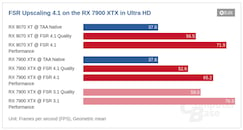
 The performance gap is similar in the less premium GPUs, with FSR 4.1 Performance underperforming FSR 3.1 Performance by 9% on the RX 7800 XT and FSR 4.1 Quality coming in with a 7% performance regression. The RX 7600 tells a similar story, showing a 7% difference between FSR 3.1 Quality and FSR 4.1 Quality and a 9% gap between FSR 4.1 and FSR 3.1 in Performance mode.
Source:
ComputerBase
The comparison between FSR 4.1 and FSR 3.1 on RDNA 3 is where it becomes even more interesting, with the geometric mean reflecting an 11% performance penalty for FSR 4.1 in Quality mode and a 14.5% regression in Performance mode. AMD previously explained in an interview with TechPowerUp that there were notable differences between the implementation of FSR 4.1 on RDNA 4 and RDNA 3, specifically that the older hardware uses 8-bit integer (INT8) data, while the RDNA 4 implementation uses the built-in FP8 support in the 2nd-generation AI accelerators in RDNA 4 GPUs. Despite this, AMD claims that it aimed for quality parity across different RDNA generations, which may partially explain the bigger performance penalty on RDNA 3 GPUs. FSR 4.1 support has yet to make it to RDNA 2 GPUs, with official support for the RX 6000-series graphics cards planned for early 2027, so we have yet to see what sort of performance penalty will be incurred there, however, AMD also commented that supporting that older hardware is even more complex, since there are no dedicated AI accelerators. This means RX 6000 GPUs will need to rely on Stream Processors to compute FSR 4.1 upscaling.


189 Comments on AMD's FSR 4.1 Performance on RDNA 3 Notably Slower than FSR 3.1
So in other words, Nvidia isn't releasing FG for older RTX cards because they already have enough money and just simply can't be asked? Meanwhile modders can do their own version no problem? I see the logic, but then please allow me think of it as a super scumbag move because it is. Having the money shouldn't be an excuse not to do things, but a reason to do them.
Radeon is just that bad, you don't see it because it suits your needs entirely
Now of course - for that very reason - RDNA 4 is competitive. But they had to grab a revolver and shoot their brains out by literally putting GPUs they were making as brand new in 2022 to a legacy driver. That really builds confidence doesn't it? Like yes, currently the 9070xt is so much cheaper that you don't really care that much whether you are going to be getting drivers or not, but that wasn't always the case. Majority of people buy GPUs close to launch, prices back then were overly pretty similar, and with AMD proving how much love they give to their older GPUs, oh well, let's just say that buying RDNA 4 wouldn't have been the wisest of investments.
2. Niche case. How many people stream?
It's the same argument as DLSS vs FSR. "AMD is so bad because that tiny pixel in the top left corner is slightly off." Honestly, for such a price difference, who cares? Nobody notices these things unless you've got two screens running two different cards side by side. Only reviewers have that luxury.
This was no contest even the RDNA 3 encoder produced fugly results, this new one on RDNA 4 is so much better
The reaching when the price difference is massive doesn't surprise me though, but you're arguing with people who have said they want the competition out of existence or admit they want AMD to be cheap in hopes the leather clad man lowers prices.
First it was oh it's only $50 why would you buy anything else, then $100, you should spend the extra $100 that's nothing, then $250 drivers are totally worth it with the usual "AMD driver bad" nonsense. Now at $300-400 it's niche features or you have to stare at a screenshot 200x zoomed in, the same arguments over and over.Or how many stream who aren't vtubers or sponsored and get a 5090 for free anyway.
Question: do you know that AMD is dogshit, or do you believe so based on what you've seen on Youtube? What was the last AMD card that you tried and used? Because I find it awkward that I have to believe that my day to day experience is sub-par because someone who seemingly hasn't touched a single Radeon card in eons tells me so.
The argument is that the price difference is usually so small that it's not worth going for radeon. Especially if you plan on keeping your card. And I think both you and the other usual suspect kinda proved the point when you kept insisting that the 2022 1.2k$ radeon gpu lacked hardware that the 2018 349$ nvidia gpu had. I'm sure back then you would be like "save 50$ and get the 5700xt over the 2070 yadayada" but it turns out the 2070 was a much better buy. Same case with rdna 2 vs ampere. Who's to say it won't happen again with rdna 4
If you want to know, I did have a 2070. I only swapped it for a 6750 XT when it died. I agree that it was miles better than my 5700 XT, which was plagued by driver errors and the infamous Asus Strix overheating. I'm so glad I got rid of it for a profit during the crypto boom and bought the 2070 with money still left in my pocket. But then, the 6750 XT was a miles better card than the 5700 XT, like it wasn't even made by the same company. No driver errors, and while it ran hot, it didn't overheat despite being an AMD reference card. The experience of using it was pretty much on par with the 2070. I still have it as a backup.
After pages of constant, mind-numbing bickering, neither of you are addressing the OP any longer. Simply that FSR is slower on RDNA 3 than FSR 3.1 is.
It has nothing to do with Nvidia.
I'll ask that you take your discussions to a PM where it wont clog the thread.
In long term those 49€ simply is not true. If there would be a 49€ difference i would bought RTX 5070 Ti it simply was not the case usually 150€ or more.
Now difference between RTX 5070 Ti and RX 9070 XT in price is ~54% for the same performance.
The essence, though, is that the GTX 16 series GPUs, just like RDNA 1, lack features that are considered important today. Even if there were a hypothetical GTX 1670 with rasterization performance superior to an RTX 2070, the majority today would prefer an RTX 2060 (not a typo, 60) over it.
And that's not an opinion I just came up with today. Back when the RX 7900 XTX was released, I kept saying that AMD's decision not to put extra focus on ray tracing performance would cost them. People were calling me an Nvidia shill in that thread. As the years go by, certain features become essential—even if they seemed minor back when the card first launched.Ever since the launch of FSR and XeSS—which ran just fine on Nvidia hardware—as well as Frame Generation methods like AMD's and even Lossless Scaling, we knew these features didn't require any sophisticated hardware to implement. Nvidia itself has now come along to confirm this. At this point, someone would have to be either naive or willfully blind to believe that all these years Nvidia couldn't bring its latest technologies to older RTX cards.Marketing. AMD's marketing will either be bad, or pointless.They hold 90% of the market, and reviewers/Youtubers are terrified of them. Regardless of how much pressure AMD exerted, it wouldn't force Nvidia to provide a feature that significantly boosts performance on an older lineup of GPUs. It has been shown that Nvidia only provides new features to old graphics cards when doing so aligns with its business goals.
We saw it with poorly written software PhysX designed to turn games into an unbearable slideshow, and ray tracing on hardware that lacked proper support so it would run slowly and push owners of fast GTX cards to switch to RTX GPUs. Most recently, DLSS—which naturally runs slowly on older generations due to higher processing demands. But certainly not Frame Generation, and even less so Multi Frame Generation (MFG), because that would encourage people to delay their upgrades.
I do hope, however—and I've written this before—that market conditions will force them to change their minds and provide these features to their customers. Because they are their customers. They've already taken their money and will get more from them in the future. But as a company, they need to realize at some point that it's wrong to tell an RTX 3070 owner to cough up $1,000 just to buy an RTX 5060 Ti 16GB. At some point, they have to say, "Whoa, hold on, this isn't right."You are twisting reality and you know it. Just that.This argument has been thrown around ever since CUDA came out. Suddenly, anyone who wanted a graphics card for gaming didn't want it exclusively for games, but also to run CUDA. Now, if a card without the Nvidia logo was 20% faster in games at the exact same price as Nvidia's, it didn't matter—because it lacked CUDA.
Similarly today with CPUs, if someone wants a processor for gaming, they don’t actually want a processor for gaming—they want a processor with plenty of cores, the majority of which will be efficient ones. Because obviously, someone who wants a gaming processor doesn't want one that's 30% faster in many of those games; they want a processor with enhanced multitasking performance, because as it turns out, they happen to stream and run virus scans simultaneously while playing their game.Nobody has made negative comments about Nvidia cards. Seriously, is this the first time you've come across fabricated arguments?We've answered you multiple times on this, bringing up the example comparing an RX 6400 to an RTX 3090, or an Intel iGPU against an RTX 4090.
Since mods already asked us to stop bickering, I'm also gonna cut this short and not address the rest. It's not that I can't, it's that it'll turn into a full blown thread hijack, I just want you to stop for a brief moment and reflect on something: sometimes we spend so much time telling ourselves something that we might as well start believing it. The reality is that AMD GPUs do not offer the same value, same features, and same stability of Nvidia cards. They just don't. Anyway, long enough, time for lunch
- Nvidia puts out a driver and because they weren't stupid enough to say something like "maintenance mode" we are convinced that they still fully support old cardsEvery game review out there with FSR 2 or 3 has a copy pasted paragraph explaining why "FSR is crap". I guess there could be two paragraphs instead of one, but reviewers are AMD biased, so we only get one.Yeah, I replied first, seen that post later. Be good.
On the other hand, AMD obfuscates things like runtime versions by deliberate misdirection (the "for RDNA1 and RDNA2" detail seen in this table is intentionally omitted from EVERY consumer-facing download and documentation, with this driver versioning removed from all download pages), see Vulkan for example, from their table you can see the branch split clearly even though they only report their internal, not the actual runtime's versioning, and that the branch that services RDNA 2 stopped being updated when the branch split occurred
gpuopen.com/version-table/
2.0.353 translates into 1.4.315, roughly on par with what Pascal supported at the time of EOL... except that RDNA 2 is supposed to match with the Ampere/RTX 30 generation.
Later the OFA requirement was thrown away by a newer model. In theory it could be made to work, Nvidia could just not be arsed, but they never claimed it was impossible or anything of the sorts.GTX 1600 has the exact same ISA as the 2000 series, so any optimizations still apply. It has been stripped of tensor cores and the RT cores, but the calls to those still work (at way slower rates), and it's not like Tensor cores are actually used by any game (as in actual game rendering stuff, rather than things like DLSS which call upon CUDA kernels).
The above is actually really annoying since there are some cases where you might detect that you have a sm_75 GPU (meaning Turing), but you can't easily know if it lacks tensor cores, meaning that you can dispatch GEMM kernels assuming tensor cores and end up with 5~20x slower speeds compared to if you just used regular scalar/vector FP32 kernels. (see this and this).
Nonetheless, as long as 2000 series gets optimizations, so do the 1600 series by default (now you could argue that Turing does not get any support, but I won't be arguing about that).