Thursday, June 25th 2026
AMD's FSR 4.1 Performance on RDNA 3 Notably Slower than FSR 3.1
AMD recently released FSR 4.1 for its RDNA 3 GPUs, which demonstrated a handy performance increase over native rendering on RDNA 3, but a recent comparison by German outlet, ComputerBase, has revealed that there are noticeable performance regressions when comparing FSR 4.1 to FSR 3.1 on RDNA 3 GPUs. The publication tested FSR 4.1 and FSR 3.1 on the AMD Radeon RX 7900 XTX, RX 7800 XT, and RX 7600, and FSR 4.1 on the Radeon RX 9070 XT. In geometric mean results of nine tested games, the 9070 XT scores an identical frame rate to the RX 7900 XTX in 4K native resolution, but the RDNA 3 flagship scores 52.6 FPS when using FSR 4.1 Quality settings, compared to 56.5 FPS on the 9070 XT—a 7% performance penalty. Looking at FSR 4.1 Performance, the gap grows, with the 7900 XTX serving 65.2 FPS in the test, while the 9070 XT scores 71.9 FPS, making the 7900 XTX 9% slower than the 9070 XT at FSR 4.1 compute.
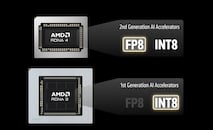
The comparison between FSR 4.1 and FSR 3.1 on RDNA 3 is where it becomes even more interesting, with the geometric mean reflecting an 11% performance penalty for FSR 4.1 in Quality mode and a 14.5% regression in Performance mode. AMD previously explained in an interview with TechPowerUp that there were notable differences between the implementation of FSR 4.1 on RDNA 4 and RDNA 3, specifically that the older hardware uses 8-bit integer (INT8) data, while the RDNA 4 implementation uses the built-in FP8 support in the 2nd-generation AI accelerators in RDNA 4 GPUs. Despite this, AMD claims that it aimed for quality parity across different RDNA generations, which may partially explain the bigger performance penalty on RDNA 3 GPUs. FSR 4.1 support has yet to make it to RDNA 2 GPUs, with official support for the RX 6000-series graphics cards planned for early 2027, so we have yet to see what sort of performance penalty will be incurred there, however, AMD also commented that supporting that older hardware is even more complex, since there are no dedicated AI accelerators. This means RX 6000 GPUs will need to rely on Stream Processors to compute FSR 4.1 upscaling.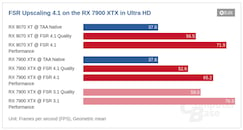
 The performance gap is similar in the less premium GPUs, with FSR 4.1 Performance underperforming FSR 3.1 Performance by 9% on the RX 7800 XT and FSR 4.1 Quality coming in with a 7% performance regression. The RX 7600 tells a similar story, showing a 7% difference between FSR 3.1 Quality and FSR 4.1 Quality and a 9% gap between FSR 4.1 and FSR 3.1 in Performance mode.
Source:
ComputerBase
The comparison between FSR 4.1 and FSR 3.1 on RDNA 3 is where it becomes even more interesting, with the geometric mean reflecting an 11% performance penalty for FSR 4.1 in Quality mode and a 14.5% regression in Performance mode. AMD previously explained in an interview with TechPowerUp that there were notable differences between the implementation of FSR 4.1 on RDNA 4 and RDNA 3, specifically that the older hardware uses 8-bit integer (INT8) data, while the RDNA 4 implementation uses the built-in FP8 support in the 2nd-generation AI accelerators in RDNA 4 GPUs. Despite this, AMD claims that it aimed for quality parity across different RDNA generations, which may partially explain the bigger performance penalty on RDNA 3 GPUs. FSR 4.1 support has yet to make it to RDNA 2 GPUs, with official support for the RX 6000-series graphics cards planned for early 2027, so we have yet to see what sort of performance penalty will be incurred there, however, AMD also commented that supporting that older hardware is even more complex, since there are no dedicated AI accelerators. This means RX 6000 GPUs will need to rely on Stream Processors to compute FSR 4.1 upscaling.


189 Comments on AMD's FSR 4.1 Performance on RDNA 3 Notably Slower than FSR 3.1
A 2022 GPU can run upscaling, never heard of lossless scaling? You must be fine with running mods since the 4090 requires mods to use dlss5 and mfg.
I'd still be happy with my 6750 XT if I hadn't got a 9070 XT for launch MSRP. Maybe because I don't care about upscaling much, so there's that.
You see, this is what green fans don't understand about AMD buyers. We don't buy AMD because it's better at every conceivable feature. We buy AMD because it fits the needs, and is cheaper. Why spend more money on stuff that we don't need? Whereas if upscaling is so deeply important to you, and money isn't a question, then by all means, buy the card that's better at it.
And, I know that objectivity and logic make you feel uncomfortable, but there is nothing I can do about that.Do you know that he hates Multi Frame Generation (you need another mod to unlock it for the 4090) and because he says that he hates MFG, everyone hates MFG? People only ask for great upscaling. No one wants FG.
And you know, forums kinda exaggerate the problem. I say one thing then I get 10 replies and then I reply to them and it turns out into a bigger deal than it is. So basically, im not complaining as such, I just don't see why I would make the same mistake again and buy an AMD GPU - unless the price difference is ridiculously high (like it is currently), I really see no point. Saving 50 or 100$ is peanuts for hardware that you plan to keep for 4-5+ years.
Did you know whether AMD's upscaler would get better or not? No.
Did you know what you'd want from your GPU in 2026? Probably no.
Did AMD know which direction they'd want to move their upscaler tech? I assume, also no.
Is FSR 4 coming for your RDNA 2 card? Yes.
No more questions, your honour. No one is accountable for not knowing the future.That's fine. Personally, I don't like wasting money on stuff that I don't need. Those 50-100 bucks can buy me a nice day/weekend out with the missus. That's infinitely more valuable to me than slightly less blurry pixels. Not to mention the seamless Linux support, which we've also discussed elsewhere, I believe. But each to their own. :)
Intel iGPUs MFG, RTX 4090 no MFG
But yeah, you choose where to complain.
Second of all, why in the freaking hell would I complain about a feature I don't care about? I've always said that FG is super niche, MFG is even more so.
In that case, I don't care about upscaling, only price-to-performance ratio, therefore AMD is brilliant, everybody must buy from them. :peace: Is this how we roll? :confused:
This is the guy with enough balls to try and justify the 5700 XT, which is arguably the worst GPU in recent memory. RDNA 1 was chock full of hardware errata, feature level far below Turing or even Volta, no matrix multiplication capability, low performance, the drivers were so garbage but so garbage that they spent a year chasing one single black screen bug that plagued it, yet he still tried to defend it
I can respect that somehow - unlike MLID he certainly does NOT invent or manufacture his points or stance, every argument and every point he makes is backed by data and genuine research, and he has an understanding of how technology works