Thursday, June 25th 2026
AMD's FSR 4.1 Performance on RDNA 3 Notably Slower than FSR 3.1
AMD recently released FSR 4.1 for its RDNA 3 GPUs, which demonstrated a handy performance increase over native rendering on RDNA 3, but a recent comparison by German outlet, ComputerBase, has revealed that there are noticeable performance regressions when comparing FSR 4.1 to FSR 3.1 on RDNA 3 GPUs. The publication tested FSR 4.1 and FSR 3.1 on the AMD Radeon RX 7900 XTX, RX 7800 XT, and RX 7600, and FSR 4.1 on the Radeon RX 9070 XT. In geometric mean results of nine tested games, the 9070 XT scores an identical frame rate to the RX 7900 XTX in 4K native resolution, but the RDNA 3 flagship scores 52.6 FPS when using FSR 4.1 Quality settings, compared to 56.5 FPS on the 9070 XT—a 7% performance penalty. Looking at FSR 4.1 Performance, the gap grows, with the 7900 XTX serving 65.2 FPS in the test, while the 9070 XT scores 71.9 FPS, making the 7900 XTX 9% slower than the 9070 XT at FSR 4.1 compute.
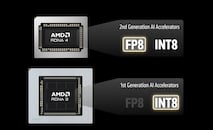
The comparison between FSR 4.1 and FSR 3.1 on RDNA 3 is where it becomes even more interesting, with the geometric mean reflecting an 11% performance penalty for FSR 4.1 in Quality mode and a 14.5% regression in Performance mode. AMD previously explained in an interview with TechPowerUp that there were notable differences between the implementation of FSR 4.1 on RDNA 4 and RDNA 3, specifically that the older hardware uses 8-bit integer (INT8) data, while the RDNA 4 implementation uses the built-in FP8 support in the 2nd-generation AI accelerators in RDNA 4 GPUs. Despite this, AMD claims that it aimed for quality parity across different RDNA generations, which may partially explain the bigger performance penalty on RDNA 3 GPUs. FSR 4.1 support has yet to make it to RDNA 2 GPUs, with official support for the RX 6000-series graphics cards planned for early 2027, so we have yet to see what sort of performance penalty will be incurred there, however, AMD also commented that supporting that older hardware is even more complex, since there are no dedicated AI accelerators. This means RX 6000 GPUs will need to rely on Stream Processors to compute FSR 4.1 upscaling.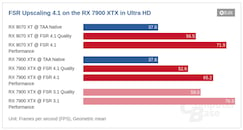
 The performance gap is similar in the less premium GPUs, with FSR 4.1 Performance underperforming FSR 3.1 Performance by 9% on the RX 7800 XT and FSR 4.1 Quality coming in with a 7% performance regression. The RX 7600 tells a similar story, showing a 7% difference between FSR 3.1 Quality and FSR 4.1 Quality and a 9% gap between FSR 4.1 and FSR 3.1 in Performance mode.
Source:
ComputerBase
The comparison between FSR 4.1 and FSR 3.1 on RDNA 3 is where it becomes even more interesting, with the geometric mean reflecting an 11% performance penalty for FSR 4.1 in Quality mode and a 14.5% regression in Performance mode. AMD previously explained in an interview with TechPowerUp that there were notable differences between the implementation of FSR 4.1 on RDNA 4 and RDNA 3, specifically that the older hardware uses 8-bit integer (INT8) data, while the RDNA 4 implementation uses the built-in FP8 support in the 2nd-generation AI accelerators in RDNA 4 GPUs. Despite this, AMD claims that it aimed for quality parity across different RDNA generations, which may partially explain the bigger performance penalty on RDNA 3 GPUs. FSR 4.1 support has yet to make it to RDNA 2 GPUs, with official support for the RX 6000-series graphics cards planned for early 2027, so we have yet to see what sort of performance penalty will be incurred there, however, AMD also commented that supporting that older hardware is even more complex, since there are no dedicated AI accelerators. This means RX 6000 GPUs will need to rely on Stream Processors to compute FSR 4.1 upscaling.


189 Comments on AMD's FSR 4.1 Performance on RDNA 3 Notably Slower than FSR 3.1
That way, you can tick the positivity box, everybody is smiling, but the negative info hits the spot. Every tech channel does it consciously or subconsciously. That's why I skip the assessment, and look for the hard facts: tech details, performance numbers, price. The rest is fake babbling to me. The same bullshit my manager does when he's got a problem with the team. "Guys, you're all doing amazing work, but..." Yeah, right, here it comes.
"he is attacking nvidia all the time while keeping his mouth shut about amd not offering features to RDNA 1, RDNA 2, RDNA 3 and RDNA 4 owners'.
There, I did it. That was easy.What an evil person!! He suggested that if you are in X country that the 5060ti is cheap you should buy it? He is definitely shilling for nvidia. He should be suggesting an AMD card no matter the country and the price. AMD or bust. You are right. Im the one distorting reality, not the person saying that unless you suggest AMD unequivocally you are an nvidia shill :roll:
Holy cow dude, that was something
I can't think of anything more recent when they backported something to unsupported hardware - only the opposite, when they blocked perfectly supported hardware (FG and MFG).
Bought it in 2022 btw, brand new, the same year I bought my 4090.
But no only AMD could be greedy with features.
Waste of time, as per the usual. You are too far gone
Also the DLSS marketing brand is no longer simply upscaling, it's a whole feature suite, but it's on Nvidia for branding features that way, and disappointing AMD is copying it with FSR.Goal post moving as usual.
One company doesn't have the hardware present to support the feature on older hardware, the other company does but lies and gives excuses it can't and people take it as gospel without proof.
If you want to make an argument at least use MFG (which I think amd has ported back to rdna2? not sure), not DLSS 5.That is not a winning argument my man, shush. You are literally saying amd sells you gpus with lacking hardware. 1.2k $ GPU from 2022 lacking hardware that a 2018 349$ GPU had. GREAT endorsement. Just wow. I really wonder why they don't sell, it's a mystery. :roll:
And it won't be the same even if it takes nvidia 3 years to make DLSS 5 work, but we both know that won't be the case.
Nvidia - even if they are going to need 3 years (which they won't, but for the sake of argument) - needed 3 years to backport a feature that doesn't exist ANYWHERE else on any other GPU.
Clearly not the same.