Thursday, June 25th 2026

AMD's FSR 4.1 Performance on RDNA 3 Notably Slower than FSR 3.1

AMD recently released FSR 4.1 for its RDNA 3 GPUs, which demonstrated a handy performance increase over native rendering on RDNA 3, but a recent comparison by German outlet, ComputerBase, has revealed that there are noticeable performance regressions when comparing FSR 4.1 to FSR 3.1 on RDNA 3 GPUs. The publication tested FSR 4.1 and FSR 3.1 on the AMD Radeon RX 7900 XTX, RX 7800 XT, and RX 7600, and FSR 4.1 on the Radeon RX 9070 XT. In geometric mean results of nine tested games, the 9070 XT scores an identical frame rate to the RX 7900 XTX in 4K native resolution, but the RDNA 3 flagship scores 52.6 FPS when using FSR 4.1 Quality settings, compared to 56.5 FPS on the 9070 XT—a 7% performance penalty. Looking at FSR 4.1 Performance, the gap grows, with the 7900 XTX serving 65.2 FPS in the test, while the 9070 XT scores 71.9 FPS, making the 7900 XTX 9% slower than the 9070 XT at FSR 4.1 compute.

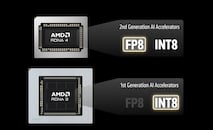
The comparison between FSR 4.1 and FSR 3.1 on RDNA 3 is where it becomes even more interesting, with the geometric mean reflecting an 11% performance penalty for FSR 4.1 in Quality mode and a 14.5% regression in Performance mode. AMD previously explained in an interview with TechPowerUp that there were notable differences between the implementation of FSR 4.1 on RDNA 4 and RDNA 3, specifically that the older hardware uses 8-bit integer (INT8) data, while the RDNA 4 implementation uses the built-in FP8 support in the 2nd-generation AI accelerators in RDNA 4 GPUs. Despite this, AMD claims that it aimed for quality parity across different RDNA generations, which may partially explain the bigger performance penalty on RDNA 3 GPUs. FSR 4.1 support has yet to make it to RDNA 2 GPUs, with official support for the RX 6000-series graphics cards planned for early 2027, so we have yet to see what sort of performance penalty will be incurred there, however, AMD also commented that supporting that older hardware is even more complex, since there are no dedicated AI accelerators. This means RX 6000 GPUs will need to rely on Stream Processors to compute FSR 4.1 upscaling.
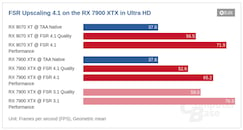
The performance gap is similar in the less premium GPUs, with FSR 4.1 Performance underperforming FSR 3.1 Performance by 9% on the RX 7800 XT and FSR 4.1 Quality coming in with a 7% performance regression. The RX 7600 tells a similar story, showing a 7% difference between FSR 3.1 Quality and FSR 4.1 Quality and a 9% gap between FSR 4.1 and FSR 3.1 in Performance mode.
Source: ComputerBase

189 Comments on AMD's FSR 4.1 Performance on RDNA 3 Notably Slower than FSR 3.1

#126
john_
Dr. DroSteve doesn't shy from a hot take.

This is the guy with enough balls to try and justify the 5700 XT, which is arguably the worst GPU in recent memory. RDNA 1 was chock full of hardware errata, feature level far below Turing or even Volta, no matrix multiplication capability, low performance, the drivers were so garbage but so garbage that they spent a year chasing one single black screen bug that plagued it, yet he still tried to defend it

I can respect that somehow - unlike MLID he certainly does NOT invent or manufacture his points or stance, every argument and every point he makes is backed by data and genuine research, and he has an understanding of how technology works
RX 5700 was competitive to RTX 2060 at an era that people didn't care for anything else other than raster performance. Ray tracing wasn't a must have, upscaling was still at DLSS 1 which wasn't exactly anything more than marketing material. AI was nowhere, CUDA was probably used only in tasks that had nothing to do with gaming. So, RX 5700 was a good alternative. As for drivers, should I remind you the state of Nvidia drivers when RTX 50 series was released? How many months it took Nvidia to fix it's own black screen problems? Maybe how many years it took to restore some kind of support for PhysX?
Posted on Reply
#127
JustBenching
AusWolfMaybe because your RDNA 2 card... I don't know... is lacking AI hardware and the feature has to be backported to run on shader cores? Hmm, nah, that can't be it. Dirty, evil company sounds a lot better. :rolleyes:
And how is that not an issue? Like - this is a much bigger issue yet you act like it's no biggie. They are selling - in 2022 - flagship 1.2k$ MSRP GPUs that lack hardware that 349$ 2018 GPUs had. You literally liked a post at the top of the page from the usual suspect crying about nvidia offering worse cards for more money, and yet here you are literally admitting that nvidias much cheaper much older cards packed a bunch more hardware...im freaking speechless, how the hell can you not see this, lol :D
Posted on Reply
#128
john_
JustBenchingNvidia restricts niche features (like MFG) cause they are greedy, bad, disgusting and evil. That's a given. The real question is why does AMD restrict features that a bad, greedy, disgusting and evil company freely offers? THATS the hard question to answer, is it not? :D
FG that today is a standard option in video settings is a niche feature? Then maybe upscaling is also a niche feature.

AMD isn't locking fully working features in it's drivers like Nvidia. Sorry. Try again.
JustBenchingThey are selling - in 2022 - flagship 1.2k$ MSRP GPUs that lack hardware that 349$ 2018 GPUs had.
You keep repeating this argument when integrated - wait let me use bold here - INTEGRATED Intel GPUs offer MFG while - what is the current pricing? $2000, $3000? - RTX 4090 doesn't support it because Nvidia insists that - wait for it - it LACKS HARDWARE.
Posted on Reply
#129
JustBenching
john_FG that today is a standard option in video settings is a niche feature? Then maybe upscaling is also a niche feature.
Yes, cause it only works properly (ie. not increasing input lag) when you are CPU bound. Which is usually a very niche scenario.
john_AMD isn't locking fully working features in it's drivers like Nvidia. Sorry. Try again.
Ah, you went into reality denying again. FSR 4 int8 version totally didn't leak from AMD's very own github repo. LOL, what are you talking about dude, they had FSR 4 working on RDNA 2 since last year.
john_You keep repeating this argument when integrated - wait let me use bold here - INTEGRATED Intel GPUs offer MFG while - what is the current pricing? $2000, $3000? - RTX 4090 doesn't support it because Nvidia insists that - wait for it - it LACKS HARDWARE.
But we already agreed nvidia is greedy evil disgusting etcetera. What's AMDs excuse for not offering and locking features that the disgusting greedy evil competition offers to decade old GPUs? :D

Phew, we are struggling with this one aren't we...
Posted on Reply
#130
AusWolf
JustBenchingAnd how is that not an issue? Like - this is a much bigger issue yet you act like it's no biggie. They are selling - in 2022 - flagship 1.2k$ MSRP GPUs that lack hardware that 349$ 2018 GPUs had.
Like I said, you knew about it, but you bought one anyway. This is in no way on AMD.
JustBenchingYou literally liked a post at the top of the page from the usual suspect crying about nvidia offering worse cards for more money, and yet here you are literally admitting that nvidias much cheaper much older cards packed a bunch more hardware...im freaking speechless, how the hell can you not see this, lol :D
Nvidia is offering slower cards for more money now. How you think that relates to RDNA 2 and Ampere, I have no idea.

I had strictly Intel + Nvidia systems for 10+ years before I switched circa 2022, mind you.
JustBenchingWhat's AMDs excuse for not offering and locking features that the disgusting greedy evil competition offers to decade old GPUs? :D
Hm, let me see... actually lacking the hardware maybe?
Posted on Reply
#131
john_
JustBenchingYes, cause it only works properly (ie. not increasing input lag) when you are CPU bound. Which is usually a very niche scenario.
Well FSR 4 works ***properly*** on RDNA4. So? AMD did the EXTRA job to bring it back to RDNA 3 and RDNA 2. Nvidia didn't even had to do extra job to offer (M)FG to RTX 20, RTX 30 and RTX 40 series. Just click a switch from "Denied" to "Available".
JustBenchingAh, you went into reality denying again. FSR 4 int8 version totally didn't leak from AMD's very own github repo. LOL, what are you talking about dude, they had FSR 4 working on RDNA 2 since last year.
AMD did the extra job to create a new version of FSR 4 without having that obligation. Should they had offered it from the beginning? Yes. I said a dozen times that they should.
Nvidia had the code ready for all those features. But they are locking their drivers. No one asked them to offer DLSS or FG to GTX cards that lack tensor cores. Only offer those features to cards that do have Tensor cores. It's a much easier task than having to create a totally different version running on different parts of the GPU. The bad ugly AMD did it, heavenly Nvidia put a lock on those features and said "You want more? Pay me again. Buy the new RTX 50 series cards at these ridiculous prices"..
Posted on Reply
#132
JustBenching
john_Well FSR 4 works ***properly*** on RDNA4. So? AMD did the EXTRA job to bring it back to RDNA 3 and RDNA 2. Nvidia didn't even had to do extra job to offer (M)FG to RTX 20, RTX 30 and RTX 40 series. Just click a switch from "Denied" to "Available".

AMD did the extra job to create a new version of FSR 4 without having that obligation. Should they had offered it from the beginning? Yes. I said a dozen times that they should.
Nvidia had the code ready for all those features. But they are locking their drivers. No one asked them to offer DLSS or FG to GTX cards that lack tensor cores. Only offer those features to cards that do have Tensor cores. It's a much easier task than having to create a totally different version running on different parts of the GPU. The bad ugly AMD did it, heavenly Nvidia put a lock on those features and said "You want more? But the new RTX 50 series cards at these ridiculous prices"..
So you agree that they have it working but locked since last year, they will probably release it at some point next year. A feature that their evil greedy disgusting competition offers freely on decade old entry level GPUs. What does that say about AMD , I wonder.

Bad ugly AMD doing it doesn't matter since they literally kept it under lock and key. What difference does it make whether they ported it or not if they haven't released it?
Posted on Reply
#133
AusWolf
JustBenchingSo you agree that they have it working but locked since last year, they will probably release it at some point next year. A feature that their evil greedy disgusting competition offers freely on decade old entry level GPUs. What does that say about AMD , I wonder.

Bad ugly AMD doing it doesn't matter since they literally kept it under lock and key. What difference does it make whether they ported it or not if they haven't released it?
They're working on it, and it will be released. Even if they didn't, lacking the hardware necessary would be an acceptable (albeit, sad) excuse.
Nvidia has the hardware for FG and MFG on all RTX cards, there is no backport needed, just a switch in the driver, they have no excuse.
Posted on Reply
#134
john_
JustBenchingSo you agree that they have it working but locked since last year, they will probably release it at some point next year. A feature that their evil greedy disgusting competition offers freely on decade old entry level GPUs. What does that say about AMD , I wonder.

Bad ugly AMD doing it doesn't matter since they literally kept it under lock and key. What difference does it make whether they ported it or not if they haven't released it?
They had a working version of FSR 4 for RDNA 2 and RDNA 3 that they should have released as beta at least. I am saying it for over a year.

Nvidia has working libraries for every RTX that they lock in their drivers. All these mods prove it. And when a mod unlocks a feature what Nvidia does? Create a new lock to cut the mod. Bravo Nvidia. Have you heard about AMD releasing new FSR INT 8 versions that are locked and need new mods to get unlocked? The latest version of FSR 4.1 something is just a plain dll. You download it, put it in game's folder. The end. Ready. NO LOCKS TO BREAK. It shows which company wants to let features to leak to the general public and which company loves to put locks in everything.
Posted on Reply
#135
JustBenching
K lads, you got me, AMD leaked it on purpose so us poor RDNA 2 users could mod it to get access to FSR 4. They really wanted to give it to us but didn't do it officially for reasons. Kk. For sure
Posted on Reply
#136
AusWolf
JustBenchingK lads, you got me, AMD leaked it on purpose so us poor RDNA 2 users could mod it to get access to FSR 4. They really wanted to give it to us but didn't do it officially for reasons. Kk. For sure
Hiding it was a scummy move. All they had to do is announce that they were working on it. But you know, AMD and good PR can't usually be found within the same sentence.

I still prefer to judge based on actions, not (a lack of) words.
Posted on Reply
#137
Dr. Dro
john_RX 5700 was competitive to RTX 2060 at an era that people didn't care for anything else other than raster performance. Ray tracing wasn't a must have, upscaling was still at DLSS 1 which wasn't exactly anything more than marketing material. AI was nowhere, CUDA was probably used only in tasks that had nothing to do with gaming. So, RX 5700 was a good alternative. As for drivers, should I remind you the state of Nvidia drivers when RTX 50 series was released? How many months it took Nvidia to fix it's own black screen problems? Maybe how many years it took to restore some kind of support for PhysX?
Eh, ultra hard pass on anything Navi 10, it's just trying to defend the indefensable especially if you look at the moribund state it is in today vs. Turing in active development, but...

Years? Months at most perhaps, Blackwell is barely 1.5 years old and PhysX has been restored for what almost a year now. And I was an yearly adopter, Blackwell driver issues were real but greatly exaggerated
Posted on Reply
#138
john_
JustBenchingK lads, you got me, AMD leaked it on purpose so us poor RDNA 2 users could mod it to get access to FSR 4. They really wanted to give it to us but didn't do it officially for reasons. Kk. For sure
They did threw resources on it, creating something much different than the FP8 version. Did they wanted to release it officially? Considering they love to shoot their feet, there is a possibility that they wouldn't release it officially.

But FSR 4 INT8 wasn't a part of AMD's drivers like the features Nvidia locks. The hardware (tensor cores) is there, the features are working on older cards, but they choose to lock the features that are already integrated in the driver and work when unlocked with older cards. This looks worst.
Dr. DroEh, ultra hard pass on anything Navi 10, it's just trying to defend the indefensable especially if you look at the moribund state it is in today vs. Turing in active development, but...

Years? Months at most perhaps, Blackwell is barely 1.5 years old and PhysX has been restored for what almost a year now. And I was an yearly adopter, Blackwell driver issues were real but greatly exaggerated
As I said, back then Raytracing and upscaling and FG wasn't something that people cared about. RX 5700 series and GTX 16 series are dead because they lack support of those features that back then where irrelevant and today are must have. Remove Tensor Cores from Turing, you get GTX 16 series. Do you see anyone care about GTX 16 series cards? Even as low end options. No, because they lack Tensor cores that are important for Nvidia features.

Yeah, nVidia driver problems exaggerated, AMD driver problems.... I just remembered when rumors where spreading saying that AMD drivers where breaking the GPU core. Fun times.
Posted on Reply
#139
Dr. Dro
john_They did threw resources on it, creating something much different than the FP8 version. Did they wanted to release it officially? Considering they love to shoot their feet, there is a possibility that they wouldn't release it officially.

But FSR 4 INT8 wasn't a part of AMD's drivers like the features Nvidia locks. The hardware (tensor cores) is there, the features are working on older cards, but they choose to lock the features that are already integrated in the driver and work when unlocked with older cards. This looks worst.


As I said, back then Raytracing and upscaling and FG wasn't something that people cared about. RX 5700 series and GTX 16 series are dead because they lack support of those features that back then where irrelevant and today are must have. Remove Tensor Cores from Turing, you get GTX 16 series. Do you see anyone care about GTX 16 series cards? Even as low end options. No, because they lack Tensor cores that are important for Nvidia features.

Yeah, nVidia driver problems exaggerated, AMD driver problems.... I just remembered when rumors where spreading saying that AMD drivers where breaking the GPU core. Fun times.
16 series aren't dead, they continue to receive timely driver updates with access to the latest runtimes. But they were designed to be cut down, low cost products specifically because the entry price for Turing was too high. This means the expectations surrounding them are much lower by default.
Posted on Reply
#140
wolf
Better Than Native
JustBenchingWell that is not true though
It's too late man, it's already been declared they use logic and objectivity and you don't, you've been depicted ans the soyjack and himself as the Chad. The claim alone is devastating, you lay defeated....in his mind.

Another charming exchange of mental gymnastics and accusations of bias.

At the end of the day, they're content creators who want as much revenue from a riled up crowd they can get, do you really think they care the colour of the logo? They play both sides so they always come out on top.

I should revisit the meme and add modders there, they're doing a lot of work on both sides of the fence recently. Obviously DLSS5/MFG going wild (which again, should be released if the results are good) but they've also beaten AMD to FSR4 for RDNA2.

Posted on Reply
#141
Visible Noise
JustBenchingYes, absolutely. There is no way they need 2 years to backport it to RDNA 2, lol.
When you give it to the interns…
AusWolfIt is the same. I'm done.
AusWolfNvidia's 2018 GPUs have the same Tensor core as the newer ones
That lasted 2 posts and seven minutes.

I have no idea why you would think this. It’s been eight years man. That’s like saying Zen+ has the same core as Zen 5.

You must think RX 590 has the same core as your 9070 XT.

I’m trying to grasp how someone on a tech forum could think this.


Posted on Reply
#142
AusWolf
Visible NoiseThat lasted 2 posts and seven minutes.

I have no idea why you would think this. It’s been eight years man. That’s like saying Zen+ has the same core as Zen 5.

You must think RX 590 has the same core as your 9070 XT.

I’m trying to grasp how someone on a tech forum could think this.


Do we know any technical details as to what's in a Tensor core? No. We only have a vague comment from Nvidia about the OFA not being strong enough in earlier generations for FG. Then someone called bullshit on that, which then they admitted. Now we have mods running FG on Ampere. Seems legit.
Posted on Reply
#143
Dr. Dro
AusWolfDo we know any technical details as to what's in a Tensor core? No. We only have a vague comment from Nvidia about the OFA not being strong enough in earlier generations for FG. Then someone called bullshit on that, which then they admitted. Now we have mods running FG on Ampere. Seems legit.
It's not that "someone called bullshit on that and they admitted", they changed DLSS so it doesn't use the OFA anymore
Posted on Reply
#144
AusWolf
Dr. DroIt's not that "someone called bullshit on that and they admitted", they changed DLSS so it doesn't use the OFA anymore
DLSS doesn't. What about FG?
Posted on Reply
#145
Dr. Dro
AusWolfDLSS doesn't. What about FG?
This is a mess, just to clarify "DLSS" has become a marketing umbrella term for their neural graphics toolkit, which runs off the "NGX framework".

1. "Super Resolution" AI upscaler, convolutional auto-encoding neural networks (older presets) or vision transformer-based (newer presets marketed as DLSS 4 and up) - "nvngx_dlss.dll"
2. "Frame Generation" motion interpolation (initially marketed as DLSS 3) - "nvngx_dlssg.dll"
3. "Ray Reconstruction" AI denoiser, initially marketed as DLSS 3.5 - "nvngx_dlssd.dll"
4. The new Neural Rendering system, marketed as "DLSS 5" - "nvngx_dlssnr.dll"

However, it's not a "done deal" once released, as the NGX DLLs are always being updated and maintained by Nvidia. So while "Super Resolution Preset E", which is the latest convolutional model introduced by "DLSS 3.5", the image presented by an old DLSS v3 series DLL is not going to be the exact same as the newer, more accurate versions like 310.9.1, hence the need/desire to upgrade and override the DLL for games that have already shipped.

There are some other misconceptions, such as DLAA being a thing unto itself (it is just the Super Resolution model applied at full quality/native resolution, with a 1:1 pixel input<>output), or that the "DLSS Frame Generation" relying on OFA - the old "DLSS 3" models might have needed it, but it is known that since the "DLSS 4" it has been rewritten to use the tensor cores because it's a lot faster.

Other details worth mentioning are quirks of each tensor core generation, for example, Turing's 2nd gen core is the earliest version that is usually supported because it's the earliest type of tensor core that can access the geometry and vector data in the shaders. Volta's original is unable to do this, which is why the Titan V cannot support DLSS. Each generation added new tricks and new numeric data formats (the table that @Visible Noise posted is a good reference), for AMD basically what you need to know is that RDNA 2 has no such functionality, and RDNA 3 lacks dedicated hardware for it (although it does have relevant instructions to execute most math types needed for deep learning applications), it was only with RDNA 4 that they finally got "Turing-complete" here.
Posted on Reply
#146
Visible Noise
AusWolfDo we know any technical details as to what's in a Tensor core? No. We only have a vague comment from Nvidia about the OFA not being strong enough in earlier generations for FG. Then someone called bullshit on that, which then they admitted. Now we have mods running FG on Ampere. Seems legit.
You know there’s programming documentation for all this. You kinda gotta know what’s in a tensor core to program it. It’s literally in the post you replied to.

But hey, that AMD, love those AI cores they promised were in RDNA 3.

Dude, seriously, calm down. Think. Use the space between your ears. To say the cores haven’t changed in eight years on a tech forum is just incredible. It boggles.
Posted on Reply
#147
AusWolf
Dr. DroThis is a mess, just to clarify "DLSS" has become a marketing umbrella term for their neural graphics toolkit, which runs off the "NGX framework".

1. "Super Resolution" AI upscaler, convolutional auto-encoding neural networks (older presets) or vision transformer-based (newer presets marketed as DLSS 4 and up) - "nvngx_dlss.dll"
2. "Frame Generation" motion interpolation (initially marketed as DLSS 3) - "nvngx_dlssg.dll"
3. "Ray Reconstruction" AI denoiser, initially marketed as DLSS 3.5 - "nvngx_dlssd.dll"
4. The new Neural Rendering system, marketed as "DLSS 5" - "nvngx_dlssnr.dll"

However, it's not a "done deal" once released, as the NGX DLLs are always being updated and maintained by Nvidia. So while "Super Resolution Preset E", which is the latest convolutional model introduced by "DLSS 3.5", the image presented by an old DLSS v3 series DLL is not going to be the exact same as the newer, more accurate versions like 310.9.1, hence the need/desire to upgrade and override the DLL for games that have already shipped.

There are some other misconceptions, such as DLAA being a thing unto itself (it is just the Super Resolution model applied at full quality/native resolution, with a 1:1 pixel input<>output), or that the "DLSS Frame Generation" relying on OFA - the old "DLSS 3" models might have needed it, but it is known that since the "DLSS 4" it has been rewritten to use the tensor cores because it's a lot faster.

Other details worth mentioning are quirks of each tensor core generation, for example, Turing's 2nd gen core is the earliest version that is usually supported because it's the earliest type of tensor core that can access the geometry and vector data in the shaders. Volta's original is unable to do this, which is why the Titan V cannot support DLSS. Each generation added new tricks and new numeric data formats (the table that @Visible Noise posted is a good reference), for AMD basically what you need to know is that RDNA 2 has no such functionality, and RDNA 3 lacks dedicated hardware for it (although it does have relevant instructions to execute most math types needed for deep learning applications), it was only with RDNA 4 that they finally got "Turing-complete" here.
That's a good read, thanks.

But then, we have Nvidia telling us that FG doesn't run on Ampere and Turing, and we have modders who say that it does. What gives?
Visible NoiseYou know there’s programming documentation for all this. You kinda gotta know what’s in a tensor core to program it. It’s literally in the post you replied to.

But hey, that AMD, love those AI cores they promised were in RDNA 3.

Dude, seriously, calm down. Think. Use the space between your ears. To say the cores haven’t changed in eight years on a tech forum is just incredible. It boggles.
RDNA 3's AI cores can't run FP8 instructions that are needed for native FSR 4. I don't even know why they're called AI cores, or what they do. Nothing gaming-related, that's for sure. I'm certainly not giving them points on that one, you can be sure of that.
Posted on Reply
#149
AusWolf
Visible NoiseHoly smokes. Nope. Bye.
Hey, I finally agree with you for once, partake in your AMD bashing, and all you say is bye? You're funny, man. :laugh:
Posted on Reply
#150
Dr. Dro
AusWolfThat's a good read, thanks.

But then, we have Nvidia telling us that FG doesn't run on Ampere and Turing, and we have modders who say that it does. What gives?
It's in the word, "mod". Sure, Nvidia could go back and spend the time and resources testing and fixing any issues that would eventually arise on earlier architectures, but the honest truth is that they haven't felt the heat. Overwhelming market share and the fact that AMD froze RDNA 1/2 on an earlier driver branch and hasn't felt pressured to release FSR 4 for even RDNA 3, there was no need because they were under no threat.

In the meantime, features that pretty much just work with zero possible compatibility issues were just left available for Turing/Ampere, it was "enough". This is why competition is good. If AMD had FSR 4 available day one on RDNA 2 and didn't stop issuing runtime updates to those cards it's quite possible we'd see at least 30 series with 2x FG and NR officially
Posted on Reply
Nov 18th, 2026 10:03 CST change timezone

New Forum Posts

Popular Reviews

TPU on YouTube

Controversial News Posts