Friday, July 3rd 2026
AI Server Demand Continues to Support Memory Prices in 3Q26, but Gains Moderate as Consumer Demand Weakens and High Base Effects Take Hold
TrendForce's latest memory pricing survey reveals that the DRAM market will remain extremely tight in the third quarter of 2026. However, weaker demand from consumer applications and the impact of a higher comparison base are expected to moderate contract price increases to 13-18% QoQ.
Demand for NAND Flash will continue to be driven primarily by AI inference and large-scale data center deployments. Yet, with contract prices already at record highs and consumer demand slowing, price tolerance among consumer customers has reached its limit. As a result, NAND Flash contract prices are projected to increase by 10-15% QoQ—a noticeably slower pace than in previous quarters.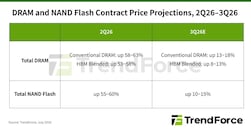 In the PC DRAM market, PC OEMs will continue to support procurement activity through inventory replenishment. However, retail notebook prices are expected to rise across the board as higher-cost components gradually flow through notebook inventories, weighing on full-year shipment volumes.
Memory suppliers will continue to deliver the volumes agreed upon with PC OEMs and module makers for 2026, but ongoing capacity reallocations toward server applications are reducing the supply available for PC DRAM.
For server DRAM, general-purpose servers based on x86 CPUs and RDIMM memory configurations remain the primary memory platform for Agentic AI workloads, thanks to their strong multitasking capabilities.
Server shipments are expected to remain robust through 2027 as CPU availability continues to improve, supporting continued RDIMM consumption and inventory build-up during the second half of 2026. While server DRAM will remain undersupplied in the third quarter, pricing gains are expected to moderate as a portion of procurement is governed by long-term supply agreements (LTAs).
Smartphone vendors are expected to raise retail prices in the third quarter to offset persistently high LPDRAM costs, though these higher prices are likely to weigh on handset sales. Faced with weaker consumer demand, smartphone brands are becoming increasingly conservative in production planning and procurement, which could potentially reduce LPDRAM demand further.
Nevertheless, suppliers continue to prioritize AI-related applications when allocating production capacity, keeping LPDRAM supply tight and supporting further contract price increases.
In the graphics DRAM segment, NVIDIA's RTX PRO 6000 Blackwell has not generated the anticipated wave of GDDR7 demand, while weaker notebook shipments have also reduced demand for GDDR6 and GDDR7. Memory suppliers have also been flexibly reallocating production capacity toward other mainstream products, which has kept graphics DRAM supply constrained and allowed GDDR6/7 prices to rise alongside broader DRAM pricing trends.
Demand for consumer DRAM used in televisions, set-top boxes, and other traditional consumer electronics remains weak. Conversely, niche applications, including automotive, server SSDs, and networking equipment, continue to perform relatively well. In the meantime, the migration of orders triggered by major suppliers' accelerated withdrawal from the consumer DRAM market remains ongoing, preventing any meaningful decline in underlying demand.
Furthermore, contract prices are expected to continue rising due to a combination of disciplined production cuts by leading memory manufacturers and the inability of Taiwanese suppliers' DDR4 capacity expansion to fully offset the reduction in supply.
In the client SSD market, PC OEMs built inventories aggressively during the first half of the year, while end-market demand is now supported primarily by commercial notebook models.
Elevated OEM inventories have significantly reduced buyers' willingness to accept another round of price increases, pushing suppliers to adopt a more flexible pricing strategy for client SSDs to maintain shipment momentum. This has resulted in prolonged negotiations that are expected to moderate contract price increases.
In the enterprise SSD segment, CPU supply shortages have constrained system shipments, prompting buyers to gradually build inventory as suppliers expand enterprise SSD production.
On the supply side, NAND vendors are allocating more capacity to enterprise SSDs, supported by the gradual rollout of NVIDIA's Vera Rubin platform and weaker consumer demand. However, shortages of internally sourced DRAM continue to constrain the supply of small-capacity, high-performance enterprise SSDs, keeping overall prices on an upward trajectory.
Most smartphone brands completed the bulk of their new product manufacturing and component procurement during the first half of 2026. In the second half, only flagship models will continue to generate meaningful demand for UFS 4.0 upgrades, while procurement activity for mid-range and entry-level smartphones remains subdued.
As overall demand weakens, the supply of eMMC and UFS products, which had previously been heavily constrained, has become relatively more abundant in the third quarter. OEMs' reduced willingness to absorb higher costs and softer end-market demand have weakened suppliers' pricing power, leading to more modest increases in eMMC and UFS contract prices.
In the NAND Flash wafer market, demand from retail storage products, including USB flash drives and memory cards, remains sluggish. Module makers are also keeping purchases at low levels as high upstream costs cannot be fully passed through to end markets.
Memory suppliers continue to prioritize capacity allocation toward higher-margin AI and server products, limiting the volume of wafers released to the open market. However, wafer demand has weakened so significantly that contract price increases are expected to moderate substantially in the third quarter.
Source:
TrendForce
Demand for NAND Flash will continue to be driven primarily by AI inference and large-scale data center deployments. Yet, with contract prices already at record highs and consumer demand slowing, price tolerance among consumer customers has reached its limit. As a result, NAND Flash contract prices are projected to increase by 10-15% QoQ—a noticeably slower pace than in previous quarters.

Memory suppliers will continue to deliver the volumes agreed upon with PC OEMs and module makers for 2026, but ongoing capacity reallocations toward server applications are reducing the supply available for PC DRAM.
For server DRAM, general-purpose servers based on x86 CPUs and RDIMM memory configurations remain the primary memory platform for Agentic AI workloads, thanks to their strong multitasking capabilities.
Server shipments are expected to remain robust through 2027 as CPU availability continues to improve, supporting continued RDIMM consumption and inventory build-up during the second half of 2026. While server DRAM will remain undersupplied in the third quarter, pricing gains are expected to moderate as a portion of procurement is governed by long-term supply agreements (LTAs).
Smartphone vendors are expected to raise retail prices in the third quarter to offset persistently high LPDRAM costs, though these higher prices are likely to weigh on handset sales. Faced with weaker consumer demand, smartphone brands are becoming increasingly conservative in production planning and procurement, which could potentially reduce LPDRAM demand further.
Nevertheless, suppliers continue to prioritize AI-related applications when allocating production capacity, keeping LPDRAM supply tight and supporting further contract price increases.
In the graphics DRAM segment, NVIDIA's RTX PRO 6000 Blackwell has not generated the anticipated wave of GDDR7 demand, while weaker notebook shipments have also reduced demand for GDDR6 and GDDR7. Memory suppliers have also been flexibly reallocating production capacity toward other mainstream products, which has kept graphics DRAM supply constrained and allowed GDDR6/7 prices to rise alongside broader DRAM pricing trends.
Demand for consumer DRAM used in televisions, set-top boxes, and other traditional consumer electronics remains weak. Conversely, niche applications, including automotive, server SSDs, and networking equipment, continue to perform relatively well. In the meantime, the migration of orders triggered by major suppliers' accelerated withdrawal from the consumer DRAM market remains ongoing, preventing any meaningful decline in underlying demand.
Furthermore, contract prices are expected to continue rising due to a combination of disciplined production cuts by leading memory manufacturers and the inability of Taiwanese suppliers' DDR4 capacity expansion to fully offset the reduction in supply.
In the client SSD market, PC OEMs built inventories aggressively during the first half of the year, while end-market demand is now supported primarily by commercial notebook models.
Elevated OEM inventories have significantly reduced buyers' willingness to accept another round of price increases, pushing suppliers to adopt a more flexible pricing strategy for client SSDs to maintain shipment momentum. This has resulted in prolonged negotiations that are expected to moderate contract price increases.
In the enterprise SSD segment, CPU supply shortages have constrained system shipments, prompting buyers to gradually build inventory as suppliers expand enterprise SSD production.
On the supply side, NAND vendors are allocating more capacity to enterprise SSDs, supported by the gradual rollout of NVIDIA's Vera Rubin platform and weaker consumer demand. However, shortages of internally sourced DRAM continue to constrain the supply of small-capacity, high-performance enterprise SSDs, keeping overall prices on an upward trajectory.
Most smartphone brands completed the bulk of their new product manufacturing and component procurement during the first half of 2026. In the second half, only flagship models will continue to generate meaningful demand for UFS 4.0 upgrades, while procurement activity for mid-range and entry-level smartphones remains subdued.
As overall demand weakens, the supply of eMMC and UFS products, which had previously been heavily constrained, has become relatively more abundant in the third quarter. OEMs' reduced willingness to absorb higher costs and softer end-market demand have weakened suppliers' pricing power, leading to more modest increases in eMMC and UFS contract prices.
In the NAND Flash wafer market, demand from retail storage products, including USB flash drives and memory cards, remains sluggish. Module makers are also keeping purchases at low levels as high upstream costs cannot be fully passed through to end markets.
Memory suppliers continue to prioritize capacity allocation toward higher-margin AI and server products, limiting the volume of wafers released to the open market. However, wafer demand has weakened so significantly that contract price increases are expected to moderate substantially in the third quarter.
23 Comments on AI Server Demand Continues to Support Memory Prices in 3Q26, but Gains Moderate as Consumer Demand Weakens and High Base Effects Take Hold
Anthropic is raising prices by a lot as both token use for new models is higher and per token cost is increasing and the all you can eat api access severely restricted.
I think the manufacturers that have scaled back production for products that need ram will come out on top as they won't have the suffocating long term contracts
little ray of hope
I remember during cryptomadness we had enthusiasts here who actually defended it, that in the long run it's going to be just a positive thing - that so much money pumped into the sector can only mean more money for development, better products, eventually even lower prices!
And then crypto crashed, and instead of $700 RTX 3080 we got $1200 RTX 4080.
I think that if the AI bubble pops, companies will try as hard as possible to rise the prices instead of lowering them to make up for the loss of a golden goose. They will find an excuse. A retrograde Mercury, or something to do with Uranus.
Ya don't say!
Might be because you're channeling all of your production to high DC projects for AI Integrators, Huang, and leaving nothing outside to your usual (now past-)buyers such as:
- Everyone else that already used CUDA for compute!
Therefore making the sales only grow as those big buildings move along. Which slowed down considerably since March. No wonder your stock is slumping, Huang.I mean, 14.2k a pop when I used to design compute racks with 4 or 6 of cards on this class and that would come at about ~30k, already including chassis, CPU, a buttload or RAM and storage...really makes a dent in anyone's budget.
Special mention for this ****er right here:
"2 units available".
Yes, I'm sure I'll make an investment for a limited approach at something you sell me as a more return the more I buy. Good one!
The rest of the news from TrendForce reads like:
[INDENT]"The industry is really pushing the business plan laid out in contracts over the next two years, signed from Set. '25 to Feb. '26, and are stubbornly holding on to prices while consumption is universally decreasing now that AI applications will invariably be optimized in dimension/scale, application and budgets. General public opinion towards GenAI is negative so commercial usage is expected to wane over the course of the current year, but that cannot motivate DCs to slow down it's build-up. The industry is applying all of the tricks they have to keep prices at a premium as that is the only business model they have that allows to scale-up their business with margins over 60%, for their products. The continuation of this trend will force sales volume down, but some how, MBA analysts thing that unit pricing will some how supplant that. Moore's Law may be dead but if processing power doesn't double every couple of years, and the demand for it exists, there's really no reason to upgrade either. That is somehow lost in every body's consciousness, in this business."[/INDENT]
NVIDIA Grabs 94% AIB GPU Market Share, AMD Falls to 5%
It's not "anti Nvidia" that is just the reality when one company has a near monopoly, any competition will simply follow on pricing.
Also not to mention, Nvidia plays a very significant role in the whole AI push and RAMpocalypse, Jensen is good buddies with Micron and SK Hynix and supplying Nvidia first while the rest of the PC market is facing shortages never seen before.
For the sake of the hobby the bubble needs to pop, otherwise we're going to be left with less DIY suppliers that won't survive without RAM, and will only cause prices to remain higher.
have towill continue this way until20282030" alludes to react to that.Sort of putting a blanket on top to hide that that is happening, so that contracts can be maintained and stocks don't plunge.
The way geopolitics are going patents will only protect you in domestic markets.
which just means that DDR4 supplies will be shrinking, prices will keep jumpingone (or more) of the AI companies needs to die, there is no way around it, and they need to start making a profit
the question is, how many companies will keep spending these crazy prices for "AI services"Oh, they do live, they live in warehouses until they can actually make the data centers
so they just stockpile everything, and that is costing millions to keep them in storage
and I highly doubt corporate will be all that interested giving all their data to any of the big providers.
Let see, is AMD not affected with this DRAM fiasco? Yes, they do so they need to buy GDDR6 RAM. GDDR6 being used on consoles as well. With nvidia wanted to use thei RTX 3060 back it still uses GDDR6 too, not accounting their other lower end card which also uses the same RAM.
How about the die? They made Navi44 from TSMC, which, surprise surprise, current TSMC allocation is 60% goes to nvidia, while AMD only got 11% of allocation.
Still didn't think nvidia don't have any sort of influence on their pricing?
Latest cryptomining insanity started in late 2020 - just as the RTX 30 cards launched, so majority of buyers could never purchase them for their MSRP, and most could only lament why they waited at the launch when prices were just a bit inflated. RTX 3080, a $699 card was selling for over $1500 at some points of cryptoinsanity. The crypto inevitably crashed, as it always does, in April 2022. But unlike the previous crypto crash which flooded the used markets with cheap GTX 1080 Ti and similar cards that miners tried to sell, the used market prices remained relatively high, and stores also kept their prices inflated - during the crypto high Nvidia increased the base MSRPs, and even launched cards that had their base price adjusted for the market of crazy cryptominers that spent much more money that they could ever recover by mining, even if the crash didn't happen for months. For instance they launched RTX 3090 Ti in March 2022 for $2000 - at that point the crypto was already on the way down, but many miners were of course hoping that was just a normal short time fluctuation.
So RTX 40 cards launched months after the crypto crashed - but the market still wasn't exactly normal, RTX 30 cards never returned to their pre-crypto prices, in part fueled by all the demand of corona lockdown demands that was still about in 2022, although also in it's final stages by the end of the year.
The launch of RTX 40 cards with hugely inflated prices in late 2022, early 2023 with prices inflated more than the performance uplift (thus making them basically regressing in price / performance) was defended even by review sites and YouTube reviewers, no doubt by repeating what Nvidia wanted the narrative to be. So instead of pointing out that $1200 RTX 4080 increased more in price than in performance compared to $700 RTX 3080, we were fed that the card is faster than $2000 RTX 3090 Ti, so it's a bargain! And that there's no sense in pointing out the $700 RTX 3080 price, because numerous reasons - it's more expensive now, 2 years later; nobody could buy it at that price; inflation and the death of Moore's Law...