Monday, August 17th 2026

CXMT Breaks 9,000 MT/s Barrier with DDR5
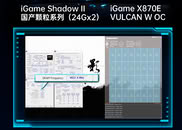
Chinese memory giant CXMT has finally surpassed 9,000 MT/s on the AMD platform, rivaling DRAM kits from Micron, SK hynix, and Samsung. On the Colorful iGame X870E VULCAN W OC motherboard, an iGame Shadow II 24G×2 kit with 48 GB of memory achieved speeds of 9,000 MT/s. In the provided screenshot, the kit runs at 4,507 MHz, which translates to over 9,014 MT/s, thanks to double data rate technology. Late last year, CXMT announced that its DDR5 could reach 8,000 MT/s, but now we see that overclocked memory can exceed these speeds on the AMD platform.
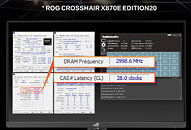
Additionally, CXMT is working on improving latency. Some Colorful iGame Shadow II 24Gx2 48 GB kits are being tested on ASUS motherboards to achieve ultra-low latency, matching the performance of the top three memory manufacturers. On the latest AMD and Intel platforms, Colorful has tested DDR5 kits running at 6,000 MT with CL30 latency and even some preliminary tests with CL28 latency. This is a promising sign that CXMT memory is finally meeting the standards of competing DRAM from the leading memory makers in both transfer rate and latency.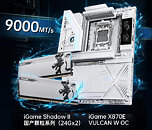
 Earlier reports indicate that CXMT uses a 17 nm node for DDR5 chip production and has achieved a 90% yield for these chips. This is only 2-3% lower than Samsung's yield on its 10 nm class node for DDR5 production, suggesting that CXMT's production quality is approaching that of the world's largest memory maker.
Sources:
Colorful on Weibo, ASUS on Bilibili
Additionally, CXMT is working on improving latency. Some Colorful iGame Shadow II 24Gx2 48 GB kits are being tested on ASUS motherboards to achieve ultra-low latency, matching the performance of the top three memory manufacturers. On the latest AMD and Intel platforms, Colorful has tested DDR5 kits running at 6,000 MT with CL30 latency and even some preliminary tests with CL28 latency. This is a promising sign that CXMT memory is finally meeting the standards of competing DRAM from the leading memory makers in both transfer rate and latency.


60 Comments on CXMT Breaks 9,000 MT/s Barrier with DDR5
Cherry-picking single results as a proof to contradict tons of other evidence does not really make all this evidence false.
asksurf.ai/pulse/en/openai-dram-deals-price-spike-turboquant
Hell, even Altman's own AI knows there was no real payment. The documents signed back in 2025 were not binding.
Those documents were revoked this year. There is no 40% allocation for world's worth memory production for OpenAI anymore.
And factually, never was, since it was never paid. Memory chips prices went up solely due to anticipated demand. No real demand.
This violates market fundamentals (offer vs. demand), as something that does not exist in fact cannot have real value.
No chip maker would accept such deal without prior (at least partial) payment called deposit.
Memory price hikes are directly tied to OpenAI's statement that they want 40% of world's memory chips production. You can absolutely clearly back-trace it to this event.
It was a something like detonator that allowed memory cartel to fuck up the prices. What OpenAI did is called Ghost Demand. This move was deliberate and planned.
There are 3 major memory chips makers that were already found guilty of setting up cartel twice before, so there's no real reason not to think it's a cartel move again.
OpenAI is a company that never ever to this day reported any profits, yet it reported mind blowing sums in revenues.
Who feeds OpenAI with money? Who would like to earn extra money on top of their AI chips saying "sorry, the prices went up ... y'know, the chips crisis" ...
The thing is, AI chip maker will not raise price of it's stuff accordingly to how much memory chips prices went up. They raise it a lot more and use the phrase above to "justify" their doing.
It's called "greedflation":
Greedflation is an economic and political term describing the practice where corporations raise prices higher than necessary to cover rising costs, using general inflation as a cover to expand profit margins.
(You may exchange general inflation for in-fact-not-existing chips crisis, it's still the same thing.)
In other words:
- memory chip makers make insane amounts of money
- AI chip makers/designers makes extra money on top of their products
- AI model owners can sell token time at higher prices
- everyone's happy, except end users
I'm not trying to do conspiracy here, it's just it all started with OpenAI and this very company is absolutely bonkers. This company literally exists to burn money.
What's the point of company, if it can't make money in terms of profits? Who starts a company to make it only suffer from losses for years?
OpenAI is not standard a company, it's a burden, which is intentionally kept being fed in a an AI circle.
As for CXMT, they could ramp up production in year or two and offer sligthly lower prices than the cartel and everyone would want their chips, whether they are Chinese or not.
First, huge geopolitical instabiltiy that threatens economy and pushing big players into different types of protectionism.
Second, fallout of US-Iran war is finally starting to make mark - if you think this is bad, just wait to see food prices within next 12 months - it is going to hurt much more.
Third, US economy is artificially inflated with artificial AI deals - and all that inflation created by this must raise prices.
Fourth, militaries around the world are arming themselves in full speed, and bigger part of that are drones and hi-tech equipment meaning - lot of electronics.
Memory market was always volatile and problematic, and given influence of all factors above - what we see with pricing is perfectly logical.
Issue is that we are running out of time to return things to some "normality", because modern civilization will survive extreme price spikes of electronics, but spikes of food pricing will cause will be far more devastating.
I said the dram cartel wasn't being honest about the supply and demand, not the revenue
I used the openai dram deal as an example to why people are skeptical about that supply and demand
If they were selling a lot more at those massively increased prices, shouldn't their revenue be even higher than the roughly four times increase they have shown?
www.techpowerup.com/351172/sk-hynix-announces-2q26-financial-results
www.techpowerup.com/350262/micron-technology-inc-reports-record-results-for-the-third-quarter-of-fiscal-2026
Of course the fabs are not built overnight, likewise those investments haven't been spent overnight either, they said they are going to be investing that money over X number of years
Micron for example
Micron were also given about $6.2 billion of tax payers money and massive tax creditsThe openai dram deal was covered on WSJ but that's pay walled
thedeepdive.ca/openai-locked-up-40-of-global-ram-with-no-obligation-to-buy-any-of-it/
timesofindia.indiatimes.com/technology/tech-news/popular-twitter-user-explains-how-sam-altmans-openai-may-have-caused-the-worst-consumer-hardware-crisis-with-purchase-orders-that-were-never-real/articleshow/129879770.cms
kotaku.com/ram-ai-stock-prices-bubble-openai-nvidia-chatgpt-2000683539
www.tomshardware.com/tech-industry/artificial-intelligence/openais-massive-stargate-data-center-canceled-as-firm-cant-reach-terms-with-oracle-operator-struggles-with-reliability-issues-meta-said-to-be-interested-in-snatching-excess-capacity
I think it was mentioned in one of the GN videos
The proof is already there, already selling above market price, so...
Servers following JEDEC will benefit here. Not us because I'll take 7200 CL32 over 9000 CL80
You didn't watch that video, you didn't know memory was booked / allocated in advance, not bought.
In your own words, you've provided your opinion but what's the value of that opinion if you actively avoid learning more about the topic?Says every article regarding the topic: medium.com/@mastinbailey/the-letter-that-moved-a-market-95a249dd7b3b
"In October 2025, Sam Altman flew to Seoul and signed letters of intent with Samsung and SK Hynix for 900,000 DRAM wafer starts per month. That volume represented roughly 40 percent of global DRAM output.
The letters were non-binding. There was no legal obligation to purchase a single wafer."
www.remio.ai/post/samsung-sk-hynix-and-micron-reportedly-sell-out-2027-memory-supply
"“Sold out” can describe contracted production, preliminary allocations, or supply unavailable to customers without long-term agreements. It does not necessarily mean every wafer has a final buyer or that shipments cannot change."
The people using the term "Sold out" either a) don't understand how the production of silicon products works or their related contract b) trying to make clickbait headlines c) both.
It's simply not how the industry works. There is inherent and intended flexibility. That's by design as customer often needs changes in the time between the agreement and actual delivery.
In addition, other sources indicate that customers are not getting their fully booked amount:
"Customers are being allocated only 60–70% of the volumes they initially requested."
seekingalpha.com/news/4625688-samsung-sk-hynix-micron-sell-out-2027-memory-chip-supply-report
Aside from them not fully delivering on each customer's requested allocation, they will also reserve a number of wafers as flex capacity. For the DRAM business this is primarily used to cover the spot market.These questions are relevant to the part your quoting. You're answering a question with another question. The part of my comment you quoted is:
"2027 being booked also doesn't answer the question as to why it couldn't have been booked with more DDR5 memory production instead of HBM. "
So again, why couldn't they book more DDR5?So for the 2027 bookings, no it was not. We know that for a fact given those bookings were just recently reported on and DDR5 has had a greater margin for some time now.
You seem to be under the impression that memory production is only booked once and are seemingly pointing to the 2026 bookings (because that's the only time your comment makes sense) as if they are evidence that DDR5 wasn't higher margin during the 2027 bookings.
It's ignorance plain and simple.Early termination clauses are not uncommon for these kind of contracts. Bankrupcty would be covered under failure to pay or price floors.
You are trying to imply that these contract have a great level of uncertainty, which seemingly goes against your prior point that everything in locked in.
You've put yourself into a corner where you've argued that these contract completely prohibit changing course (which is wrong) while also arguing they don't take risks because they have no security (also wrong).
The reality is that these contracts, as they are being signed now, provide a good deal of security to the memory manufacturers. They have all the leverage right now and are extracting higher price floors and other concessions. That said, as with other wafer allocation agreement or silicon production agreements, the actual amount delivered is flexable. That's particularly true in the memory industry, although a bit less so now.
You keep blaming others for misassumptions but that's all you've done so far.
In addition, have you looked at your comment. Mostly 1 line responses. A cursory glance could tell a reader one cannot formulate an argument in a single line.They've switched a considerable amount of production over to HBM, so they intentionally took on the production downtime and AI related risks.
HBM takes 3 times the wafer to produce the same amount of memory as DDR5.You are citing a single down year as a counter to my argument that they are profitable but if you read the article or look at Micron's profits by year, you see that I'm correct.
I don't see why you linked this without a word with it, other than to try and cherrypick.There was no "Stargate" level of investment in stargate lol. You are setting an arbitrary bar based on a level that never came to pass.
Your 2025 figure is BS, you are picking that figure because it meets your narrative (because that would support your point that memory manufacturers couldn't respond to capacity concerns until 2027). Not because it represents the actual inflection point that AI become popular and started attracting large amounts of investment.Yet you fail to provide an explanation and instead continue with 1 line replies. Use your words if you have them.
FYI, including an observation as part of your argument is making an argument with that observation. Should go without saying.
Why do your observations constitution sufficent evidence to dismiss other arguments while other people's observations regarding the memory industry are "irrational" as you put it?
Seems like a double standard.You are making claims. You claimed they were locked in contracts, that they couldn't get production up in a more timely fashion, that production capacity was already booked by the time DDR5 was more profitable,
You claim that you are only saying people cannot state it is collusion as a fact but you specifically only spend your words on reasons why it cannot be collusion. There is no way to interpret your arguments as anything but being against the idea that collusion is occuring. You are not neutral as you imply.
In regards to the rest of your comment, you ask a bunch more questions with many of them going off-topic. I'm not your AI research assistant. You have hands, use them.Agreed. I'd like to add, even if these companies were not in fact colluding the actual impact to regular people and OpenAI competitors is real. It's very very hard to believe that these memory companies and OpenAI didn't know this would be the result when announcing the "sale" of 40% of the world's memory supply but even if they inexplicitly didn't, the impact alone is enough to pursue charges. Ignorance does not absolve one from gross negligence. Personally, I find it impossble that these companies could ignore the impact of selling such a large swath of their production to a single company. It's a lot more risky, unless of course they have a captive market.
What you're doing is dumping stuff on someone without actually highlighting where your arguments lie, it's just bad faith. If at least you'd given a written article, I could have browsed over it and used search to find the interesting parts.
Steve from GN tends to talk way too much for the amount of information that he has to offer. More viewing time earns the content creator more, that's why we get so many 30-minute videos that could be summed up in 2 minutes.Thanks for making my case. You can't expect the big 3 to rush to build new fabs to cover the new market demand if all they have are non-binding agreements. They still moved to honor them, but they couldn't commit to the extent of building new fabs until they had better visibility on the market for the next few years.So according to that, you're implying that they can produce more DDR5, right? And you claim that it's more profitable too, right? So, explain the logic of why they are not producing more of it. You claim that there is collusion, what are they colluding on, what did they agree among themselves?I'm also asking that question, to you. Explain how the collusion that you claim works to prevent production of DDR5.I never claimed that DDR5 was not higher margin. I dare you to quote where that happened.
It's illiteracy plain and simple.First of all, I'm not arguing that it's the truth, I'm presenting a hypothesis, not a claim.
The hypothesis is that the contract was binding for the seller, preventing them from changing course, but with opt-out clauses for the buyer (+ possibility of bankruptcy), putting a level of risk for the seller. As long as that hypothesis is possible, it's sufficient (but not necessary) to prevent concluding that the big 3 are colluding against the market.A cursory glance has no value, and "one cannot formulate an argument in a single line" is a ridiculous (I'm being generous) statement.So, where does the collusion fit in that picture? What did the big 3 agree among themselves in the shadows that skews the market even more to their advantage than if they had not colluded?
That's the crux of the question, the whole debate is about your claim of collusion.All it takes is one year to make them learn the lesson. I don't know exactly how that oversupply shock was written off. Maybe most of it was in 2023, and the overproduction of consumer DRAM continued to inundate the market over 2024 till mid 2025. I remember buying 64 and 96GB RDIMMs of DDR5 in early 2024 (Threadripper systems) at very low prices compared to today. By late 2024, those prices had already started to increase substantially, but not on regular UDIMMs. So it's likely that the server market absorbed the RDIMM overproduction much faster and allowed the big 3 to turn a profit in 2024.
Anyway, I didn't make up that claim, I learned it from reputable source. It was not the main topic of the article or video so I can't find it, but the losses that Micron faced in 2023 align very clearly with that, and it's briefly mentioned in the Wikipedia article about the shortage (first sentence in "Background").I quoted you saying "they were still making a profit". The title of the article says "The Last Memory Boom Ended With Micron Losing $5.8 Billion in a Single Year"
What did you want me to add to that? Should I have repeated the title, or did you want me to phrase explicitly that you're wrong?Well, since you say that I'm wrong, obviously that means that I'm wrong. Anything that meets my narrative is just cherry-picking, unlike what you pick.I think you just don't understand how debates work. You think that I have something to prove. No, I don't. You have to something to prove, because you're the one making the claim that there was collusion, and you claimed it very categorically, as a fact.
When someone makes a claim, all the other side has to do is put forward hypotheses that could bring doubt to the claim. They don't even need to be proven, the doubt is enough to turn the claim from solid conclusion to simple conjecture. Now if you're able to fend off all the counter-hypotheses, then your claim becomes strong. But despite what you are likely to think (judging by your tone), you have not achieved that.If person A makes a claim and gives invalid arguments for it, person B saying "your arguments don't prove your claim" is not an argument.
We both agree on that, because you said it yourself: "simply saying someone's argument holds no merit doesn't constitute an argument"
So what it is instead, is an observation, or maybe a judgement. Call it what you will.They don't. They come as conclusion after I've emitted my counter-arguments and hypotheses.Because they're not observations, they're conjecture without proof.I don't pretend to be neutral, I definitely am not. I have a clear position, and that position is that what you claim as fact, is just conjecture at this point (i.e. you have no proof).
Maybe I did not formulate everything properly, but what you paint as claims are mostly hypotheses, that the burden is on you to disprove because they put doubt on your claim. I've explained it earlier.I do ask questions that challenge the claim. That is part of debating whether you like it or not.Are you admitting that it's possible that they're not?This video shows that you don't even know what you're talking about:
And I won't just throw 80 minutes of video at you like you did. Just watch a couple of minutes at 12:47 the section Boom and Bust, they talk about 5-year contracts, and long term agreements with 10 major actors. The video also covers the investments that SK Hynix started making in 2023 to increase production in light of the AI boom.
Good luck making that video fit with your narrative of collusion.