Monday, August 17th 2026

CXMT Breaks 9,000 MT/s Barrier with DDR5
Chinese memory giant CXMT has finally surpassed 9,000 MT/s on the AMD platform, rivaling DRAM kits from Micron, SK hynix, and Samsung. On the Colorful iGame X870E VULCAN W OC motherboard, an iGame Shadow II 24G×2 kit with 48 GB of memory achieved speeds of 9,000 MT/s. In the provided screenshot, the kit runs at 4,507 MHz, which translates to over 9,014 MT/s, thanks to double data rate technology. Late last year, CXMT announced that its DDR5 could reach 8,000 MT/s, but now we see that overclocked memory can exceed these speeds on the AMD platform.
Additionally, CXMT is working on improving latency. Some Colorful iGame Shadow II 24Gx2 48 GB kits are being tested on ASUS motherboards to achieve ultra-low latency, matching the performance of the top three memory manufacturers. On the latest AMD and Intel platforms, Colorful has tested DDR5 kits running at 6,000 MT with CL30 latency and even some preliminary tests with CL28 latency. This is a promising sign that CXMT memory is finally meeting the standards of competing DRAM from the leading memory makers in both transfer rate and latency.

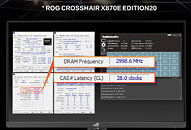 Earlier reports indicate that CXMT uses a 17 nm node for DDR5 chip production and has achieved a 90% yield for these chips. This is only 2-3% lower than Samsung's yield on its 10 nm class node for DDR5 production, suggesting that CXMT's production quality is approaching that of the world's largest memory maker.
Sources:
Colorful on Weibo, ASUS on Bilibili
Additionally, CXMT is working on improving latency. Some Colorful iGame Shadow II 24Gx2 48 GB kits are being tested on ASUS motherboards to achieve ultra-low latency, matching the performance of the top three memory manufacturers. On the latest AMD and Intel platforms, Colorful has tested DDR5 kits running at 6,000 MT with CL30 latency and even some preliminary tests with CL28 latency. This is a promising sign that CXMT memory is finally meeting the standards of competing DRAM from the leading memory makers in both transfer rate and latency.


60 Comments on CXMT Breaks 9,000 MT/s Barrier with DDR5
The people getting squeezed in that scenario might be those forced to sign the contracts, because if they don't they won't be able to operate as a business right now with memory demand as it is. The big 3 are using their current leverage to lock in long term profits.You mean colluding again. It's not the first time.
Micron is already on record that DDR5 is more profitable than HBM and couldn't give a reasonable response when asked why they aren't pursing that instead of HBM that eats up 3x the wafers.
That was before the recent price increases to boot. Nevermind the price increases they are projecting. Competing companies don't just leave money on the table like that. DDR5 pricces should have stabilizid before the recent 20% hike because that's when it was more profitable than HBM. In a normal functioning market, supply and demand would dictate that memory manufacturers would serve whichever market makes them the most money. Right now, that's consumer DDR5. That prices are still increasing further past the profitability of HBM indicates market manipulation by the big 3.
You have three "competitors" that had years to increase production and they didn't. They still aren't increasing production to meet demand, merely going ahead with production planned years ago.
Instead of talking about how they will ramp up production to meet demand and capture marketshare, they instead insist demand will exceed supply until 2028. No mention of ramping production to meet demand.
They are all signing identical contracts with their suppliers forcing sky high floors to lock in their profits.
This isn't an "if" they are colluding, they are colluding.Which is not an argument against it happening again, especially seeing as the individuals involved in the prior collusion were promoted up in their company.
As evidenced above, it very clearly isn't obeying supply and demand. Please explain how companies ignoring the now more profitable DDR5 is regular "supply and demand".
Also I doubt really anyone cares about overclocking RAM at this point, we just want reasonably priced memory.
Also, you're actually arguing against your own position. The whole point of anti-competitive collusion is to make more profits. Why would they not collude to make DDR5 instead of HBM, if was already more profitable than HBM before the even higher prices?They do if their capacity is locked down in existing contracts, and they don't have additional capacity to satisfy the market at spot pricing.Memory prices have had cycles of ups and downs, and the big three have been made wary to react to upward market trends too fast. Before this crisis, they had an overproduction of wafers, and had to sell off their production at cheap prices, as you could witness between 2023 and 2025. They were not happy about that situation.
So it's quite understandable that when there is this sudden surge in demand because of a new technological disruption, they're not going to overnight write checks of tens of billions of dollars to build new fabs if there's any sort of risk that it will collapse before the fabs are up. They've got this huge windfall, they don't need to rush, they can let it simmer a bit, see if that demand holds, wait to gain enough confidence in it to invest into more fabs. And the effects would make people start being suspicious of collusion.Now they're starting have that confidence:
news.skhynix.com/en/fab-facility-investment-2026/
Still, even if they had immediately written the checks in march 2025 when the gigantic OpenAI contracts came, it takes 2 years to build a fab. Collusion or not, this crisis was going to happen until at least mid-2027.You're still jumping to conclusions. You have no proof, and your arguments don't hold. I'm not saying that it's impossible, but they've been caught before, so they know that they're unlikely to just get away with it, and if they repeat the offense, boy is it going to be an expensive fine. Maybe they're still doing it, but you just can't know that for sure. If you think you do, that's faith, like believing in God, it's not based on rational thinking.It would be too obvious after they've been previously caught. How would they expect to get away with it? The fines have no limit for that, they are scaled to the estimated benefits of the collusion.I explained it. Production allocated to contracts.One occurrence does not make a pattern. It is at best cynicism if you *conclude* that there is collusion despite having no proof. You could suspect, and not be surprised if such a collusion were put to light, that would be fair. But stating it as a matter of fact is not being rational when there are other cheaper explanations (lack of production capacity to face the sudden surge in demand).
Maybe, maybe not. The initial 2025 contracts/bookings certainly not, though surely higher than what the consumer market level was (otherwise Scammy wouldn't have secured it).
So the latest contracts surely have the RAM priced higher than initially. How much I have no idea.Because they're not truly competition (not right now), they're not taking anything away from the big 3, they're providing extra capacity which the big 3 currently don't have. And that's because they've opted not to have it.
Open your eyes, it helps.
A 2018 class-action lawsuit alleged that the "Big Three" DRAM manufacturers colluded to artificially inflate memory prices between 2016 and 2018.
Dynamic Random Access Memory (DRAM) Indirect Purchaser Antitrust Litigation, filed on April 27, 2018
Case Number: 4:18-cv-02518 (N.D. Cal.)
The suit claimed the trio, which controlled 96% of the market, coordinated production cuts to stop downward price pressure, causing DRAM prices to nearly triple during that period
It was dismissed by a U.S. District Court in 2020 . In 2022 was closed in the favor of the Big 3 as plaintiffs didn't bring enough evidence.
So the last alleged colluding was not a quarter century ago. The "lack of evidence" against them doesn't surprise me, the Big 3 got craftier.
History repeats itself.
2005
2016-2018
2025.......
3 times already, same accusations, let that sink in...
Than we have the DDR5 profit resulting from "scarcity", even when HBM was already shown less profit for the big 3
Samsung conference call Q1 2026 reports higher margins for consumer DDR compared to HBM followed by Micron Financial Call Q2 2026 statement with same conclusion as Samsun and than Sk Hynix written statement.
CXMT will just help a bit in to supply in a world of "scarcity" as other mentioned in this thread.
In no way are we discussing the stock market valuations of the memory cartel. We are talking about the realities of supply and demand. I get you have a hate boner for AI, but please try to address the arguments instead of tilting at windmills.Factually FALSE
www.backblaze.com/blog/hard-drive-cost-per-gigabyte/
Here, I circled the HDD flood era so you can follow along:
Keep in mind, towards the end of that graph, the last few years were AFTER the money printers got switched on, yet HDD prices continued to FALL.
So....what was that about HDDs never returning to previous levels? Because even if you try to pull the "well well well we're talking about the specific drives, not bigger ones", the 4TB drives from the flood era would crash down to 1/3rd their selling price by 2016, and the 3TB models were 33% cheaper then flood price by 2014.Also factually incorrect. The R9 290x launched for a price of $550 in 2013.
www.techpowerup.com/review/amd-r9-290x/
It then peaked at over $900 during the crypto boom in february of 2014
www.overclock.net/threads/anandtech-radeon-r9-290x-retail-prices-hit-900.1467088/
Then it crashed, with AMD cutting official MSRP in October, and prices hitting $350 a week later
www.techpowerup.com/206106/amd-cuts-prices-of-r9-290-series-and-r9-280-series-even-further
www.pcgamer.com/amd-r9-290x-prices-dip-below-350-in-reaction-to-the-nvidia-gtx-970/
The generations after this gave us the 980ti, one of the best high end tinkerer GPUS we'd had in years, and the GOAT, the 1080ti, which was an absolute steal, as was most of the Pascal generation.
Now, before you go whining about how you're talking about the current generations, the 7800xt launched during the 2022/2023 crypto turndown, at a pricetag of $500, offering 3% more performance then the $650 6800xt. That was after a three year period where 6800xts were commonly selling, when you could find them, for well over a grand. The 7900 GRE came out about 5 months later with a MSRP of $550, and was 12% faster then the 6800xt. Huh, thats weird, what was that about GPU prices never coming down?
Things are less rosy on Team Green, but even with all the controversy, the 4070 was 20% faster and 20% more expensive as the 3070. So...the same perf/$ for both generations, despite all the crying about crypto prices. The 4060ti was neck and neck with the 3070, for $100 less then the 3070 MSRP.
So....again, what was that about GPUs never coming down in price? Because it sure looks like, for the same or better performance, prices either went the same or went DOWN after the crypto bubble.
Now, in our previous arguments, you have also stated that inflation doesnt matter (lol it does), but as you can see, WITHOUT counting inflation, your arguments are factually incorrect. Prices DID come back down, lower then the pre crash for the same or even better performance. Once you do count inflation, which even conservatively by government numbers was over 20% between the launch of the 6800 and 7800xt, the 7800xt comes out looking REALLY cheap. Factor in real world inflation being closer to 50-75% over that same time, the ever rising costs of node production and electronics, both of which outpaced inflation, plus nvidia switching from the much cheaper Samsung 8nm to TSMC 4N for the RTX 4000s, and any foundation your argument had gets demolished. Every time you make these ridiculous claims, you are fighting a war with reality, and you are LOSING.
Of course I dont know why I even bother explaining all of this, you're just going to ignore it, probably cry about nvidia for some reason, then refute anything to do with inflation or pricing data because it doesnt support your opinion.So...you just contradicted yourself. These companies won't slow down their demand, but that demand is unsustainable? So...which is it? What happens when you reach that unsustainable point? Could it be that demand....will go DOWN, and AI companies will slow down investment?This has already been addressed, there is more to the world then the USA and your gaming PC. The largest electronics market on the planet is China, not the US, so CXMT working there alone would cut out the single largest consumer demand for the big 3. They are ALSO one of the largest corporate markets for RAM like HBM too.
If you dont think that would affect supply for the rest of us, I dont know what to tell you, other than take economics 101 again and learn how supply chains and markets work. This isnt a very hard concept to grasp.Well, take one look at the memory maker's revenue statements and tell me, do you think they are paying a fraction of what we are paying, or do you think they are paying the gouge prices?
The obvious answer, BTW, is that they are paying the gouging prices. It takes maybe 0.5 seconds to make that connection. You do not get 1-200% revenue surges without the AI companies paying price gouging.Why do people keep repeating this misinformation? Do they think if they repeat the magical incantations enough times, memory prices will return to 2024 levels?
SK hynix invests $14.6 billion into new memory facility in 2024:
www.yolegroup.com/industry-news/sk-hynix-to-invest-14-6-bn-to-build-hbm-plant-in-s-korea/
SK hynix invests $3.87 billion into new memory packaging facility in indiana, again 2024:
news.skhynix.com/en/sk-hynix-signs-investment-agreement-of-advanced-chip-packaging-with-indiana/
Micron invests $2.17 billion to expand production of DRAM in virginia, december 2024:
www.tomshardware.com/pc-components/dram/micron-to-invest-usd2-17-billion-to-expand-u-s-based-memory-production
SK hynix invests over $500 billion into four new fabs december 2025:
www.pcgamer.com/hardware/memory/hot-on-the-heels-of-micron-bailing-out-of-the-consumer-ram-market-sk-hynix-is-apparently-committing-over-usd500-billion-to-build-four-new-memory-fabs-with-the-first-to-be-finished-by-2027/
Crucial spending $200 billion on 2 new facilities in Boise, feb 2026
www.wsj.com/tech/micron-is-spending-200-billion-to-break-the-ai-memory-bottleneck-a4cc74a1
Micron begins production at new fab in Virginia, may 2026:
www.micron.com/us-expansion/va
Samsung building new fab in Giheung, 2026:
finance.biggo.com/news/9eab76d3-16ce-4049-8ec8-92be7f0506c1
and I could keep going. Why pretend like the industry is doing nothing? Total investment is going to exceed $150 billion this year, and it takes YEARS to build new fabs. What, exactly, do you want them to do? Even CXMT laid the groundwork for their facilities years ago. You cant just snap your fingers and make a fab appear.
And paying 20% more for 20% more performance is how the GPU market has effectively stagnated in gen over gen improvements, tech should become cheaper as it progresses not paying more for faster hardware.The demand is unsustainable, but companies like Nvidia will just throw more money at more companies to keep the circular investment going, even going so far as to invest $500 billion in Wall Street.
nvidianews.nvidia.com/news/nvidia-partners-with-apollo-blackrock-blackstone-brookfield-goldman-sachs-and-kkr-to-establish-ai-compute-infrastructure-financing-platforms-to-mobilize-over-500-billion-of-third-party-capitalThe USA is a massive market for PC's, CXMT not being able to compete in the US means they won't be any true competition against the big 3.
And this isn't just about gaming PC's, without memory and the big 3 allowed to manipulate the market, it'll be the end of owning computers as we know it, if you enjoy AAA games you'll be renting a gaming PC in the cloud.Because the industry waited too long to do anything, and there isn't anything to suggest further expansion will be used to produce consumer market DRAM, because datacenters and people like Scam Altman can just send a letter of intent saying they'll maybe buy up a massive amount of the memory supply.It isn't just one occurrence, the big 3 have colluded and price fixed several times before, the most recent one being in 2018, there is plenty of evidence of them doing so again.
All 3 companies did the same thing at the same time, as already mentioned they switched to HBM despite admitting DRAM was more profitable, while not expanding capacity to meet the demand, also locking in long term pricing contracts to keep pricing high end if there is expansion or a bubble pop companies agreeing to these contracts will still have to pay high costs.
They are not behaving as competition to the dram cartelWhere did I say their revenue was fake?
SK Hynix's revenue for 2026 Q2 was about 3.6 times of that from 2025 Q2, gross profit about 5.5 times and operating profit about 6.6 times
Their prices increased by several times so did they really sell a lot more or a similar amount but at several times the original price?
The dram cartel members are all saying dram shortages till at least 2028, they are not even trying to compete with each other, same excuses for not replacing ram and ssds under warranty, coincidence or collusion?
2027 being booked also doesn't answer the question as to why it couldn't have been booked with more DDR5 memory production instead of HBM. You seem to be trying to throw your hands up and imply there's nothing that can be done but you gloss over the fact that DDR5 production should have had a mouth at the table when these companies were booking for 2027 production.
You'd have to argue that HBM is more profitable on a per unit basis but that's not the case. DDR5 is larger margin.
So what excuse does that leave? Why wasn't more DDR5 considered given the margin is higher on it?You are arguing that:
They are locked into contracts and thus can't change course
They can't take risks because the demand might disappear overnight.
Well, which is it? Eventhing cannot be locked in as you suggest while simulataniously claiming they didn't take capacity risks due to a lack of certainly. If it's locked in, they inherently have some level of certainty. Particularly when they have all the leverage and heavily dictate the terms.
Nevermind that
1. Micron, Samssung, and SK Hynix are taking stakes in some of the datacenter buildouts, which increases their exposure to AI related risk.
2. Focusing on AI memory production increasing their exposure to AI related risk as well.
Your argument cannot be that these companies are being risk adverse only in terms of production capacity when their investments elsewhere signal otherwise. If they wanted to reduce their exposure to the AI market, they could just put more wafers into consumer DDR5.Recent, as in early August. You seem to be under the impression that prices have only increased once when in reality it's come in waves.If they all were to direct more wafers to consumer DDR5, the prices would go down. That market isn't like the AI market where demand is nearly infinite.
In a scenario where all market participants coordinate, it's more profitable (in terms of total earnings) to puresue AI HBM demand over DDR5 because it's far higher quantity, AI companies just keep buying. It allows memory manufacturers to exploit the limited time nature of the AI bubble while keeping in reserve pent up consumer demand.
Nevermind that they likely factor in that consumer demand will still be there should the AI bubble burst and that a good amount of DDR5 sales are captive. That is to say a certain percentage of organizations and individuals must purchase memory or systems containing memory products. Schools, hospitals, companies, anyone wanting a new phone, people who's memory failed, the list goes on forever. Due to the limited supply, that means they are fetching higher prices for sales that are virtually guaranteed.
Now if market participants were actually competing, a single competitor selling the higher profitability (on a product margin basis) consumer DDR5 would in fact be more profitable overall than simply selling HBM. You don't run into over-supply issues if just one of the big 3 supply the market.Memory contracts do not last multiple years, they average per month to quarterly, leaning towards monthly in the current environment. That's if you are lucky enough to get a contract, most do not in the current enviroment (not even Valve has one, they have to pay spot).They were still making a profit. What you're pointing out here is that they disliked having to sell at reasonable price.
The other times memory companies have taken a hit profitability wise was when Samsung was rubbing out competing memory companies, because it had the size to sell at a loss for a longer period than the others. That wasn't an indication that the industry can't be profitable and thus deserve to bilk customers, it was entirely voluntary and ended up bilking customers anyways.
The memory market absolutely has it's boom and bust cycles but that does not excuse collusion and other such nonense.That's not when AI first started to boom. Not even close.
ChatGPT was released Nov, 2022, which was when demand for AI services was sent spiking.
Yeah it takes 2-3 years to build a fab, which they had. That's just the broad popularity phase, AI has had feasible usefulness since Nvidai's 2000 series.
Even if you give them the most generous timeline, they still failed to do anything to increase capacity beyond what they already had planned.Just in case you are aware, simply saying someone's argument holds no merit doesn't constitute an argument.
I'd like to ask, what exactly is your supporting evidence thus far? Something has happened before and they've been caught, surely it cannot happen again? That's it? Thus far you've provided incorrect points, particularly around contracts that we know as fact from statements from industry sources (check the video).
You pander on about rational thinking but it's irrational to expect companies that were rewarded for illegal behiavor to not consider performing that illegal behiavor again. We've seen it countless times with big businesses. Getting caught is merely a cost of doing business.
You have no grounds to try and dismiss other's comments. GN has 3 videos on the topic, all using publically available documents:
Well
1) they do, either fixed or percentage based depending on the country
2) The fines last time were paltry compared to the gains.
3) The largest corporate fine was $65 billion USD. Samsung alone makes 62.9 billion in profits per quarter. There is no evidence that we will see fines sufficent to discourge this behavior.You assumed, as if memory contracts are multi-year in the current environment.
Also, no. Read the graph again. The 4TB drives fell from $0.75/GB to $0.40/GB, a 40% drop, by 2014, not 2016.So rather predictably, you ignore the two generations that followed the first crypto boom, and cherry picked the most expensive halo available, because those numbers dont support your argument.
And tech did get cheaper. I game multiple examples of GPUs that were lower priced while offering the same or better performance than the previous generation. IDK why you ignore this, probably because it destroys your argument as I stated before.You are once again arguing that the market is simultaneously unsustainable, yet it will continue indefinitely.China is a larger market then the US. Look outside your zip code instead of doomposting.
CXMT taking the Chinese market would create a significant reduction in demand for the big 3. This was the conversation being had when you jumped in, the US is a big market, but it is not dominant anymore, and the combined CXMT friendly markets are likely much larger then the total CXMT hostile market, that is the USA. A US ban is irrelevant, the big 3 are going to be receiving extreme pressure by the Chinese globally, and that is going to have a significant domino effect on prices globally.DRAM lines were retooled for HBM, so the reverse is also possible. CXMT is rapidly expanding DDR production.So what exactly is your solution here? I hear a lot of crying and whining about how memory companies are making money, but not a whole lot of actionable solutions as to how they could navigate the current crisis while maintaining prices, outside of vague suggestions that they should have predicted the future and massively overbuilt capacity back in 2021.
The price increase was entirely speculative, based on predicted future RAM supply.
OpenAI has since massively cut their stargate spending projections and yet memory pricing has only gone up.
It seems rather advantageous for OpenAI and memory manufacturers that everyone has to pay higher prices for demand that never materialized. It hurts OpenAI's competitors and fattens the DRAM cartel's pockets.
2. How long does it take, and how expensive is it, to pivot production from HBM to DDR5?They're only exposed to the AI market by producing more HBM instead of DDR5 if switching from one to the other takes several months and would leave them with tons of unsold HBM production. Do you think that that's the case?Most of the increase happened prior to March 2026. If you think that there were other significant increases after March when DDR5 was already being reported as more profitable, then why would they not produce more DDR5 until price came back down to just above that of HBM? Are they colluding to make less money?Oh so now you're invoking market mechanics. Suddenly the market is what is driving what's happening, not some collusion.Why would suppliers have to coordinate for that to happen?Even if one of them has better yields on DDR5, that does not mean that DDR5 would not still be more profitable to the other 2 than HBM.
And yet those other 2 would just let that one get the higher margins on DDR5 all to themselves, and remain happy with their lower-margin HBM?
Now that sounds like collusion happening: "you sell DDR5, we sell HBM". Because if they were competing freely, they would all pivot to DDR5.Is there a law that forbids them to be longer than monthly or quarterly? If not, then how do you know that there were no such contracts between the big AI players and the memory suppliers?finance.yahoo.com/markets/stocks/articles/last-memory-boom-ended-micron-200400562.htmlI don't know what you're talking about. When was that?Who is that statement for? Nobody said that it would excuse it.There was no "Stargate" level of investment in November 2022. Companies didn't decide overnight to massively rely on AI. Adoption has been somewhat gradual, especially since the early models weren't as convincing as those of today. They didn't even have thinking back then.
2025 was a pivotal year in investments, it suddenly boomed by a previously unseen magnitude.Once again, that can easily be explained by market mechanics and sound strategic decisions.It's not an argument, it's an observation. I'm rejecting your conclusion because the way you arrived at it does not hold water.In what world is the burden of proof on me? I'm not the one making claims about whether or not there is collusion. You're the one making the claim that there is collusion. I'm not even saying that there isn't, I'm simply saying that you can't state that as a fact, you're completely speculating.So why were prices so low from 2023 to mid-2025? Why did Micron have losses in 2023?Thanks for the link but I'm not going to watch 100 minutes of video hoping to find proof that you were right. The description just says that Steve "noticed a lot of parallels between the current AI demand (or "demand") for memory and the DRAM Cartel eras of the industry". I hope that he proves why it cannot be normal market behavior, otherwise it's just more speculation.I should have been more specific. Percentage is what I mean by no limit. However much the benefits from the unlawful action were, the fine will scale with them, it won't be capped by an absolute amount.What was the revenue of the company that got fined $65bn USD, prior to that fine? Then apply the ratio fine/revenue to Samsung, would they break that record if they got fined at the same ratio?And you're not assuming? So you know for fact that they are not multi-year or even just year-long. Care to share where you get that from?
If they are not, and DDR5 is more profitable than HBM, then why would they not make DDR5? How would colluding to make less profitable products make sense?
Anyway, were they even selling DDR5 two years ago? They're rapidly improving their products and ramping up production capacity. They actually punish corporate corruption in China, so maybe, at least the world outside the US, will have another manufacturer to choose from. The other three deserve to get taken down many pegs.
If their are not driven by profit, than what kind of the market is?
"You cant just snap your fingers and make a fab appear."
Nobody expect that but than, you balance your production such way that you profit MORE not less, again yields for DDR5 are more profitable.
CXMT had a huge investment in researching and producing EUV, they can't print only DDR alone, "to save the world" are other chips they have to supply, as their economy(CCP) dictates.Yes, Epstein like islands are expensive and also lobbying is even more expensive. To feed AI with HBM, you need to give AI builders free hand in everything. You need to have regulations in place(that comes with costs) that let AI data centers to consume huge amounts water and electricity and pollute as much as they can.