News Posts matching #limit

Return to Keyword Browsing

Microsoft Developer Builds a GPU Task Manager to Show Which Apps Are Eating Your VRAM

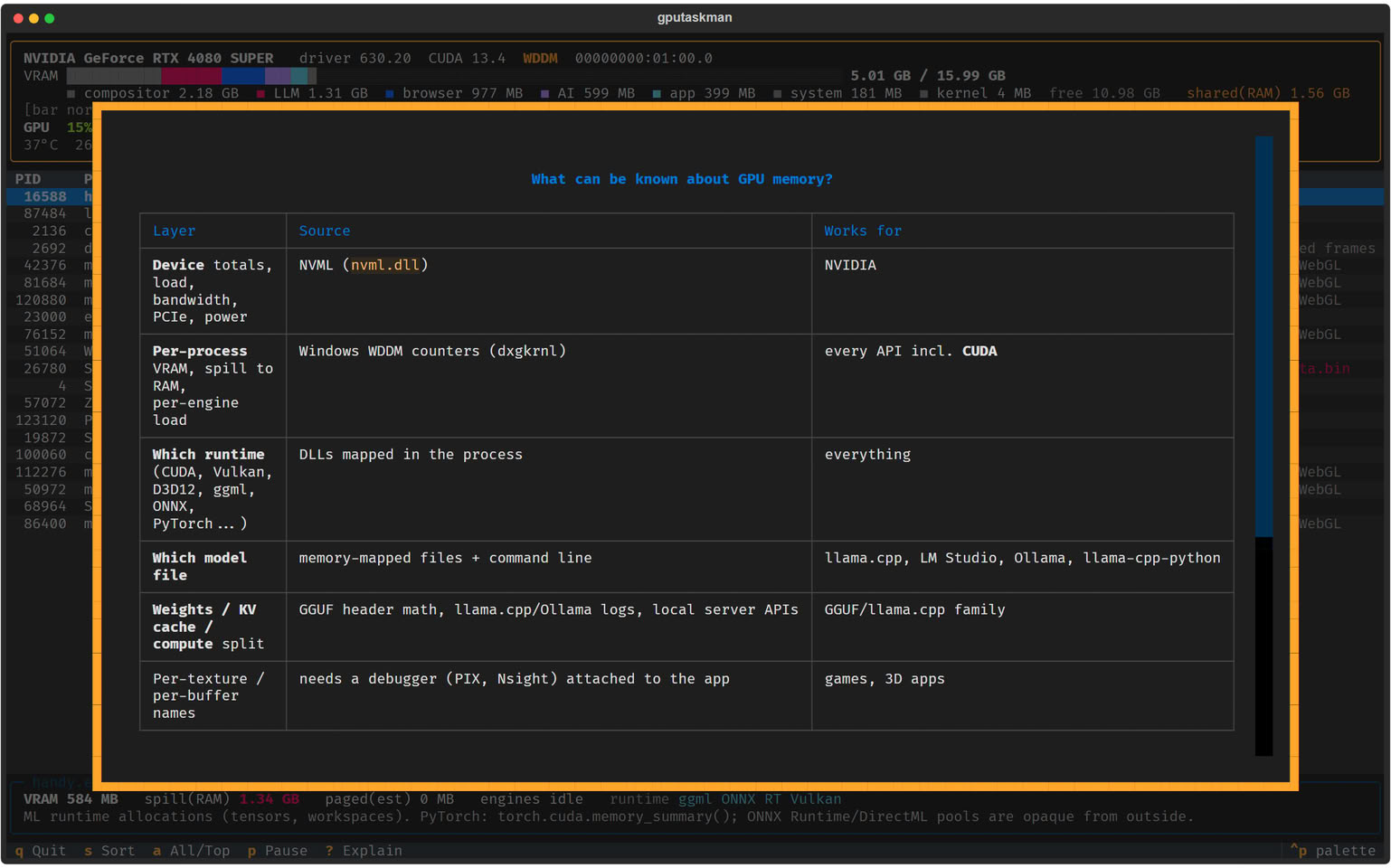
Anyone wondering what is filling up their GPU's VRAM can now try gputaskman, a free, open-source tool from Microsoft VP Scott Hanselman. It runs in a terminal window with an htop-style layout and lists every process using the GPU with its memory footprint, engine activity, and loaded runtime, such as CUDA or Vulkan. A panel up top tracks utilization, clocks, temperature, and power. Hanselman shared the project on X last week and asked for pull requests.

Task Manager has shown GPU usage since 2017, and it will happily tell you that 15 GB of video memory is in use. It just won't say what is using it. gputaskman goes after that gap with a heavy focus on local AI. Its model inspector can identify the LLM a process has loaded and report its quantization, weights, and estimated KV cache cost, while Ollama and LM Studio users also get context size and proper model names. Hanselman calls it early, experimental software, and the AI breakdowns are estimates for now.
Microsoft Patent Describes Paying PC Owners to Train AI on Idle GPUs

Gaming PCs sitting idle could one day earn their owners credits, or even cash, by training AI models, at least if a newly published Microsoft patent application ever becomes a product. Titled "Opportunistic Micro-training on Edge Devices Using Spare GPU Utilization," the filing US-20260349820-A1 from Microsoft Technology Licensing was submitted in April 2025 and made public on November 5. It describes chopping large training jobs into small micro-tasks sized to what each device can handle, then sending them to phones, laptops, and gaming PCs whenever they have spare capacity. Owners would have to explicitly opt in, after which the system could track the work done and apply credits to their account, redeemable for free software, access to the trained model, or money.

To stay out of the way, the system watches GPU and CPU load, memory use, temperature and power draw, and checks less often when the GPU is busy or hot. Apparently, tasks can be paused or stopped when limits are crossed, and results get cross-checked across devices to catch faulty or tampered work. The filing doesn't give a payout rate or list supported hardware, and Microsoft hasn't announced a Windows or Xbox service, so it's impossible to say whether the rewards would cover the extra electricity. Of course, this is only an application for now, and plenty of those never turn into products.

Intel Nova Lake-S CPUs Reportedly Drop to 5.1 GHz Max Above 90°C

Intel's upcoming Core Ultra 4000 "Nova Lake-S" desktop processors will reportedly cap their maximum core frequency at 5.1 GHz whenever they run above 90°C, according to Intel leaker Jaykihn on X. He says the limit applies to the entire Nova Lake-S desktop lineup, works separately from regular TjMax throttling at 100°C, and can't be raised. He also notes that the information is still preliminary. In practice, it looks like a safety net that sits between normal boost behavior and full thermal throttling. Below 90°C, the chips should presumably boost as usual, and models that don't exceed 5.1 GHz in the first place wouldn't be affected at all.

Final Nova Lake clocks aren't official yet, though the current Core Ultra 9 285K already boosts up to 5.7 GHz, so a high-end Nova Lake chip that runs hot could lose a sizable chunk of its peak frequency. A 100°C TjMax would also be lower than Arrow Lake's 105°C, which can be manually raised to 115°C on the 285K. That puts more weight on cooling, since the 28-core Core Ultra 9 4970K BFC was reportedly set to pull up to 296 W at PL2 despite its 125 W rating, and staying under 90°C at that kind of power draw will probably take a really capable cooler. Nova Lake-S is currently expected to arrive in Q1 2027, and Intel hasn't confirmed any of this yet.

Resizable BAR Comes to Haswell Motherboards Thanks to a Community UEFI Driver

Haswell owners finally have a way to get Resizable BAR running on Intel 8-series motherboards. As spotted by Haze on X, a developer going by roschank has released reBART, an open-source UEFI driver for Z87, H87, Q87, B85, Q85, and H81 boards. Back in 2020, it was reported that Intel CPUs since Haswell support Resizable BAR, pending firmware updates from motherboard makers that never came for 8-series. The developer went digging after failing to get Above 4G Decoding working on their own B85 board, and found that Intel's 8-series platform code skips mapping memory above 4 GB altogether, something both 7-series and 9-series firmware handle. Apparently, every board maker they checked inherited the same gap, so the 4G toggle some of these BIOSes expose likely does nothing.

reBART lets the board boot normally and only kicks in right before the OS loads. At that point, it shifts the GPU's memory window up past the 4 GB line and points the boot display at the new location too. Unlike ReBarUEFI, it doesn't need module patching, though a DSDT patch is still required. Newer builds added experimental support for Intel Arc cards and multi-GPU setups, which is important since Intel once told Arc buyers without ReBAR to stick with other vendors. One user reports an Arc A750 and an Arc B580 both working with an unlimited BAR size on a Gigabyte GA-Z87M-D3H under Ubuntu. Of course, going this route means flashing a modified BIOS, and at least one ASUS Z87-Plus owner couldn't get the board to boot after the DSDT patch. The developer hasn't shared any performance numbers yet either.

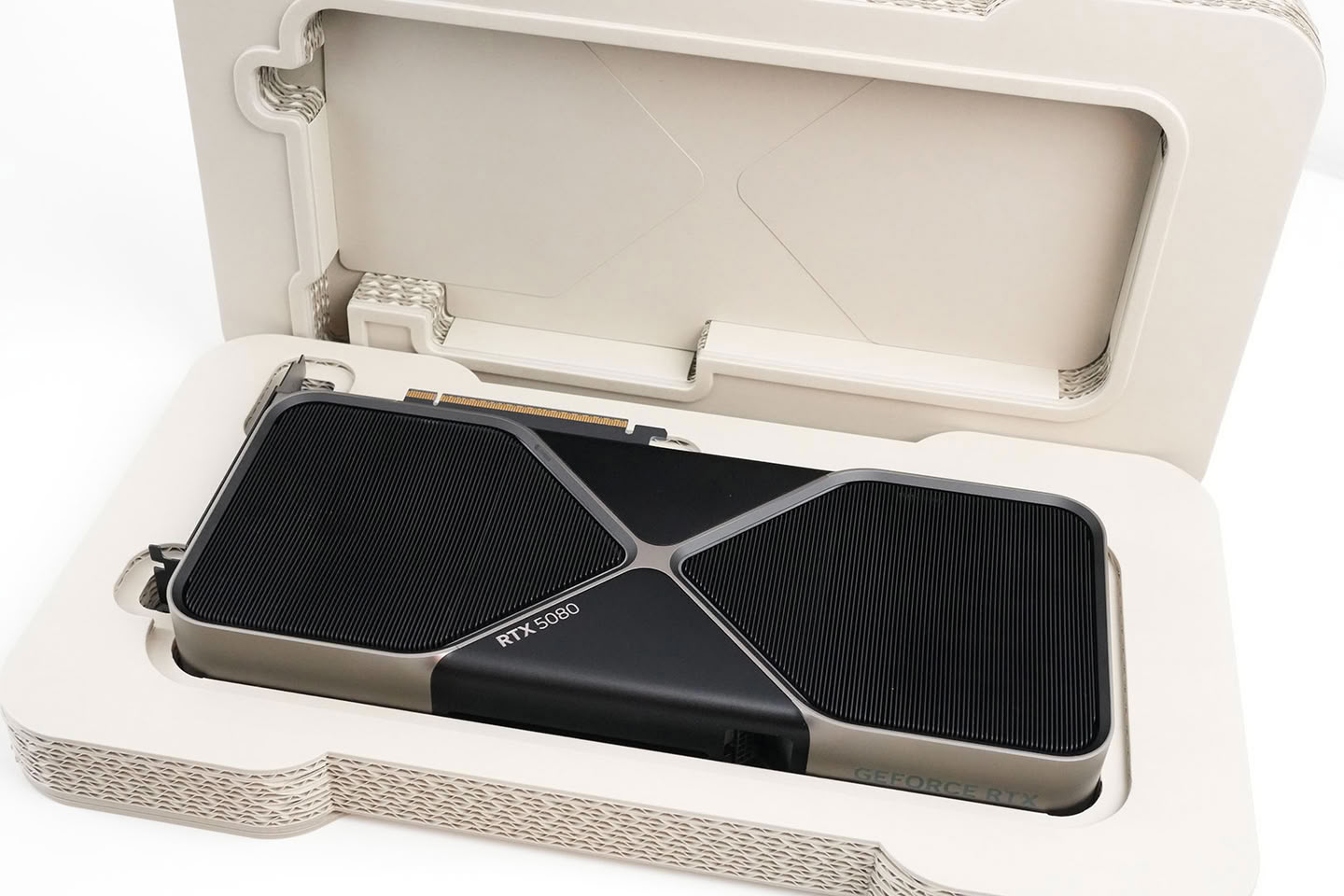
RTX 5080 Vanishes From NVIDIA's US Marketplace Two Weeks After the RTX 5090

NVIDIA's US Marketplace no longer lists the GeForce RTX 5080. The GPU filter on the store's graphics card page now tops out at the RTX 5070 Ti, followed by the RTX 5070, RTX 5060 Ti, RTX 5060, and RTX 5050, with partner RTX 5080 models gone as well. The same thing happened to the RTX 5090 about two weeks ago and, barring a brief cameo at $5,599, the card still hasn't returned. NVIDIA has since denied that the RTX 5090 is discontinued, though it hasn't said anything about the RTX 5080 yet. Oddly enough, its RTX 5080 product page still says "Starting at $999."

The removal seems limited to the US for now. NVIDIA's UK Marketplace still has 13 RTX 5080 listings and two RTX 5090 cards. Of course, a missing listing could simply mean there's no stock left, since the RTX 5080 already costs close to $2,000 at US retailers, roughly double its MSRP. That leaves the RTX 5070 Ti as the fastest card on NVIDIA's US store, and it isn't cheap either. The seven listings there range from $1,269.99 to $1,499.99, well above its $749 launch price.

New UEFI Tool Lifts NVIDIA's Tensor Cap on RTX 20 to 40 Series Cards in Windows

Last week, modders found a way to double the tensor throughput of GeForce RTX 20, RTX 30, and RTX 40 cards, though Zagitta's original tool only ran on Linux. Now, Chinese modder physicsdolphin has released nv-uefi-unlocker, a UEFI tool that lifts the same limit on Windows. NVIDIA runs FP16, BF16, and TF32 tensor math with FP32 accumulation at half rate on GeForce cards, while the same silicon in professional cards runs at full speed. The tool removes that cap before the driver even loads, without any VBIOS flashing. An earlier Windows port from impacifist targeted a single RTX 3090 system, while this one covers all three generations.

The gains look substantial. One user's RTX 4070 Ti Super went from 57.00 to 150.93 TFLOPS in FP16 (2.65x), though board power also climbed from 227 W to nearly 292 W. An RTX 2070 reportedly jumped from 36 to around 60-63 TFLOPS. Not every card has been tested; RTX 20 owners have to enable GSP firmware mode first, and RTX 50 isn't supported at all. The unlock resets on every power-off, so it runs from a USB stick on each cold boot, with Secure Boot disabled or a self-signed certificate enrolled. That could be a problem for games whose anti-cheat requires Secure Boot.

TSMC Could Charge Up to 20% More for CoWoS Packaging Amid AI Crunch

TSMC is reportedly considering raising prices for its CoWoS (Chip on Wafer on Substrate) advanced packaging by as much as 20%, according to supply chain sources cited by Taiwan's Commercial Times. Foundries and outsourced packaging firms are apparently weighing another round of 10% to 20% increases, as CoWoS demand has spread beyond AI GPUs to server CPUs and custom ASICs, leaving a growing backlog of unfilled orders. TSMC hasn't confirmed anything yet.

Testing is turning into a bottleneck of its own. Nomura estimates, via Seoul Economic Daily, that NVIDIA's Blackwell takes roughly four times longer than Hopper in final testing, while Rubin could need seven times as long. Packages keep growing too, with TSMC already mass producing CoWoS-L at 5.5 times the reticle limit. Tool lead times have reportedly stretched from three to six months to as long as eight months. TSMC, which usually negotiates for discounts or extra features, apparently placed this year's equipment orders at existing prices instead, which says a lot about how tight things are.

Micron Walks Away From 4F² DRAM After Two Decades of Research, Bets on 3D DRAM Instead

Micron has decided not to bring 4F² DRAM to market, even though it says it invented the cell design and has been researching it for around two decades. Scott DeBoer, Micron's President and Chief Technology and Products Officer, shared the decision during the company's technology webinar on October 21. On paper, 4F² uses vertical channel transistors to shrink each memory cell's footprint by about a third compared with the 6F² layout used in today's DRAM. However, DeBoer argued that real-world density is limited by how closely the capacitors can be packed, not by the cell's footprint, calling the density advantage over 6F² "a bit of a myth." He also said 4F² can be built, but at a higher cost and complexity, and that it runs into fundamental scaling problems at leading-edge nodes, which points toward 3D DRAM instead.

That puts Micron at odds with its rivals. Samsung and SK hynix are both developing 4F² designs, and China's CXMT says its first 4F² product will be a server DDR5 RDIMM due by the end of this year. Micron will keep scaling 6F² instead, with its 1-delta node set to ramp in Boise, Idaho, in the second half of 2027 and the 1-epsilon node after it moving to wafer bonding. 3D DRAM is being developed as a parallel path, but there's no timeline yet, and Micron says it will only switch once the economics make sense. It's a risky bet if rivals manage to make 4F² cheap at scale, especially with memory supply expected to get even tighter in 2027 and 2028, per Micron's own estimates.

Super Flower's 12V-2x6 OCP Dongle Watches Every Pin, Blacks Out Your Screen on Overcurrent

Super Flower has launched the VGA 12+4PIN OCP Dongle, a small inline box that sits between the PSU cable and a graphics card's 12V-2x6 connector and keeps an eye on the current running through each 12 V line. It was first shown at Computex 2026, and can now be seen on Super Flower's website, priced at NT$1,190 (roughly $38) in Taiwan. However, you can't buy it on its own just yet. For now, it's only offered as part of a limited promotional bundle with Leadex VIII power supplies, and there's no word on standalone sales or a wider release.

As for the protection part, each alert needs to hold for 10 seconds before it fires. Between 9.5 A and 12 A on any line, or if two lines drift more than 6 A apart, the LED turns orange and the buzzer starts beeping. Past 12 A, it flashes red with a continuous tone for 180 seconds, stays solid red for another 15, and then triggers "VGA Black Screen Protection." That mode stays active even if the current settles. Super Flower doesn't say how the black screen works or whether power is cut, and simply advises shutting down and checking the cables. That part can be a bit unreliable, but it's safe to assume that most users will suspect something is wrong if the screen blacks out for a significant bit of time.

AMD Readies Official Ryzen Overclocking Driver for Linux

AMD is reportedly working on official Ryzen overclocking controls for Linux. Per Phoronix, AMD engineer Shyam Sundar S K has posted a three-patch series for a new driver called AOD, short for AMD Overclocking Driver, to the platform-driver-x86 mailing list. It is a WMI driver that talks to the same firmware interface Ryzen Master uses on Windows, with all of its controls exposed through sysfs. For now, that covers PPT, TDC, and EDC limits along with their supported ranges, a platform-level SMT toggle, and a read-only memory clock readout. Notably, Ryzen Master itself isn't coming to Linux with this. AMD seems to be following the same approach it took with its amdgpu graphics driver, handling the kernel side and leaving the GUI to third-party tools such as CoreCtrl and to desktop environments.

There are a few catches, however. Power limit changes are stored in firmware and only kick in after a reboot. AMD's existing HSMP interface works the other way around, applying limits instantly but losing them on restart. The PPT, TDC, and EDC attributes are also write-only, since the firmware doesn't report the currently active values. The SMT switch, meanwhile, behaves more like a BIOS option than the kernel's nosmt boot parameter. Apparently, the firmware supports many more commands than the initial patches wire up, so more controls could arrive later. The patches are still under review, and there is no word yet on which kernel release will pick them up, so a proper Linux app for this is probably still a while away.

PlayStation Physical Game Share Still As High As 32%

Since Sony announced that it would be ending physical media production for the PlayStation 5 and PlayStation 5 Pro, there has been much discussion about the value of physical games media in the modern gaming landscape. Some argue that physical media is invaluable for game preservation and access to content in some remote parts of the world, while others argue that its value is limited, because the physical media market share is small for most games, and it has limited preservation value, thanks to day-one patches. Alinea Analytics recently posted some data about physical media sales on PlayStation, putting more numbers to the impact of physical games media on PlayStation.

Interestingly, despite the relatively high physical sales split of some games, like Resident Evil Requiem, with disc sales accounting for 30.2% of its sales, and Marvel's Wolverine, whose disc sales came to 32.3% of its total sales revenue, the total physical game sales revenue for games released in 2026 on PlayStation 5 and PS4 amounted to $655 million, which is less than 20% of sales revenue for the year. As the analytics firm explains, that revenue split itself is skewed by digital-only releases and pre-order bonuses, which are all digital sales. The data itself seems to tell a story of a split player base: those who buy first-party, single-player, narrative-driven games tend to skew more towards physical media, while sports and multiplayer gamers tend to buy digital more often.

New Tools Let Users Edit and Load Modified VBIOS on GeForce RTX GPUs Without Flashing

A developer who goes by Panchovix has released three tools that let NVIDIA GeForce RTX 50, RTX 40, and RTX 30-series owners run a modified VBIOS without writing anything to the card's flash chip. The first is a VBIOS editor for Windows and Linux that can change power limits, voltage ceilings, current (OCP) limits, fan channels, and the core and memory offset ranges. Edited images keep NVIDIA's original signature, which no longer matches, so they can't be flashed with nvflash. Patched tools did break NVIDIA's BIOS signature lock for crossflashing back in 2023, but this approach skips flashing altogether. On Windows, the loader stores the edited image in the GPU's driver registry key, where the driver picks it up as an override every time the device starts, and it only needs a quick GPU restart. The Linux loader instead patches NVIDIA's open kernel modules so the GSP firmware starts with the custom image, with Fedora 43 being the only distro tested on real hardware so far.

The screenshots show how this works in practice. On what appears to be an RTX 5090 Founders Edition ROM, the board power ceiling went from 600 W to 700 W and the NVVDD and MSVDD voltage ceilings from 1,110 mV to 1,150 mV. An RTX 4090 ROM had its power ceiling raised from 666 W to 750 W and its core offset range doubled to +2,000 MHz, and nvidia-smi later confirmed that card's power limit going from 550 W to 671 W. Apparently, an RTX 5090 reached 800 W, an RTX 5080 went from 360 W to 500 W, and an RTX 5060 Ti from 185 W to 300 W in the developer's own testing. Laptop RTX 40 GPUs can't be edited yet, and memory timings can't be changed since the card reads them directly from the flash chip.

The Blood of Dawnwalker Update 1.1 Arrives Next Week With Skill Respec and New Difficulty

Rebel Wolves has confirmed that Update 1.1 for The Blood of Dawnwalker arrives next week, a little later than the "early October" window the studio mentioned last month. There's no exact date yet. The biggest addition is the Draught of Mind Rebirth, an item that lets players reset their Swordmastery, Witchcraft, and Vampirism skills and get back the in-game time spent learning them, which matters a lot under the game's 30-day limit. There's also a new Story difficulty with extra combat assists, while the existing Story mode gets renamed to Forgiving. Combat targeting, lock-on, and disengaging have been improved, Shadowstep and Planeshift should feel more responsive, and the camera has been tweaked. Players can also pet dogs and cats now, using the directional combat system, of all things.

For PC players, frame generation is getting an update along with its own dedicated settings, though Rebel Wolves hasn't shared any specifics. The game already supports NVIDIA DLSS, and in a September interview, game director Konrad Tomaszkiewicz said broader optimization work was still ongoing, so it's reasonable to hope some of the 1,100+ improvements and fixes target performance. The update also adds larger font sizes and subtitles for all dialogue, and it removes blood and gore censorship from the Japanese version. The Blood of Dawnwalker launched on September 3 for PC, PS5, and Xbox Series X|S, and sold a million copies within days, on a budget that is reportedly just $40 million.

KINGPIN Says a Connector Dispute With NVIDIA Derailed EVGA's Last Flagship Card

Vince "KINGPIN" Lucido has blamed NVIDIA for the troubled launch of the EVGA GeForce RTX 3090 Ti KINGPIN, the last graphics card to carry his name. In the first video on his new Overclocking Kingpin YouTube channel, the overclocker said he wanted the card to have two 12VHPWR power connectors, while NVIDIA wanted it limited to just one. The disagreement, in his words, "really screwed up the production timeline", and he also holds it responsible for how few units were made afterward. The card did eventually ship with both 16-pin connectors when it went on sale for $2,500 with a bundled 1600 W power supply, about three months after the RTX 3090 Ti itself came out. This is only Lucido's side of the story, and it isn't clear why NVIDIA pushed for a single connector.

In September 2022, EVGA ended its partnership with NVIDIA and stopped making graphics cards, with CEO Andrew Han pointing to a souring relationship between the two companies. Every card in development was canceled, KINGPIN models included. Lucido is now working with ASUS, which sent over the hardware shown in the video, although no ASUS-made KINGPIN card has been confirmed. He did lay out one condition for such a card: the PCB and power delivery have to let the GPU reach its full potential under liquid nitrogen without the buyer modifying anything. An earlier plan with PNY never produced a card, and Lucido ended up skipping the RTX 50 generation entirely.

Modder Solders Dual 8-Pin Board to RTX 5090's 16-Pin Header, Wires Stay Below 40°C

Melting 16-pin connectors keep making headlines, and some RTX 5090 owners have started taking the protection of their expensive cards into their own hands. Reddit user DallasGrave has modified an MSI GeForce RTX 5090 with two extra 8-pin PCIe power inputs that work alongside the card's original 16-pin connector. According to their post on r/pcmasterrace, a small pickup PCB is soldered to the contacts of the 16-pin header, and that board feeds a second PCB carrying the two 8-pin sockets. The card then runs on three cables in total. DallasGrave says each conductor now carries roughly 3 A, and that the wires never crossed 40°C during a 48-hour run at 550 W, even at the joint. More test data is apparently on the way, so for now these are the modder's own numbers.

The 12V-2x6 revision was supposed to fix the melting power connector issues. In early 2025, NVIDIA said the 16-pin melting issues were over, pointing to the updated connector on the RTX 50-series. However, the first melted RTX 5090 Founders Edition was reported shortly after, in that case with a third-party cable. Since then, several RTX 5090 power connectors have reportedly melted, including one with an undervolt and a -100 W power limit. Moreover, last month Hardware Unboxed watched its RTX 5090 power cable reach 175°C with a single wire pulling around 22 A.

NVIDIA Raises Shield TV Pro Price to $299, Discontinues Standard Shield TV

NVIDIA has raised the price of the Shield TV Pro from $199.99 to $299.99, effective October 2. The streaming box launched in October 2019 at $199.99 and held that price for almost seven years. Earlier this year, NVIDIA promised to keep updating the Shield TV, with hardware engineering SVP Andrew Bell saying the company had no plans to abandon it anytime soon. NVIDIA has also stopped making the standard, tube-shaped Shield TV, which had reportedly been out of stock for months. That leaves the Pro as the only Shield model in production. NVIDIA confirmed both changes in a statement. Here's what the company said:
Starting October 2, SHIELD Pro will be priced at $299. The cost of components, including memory, has increased substantially across the industry. We've also stopped producing the standard SHIELD TV model as we focus on production for SHIELD TV Pro.

DLSS 5 Boosts RTX 5090 Connector Power Spikes to 647 W, Pushing Past 90°C

NVIDIA's DLSS 5 has been controversial ever since its announcement and eventual launch. Perhaps more concerning than the visual changes is its effect on the user's hardware. As reported by Videocardz, Korean outlet QuasarZone ran its own thermal tests on the RTX 5090's power connector with DLSS 5 enabled, to see if the technology really has a hand in recent reports of melting 12V-2x6 connectors. Testing an RTX 5090 Founders Edition in Cyberpunk 2077 at 4K with DLSS Quality and the Ultra preset over 20 minutes, the 12V-2x6 connector reached 91.7°C on the sense-pin side with DLSS 5 on, up from 80.9°C without it. The latch side climbed from 77.1°C to 83.4°C. An RTX 5080 FE tested the same way stayed far cooler, reaching just 48.6°C and 52.2°C at those two points with DLSS 5 enabled.

The increased heat aligned with a real jump in power draw. HWiNFO logged the RTX 5090's average power draw rising from 509.2 W to 575.1 W with DLSS 5 on, right at its 575 W limit. The RTX 5080 went from 298.2 W to 350.3 W, close to its own 360 W ceiling. External PCAT readings, which also catch short spikes, showed higher figures still: total board power rose from 527.3 W average and 582.5 W peak to 593.9 W average and 658.0 W peak. On the 16-pin 12V-2x6 connector alone, the RTX 5090 pulled 582.7 W on average and briefly spiked as high as 646.7 W. Of course, transient power spikes over 600 W are normal, and are not necessarily to blame for any melting connector issues. The increased power draw, however, lines up with Tom's Hardware's early DLSS 5 testing, which showed a noticeable jump in power draw with DLSS 5 enabled.

Sony Patents AI That Fills In Controller Inputs for Players With Physical Limitations

Sony has a new patent that describes an AI model designed to help gamers with mobility issues. Spotted by Insider Gaming, the patent was published on September 17, 2026. The idea is that the system tracks how a player actually operates the controls, then generates the output needed to complete the action they were going for. The AI model looks at the timing and duration of inputs, movement patterns, and even the game context. It is pre-trained on control actuation and accessibility data, and the patent says the amount of compensation can depend on the user, the controller, and the game being played.

The abstract gives an example of an injury to the left hand causing less than 50% actuation on the left controls. It also seems like the system could run locally or in the cloud. In multiplayer games, the AI can be switched off automatically or by the player, and other players can apparently see an indicator when it is active. The patent also doesn't seem to tie the system to a PlayStation controller, and describes it as controller-agnostic. Sony already sells the PS5 Access Controller for players with limited mobility, and it also patented a buttonless controller earlier this year. As always, a patent is not a finished product, so this concept might never see the light of day.

DLSS 5 Testing Ends in a Melted RTX 5090 Connector, Power Shoots Past 600 W

DLSS 5 seems to be contributing to increased power draw, and we have our first victim here. Videocardz reports a new melted-connector case on an MSI GeForce RTX 5090 Gaming Trio OC, which surfaced during DLSS 5 Neural Rendering testing in NBA 2K27, currently the only officially supported game. A reader nicknamed erek documented the incident, noting DLSS 5 pushed the card's power draw from around 450 W to over 600 W, which is above MSI's 575 W rating. A GPU-Z screenshot showed a peak board power reading of 613.5 W, which erek says held steady rather than spiking briefly.

Erek reported the card stopped working shortly after, and a burning smell led him to find that the connector's plastic had melted and fused to the socket. We already reported last week that DLSS 5 can push the RTX 5090's power draw unusually high, so this seems to be the first reported case where that added power draw has burned the notorious RTX 5090 power connectors. However, it should be remembered that GPU-Z tracks total board power rather than just the auxiliary connectors, since the PCIe slot also supplies power, so the reading doesn't necessarily mean the connector carried the full load.

Xbox Cloud Gaming Gets Monthly Time Limits Starting in November

Microsoft is putting a hard cap on Xbox Cloud Gaming for the first time, ending years of unlimited streaming for Game Pass subscribers. Starting in November, Game Pass Essential will include 5 hours of cloud streaming a month, Premium gets 10 hours, and Ultimate tops out at 15 hours. Once subscribers burn through their allotment, they'll need to pay for extra hours through the Xbox Store to keep going. Xbox says the change should only affect around 4% of subscribers, so casual streamers likely won't notice much. Heavy users are a different story, particularly anyone leaning on cloud streaming as their main way to play.

Xbox hasn't announced pricing for extra hours yet, saying more details will come before the change goes live. The company did admit outright that "the practical result is a higher cost" for some players. Contrary to how generous this might look on paper, Xbox's own ceiling is notably tighter than NVIDIA GeForce Now's 100-hour monthly cap on its top tier. Microsoft points to rising cloud infrastructure costs as the reason, though it's hard not to read this as part of the division's overall push toward profitability after a rough stretch of layoffs.
Return to Keyword Browsing
Nov 11th, 2026 06:14 CST change timezone

New Forum Posts

Popular Reviews

TPU on YouTube

Controversial News Posts