Tuesday, October 20th 2026

AMD and Microsoft Bring FSR 4.1 to Xbox Series X|S, FSR Diamond Teased for Project Helix
AMD and Microsoft have confirmed that FSR Upscaling 4.1 is coming to the Xbox Series X and Series S. The news came in an AMD video presentation led by Jack Huynh, joined by Xbox CTO Scott Van Vliet and ASUS. The ROG Xbox Ally handhelds are getting it too, and it looks like they will be first in line, while the consoles are only listed as "coming soon." Neither company has shared a release date or a list of supported games. Both consoles use RDNA 2 graphics, the same architecture as the Radeon RX 6000 series, which AMD also announced FSR 4.1 for today, well ahead of the early 2027 target it set in May. Here's what Van Vliet said:
 The handheld side is a bit murkier. AMD said earlier this month that a lighter FSR model for APUs would arrive by the end of 2026, and it has reportedly listed both the Ryzen Z2 Extreme and Z2 A as targets. However, one report claims the base ROG Xbox Ally is left out, so owners are advised to wait for ASUS's driver update before assuming anything. Van Vliet also teased Project Helix, Microsoft's next-gen Xbox, which will use FSR Diamond with ML-based upscaling and multi-frame generation. Sony recently announced its own QSSR upscaler for the base PS5. The Series S probably stands to gain the most here, though a lot depends on how many developers actually adopt it.
Source:
AMD
With FSR 4.1 coming to Xbox. Now, we've worked very closely with AMD to optimize this technology, giving developers another powerful tool for great performance and visual quality for players. Now, whether you're playing on an Xbox Ally handheld, as well as coming soon to Xbox Series X and Series S consoles. And this is just the beginning. Our teams are continuing to work together across hardware and software, and there's even more ahead with Project Helix, leveraging FSR Diamond to power what comes next.


18 Comments on AMD and Microsoft Bring FSR 4.1 to Xbox Series X|S, FSR Diamond Teased for Project Helix
RDNA 1-2-3-3.5 really paying for not having that RDNA 4 AI hardware FSR 4.x needs to run natively it seems. At least it can run, which wasn't the case not long ago.
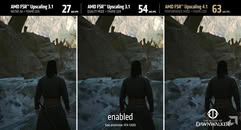
For reference, the internal resolution is 50% that of native with Performance upscaling, for a 2x scale factor, whereas with Quality you're at 67% and 1.5x. Balanced is 59% 1.7x. UItra Quality is 77% 1.3x. Quality generally has a 20-30% performance bonus, with Performance being up to 70% bonus FPS due to literally rendering half of native. I'm honestly shocked that the raw FPS before frame gen on FSR 4.1 Performance is in the ~30 FPS range on hardware as on-paper powerful as an XSX. That's 540p internal resolution assuming output is 1080p, and it's only just holding ~30 FPS. Damn.
Can definitely see why that lighter model is required for handhelds. Lets hope that even with a cut down model the IQ improvements are still as notable as the jump from (typically not worth using as it's impossible to ignore the IQ issues) FSR 1-3.x to FSR 4.x (worth using and on par with DLSS 3.x). The Switch 2 had a pretty good result even with cut-down DLSS on obsolete handheld hardware, so in theory, it's possible. Fingers crossed. If not, at least there's still Intel XeSS, which even in compatibility mode is still much better than FSR 1-3.x, and works pretty well on those handhelds.
RDNA 4/5 handheld/console chips can't come soon enough, even if the raw raster is barely improved, these upscalers are essential in modern games, and struggling to hit 30 FPS before FG with the upscaler almost as low as it can go, internal resolution wise, isn't good.
Hey, at least MS/Sony are trying to eke out every last bit of oomph these consoles have. Kudos there.
Hopefully they'll implement it correctly and do a better comparison in the future. I'm no console user anymore, but still interested in the market.
Did you expect anything different? FSR 4.x was known to be heavier than FSR 3.x and would therefore yield lower performance on RDNA2 hardware. The question was simply whether FSR 4.x on performance/balanced settings would offer a better, more stable image compared to FSR 3.x on quality. And that was the whole point of releasing FSR 4.x for RDNA2 cards: to give the user more options—options that might offer image quality improvements that FSR 3.x couldn't deliver. In no way were we expecting higher performance out of RDNA2.
As has been said, this isn't tested on the base PS5 with its RDNA 1.5 esque GPU, this is full RDNA 2 on a fairly powerful config on the series X. Sure, it's not a PS5 Pro with a newer arch, but two quality levels? Damn.
While we knew it's a heavy model especially if the dedicated hardware isn't present (why wasnt it AMD/Xbox/Sony, you had both Turing and Ampere to learn from by the time the console chips shipped), I am quite surprised that the move from Quality to Performance is necessary to end up roughly at the same output FPS (considering the 9 improvement is after frame gen, the actual improvement is roughly half that). A whole 5 FPS gained at ~25 vs 30 base FPS while jumping down two quality settings is pretty nuts to me.
Anyway. Glad I've not really recommended any console besides the Switch 2 and PS5 Pro when I've been asked by friends what to pick if not going PC. Besides being roughly 2x the performance GPU wise of the base PS5, not being stuck in RDNA 1/2 hell is worth the premium.
Now, concerning the absence of corresponding hardware in RDNA 1/2 implementations that existed in Nvidia's GPUs, I imagine Nvidia didn't design that hardware in a month—let alone test it and build software and drivers for it. AMD would needed even more time, being something new to them. And of course, additional hardware means extra cost and potentially higher power consumption. With consoles being 6 years on the market already, the fact that the need for such hardware surfaced likely somewhere in their 4th, 5th, or 6th year of life suggests that choosing not to complicate the architecture with extra hardware—which would have increased both complexity and cost—was probably the right call.
Going from 25 fps to 30 fps is a 20% increase. Sounds good to me, maybe even better than good.
As for the last point, since you're a PC user who is deeply immersed in technology and its news, and since you're a PC enthusiast who finds themselves caring about things like "what technology is being used here", I think the wisest choice is to go for hardware that won't feel obsolete to you, because psychologically it won't sit well with you. It's like buying an RX 6950 today. It might still perform very well in games, but the moment you get it in your hands, you've already built a mental list of everything it can't do. This is a classic case of "ignorance is bliss".
Nvidia either refused to do dieshrinks or kept charging as much as before, harming Microsoft's first Xbox generation. There may have been technological dissatisfaction issues too (Sony dropped Nvidia after PS3 over those a generation later).You realize Xbox was Microsoft console? It was neither Nvidia console, nor joint Nvidia-MS project where Nvidia was in place to push some ideas or vision and be in position to mind alleged "enshitifications" or whatever. They were asked (and paid) to supply a GPU and a chipset.
This is the result of that decision making by both AMD/MS, and predictable (many people here on TPU have been talking about this for years). MS/Sony want to add non-shit upscalers, and it's a struggle, because to get good image quality you need AI, and if you need AI, it's going to be slow on anything without (decent) dedicated AI hardware. So, Pre RDNA 4 or Pre Turing. One of those debuted in 2018, the other in 2025. If you are making a console in 2019, which do you pick?
Obviously a last gen/two generation old combo you can get cheaply from AMD, right? Well here we are. 20-30 base FPS after upscaling from 540p. What can you do with that? Very little. They've boxed themselves in. Can't even sell the consoles cheaply to make up for it because of that same AI train they missed the boat on.
Only good thing I can say about the non-PS5P consoles is at least they weren't using the *shudder* Jaguar cores for CPU. That decision set back game dev what, 5 years? The Zen 2 cores in consoles are at least workable, even in 2026.
The question now becomes how many years using RDNA 1/2 GPU IP in the current gen of consoles set back the game dev industry.
Now we're at the point where the rumours are "next xbox is PC with UDNA 5", so, decent GPU/AI IP, presumably. Downside? ~1.5-2k "console". What's the alternative? PS5P (if you can find), or 20-25 FPS last gen console.
Good luck John Consumer, definitely some great choices set before you. Hope you built a PC a year ago, though you probably didn't.Given the GPU architecture the base PS5 and both XBOXes use, the only way to get both decent upscaling and decent performance is to run it on PS5P, it seems. Sony released a worse IQ and lighter upscaler for the base PS5 recently IIRC, to throw them a bone.
Part of the reason the old Gearbox Halo PC port way back in the day didn't have the same reflective surfaces and some other fancy shading effects as the console version despite PC parts being more than powerful enough to run the game with all shaders enabled.
I mean the issue you point out is across the board, Sony is in the same boat. But there is a reason both console devs have stuck exclusively with AMD after doing one console gen with Nvidia (Xbox for MS and PS3 for Sony) despite AMD's flagging popularity and install base.
Nintendo is the odd man out, going from AMD/ATI to Nvidia, but that's pretty obviously because Nvidia had an ARM based chip for their form factor that AMD couldn't match in power/thermals.