News Posts matching #2027

Return to Keyword Browsing

Intel Core Ultra 9 4950K Could Signal New Naming Scheme for "Nova Lake-S"

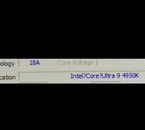
Intel's upcoming desktop CPU generation, part of the "Nova Lake-S" processor family, might adopt a new naming convention that returns to a four-digit format, unlike the current three-digit format used in the "Arrow Lake" family. According to a leaked CPU-Z submission, Intel's Core Ultra 9 4950K has been identified as a 28-core "Nova Lake-S" desktop chip. It features 8 "Coyote Cove" P-Cores, 16 "Arctic Wolf" E-Cores, and 4 LPE-Cores. This chip was tested on an unknown Z990 high-end overclocking platform, where it achieved over 1,000 points in single-core CPU-Z rankings and exceeded 20,000 points in multicore performance. This performance surpasses any consumer-focused desktop CPU currently available.

Despite this information, it's still uncertain if the naming convention is final. Intel is testing many SKUs for "Nova Lake-S," and a four-digit naming could be necessary due to the numerous SKUs and configurations. Some leakers, like Golden Pig Upgrade and Gotou_3rd, have suggested that the four-digit naming is a possibility, leaving room for speculation. Interestingly, qualification samples for NVL-S have not yet started shipping, but we can expect these shipments in the coming weeks, before manufacturers and motherboard makers begin integrating the latest CPU generation into their products.

Microsoft and China's Joint Windows 10 Faces Early Retirement

The Chinese Ministry of State Security has reportedly ordered local governments and state-affiliated organizations to remove Windows 10 installations from their systems as the central government seeks to completely diversify away from Western technology. However, the irony is that this is not the standard Windows 10 OS we are all familiar with. The software was developed by C&M Information Technologies (CMIT), a joint venture between Microsoft and China Electronics Technology Group, and was specifically modified to meet Beijing's security requirements. Based on Windows 10 Enterprise, this government version removes or disables several consumer-facing features, keeps activation and updates within China, and supports the use of Chinese cryptographic standards.

According to Bloomberg, the central government has reportedly moved up the planned obsolescence date, and instead of lasting until February 2027, the retirement is happening now. Despite receiving a highly customized version of Windows 10, Beijing now seems increasingly uncomfortable with maintaining a foreign-origin operating system at the core of sensitive government infrastructure. However, China does have a replacement plan for the Windows operating system.

Intel's New CPU Cores Debut on "Nova Lake-S" Desktop Before Xeon Servers

Intel's approach to releasing the latest CPU technology differs significantly from AMD's. Robert Hallock, the company's VP and general manager of the enthusiast business, confirms that desktop PC DIY enthusiasts are the first to experience the latest CPU cores. In an interview with Tom's Hardware, Hallock emphasized that Intel prioritizes bringing its newest CPU cores to desktops first, subtly hinting at the upcoming "Nova Lake-S" processor generation. Unlike AMD, which introduces its latest core designs in the server segment first, Intel debuts them on the desktop. While these cores will eventually be used in Xeon server processors, they initially appear on the desktop platform. This means that the "Coyote Cove" P-Cores and "Arctic Wolf" E-Cores will first be available for desktops, in contrast to AMD's Zen 6 CPU technology, which debuts with the EPYC "Venice" and only later appears in desktop CPUs.
Intel's Robert HallockWhat I would say is, as we think about our own roadmap, I have a new core. It's coming to desktop first. I mean, I hope enthusiasts do the math about that one, and that's all I'm going to say.

Amazon Cuts Throne of Liberty and Lost Ark—Devs To Take Over Servers

Following a round of layoffs and the apparent cancellation of an in-progress Lord of the Rings MMO, Amazon has officially cancelled active development of both Throne of Liberty and Lost Ark, announcing that it would hand off server management to each game's respective dev team. This is only Amazon's latest move in what was previously revealed to be a shift in strategy away from game development.

This means that Throne of Liberty will be fully in the hands of NCSoft's Western division, FirstSpark Games, and Lost Ark will be handed over to Smilegate. Lost Ark is expected to transition to its new management in early 2027, while Throne of Liberty will move over in Q4 2026, although no specific dates have been set. From a player perspective, there will be changes, but both studios have promised to minimize interruptions.

CXMT Surpasses 90% DDR5 Yield, Challenges Industry Giants

Chinese memory giant CXMT has reportedly achieved a significant milestone in DDR5 production, with manufacturing yields now comfortably above 90%. This is comparable to what major manufacturers like Samsung, SK hynix, and Micron are achieving. According to reports, CXMT uses a 17 nm node for DDR5 chip production and has reached a 90% yield for these chips. This is only 2-3% lower than Samsung's yield on its 10 nm class node for DDR5 production, indicating that CXMT's production quality is matching that of the world's largest memory maker. This is a remarkable achievement for a company that excels in cleanroom construction time, taking only 12 months to build its fab's cleanroom compared to the two years others require. As the company plans to end the year with 350,000 DRAM wafers per month, high yields mean there is little waste or leftover.

Chinese MyDrivers also notes that PC OEMs have mixed reactions to adopting CXMT DRAM in their products. For instance, Dell has completely banned the use of CXMT in its machines, while HP only allows CXMT DRAM in its Chinese PCs. Major Taiwanese brands such as ASUS and Acer have increased adoption in some models, as they have more flexibility in supply chain procurement. However, both companies use CXMT memory for PCs sold in mainland China and some emerging markets, meaning the West is still far from receiving PCs with CXMT memory modules. PC OEMs are also cautious about procuring CXMT memory due to concerns about disrupting their relationships with the big three memory makers.

Intel "Razor Lake-AX" Preliminary Support Lands in HWiNFO

Intel's "Razor Lake-AX" SoCs are getting closer to being released, as we have received further confirmation that Intel is actively working on these chips for the public. In the latest HWiNFO update, the tool's creators announced preliminary support for Intel's "Razor Lake-AX" chip, with full preliminary support expected in the next version, v8.51, of HWiNFO. This will be Intel's first competitor to AMD's existing "Halo" series of APUs, which feature a large integrated GPU alongside a substantial CPU complex. Earlier reports indicated that the "Razor Lake-AX" iGPU will come in two versions: one with a 16-core iGPU and a flagship SKU with a 32-core iGPU.

Both of these integrated graphics solutions are expected to be based on Intel's Xe3 graphics IP, currently found in "Panther Lake." This would make "Razor Lake-AX" nearly three times as powerful as the current Arc B390, which powers Intel's PTL lineup. This suggests that "Razor Lake-AX" will be a large package, as the GPU die is reportedly around 162.84 mm². We also learned that Intel plans to return to on-package memory with the upcoming "AX" chip. Although the company initially stated that the Core Ultra 200V "Lunar Lake" was the last design with on-package memory, Intel is reportedly bringing back on-package LPDDR5X/LPDDR6 memory for "Razor Lake-AX." Do note that the image below is not a real Intel slide.
Razor Lake-AX

Supermicro Announces Fourth Quarter and Full Fiscal Year 2026 Financial Results

Super Micro Computer, Inc. (NASDAQ: SMCI) ("Supermicro" or the "Company"), a Total IT Solution Provider for AI, Cloud, Storage, and 5G/Edge, today announced unaudited financial results for its fourth quarter and full fiscal year ended June 30, 2026.

Fourth Quarter Fiscal Year 2026 Highlights
  • Net sales of $11.1 billion versus $10.2 billion in Q3'26 and $5.8 billion in Q4'25.
  • Gross margin of 17.5% versus 9.9% in Q3'26 and 9.5% in Q4'25.
  • Net income of $1,178 million versus $483 million in Q3'26 and $195 million in Q4'25.
  • Diluted net income per common share of $1.62 versus $0.72 in Q3'26 and $0.31 in Q4'25.
  • Non-GAAP gross margin of 17.6% versus 9.6% in Q4'25.
  • Non-GAAP diluted net income per common share of $1.70 versus $0.41 in Q4'25.
  • Cash flow provided by operations for Q4'26 of $747 million and capital expenditures and investments of $25 million.

SK hynix to Boost NAND Flash Production in China by 50% in 2027

SK hynix is reportedly continuing to invest capital, human resources, and strategic planning into its NAND Flash fab in China. According to recent reports, SK hynix plans to increase production at its plant in Dalian, China, by 50% in 2027 to meet the rising demand for NAND Flash. This fab is owned and operated by its NAND subsidiary, Solidigm, which is finally resuming expansion in mainland China after a four-year project freeze. In 2021, when SK hynix acquired Intel's 3D NAND and SSD business, it formed Solidigm to focus on this area of production. However, export controls and a downturn in the NAND Flash market halted any expansion plans that Solidigm and SK hynix had in China, effectively stopping strategic planning from the headquarters.

Currently, Solidigm produces about 100,000 wafers per month of NAND Flash, so a 50% increase in 2027 would raise production to approximately 150,000 wafers per month. Solidigm will also begin producing its floating gate 3D QLC NAND Flash, which will feature over 200 active storage layers per chip. This advancement will enable multi-terabyte SSDs for enterprise use, which is currently the primary consumer of these solutions. With global NAND Flash production expected to finally balance with demand in 2027, this introduction will be a welcome addition, though it represents just a small fraction of the global NAND Flash demand.

EU Pressures Apple Into Universal Clipboard for Compatibility With Windows

Apple is once again complying with the rules of the European Union, as the company is now developing a universal copy and paste system to transfer text directly from an iPhone to a Windows-based PC. Under the EU Digital Markets Act (DMA), Apple is required to create a feature to align itself with Microsoft's formal interoperability request, which will help users with the simple copy and paste action that hasn't worked until now. Currently, third-party applications on iOS, which powers iPhone mobile devices, can only access the iPhone's clipboard contents while they are open and active on the screen. Every copy or paste action required the user's manual approval.

However, Microsoft has built a workaround, and the EU has been pressuring Apple to adopt the standard. The company reportedly reviewed the Union's request in March 2026, put forward project plans by late June, and is now in development. Apple will implement this universal clipboard through a framework called AccessorySetupKit. One permission is granted per device, and once a Windows PC is approved, clipboard items will move automatically in the background. No further prompts will be required. The Cupertino-based company already offers similar universal syncing between its own ecosystem of devices through the existing Universal Clipboard, which connects iPhones with Mac computers for seamless integration.
Apple Universal Clipboard

Memory Makers Seal 2027 Deals: No Room for New Buyers

According to DigiTimes, industry insiders are now claiming that the entire memory production capacity for 2027 has been fully booked, well ahead of the schedule the industry expected. All of the big three memory makers—Samsung, SK hynix, and Micron—have sold out their memory capacity for the upcoming year, leaving no room for additional supply for third parties to purchase more DRAM wafers. Interestingly, the report notes that everyone from OEM server makers and PC makers to AI labs knows that July and August are crucial months for securing allocations for the following year. However, some businesses have been kept in the dark because nobody has been public about this out of fear of losing their allocation.

Memory makers have been pushing customers into long-term agreements with contracts ranging from three to five years, using an advance payment deposit model where customers essentially pre-pay for some of the memory capacity. These deals are made on an individual customer level. All of this combined signals that 2027 will be the worst year in recent history regarding memory shortages, meaning that only those who managed to sign agreements for supply will benefit, while the rest are left without as there simply isn't enough available DRAM. Only about 60-70% of the estimated demand can be met in 2027, leaving a significant amount of demand unmet and waiting for the 2028 supply.

Intel's EMIB-T to Rival TSMC's CoWoS with 50% Cost Advantage, Volume Production in 2027

Intel's push for advanced packaging is reportedly attracting significant attention from external customers to Intel Foundry. However, the company's latest packaging will only begin mass production next year. Intel's Embedded Multi-die Interconnect Bridge (EMIB) enables designers to use 2D, 2.5D, and 3D building blocks to optimize cost, power, and bandwidth at the system level. EMIB is a substrate-embedded silicon bridge that provides localized, high-density die-to-die routing without the cost and area penalty of a full-size silicon interposer. For example, small silicon EMIB bridges—available in variants like EMIB-M with embedded MIM capacitors and EMIB-T with TSVs—offer low-cost, high-density shoreline connections ideal for logic-to-logic and logic-to-HBM interfaces. The EMIB-T variant, which includes TSVs, allows ASICs to gain direct access to power connections, resulting in a massive, multi-kilowatt solution on a single package.

However, this EMIB-T advanced packaging will only enter mass production next year, as Intel is currently ramping up its regular EMIB and Foveros for customers. According to Taiwan's Unimicron, which manufactures PCBs and silicon substrates, Intel's EMIB-T will reach high-volume production in 2027. The company also notes that customers, including ASIC designers like Broadcom and Meta, are considering switching from TSMC's CoWoS packaging to EMIB to reduce costs while maintaining the same benefits and even gaining more features in some areas. The price gap between EMIB-T and CoWoS (presumably CoWoS-L or CoWoS-R) can be as much as 50%, depending on whether an expensive interposer is required. This means that the costs of advanced packaging are passed back to the customer, who can then invest in other production areas.

Sony Stocks Up on DRAM for PlayStation 5 Prior to GTA VI Launch

In its latest earnings call, Sony discussed its PlayStation 5 and PlayStation 5 Pro consoles, noting that the company has secured enough DRAM to manufacture its consoles without being affected by the current memory crisis in the semiconductor industry. Reportedly, the company has worked with the big three DRAM makers—Samsung, SK hynix, and Micron—to ensure an ample supply of DRAM for the PlayStation 5, as demand is expected to grow rapidly with the upcoming release of Rockstar's Grand Theft Auto VI. Being one of the most anticipated major AAA titles this year, it usually triggers a whole ecosystem of purchases, with gamers flocking to retailers to buy the latest generation console.

Anticipating this surge in purchasing, Sony has secured sufficient DRAM supply just before the November 19 launch of GTA VI, meaning the company will likely benefit from profits driven by the game's release. "Regarding the impact of the storage component market on PlayStation 5 hardware, we have secured the storage quantities required to achieve our projected sales volume in fiscal year 2026 [ending in April 2027]." Interestingly, the company did not announce any immediate price hikes due to ongoing DRAM pricing volatility, but it is possible that one may occur if the supply chain situation does not improve. Since consoles are also significant drivers of consumer DRAM usage, companies like Sony need long-term supply agreements to maintain pricing and availability, especially before a major AAA release.

Diverging Memory Market Outlook in 2027 as DRAM Supply Remains Tight While NAND Flash Supply Conditions Ease

TrendForce's latest research on the memory industry reveals that AI will remain the primary driver of memory demand in 2027. However, market dynamics are expected to diverge between DRAM and NAND Flash.

On the DRAM side, continued HBM capacity allocation, robust AI server demand, and growing procurement of CPU memory and HBM are expected to keep supply constrained and prices on an upward trajectory. By contrast, NAND Flash is projected to enter a looser supply environment in 2H27 as new production capacity comes online while consumer electronics demand remains weak, increasing downward pressure on prices.

Logitech Announces Q1 Fiscal Year 2027 Results

SIX Swiss Exchange Ad hoc announcement pursuant to Art. 53 LR—Logitech International (SIX: LOGN) (Nasdaq: LOGI) today announced financial results for the first quarter of Fiscal Year 2027.
  • Sales were $1.23 billion, up 7 percent in US dollars and 5 percent in constant currency, compared to Q1 of the prior year.
  • GAAP gross margin was 49.5 percent, up 780 basis points, compared to Q1 of the prior year. Non-GAAP gross margin was 49.8 percent, up 770 basis points, compared to Q1 of the prior year. These numbers include $61 million in tariff refunds.
  • GAAP operating income was $259 million, up 60 percent, compared to Q1 of the prior year. Non-GAAP operating income was $290 million, up 44 percent, compared to Q1 of the prior year. These numbers include $61 million in tariff refunds.
  • GAAP earnings per share (EPS) was $1.63, up 66 percent compared to Q1 of the prior year. Non-GAAP EPS was $1.85, up 47 percent compared to Q1 of the prior year.
  • Cash flow from operations was $167 million. The quarter-ending cash balance was $1.75 billion.
  • The Company returned $114 million of cash to shareholders through share repurchases.

China Begins Limited Production of Domestic Immersion DUV Machines

According to sources close to The Information, a Chinese company Shanghai Yuliangsheng Technology has reportedly begun limited production of immersion DUV lithography machines. This Shanghai-based company aims to produce five systems for delivery this year, with an estimated production of about 20 immersion DUV machines by 2027. While this may not seem like a large number, it represents a significant effort in developing homegrown DUV machine production, reducing reliance on third-party suppliers like ASML. The Shanghai company plans initial deliveries to SMIC, CXMT, and Hua Hong, which will integrate these machines into their production processes.

For those unfamiliar, immersion deep ultraviolet (DUV) machines use an argon-fluoride (ArF) excimer laser to produce DUV light at a 193 nm wavelength. This light travels through a layer of ultra-purified water placed above the final lens, which imprints circuit designs onto a wafer. Although this may sound straightforward, immersion DUV lithography tools are highly complex machines that ASML has been mass-producing for years. By comparison, ASML shipped 131 immersion DUV machines last year, showing the smaller scale of the Chinese production. Additionally, Chinese immersion DUV also imports some key components from Japan, while most are being sourced from China.

Intel Reaffirms: Multithreading Returns in 2028 with "Coral Rapids"

In recent years, Intel has shifted away from traditional multithreading in its CPU core designs. This change began with the 12th-Gen Core CPUs when Intel started moving away from Hyper-Threading. At the same time, the company transitioned to asymmetrical CPU designs, initially enabling SMT only on performance cores. On the consumer side, Intel completely abandoned Hyper-Threading with the Core Ultra 200 series but still maintains it in the P-Core Xeon 6 "Granite Rapids" CPU family, which features up to 128 P-Cores and 256 threads. Meanwhile, the "Clearwater Forest" E-Core Xeon 6 has 288 E-Cores without Hyper-Threading, and Intel's upcoming Xeon 7 "Diamond Rapids" P-Core SKUs will have 192 cores and 192 threads, meaning no Hyper-Threading. Intel plans to address this by reintroducing Hyper-Threading the following year with the Xeon 8 "Coral Rapids."
Intel CEO Lip-Bu TanWe have Clearwater Forest, Diamond Rapids, and also Coral Rapids with the SMT involved. I think we continue working on improving the competitiveness against our competitor. I think clearly it's very important to drive the improvement in the single thread and also multithreading. Multithreading will be coming in the Coral Rapids.

Intel 14A Node Goes Into Risk Production in 2H 2027, Volume Production in 2028

Intel reported one of its largest quarterly growth results last night, with Q2 2026 revenue reaching $16.1 billion and generating strong cash flow. However, a key highlight from the company's earnings call was the discussion about the 14A node and its production schedule. According to Intel's CEO, Lip-Bu Tan, "With encouraging progress from external customers and increased demand for our internal products, we remain on track for 14A risk production for our internal products in the second half of 2027. We decided in Q2 to fully commit to a high-volume ramp in 2028." This is a full year ahead of previous expectations, positioning Intel to deliver its leading-edge node for both internal use and external customers interested in Intel's manufacturing and advanced packaging.

We previously reported that the defect rate for Intel's 14A node is currently at D0=0.5, indicating that defects in production are occurring at a rate of only 0.5. This reflects a limited amount of purely non-functional silicon produced during the complex semiconductor manufacturing process. Our editorial dives deeper into cases like the "Panther Lake" compute tile, which would yield 56.45% for a die size of 114.304 mm². However, Intel is still working on optimizations to reduce the defect rate to D0=0.1, which would boost yields to 80-90% without issues. By the time high-volume production starts in 2028, achieving this defect rate is expected.

Report: NAND Flash Shortages to Finally End in 2027

In the sea of negative news surrounding the entire semiconductor industry, NAND Flash might be one of the few major components that will become abundant again. According to the latest report by TrendForce, the storage supply chain is expected to achieve balance by 2027, making it the only area of computing projected to stabilize. Although the demand for NAND Flash and all SSD storage solutions that rely on it is expected to remain in short supply for the rest of 2026, TrendForce forecasts that supply and demand will return to normal in 2027. This year, there will be about a 4-6% supply deficit compared to demand for the remainder of the year. However, the second half of 2027 is anticipated to finally bring balance to the supply chain, with no deficit in NAND Flash supply a year from now.

This supply balance is driven by several factors. First, increased production capacity from NAND Flash suppliers like SK hynix, Micron, Samsung, YMTC, and others is crucial. The increase in the number of wafers produced each month, along with process node upgrades, will significantly boost supply, bringing this commodity to balance after a long period of uncertainty. The second factor is the persistently weak demand from consumers, as consumer electronics prices have risen so much due to DRAM and NAND Flash shortages that many consumers are opting not to purchase new hardware, avoiding the high premiums compared to a year ago. On the enterprise side, server demand will continue to rise, consuming most of the NAND Flash supply. Server demand accounts for about 40% of output consumption, while smartphones and notebooks together account for more than 40%.

PC Vendors "Fight" for CXMT Memory Supply, Smaller OEMs Struggle

Major PC OEMs are beginning to secure deals with Chinese memory maker CXMT, as the supply chain has been depleted of available DRAM from the big three memory makers—SK hynix, Samsung, and Micron. According to a report from DigiTimes, CXMT's memory capacity has been booked through the end of 2027, leaving little room for new customers to source DRAM from China's largest memory producer. The report notes that large PC vendors such as Dell, HP, and Apple are the only ones that managed to receive allocations, while smaller brands with less presence in the desktop and laptop market have been left with nearly no allocation.

An important aspect of this situation is the negotiation leverage that larger PC vendors have. As they command more volume than smaller companies, Dell, HP, and Apple are willing to sign bigger contracts with CXMT to secure a larger DRAM supply, even at prices higher than historical levels. For CXMT, this is a positive indication that capacity expansion is well-received and a signal to continue building new fabs. DigiTimes also notes that the United States government has not yet made a firm decision on whether to keep CXMT on the barred entity list, so PC OEMs are taking advantage of the opportunity to stockpile any available DRAM. Future policy changes might impact this, but for now, long-term supply agreements are being made to secure any DDR5/LPDDR5X memory possible.

Intel to Launch 28-Core "Nova Lake-S" Before 52-Core Version

Intel is gradually laying the groundwork for the launch of its Core Ultra 400 "Nova Lake-S" desktop processors with a basic branding overhaul. However, the company is reportedly preparing different launch dates for various SKUs, according to VideoCardz. We know that Intel has SKUs arriving with either one or two compute dies, featuring up to 8 "Coyote Cove" P-Cores and 16 "Arctic Wolf" E-Cores, along with 4 LPE-Cores that are part of the I/O die. Depending on the SKU, Intel can pack a single compute die for up to 28 cores total or two compute dies for a 52-core CPU SKU. It seems that the single compute die version will arrive first, with the dual compute die variants following. The 28-core "Nova Lake-S" DS version, a new SKU segment, is expected to launch in Q1 of 2027. For the regular overclocking-focused "K" SKUs, Intel reportedly plans an early Q2 launch between March and April.

What is particularly interesting to enthusiasts is when the 52-core compute powerhouse will launch. With its dual compute dies, Intel's most powerful desktop CPU is set to arrive between late May and September 2027, bringing this model to consumers. As for a possible reason why Intel is choosing such a schedule, we might assume that the recent change in plans to bring back most of the compute tile production on the 18A node is the reason. As Intel ramps up 18A high-volume manufacturing for its internal needs, the company likely needs more time to stockpile fully-fledged compute dies for the flagship 52-core SKUs. Since they require double the compute tiles compared to the 28-core designs, the production capacity may need to catch up first.

Nintendo Considers Release of Switch 2 with OLED Screen

According to a display industry analyst from South Korea, Nintendo is considering releasing a Switch 2 handheld console with an OLED display. While there has been speculation that Nintendo will announce a Switch 2 OLED version, the company is currently evaluating whether this option is financially feasible. If Nintendo determines that it makes financial sense, the company plans to start development towards the end of this year, with mass production targeted for the end of 2027. This would set an early 2028 goal for the market launch. If the decision is made to proceed, it is likely that Samsung Display will supply a rigid OLED panel for the Switch 2 OLED version. However, there is a significant price difference between the current 1080p LCD panel and a potential rigid OLED touchscreen display, with the LCD version reportedly being much cheaper.

The current situation with tight memory and storage supply isn't helping either, as Nintendo has been forced to increase the Switch 2 cost by about $50, depending on the configuration. NAND Flash and DRAM pricing have been rising, forcing Nintendo to raise costs, which will take effect on September 1st of this year. Additionally, Nintendo would have to pass the extra costs of the OLED panel to consumers, which could range from double to triple digits by the time the Switch 2 OLED version hits the market. If the memory and storage shortage persists, we could see another price hike for the regular LCD version, and the OLED SKU might not make financial sense. Hence, the company is currently debating whether to start development or not.

Apple M7 Ultra Chip Planned With Up to 1.5 TB of Unified Memory

Apple has recently overhauled its entire M-Series chip plans, scrapping the launch of the M6 Pro and M6 Max processors and jumping straight to the M7 series. While the base M6 SoC is expected to launch, Apple is moving into the M7 series without the M6 Pro/Max variants, with plans to offer some of the most powerful computing solutions in the market. Apple is testing the M6 SoC in the base MacBook Pro model, featuring many improvements in CPU microarchitecture and NPU performance for local AI processing. Reportedly, memory is also being upgraded for higher bandwidth, now targeting around 200 GB/s, up from 123 GB/s in the current base M5 SoC. The integrated GPU will see a 20% increase in core count, featuring 12 GPU cores in the M6, which will be a noticeable improvement from the current 10-core configuration in the M5.

However, Bloomberg's Mark Gurman, in the PowerOn newsletter, confirmed that Apple's plans for the M7 Ultra chip include much faster local AI with more CPU, GPU, and NPU power, as well as a total memory capacity of 1.5 TB, a configuration only seen on the Mac Pro desktop systems. Next year's base M7 processor is expected to arrive in the first half of 2027 and will also upgrade memory bandwidth to about 240 GB/s. This is supposed to be the first Intel-manufactured Apple Silicon design, utilizing the 18A-P node. The M7 Pro and M7 Max will arrive in late 2027 with much higher bandwidth and performance. An M7 Ultra version will follow in 2028 for Mac Studio, which will be a 1.5 TB DRAM machine. With that unified memory, local model development and heavier tasks will be supported without hassle.
Apple M7 Ultra

NVIDIA GeForce RTX 50 Super GPUs Surface Online

Previous rumors indicated that NVIDIA had seemingly indefinitely postponed the launch of the GeForce RTX 50 Super-series GPUs, with no real indication of a launch date for new Super cards in sight. With the recent apparent cancellation of the RTX 5050 9 GB GPU and RTX 60-series GPUs on the cards for late 2027, it seemed more and more unlikely that the RTX 50 Super-series GPUs would ever launch at all. Now, thanks to listings in the online Seasonic PSU calculator, rumors of upcoming RTX 50 Super GPUs are floating around. If the Seasonic calculator is anything to go by, it looks as though the RTX 50 Super cards will initially be available in three variants: RTX 5080 Super, 5070 Ti Super, and an RTX 5070 Super. There is no indication of an RTX 5060 Super just yet.

According to information in the PSU calculator, the RTX 5080 Super will have a TGP of 415 W, which is a 55 W increase over the RTX 5080's 360 W as reported by the same Seasonic PSU calculator. Similarly, the RTX 5070 Ti Super will get a 50 W increase over the 5070 Ti's 300 W, for a TGP of 350 W, while the RTX 5070 Super is rated at 275 W, compared to the 250 W of the original RTX 5070. This is a more substantial increase than the 15-20 W increase that came with the jump from the RTX 4070, 4070 Ti, and 4080 to their respective Super variants. Of course, previously, NVIDIA's Super variants also came with additional Cuda, RT, and Tensor cores as well as faster memory, all of which may result in higher power draw to sustain the same or similar GPU clock speeds.

AI Server Demand Continues to Support Memory Prices in 3Q26, but Gains Moderate as Consumer Demand Weakens and High Base Effects Take Hold

TrendForce's latest memory pricing survey reveals that the DRAM market will remain extremely tight in the third quarter of 2026. However, weaker demand from consumer applications and the impact of a higher comparison base are expected to moderate contract price increases to 13-18% QoQ.

Demand for NAND Flash will continue to be driven primarily by AI inference and large-scale data center deployments. Yet, with contract prices already at record highs and consumer demand slowing, price tolerance among consumer customers has reached its limit. As a result, NAND Flash contract prices are projected to increase by 10-15% QoQ—a noticeably slower pace than in previous quarters.

Samsung Prepares 1.4 nm Node for Mass Production in 2029

Samsung is set to begin mass production of its 1.4 nm node in 2029, according to recent reports from South Korean media outlet The Bell. Initially, Samsung aimed for mass production in 2028, but this has been postponed to 2029 due to the expanding manufacturing capacity of the 2 nm SF2 and its derivative process, the SF2P node. This timeline aligns with the rest of the industry's targets for similar node high-volume manufacturing. Intel, for example, plans to start risk production of its 14A node in 2028, with high-volume production slated for 2029. As a result, we can expect more competitive silicon manufacturing by the end of the decade, offering better alternatives for TSMC customers. TSMC plans to begin mass production of its A14 node in 2028, which will still give it a slight time advantage over Samsung and Intel.

Additionally, it is known that Samsung is exploring High-NA EUV lithography for its 1.4 nm node, marking the company's first transition from Low-NA EUV tools in a new manufacturing process. The company has been engaging with numerous domestic suppliers as well as international toolmakers like Applied Materials and Lam Research to obtain tools for its NRD-K R&D hub for semiconductors.
Return to Keyword Browsing
Nov 11th, 2026 07:08 CST change timezone

New Forum Posts

Popular Reviews

TPU on YouTube

Controversial News Posts