News Posts matching #RTX 5090

Return to Keyword Browsing

German Utility Sells a "Gaming" Electricity Plan for Gamers and Power Users

German utility SWK Energie, the municipal power company of Krefeld, is selling an electricity plan aimed squarely at gamers. It's called meinGAMING, and the pitch is simple enough: a higher fixed monthly fee in exchange for a lower price per kilowatt-hour. SWK says the plan starts to make sense at around 2,500 kWh per year, which is where the calculator's "Casual Gamer" preset sits. The "Pro Gamer" and "Gaming Haushalt" presets default to 3,500 kWh and 5,000 kWh. Of course, the wall socket doesn't know what's plugged into it. The same plan works just as well for a household with a heat pump or an electric car, so the gaming part appears to be branding more than anything else.

Pricing depends on the postcode. One example for postcode 51381 listed 25.01 cents per kWh and a €23.67 monthly base fee, along with a €100 new customer bonus and a price guarantee of up to 24 months. Apparently, that per-kWh rate was raised after a rush of sign-ups. A gaming PC alone probably won't get most people to 2,500 kWh, though. An RTX 5090 at its full 575 W for 30 hours a week works out to roughly 900 kWh a year. SWK also says the power is 100% renewable, backed by certificates of origin from European hydroelectric plants. Readers in Germany are advised to compare the plan against regular tariffs for their own postcode before switching.


Modder Solders Dual 8-Pin Board to RTX 5090's 16-Pin Header, Wires Stay Below 40°C

Melting 16-pin connectors keep making headlines, and some RTX 5090 owners have started taking the protection of their expensive cards into their own hands. Reddit user DallasGrave has modified an MSI GeForce RTX 5090 with two extra 8-pin PCIe power inputs that work alongside the card's original 16-pin connector. According to their post on r/pcmasterrace, a small pickup PCB is soldered to the contacts of the 16-pin header, and that board feeds a second PCB carrying the two 8-pin sockets. The card then runs on three cables in total. DallasGrave says each conductor now carries roughly 3 A, and that the wires never crossed 40°C during a 48-hour run at 550 W, even at the joint. More test data is apparently on the way, so for now these are the modder's own numbers.

The 12V-2x6 revision was supposed to fix the melting power connector issues. In early 2025, NVIDIA said the 16-pin melting issues were over, pointing to the updated connector on the RTX 50-series. However, the first melted RTX 5090 Founders Edition was reported shortly after, in that case with a third-party cable. Since then, several RTX 5090 power connectors have reportedly melted, including one with an undervolt and a -100 W power limit. Moreover, last month Hardware Unboxed watched its RTX 5090 power cable reach 175°C with a single wire pulling around 22 A.

Micro Center Reportedly Requires ID and a Signed No-Export Declaration for RTX 5090 Sales

Micro Center may have started asking some RTX 5090 buyers for ID and a signed declaration form. A Redditor on r/Microcenter says they bought a PowerSpec AI90 prebuilt with an RTX 5090 at the Tustin store, where a manager had them fill out a form and scan their driver's license. Apparently, staff called the process new, starting about two days earlier. The form looks to be an "Advanced Computing Product Purchaser Declaration" that asks for contact and ID details, and it reportedly says "No exports, No exceptions." The form requires buyers to certify that they will not export the hardware, nor will they resell to someone intending to take it outside the country. Micro Center hasn't officially commented on this incident or on the rule in general.

The standard RTX 5090 isn't meant to be sold officially in China under US export rules, and MSI previously said that any units showing up there came through unauthorized parallel imports. That may be why the retailer wants a paper trail, but that's unconfirmed for now. Pricing could also play a role. NVIDIA has hiked RTX 5090 prices multiple times over the past few months, and German listings recently passed €5,000, about 73% above January. AI firms are reportedly buying RTX 5090 cards in bulk, tightening supply for consumers. If other stores follow Micro Center's approach, buying a 5090 in person could come with some paperwork. Regardless, we don't yet know whether this is a new widespread policy or a one-off.

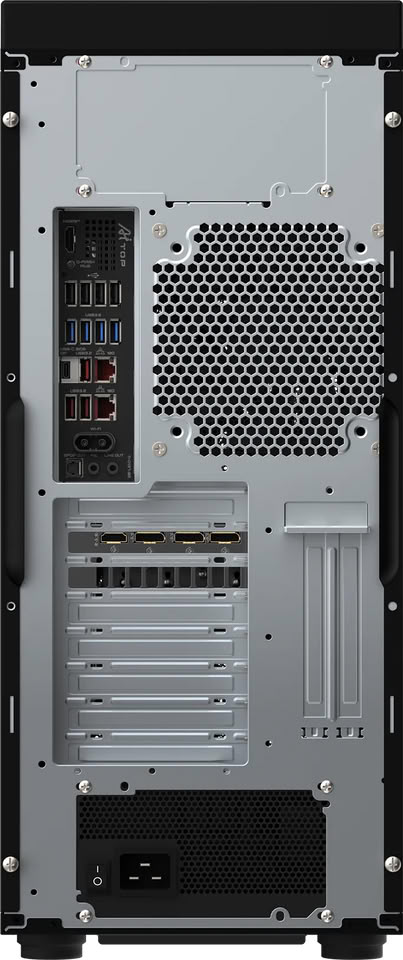
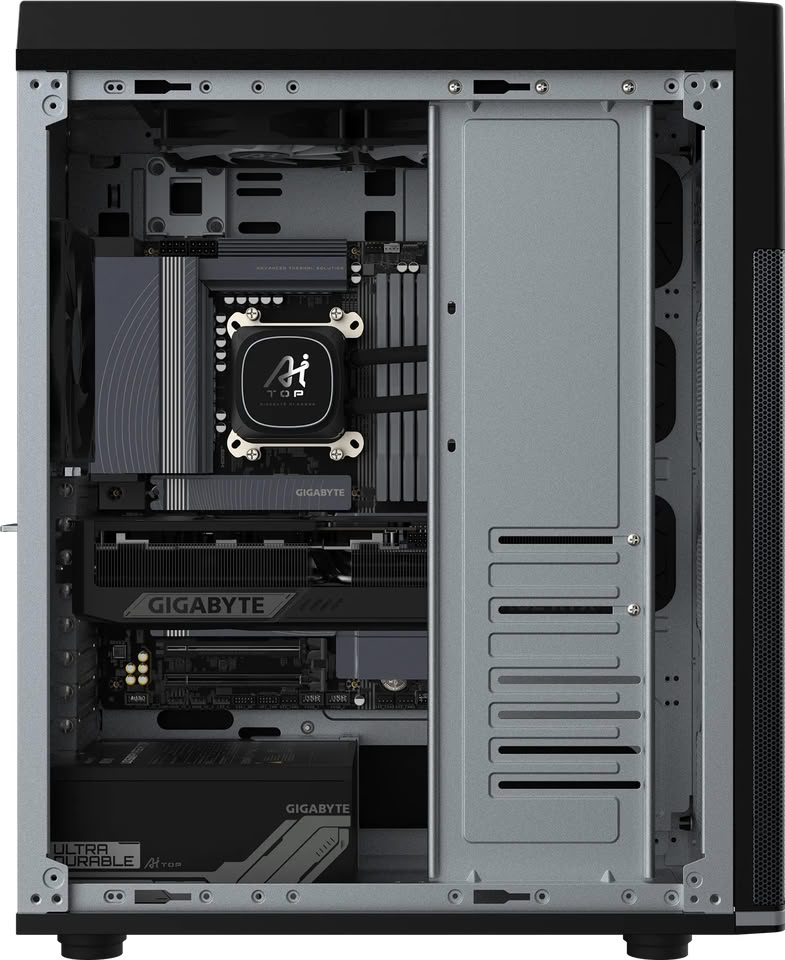
Gigabyte Accelerates Deskside AI Development with AI TOP 100 B850

Gigabyte, a global leader in computer hardware, today announced the Gigabyte AI TOP 100 B850, a high-performance desktop engineered to bring workstation-class AI compute directly to the deskside. Designed to reduce cloud dependence and lower the barriers to local deployment, the system enables businesses, developers, and researchers to run advanced AI workloads locally, giving them greater control over sensitive data and AI infrastructure while reducing reliance on cloud and token-based services.

Built for Next-Generation AI Development
At the heart of the Gigabyte AI TOP 100 B850 is the 16-core, 32-thread AMD Ryzen 9 9950X processor, delivering the performance required for modern AI workloads ranging from local LLM fine-tuning and generative AI to deep learning research and agentic AI. The system comes equipped with 128 GB of DDR5 memory and a 2 TB PCIe Gen 4 SSD, providing ample capacity and high-speed access for large datasets, local model storage, and complex development environments.

Redditor Orders One MSI RTX 5070 Ti From Walmart for $1,099, Gets Four

Orders that get mixed up often tend to leave buyers with the short end of the stick. For instance, in 2025, a Micro Center customer found backpacks inside a Zotac GeForce RTX 5090 box, and another Best Buy customer reportedly got rocks instead of an ASUS TUF RTX 5080 and was initially denied a refund. This time, apparently, the order error went the other way. Reddit user deadmanwonderland_23 says they ordered a single MSI GeForce RTX 5070 Ti 16 GB from Walmart for $1,099 and received four identical cards. The card looks like MSI's Frieren Edition, which comes with a bundled blanket, and currently goes for $1,259 on MSI's website. It was already a relatively good deal at $1,099, but getting four cards really sounds too good to be true. At the price paid, the four cards add up to roughly $4,400, and there's no word on whether the buyer has told Walmart about the extras.

One plausible explanation is that someone in a Walmart warehouse mistook a carton of four cards for a single special edition package. That seems like a possibility, but the actual reason is not currently known. As of now, Walmart hasn't commented on this incident, and the only account comes from a Reddit post, so take it with a grain of salt. Retailers have often let customers keep extra units in the past, though that is usually decided case by case. Walmart has been generous with mistakes before, like when a customer managed to pick up an RTX 5070 for just $129 due to a labeling error. Either way, it's something we don't often see in a GPU market where prices just keep climbing.

PNY Reportedly Denies Melted RTX 5090 Warranty Claim, Says Native PSU Cables Not Covered

PNY has allegedly denied a warranty claim on a burned-out GeForce RTX 5090 and closed the customer's ticket after he asked which part of the warranty it was citing. Redditor u/Melodic_Initial_1767 says his card died last month after both ends of its 12V-2x6 cable melted, on the GPU side and the power supply side. He says the card ran at stock clocks with no overclock, a power limit set below default, and was idle when it failed. The cable he was using was not a cheap third-party adapter; it came bundled with his ASRock PG-1600G power supply.

According to the Redditor, PNY's denial stated that only a PNY-approved cable or adapter is covered, and that damage from a third-party cable, adapter, or PSU cable falls on that maker instead. He says he checked PNY's warranty document and installation guide and found no mention of approved cables, connectors, or the 12V-2x6 standard in either. When he asked twice which clause backed the denial, a "Senior Technician" reportedly said the decision was final and closed the ticket without answering.

Wici Wireless eGPU Promises RTX 5060 Ti and 5090 Performance Over Wi-Fi 7

There has been a lot of development in the eGPU scene lately, with Thunderbolt 5, OCuLink, and MCIO 8i providing serious gains in bandwidth and throughput for eGPU use cases. However, Wici has just launched the Wici One, a new wireless eGPU solution that relies on Wi-Fi 7 for data transfer instead of a cable connection, available with both an NVIDIA GeForce RTX 5060 Ti or an NVIDIA GeForce RTX 5090, the latter of which does not yet have a listed price.

While Wi-Fi 7 is capable of theoretical maximum speeds of around 46.1 Gbps, as VideoCardz points out, the 4×4 radio inside the Wici One, running at 320 MHz and 4096-QAM, would top out at just 11.5 Gbps. To add to this limitation, those speeds are likely only possible over very short distances, with very little interference. Still, Wici promises high-framerate gaming over the network-connected device, with Cyberpunk 2077 reaching 80 FPS at 4K Ultra with DLSS 4 on the RTX 5060 Ti version and Black Myth: Wukong hitting 60 FPS in the 4K Cinematic preset. No latency claims are made, however, but, gaming, a latency-sensitive workload, isn't Wici's main selling point. The true focus for Wici is as a workstation machine, since it contains not only a GPU. The Wici One is actually a full platform, replete with a CPU and storage—presumably, the platform relies entirely on VRAM, since there are no RAM specs or quantities listed.

DLSS 5 Boosts RTX 5090 Connector Power Spikes to 647 W, Pushing Past 90°C

NVIDIA's DLSS 5 has been controversial ever since its announcement and eventual launch. Perhaps more concerning than the visual changes is its effect on the user's hardware. As reported by Videocardz, Korean outlet QuasarZone ran its own thermal tests on the RTX 5090's power connector with DLSS 5 enabled, to see if the technology really has a hand in recent reports of melting 12V-2x6 connectors. Testing an RTX 5090 Founders Edition in Cyberpunk 2077 at 4K with DLSS Quality and the Ultra preset over 20 minutes, the 12V-2x6 connector reached 91.7°C on the sense-pin side with DLSS 5 on, up from 80.9°C without it. The latch side climbed from 77.1°C to 83.4°C. An RTX 5080 FE tested the same way stayed far cooler, reaching just 48.6°C and 52.2°C at those two points with DLSS 5 enabled.

The increased heat aligned with a real jump in power draw. HWiNFO logged the RTX 5090's average power draw rising from 509.2 W to 575.1 W with DLSS 5 on, right at its 575 W limit. The RTX 5080 went from 298.2 W to 350.3 W, close to its own 360 W ceiling. External PCAT readings, which also catch short spikes, showed higher figures still: total board power rose from 527.3 W average and 582.5 W peak to 593.9 W average and 658.0 W peak. On the 16-pin 12V-2x6 connector alone, the RTX 5090 pulled 582.7 W on average and briefly spiked as high as 646.7 W. Of course, transient power spikes over 600 W are normal, and are not necessarily to blame for any melting connector issues. The increased power draw, however, lines up with Tom's Hardware's early DLSS 5 testing, which showed a noticeable jump in power draw with DLSS 5 enabled.

NVIDIA RTX 5090 Sells Out at Walmart for $4,299 After 10,000 Shoppers Add It to Cart

Walmart's GeForce Week promotion briefly listed MSI's GeForce RTX 5090 32 GB Gaming Trio OC at $4,299.99, and it sold out after showing up in roughly 10,000 shoppers' online carts. The listing has since gone out of stock, according to Videocardz, who first spotted it. That price sits about $2,300 above NVIDIA's $1,999 MSRP, a premium of roughly 115 percent. On paper, that looks steep, but RTX 5090 prices have been climbing hard lately, with some cards reportedly passing $9,000 to $10,000 on the secondary market. Against that, $4,299 from a major retailer apparently looked like a decent option.

It says a lot about how tight the RTX 5090 market has gotten that 10,000 people still added it to their carts. Part of the shortage seems to come from AI firms reportedly picking up RTX 5090 stock in bulk before it reaches gaming-focused retail, though it's hard to say how much of the scarcity traces back to that versus general Blackwell supply limits. The MSI Gaming Trio OC itself is a solid variant, with 21,760 CUDA cores, 32 GB of GDDR7 memory on a 512-bit bus, a 2,482 MHz boost clock, and a 575 W power draw. NVIDIA hasn't announced a successor to the RTX 5090 yet, so anyone chasing the fastest consumer GPU right now has very little room to negotiate on price.

CyberPowerPC Launches RTX Founders Edition Pre-Built PCs Starting at $1,549

NVIDIA's Founders Edition graphics cards are generally restricted to its own retail channels, but it seems as though CyberPowerPC has a limited run of RTX 50-series GPUs available in its pre-built gaming PCs for a GeForce Week event, which is slated to run until September 27. The CyberPowerPCs are currently available at Walmart with an NVIDIA GeForce RTX 5070 Founders Edition, RTX 5080 Founders Edition, or RTX 5090 Founders Edition, with CPU configs including both AMD and Intel variants.

There are two versions of the RTX 5070-powered gaming PCs at Walmart. Both feature 32 GB of DDR5-6000 RAM, 1 TB of PCIe 4.0 SSD storage, 360 mm closed-loop liquid coolers, and the aforementioned NVIDIA RTX 5070 Founders Edition GPUs inside a CyberPowerPC MA-01 case. The only difference between them is that the $1,599 variant comes with an AMD Ryzen 7 7800X3D, while the version featuring an Intel Core i7-14700KF comes in at $1,549.

Manufacturers Reportedly Planning Both 4 GB and 6 GB GDDR7 Chips For 2027-28

The NVIDIA GeForce RTX 5090 currently ships with 2 GB GDDR7 modules, but even 3 GB modules have seen limited adoption due to their high cost. However, that could change soon. According to Weibo leaker Golden Pig Upgrade, memory manufacturers are reportedly planning 4 GB and 6 GB GDDR7 chips for a 2027 to 2028 window, a jump that could reshape how much VRAM budget and mid-range GPUs can carry without needing a wider memory bus. A 128-bit card using four memory packages currently tops out at 8 GB with today's 2 GB chips. Move to 4 GB chips and that same card could hit 16 GB, or 24 GB with 6 GB modules. Scale that up to a 256-bit interface with eight packages, and you're looking at 32 GB or 48 GB respectively, without touching the PCB layout or bus width. Of course, going the other way is possible too, a narrower memory bus combined with higher density, faster memory chips, can lead to similar bandwidth, with lower relative cost.

This would matter most at the low end, where narrow 128-bit buses have made generous VRAM capacities either awkward or expensive to pull off. Videocardz, citing supply chain sources, notes that today's 3 GB GDDR7 chips are already unusually expensive due to extreme demand, and that cost has reportedly contributed to delays around the rumored RTX 5050 9 GB and the RTX 50 Super refresh. If 4 GB chips end up cheaper to produce at scale, they could become the more practical choice for mainstream cards, while 6 GB modules might make more sense for workstation and other high-memory GPUs first. It's worth noting that the leaker's timeline only points to sometime in 2027 or 2028, so there's no confirmation this lines up with NVIDIA's RTX 60 series or AMD's next Radeon generation specifically.

NVIDIA RTX 5080 Reportedly Dies After DLSS 5 Test in Modded GTA 5

An MSI GeForce RTX 5080 16G Ventus 3X reportedly stopped working after its owner injected an unofficial version of DLSS 5 into a heavily modded copy of Grand Theft Auto 5. Reddit user "wax469" said the card had been running fine for about a month before the crash. According to the post, the screen began flashing uncontrollably about five minutes into a session, and the system refused to boot afterward. Swapping to his Ryzen 9 9950X3D2's integrated graphics let the PC start normally, and reinstalling the RTX 5080 brought the failure back. A replacement card of the same model has apparently worked without issues since.

It's worth being cautious here. NVIDIA has not released DLSS 5 for GTA 5, so the injection relied on unofficial tools, and the user says the card was running at stock settings with no overclock. There's no photo evidence of physical damage, and it's entirely possible a manufacturing defect was already present and just got exposed under load. Whether DLSS 5 had anything to do with it remains unconfirmed. The user was running a heavily modified version of GTA 5 Legacy, and adding unofficial DLSS 5 seems to be what eventually led to the failure.

Mod Pushes NVIDIA RTX 5090 Laptop GPU to 225 W

Gaming laptop GPUs are generally power limited, which often results in significant performance losses compared to their desktop contemporaries, especially for higher-powered GPUs. However, a new mod called NvpwrControl aims to increase performance of NVIDIA's latest RTX 50-series gaming laptops by increasing their power targets using baked-in power policies not available to consumers.

The developer, who found the workaround by reverse-engineering NVIDIA's power management path, says that the mod supports the RTX 5070 Ti, 5080, and 5090 GPUs, with 140 W TGP 5070 Ti GPUs getting power targets all the way to 180 W. The 5070 Ti is the GPU with the most robust support so far, with the developer explicitly stating that RTX 5080 and 5090 support is experimental. Purportedly, the RTX 5080 and 5090 should be able to reach as high as 225 W with NvpwrControl, although that doesn't come without risks and caveats.

NVIDIA Reportedly Rejected RTX 5090 RMA Over Faded Serial Number

An RTX 5090 Founders Edition owner says NVIDIA turned down a warranty claim because the serial number on the card's metal bracket had faded past the point of being readable. According to a Reddit post on r/NVIDIA from user Willing-Avocado-4830, the card began throwing black screen crashes under heavy load, so the owner returned it to NVIDIA for an RMA. After roughly a month of waiting, NVIDIA reportedly rejected the claim with little explanation, and a follow-up email revealed the reason. The printed serial number was apparently too faded to confirm.

The owner claims to have never removed the bracket, and still has the original box and matching invoice. That raises an obvious question, since the same serial number is printed on the card's modular PCIe connector too, and can reportedly be pulled from Windows using NVIDIA's SMI tool, at least while the GPU still boots. NVIDIA rejecting an RMA simply due to a faded serial number is questionable, to say the least, especially with RTX 5090 stock already scarce and prices well above MSRP. Here's what the faded serial number looks like, according to another Redditor who shared this image.

NVIDIA Unveils RTX PRO 5500 "Blackwell" Workstation GPU with 84 GB GDDR7 Memory

NVIDIA today quietly added another card to its pro-viz product lineup with the RTX PRO 5500 "Blackwell" workstation GPU edition. Featuring 84 GB of GDDR7 memory, it is equipped with a GB202 die that includes 21,760 CUDA cores. This is the same CUDA core count as the consumer GeForce RTX 5090 SKU, but it is now certified for professional workloads and has a much higher memory capacity. The 84 GB of GDDR7 is connected to the GB202 with a 416-bit memory bus that delivers about 1,398 GB/s of memory bandwidth. This would put each GDDR7 memory chip at about 26 Gbps per pin, which is a standard GDDR7 memory speed, but not the fastest available on the market. Additionally, to achieve the massive 84 GB capacity, there need to be 28 memory modules. NVIDIA placed 14 GDDR7 modules on the front side with the GPU die and 14 GDDR7 modules on the back of the PCB, effectively sandwiching the PCB.

Compared to the rest of the RTX PRO lineup, the new RTX PRO 5500 "Blackwell" sits just a tick below the flagship RTX PRO 6000 SKU, which has a slightly higher CUDA core count of 24,064 and a 96 GB memory capacity. However, the RTX PRO 5500 is also much more powerful than the RTX PRO 5000 in the 5000 tier. The RTX PRO 5000 "Blackwell" has a much lower CUDA core count of 14,080 cores, with up to 72 GB of memory. Technically, the new SKU is much closer to the RTX PRO 6000 than the RTX PRO 5000 SKU, just with a slightly lower core count and memory capacity. The official specification sheet follows, courtesy of PNY.

AI Firms Are Reportedly Buying NVIDIA RTX 5090 GPUs in Bulk for Server Use

New photos shared by HKEPC allegedly show pallets of brand-new, boxed GeForce RTX 5090 cards being unpacked at AI server assembly sites. Notably, these firms are not using the RTX PRO 6000 or dedicated data center accelerators NVIDIA actually markets for that work. The cards in question are standard retail RTX 5090s, the same cards gamers have struggled to find at anywhere close to MSRP, being pulled straight from their packaging and slotted into multi-GPU AI rigs. It must be mentioned that some elements of these photos appear to be altered, or at least edited with AI, so take these with a bit of caution.

Despite that, the current situation is not entirely new. During the crypto boom, miners bought up GeForce cards in bulk while gamers got squeezed out, and NVIDIA eventually responded with Lite Hash Rate models that throttled mining performance without touching gaming specs. That restriction got fully bypassed within about a year. This time, the workload is AI instead of mining, but the outcome for gamers looks familiar. As a result, retail RTX 5090 pricing has reportedly climbed past $5,000 on some listings, more than double its $1,999 launch price. Industry analysts even warned about this possibility months ago, and we now have a good idea why the RTX 5090 is at the price it's at.

ASRock's TempGuard Failed to Stop a PSU-Side Connector Meltdown on a $15,000 RTX PRO 6000 Rig

A repair shop technician has reported another melted 16-pin power connector on an ASRock Taichi TC-1650T PSU, paired with a $15,000 NVIDIA RTX PRO 6000 Blackwell Workstation Edition GPU. The former ships with native 12V-2x6 cables carrying ASRock's own NTC temperature sensor. According to the technician's Reddit post, the connector failed catastrophically on the PSU side and melted into the socket itself, even though both ends of the cable were fully seated. The GPU reportedly survived, and the damage was confined to the power supply side. The technician also says the sensor is mounted on the wrong side of the cable, on the ground line rather than the 12 V side it's supposed to watch, which would explain why it apparently never caught the rising heat in time.

ASRock added the NTC sensor and TempGuard system to its 12V-2x6 cables specifically to shut a system down before a connector melts. This time the system failed to catch the rising temperatures, but it has worked in the past. TempGuard reportedly caught a shunt-modded RTX 5090 pulling over 1,300 W, saving its power connectors from melting. On the flip side, this isn't the first time this exact GPU and PSU pairing has run into trouble either, as a similar melting incident on the same combo surfaced back in March. If the sensor placement is really off on at least some cables, that's a bigger concern than one bad unit, especially when paired with a card that costs as much as a used car.

NVIDIA is Giving Away RTX 5090s Through an NBA 2K27 Screenshot Contest

NVIDIA has launched the NBA 2K27 DLSS 5 Poster Challenge, giving away four custom RTX 5090 graphics cards as prizes. Given what the card actually costs to buy right now, the timing is a little funny. To enter, players capture an in-game NBA 2K27 screenshot or clip with DLSS 5 enabled on an RTX 50-series GPU, or through GeForce NOW Ultimate streaming from RTX 5080 servers, then post it tagging @NVIDIAGeForce with the hashtag RTXPoster. Easier entry paths exist too, like voting on other posters or replying to prompts on GeForce's social channels. The contest runs through December 31, with winners announced by the end of January 2027.

NVIDIA values each card at $2,599, including the custom NBA 2K27 wrap. That number looks almost quaint next to what the RTX 5090 actually sells for. Multiple retail trackers put US street prices well past $5,000 this month, more than double the card's $1,999 launch price, largely thanks to the GDDR7 memory crunch that has been squeezing the entire GPU lineup. Prices have kept climbing for months now, with no sign of letting up. So, oddly enough, winning a poster contest might be one of the more realistic ways to grab an RTX 5090 without draining your bank account. It's a fun bit of marketing for a card that's become something of a punchline for how far GPU pricing has drifted, though I doubt NVIDIA meant it that way.

Modified GeForce RTX 5090 with 96 GB Memory Shows Up on Alibaba for Nearly $4,000

A Chinese manufacturer is now selling a modified GeForce RTX 5090 with 96 GB of memory, three times the 32 GB on the retail card. Shenzhen Suqiao Intelligent Technology, an OEM/ODM with over a decade of experience building graphics cards, motherboards, and servers, listed the card on Alibaba for $3,888. That's roughly 35% less than a standard RTX 5090 currently costs in the US, and a fraction of what NVIDIA charges for its RTX PRO 6000 Blackwell. The latter uses the same GB202 die and now starts at a whopping $16,000.

Suqiao likely built this with a custom PCB running clamshell memory, packing GDDR7 modules on both sides of the board to double capacity, the same approach NVIDIA itself uses on the Pro 6000. The GPU die may come from harvested RTX 5090 units, reballed onto the new board and running on leaked or modified firmware, a method Chinese workshops already used to push the RTX 4090 to 48 GB VRAM. The listing does raise some doubts, though, since it mentions GDDR6X memory at 14 Gbps, which doesn't line up with a genuine 96 GB Blackwell build.

NVIDIA RTX 5090 Shoots Past €5,000 in Germany, Prices Jump 73% Since January

GeForce RTX 5090 prices in Germany have now pushed past €5,000, with the cheapest listed model on Geizhals coming in at €5,242.94 for the INNO3D iCHILL Frostbite Pro. Hardwareluxx, which first flagged the price increase, reports that there isn't a single RTX 5090 currently listed below €5,200 in the German market, and several mainstream models are edging toward €5,500. The same card was going for around €3,029 back in January, so that's roughly a 73% jump in eight months. NVIDIA's Founders Edition RTX 5090, when it's actually in stock, is still priced at €2,099, meaning custom cards now cost well over double that.

Germany isn't alone in this crisis. RTX 5090 pricing in the US recently crossed $5,000 too, and NVIDIA hasn't addressed either situation publicly. Instead, the company appears to be leaning on event-based promotions, like the one it ran at PAX West, to hand out occasional MSRP units rather than dealing with the overall pricing problem. The rising cost of GDDR7 memory tied to AI demand appears to be the main driver, and board partners have apparently been passing those costs straight to consumers for months.

Modders Get RTX 5090 Running on 8-Pin Connectors, Ditching NVIDIA's Melting 16-Pin Design

Modders at the Brazilian YouTube channel TecLab have an RTX 5090 running on three standard 8-pin PCIe connectors instead of the 16-pin design that keeps melting on high-end NVIDIA cards. The team stripped a Galax GeForce RTX 5090D HOF OC LAB XOC down to the bare PCB, removed both native 16-pin inputs, and soldered three 8-pin connectors straight to the power regulators. Sense pins were rewired so the card would still request full power, with liquid cooling keeping temperatures in check.

During a livestream, the modders ramped the card from 400 W to 900 W across the three cables, pulling over 120 A while holding a 3,400 MHz clock. Two connectors still delivered 66 A at 3,200 MHz, and even a single 8-pin managed 65 A at 3,100 MHz. The mod stayed entirely at the hardware level, with no BIOS or software tweaks involved. Throughout the test, the modified RTX 5090 stayed within its power and thermal limits, and passed all tests with flying colors.

Japanese Retailer Predicts Further GPU Price Hikes

We recently reported that NVIDIA's RTX 50-series GPU prices rose by a median 41% between August and July 2026, putting the RTX 5090 at a whopping $4,700+. However, it seems as though the DRAM and GPU crisis is not quite done emptying the pockets of gamers just yet. According to one Japanese retailer, Applied Group (アプライド), GPU prices are slated to rise in the coming months or weeks yet again.
Applied Group on X (machine translated)There's talk about graphics card price hikes, but some graphics cards are slated for even further price increases. For those considering an upgrade, I recommend doing so sooner rather than later.

DLSS 5 Testing Ends in a Melted RTX 5090 Connector, Power Shoots Past 600 W

DLSS 5 seems to be contributing to increased power draw, and we have our first victim here. Videocardz reports a new melted-connector case on an MSI GeForce RTX 5090 Gaming Trio OC, which surfaced during DLSS 5 Neural Rendering testing in NBA 2K27, currently the only officially supported game. A reader nicknamed erek documented the incident, noting DLSS 5 pushed the card's power draw from around 450 W to over 600 W, which is above MSI's 575 W rating. A GPU-Z screenshot showed a peak board power reading of 613.5 W, which erek says held steady rather than spiking briefly.

Erek reported the card stopped working shortly after, and a burning smell led him to find that the connector's plastic had melted and fused to the socket. We already reported last week that DLSS 5 can push the RTX 5090's power draw unusually high, so this seems to be the first reported case where that added power draw has burned the notorious RTX 5090 power connectors. However, it should be remembered that GPU-Z tracks total board power rather than just the auxiliary connectors, since the PCIe slot also supplies power, so the reading doesn't necessarily mean the connector carried the full load.

NVIDIA Offers GeForce RTX 50-Series Founders Edition GPUs at MSRP at PAX West

Getting any modern GPU at reasonable prices or MSRP is almost impossible these days, but NVIDIA is making an exception at this year's PAX West. At the convention in Seattle, Washington, NVIDIA is offering its GeForce RTX 50-Series Founders Edition graphics cards at MSRP pricing. This means that the GeForce RTX 5070, RTX 5080, and RTX 5090 Founders Edition GPUs can be purchased at their original prices. The GeForce RTX 5070 Founders Edition is priced at $549, while the GeForce RTX 5080 Founders Edition is listed at $999 MSRP. The flagship GeForce RTX 5090 Founders Edition GPU is listed at $1,999 MSRP, a price that is nearly impossible to find these days.

These deals are especially beneficial for gamers who didn't purchase a new GPU before the supply chain shortage drove prices to astronomical levels. For example, you can expect to pay around $850 for any AIB-designed GeForce RTX 5070, anywhere from $1,600 and up for an AIB version of the GeForce RTX 5080, or above $5,000 for the flagship GeForce RTX 5090. NVIDIA's GeForce Evangelist Jacob Freeman noted that at PAX West, gamers can buy Founders Edition GPUs at MSRP only while supplies last. He also mentioned that GeForce trading cards are available as well.

NVIDIA Confirms DLSS 5 for GeForce RTX 40-Series is Coming

NVIDIA has officially confirmed that the company is working to bring DLSS 5 neural rendering to the previous-generation GeForce RTX 40-Series "Ada Lovelace." Previously, it was believed that DLSS 5 technology would be exclusive to the latest GeForce RTX 50-Series "Blackwell" and future models, without looking back. As NVIDIA continues to focus on hardware-software cooptimization, we now have official confirmation that the GeForce RTX 40-Series will also receive a DLSS 5 port. However, the launch of DLSS 5 on the GeForce RTX 40-Series is secondary, as NVIDIA is still preparing and optimizing performance for the GeForce RTX 50-Series to ensure that the model won't significantly impact the final game performance, despite reportedly being very compute-heavy.
NVIDIADLSS 5 is our most computationally demanding model to date. Since we initially announced it in March, we've achieved a 5X performance gain and there's more to come. Our current focus is on optimizing performance for the GeForce RTX 50 Series with model updates expected later this fall. Once RTX 50 Series performance is more fully tuned, we plan to work on expanding official support to the GeForce RTX 40 Series.
Return to Keyword Browsing
Nov 22nd, 2026 00:48 PST change timezone

New Forum Posts

Popular Reviews

TPU on YouTube

Controversial News Posts