News Posts matching #power connectors

Return to Keyword Browsing

Massive Four-GPU RX 470 Card Surfaces, Probably Built for Crypto Miners

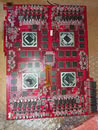
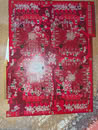
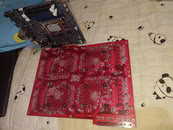
X user GOK has shared photos of a huge red graphics card that carries four Polaris GPUs on a single PCB, jokingly asking whether it might be the biggest PCIe graphics card in the world. The four GPUs sit in a 2x2 layout, and each one appears to be surrounded by eight GDDR5 memory chips, which would mean 8 GB per GPU and a gigantic 32 GB across the board. According to GOK, a sticker on the card identifies it as a quad RX 470, which would work out to 8,192 stream processors in total. Feeding all of that are four 8-pin power connectors, while the only display output is a single HDMI port. A second photo shows the card lying next to a motherboard, and it's noticeably bigger than the board itself.

The PCB does carry an AMD logo next to a "DYII-XQ570 V1.0" marking, but it looks like AMD may not have built this one. GOK pointed out that the card has no board OPN (part number) and that the marking doesn't follow AMD's official format, adding that small factories in China sometimes put the AMD logo on their own designs. He also identified the PCIe switch as a PI7C9X2G, a PCIe 2.0 part, and thinks the card was likely made by one of those factories for crypto miners. He hasn't tested it yet, since he doesn't have a heatsink for it. Multi-GPU Polaris mining boards aren't new either, as Sapphire had a dual RX 570 mining card with 16 GB and a single HDMI port back in 2021.
KINGPIN Says a Connector Dispute With NVIDIA Derailed EVGA's Last Flagship Card

Vince "KINGPIN" Lucido has blamed NVIDIA for the troubled launch of the EVGA GeForce RTX 3090 Ti KINGPIN, the last graphics card to carry his name. In the first video on his new Overclocking Kingpin YouTube channel, the overclocker said he wanted the card to have two 12VHPWR power connectors, while NVIDIA wanted it limited to just one. The disagreement, in his words, "really screwed up the production timeline", and he also holds it responsible for how few units were made afterward. The card did eventually ship with both 16-pin connectors when it went on sale for $2,500 with a bundled 1600 W power supply, about three months after the RTX 3090 Ti itself came out. This is only Lucido's side of the story, and it isn't clear why NVIDIA pushed for a single connector.

In September 2022, EVGA ended its partnership with NVIDIA and stopped making graphics cards, with CEO Andrew Han pointing to a souring relationship between the two companies. Every card in development was canceled, KINGPIN models included. Lucido is now working with ASUS, which sent over the hardware shown in the video, although no ASUS-made KINGPIN card has been confirmed. He did lay out one condition for such a card: the PCB and power delivery have to let the GPU reach its full potential under liquid nitrogen without the buyer modifying anything. An earlier plan with PNY never produced a card, and Lucido ended up skipping the RTX 50 generation entirely.

Modder Solders Dual 8-Pin Board to RTX 5090's 16-Pin Header, Wires Stay Below 40°C

Melting 16-pin connectors keep making headlines, and some RTX 5090 owners have started taking the protection of their expensive cards into their own hands. Reddit user DallasGrave has modified an MSI GeForce RTX 5090 with two extra 8-pin PCIe power inputs that work alongside the card's original 16-pin connector. According to their post on r/pcmasterrace, a small pickup PCB is soldered to the contacts of the 16-pin header, and that board feeds a second PCB carrying the two 8-pin sockets. The card then runs on three cables in total. DallasGrave says each conductor now carries roughly 3 A, and that the wires never crossed 40°C during a 48-hour run at 550 W, even at the joint. More test data is apparently on the way, so for now these are the modder's own numbers.

The 12V-2x6 revision was supposed to fix the melting power connector issues. In early 2025, NVIDIA said the 16-pin melting issues were over, pointing to the updated connector on the RTX 50-series. However, the first melted RTX 5090 Founders Edition was reported shortly after, in that case with a third-party cable. Since then, several RTX 5090 power connectors have reportedly melted, including one with an undervolt and a -100 W power limit. Moreover, last month Hardware Unboxed watched its RTX 5090 power cable reach 175°C with a single wire pulling around 22 A.

ASRock's TempGuard Failed to Stop a PSU-Side Connector Meltdown on a $15,000 RTX PRO 6000 Rig

A repair shop technician has reported another melted 16-pin power connector on an ASRock Taichi TC-1650T PSU, paired with a $15,000 NVIDIA RTX PRO 6000 Blackwell Workstation Edition GPU. The former ships with native 12V-2x6 cables carrying ASRock's own NTC temperature sensor. According to the technician's Reddit post, the connector failed catastrophically on the PSU side and melted into the socket itself, even though both ends of the cable were fully seated. The GPU reportedly survived, and the damage was confined to the power supply side. The technician also says the sensor is mounted on the wrong side of the cable, on the ground line rather than the 12 V side it's supposed to watch, which would explain why it apparently never caught the rising heat in time.

ASRock added the NTC sensor and TempGuard system to its 12V-2x6 cables specifically to shut a system down before a connector melts. This time the system failed to catch the rising temperatures, but it has worked in the past. TempGuard reportedly caught a shunt-modded RTX 5090 pulling over 1,300 W, saving its power connectors from melting. On the flip side, this isn't the first time this exact GPU and PSU pairing has run into trouble either, as a similar melting incident on the same combo surfaced back in March. If the sensor placement is really off on at least some cables, that's a bigger concern than one bad unit, especially when paired with a card that costs as much as a used car.

Modders Get RTX 5090 Running on 8-Pin Connectors, Ditching NVIDIA's Melting 16-Pin Design

Modders at the Brazilian YouTube channel TecLab have an RTX 5090 running on three standard 8-pin PCIe connectors instead of the 16-pin design that keeps melting on high-end NVIDIA cards. The team stripped a Galax GeForce RTX 5090D HOF OC LAB XOC down to the bare PCB, removed both native 16-pin inputs, and soldered three 8-pin connectors straight to the power regulators. Sense pins were rewired so the card would still request full power, with liquid cooling keeping temperatures in check.

During a livestream, the modders ramped the card from 400 W to 900 W across the three cables, pulling over 120 A while holding a 3,400 MHz clock. Two connectors still delivered 66 A at 3,200 MHz, and even a single 8-pin managed 65 A at 3,100 MHz. The mod stayed entirely at the hardware level, with no BIOS or software tweaks involved. Throughout the test, the modified RTX 5090 stayed within its power and thermal limits, and passed all tests with flying colors.

DLSS 5 Testing Ends in a Melted RTX 5090 Connector, Power Shoots Past 600 W

DLSS 5 seems to be contributing to increased power draw, and we have our first victim here. Videocardz reports a new melted-connector case on an MSI GeForce RTX 5090 Gaming Trio OC, which surfaced during DLSS 5 Neural Rendering testing in NBA 2K27, currently the only officially supported game. A reader nicknamed erek documented the incident, noting DLSS 5 pushed the card's power draw from around 450 W to over 600 W, which is above MSI's 575 W rating. A GPU-Z screenshot showed a peak board power reading of 613.5 W, which erek says held steady rather than spiking briefly.

Erek reported the card stopped working shortly after, and a burning smell led him to find that the connector's plastic had melted and fused to the socket. We already reported last week that DLSS 5 can push the RTX 5090's power draw unusually high, so this seems to be the first reported case where that added power draw has burned the notorious RTX 5090 power connectors. However, it should be remembered that GPU-Z tracks total board power rather than just the auxiliary connectors, since the PCIe slot also supplies power, so the reading doesn't necessarily mean the connector carried the full load.

Modders Bypass RTX 5090's Melting Connector Issue by Soldering Wires Directly to the PCB

Brazilian YouTube group TecLab has bypassed the RTX 5090's notorious melting problem in the most direct way possible. The group removed the 16-pin connector from the equation entirely and soldered power wires straight onto the PCB. The demonstration used a Galax RTX 5090D HOF OC LAB XOC, an extreme-overclocking variant with two 16-pin inputs and a custom BIOS rated for up to 2,000W, far above the 575W TDP of a standard RTX 5090. TecLab framed the mod as a sarcastic jab at NVIDIA, saying that enthusiasts are tired of hearing about connectors melting and that they wanted to show how it should have been done from the start.

The team stripped the card's stock cooler entirely, running the bare GPU under an industrial liquid chiller with two loosely mounted fans for extra airflow. Two adapters converted standard 16-pin PSU cables into bare wires, which were then soldered directly onto the connector traces on the board. No temperature readings were shared, but a roughly 50A draw on the 12V rail put the card at around 600W during testing, and it booted and ran benchmarks without issue.
Return to Keyword Browsing
Nov 11th, 2026 06:15 CST change timezone

New Forum Posts

Popular Reviews

TPU on YouTube

Controversial News Posts