Friday, August 23rd 2019

Alleged Leaked Details on Intel Comet Lake-S Platform Require... You Guessed It... A New Platform
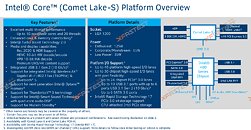
Intel's development of their Core architecture in the post-Ryzen world has been slow, with solutions slowly creeping up in core counts with every new CPU release - but much slowly than rival AMD's efforts. Before Intel can capitalize on a new, more scalable and power-efficient architecture, though, it has to deliver performance and core count increases across its product line to stay as relevant as possible against a much revitalized rival. Enter Comet Lake-S: the desktop parts of Intel's new round of consumer CPUs, which will reportedly see an increase in the maximum core count to a 10-core design. This 10-core design, however, comes with an increase in power consumption (up to 135 W), and the need, once again, for beefier power delivery systems in a new, LGA 1200 package (with 9 more pins that the current LGA 1151).
The move to a new socket and the more stringent power requirements give Intel the opportunity to refresh its chipset offerings once again. If everything stays the same (and there's no reason it should change), new Z470 and Z490 chipsets should be some of the higher tier offerings for builders to pair with their motherboards. The new Comet Lake-S CPUs will still be built in the now extremely refined 14 nm process, and allegedly keep the same 16 PCIe 3.0 lanes as current Coffee Lake Refresh offerings. The new CPU offerings from Intel are expected to roll out in Q1 2020.
Sources:
XFastest, via Tom's Hardware
The move to a new socket and the more stringent power requirements give Intel the opportunity to refresh its chipset offerings once again. If everything stays the same (and there's no reason it should change), new Z470 and Z490 chipsets should be some of the higher tier offerings for builders to pair with their motherboards. The new Comet Lake-S CPUs will still be built in the now extremely refined 14 nm process, and allegedly keep the same 16 PCIe 3.0 lanes as current Coffee Lake Refresh offerings. The new CPU offerings from Intel are expected to roll out in Q1 2020.


224 Comments on Alleged Leaked Details on Intel Comet Lake-S Platform Require... You Guessed It... A New Platform
including every major BIOS vendor, as well as hardware vendors like ASUS, Toshiba, NVIDIA, and Huawei. However, the widespread nature of these vulnerabilities highlights a more fundamental issue – all the vulnerable drivers we discovered have been certified by Microsoft. Since the presence of a vulnerable driver on a device can provide a user (or attacker) with improperly elevated privileges, we have engaged Microsoft to support solutions to better protect against this class of vulnerabilities, such as blacklisting known bad drivers,” says Eclypsium.
Eclypsium also notes that this issue affects all modern versions of Windows, and that there is currently “no universal mechanism to keep a Windows machine from loading one of these known bad drivers.”
Ive been disabling remote since WXP had it
The only important Nr is performance per Watt, and that ratio is still good with a Intel CPU, luckely AMD is doing a whole lot better in that department now to, whit the 3000 series.
SC delete ServiceNameHere
You should have already disabled the services you wish to delete.
Word of caution! Careful what you delete as restoring deleted services can be very difficult and in certain cases requires a fresh install of the OS.
I use cmd to force defrag my velociraptor.
z370 and z390 too quick and now this...
huge losses and unsold inventory of mobo manufactures incoming..
This kind of stunt with yet another new socket for clearly inferior silicone vs closest competitor is obvious example of losing capacity to think logically. :kookoo: Even cliche, shooting in the foot, backside and so on don't cut it anymore. There is nothing left to shoot. Now AMD has at least 2 years to milk the market.
Let me specifically quote the part that made me post my comment:
new, LGA 1200 package
Only a mentally deficient person would be happy with Intel doing this crap over and over again.
I wouldn't worry about about AMD's BIOS flashing bug, or the various CPU bugs like Spectre, Meltdown and all their siblings. These are all bugs which require you to have direct access or even administrative privileges already (for the BIOS flash). Spectre, Meltdown etc. is basically irrelevant for end users, they require someone to execute their code on your CPU, find something useful, and then somehow extract that data out of your computer. So it basically needs at least one or two other vulnerabilities to even be theoretically feasible. Don't get me wrong; every bug should be addressed, but that doesn't mean it's a big deal for end users. Bugs like this is also why in IT all good security practices are done by doing security in layers, since bugs in applications/services/libraries, drivers, operating systems, BIOS/EFI or hardware level, or of course user error are bound to happen sooner or later.
These bugs are primarily a concern for cloud hosting providers, where any random virtual machine may execute the next code on the same CPU. In theory people could extract tiny fragments of memory, and by luck find something useful. But in practice, dumping a hypervisor's 100s of GB of memory at up to a few kB/s, finding and dumping the all-important (and constantly changing) page table of the VM and then assembling continuous application memory page by page, let's just say that the memory you're dumping will change at a much higher rate than your dumping it.
TLDR; You shouldn't care about these bugs. But Intel and AMD should learn from it.
Browsers do know this and did some work to further mitigate the risk of Spectre.
But running other people's code is done everyday. Ad networks and other such third parties are examples of code end users do not explicitly consent for, but do run.