Monday, August 18th 2025

Microsoft Windows 11 24H2 Update May Cause SSD Failures
Microsoft issued an OS security update as part of the August 2025 Patch Tuesday cycle to counter the Lumma stealer and similar malware and exploits. The Windows 11 24H2 cumulative package KB5063878 was included in that rollout. Early deployments returned an installation error, 0x80240069, which Microsoft acknowledged and later addressed. Community testing has since identified a reproducible pattern in which certain SSDs, when running sustained sequential writes of approximately 50 GB, become inaccessible and display unreadable SMART telemetry. Follow-up analysis and vendor feedback to date primarily point to solid-state drives, although conclusions about traditional spinning hard disk drives remain unconfirmed.
A Japanese tester NichePCGamer published a 21-drive matrix and a repeatable procedure: copy a large game folder, write an approximately 62 GB archive composed of many video files to the target SSD, then decompress that archive on the same device. Failures were reported most frequently when controller utilization exceeded 60% during continuous writes. Reported devices include several Phison-based NVMe models and other drives using different controllers. Symptoms reportedly recur after a reboot, which often restores visibility temporarily but does not eliminate the underlying fault, creating a risk of file corruption if the same workload is repeated. Microsoft and SSD vendors are investigating and have not yet published a definitive root-cause report. Until vendors and Microsoft publish formal guidance, users with SSDs should back up important data, avoid long sequential transfers on systems updated to KB5063878, and monitor vendor and Microsoft advisories for SSD-specific firmware, driver, or OS fixes.
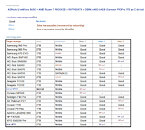
Update 14:02 UTC: Phison has posted an update, acknowledging the issue.
Update Aug 21st: Phison has reached out to us to let us know that some documents about this issue are fake.
Sources:
via Neowin, Notebookcheck
A Japanese tester NichePCGamer published a 21-drive matrix and a repeatable procedure: copy a large game folder, write an approximately 62 GB archive composed of many video files to the target SSD, then decompress that archive on the same device. Failures were reported most frequently when controller utilization exceeded 60% during continuous writes. Reported devices include several Phison-based NVMe models and other drives using different controllers. Symptoms reportedly recur after a reboot, which often restores visibility temporarily but does not eliminate the underlying fault, creating a risk of file corruption if the same workload is repeated. Microsoft and SSD vendors are investigating and have not yet published a definitive root-cause report. Until vendors and Microsoft publish formal guidance, users with SSDs should back up important data, avoid long sequential transfers on systems updated to KB5063878, and monitor vendor and Microsoft advisories for SSD-specific firmware, driver, or OS fixes.


Update Aug 21st: Phison has reached out to us to let us know that some documents about this issue are fake.
278 Comments on Microsoft Windows 11 24H2 Update May Cause SSD Failures
It's not drives or firmware it's Microsoft's incompetence!!Cuz they wanna point the finger at drive manufacturers instead. I think all the drive manufacturers need to sue tf outta Microsoft along w end users!! Cuz this is worse than crowdstrike!!!
* for clean install.
www.gamingonlinux.com/2025/08/battlefield-6-will-be-a-unplayable-on-linux-systems-due-to-the-anti-cheat/
Even if other SSDs or even HDDs should have the same or similar defects, doesn't negate the fact that it's a "hardware" issue. (Kind of analogous to the Spectre vulnerabilities where independent CPU designs had similar flaws.) Whether it's caused by malformed requests or specific sequences of requests, it's the drive's responsibility to handle any incoming requests correctly. This is sloppy QA and poor engineering.
ByPassIO is not added by simply setting the manifest value, it needs the DDI support as well.
I think my next ssd update will be Samsung again, but not sure about OS (Ubuntu sounds better).
soon to be replaced since it's been very slow with even 1GB file transfers and the latency with music production has been bad. This is a dell precision 3550 laptop w 10th gen i5 4c8t so it's far from being slow.
my 8th gen latitude 5400 w a micron sata ssd is faster w file operations and doesn't have the latency issues w the same OS, same DAW, and 8th gen i5 cpu clocked about the same. and this wd blue drive is nvme so shouldn't be slower than sata!
M.2 was used for both SATA and NVMe. Are you sure your wd blue is actually NVMe?- nevermind I see in the screenshot Linux sees it as NVMe.Do you know what the PCIe negotiated speed ended up being for your WD Blue? It is possible it's not running at full speed?