Monday, August 18th 2025

Microsoft Windows 11 24H2 Update May Cause SSD Failures
Microsoft issued an OS security update as part of the August 2025 Patch Tuesday cycle to counter the Lumma stealer and similar malware and exploits. The Windows 11 24H2 cumulative package KB5063878 was included in that rollout. Early deployments returned an installation error, 0x80240069, which Microsoft acknowledged and later addressed. Community testing has since identified a reproducible pattern in which certain SSDs, when running sustained sequential writes of approximately 50 GB, become inaccessible and display unreadable SMART telemetry. Follow-up analysis and vendor feedback to date primarily point to solid-state drives, although conclusions about traditional spinning hard disk drives remain unconfirmed.
A Japanese tester NichePCGamer published a 21-drive matrix and a repeatable procedure: copy a large game folder, write an approximately 62 GB archive composed of many video files to the target SSD, then decompress that archive on the same device. Failures were reported most frequently when controller utilization exceeded 60% during continuous writes. Reported devices include several Phison-based NVMe models and other drives using different controllers. Symptoms reportedly recur after a reboot, which often restores visibility temporarily but does not eliminate the underlying fault, creating a risk of file corruption if the same workload is repeated. Microsoft and SSD vendors are investigating and have not yet published a definitive root-cause report. Until vendors and Microsoft publish formal guidance, users with SSDs should back up important data, avoid long sequential transfers on systems updated to KB5063878, and monitor vendor and Microsoft advisories for SSD-specific firmware, driver, or OS fixes.
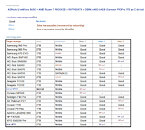
Update 14:02 UTC: Phison has posted an update, acknowledging the issue.
Update Aug 21st: Phison has reached out to us to let us know that some documents about this issue are fake.
Sources:
via Neowin, Notebookcheck
A Japanese tester NichePCGamer published a 21-drive matrix and a repeatable procedure: copy a large game folder, write an approximately 62 GB archive composed of many video files to the target SSD, then decompress that archive on the same device. Failures were reported most frequently when controller utilization exceeded 60% during continuous writes. Reported devices include several Phison-based NVMe models and other drives using different controllers. Symptoms reportedly recur after a reboot, which often restores visibility temporarily but does not eliminate the underlying fault, creating a risk of file corruption if the same workload is repeated. Microsoft and SSD vendors are investigating and have not yet published a definitive root-cause report. Until vendors and Microsoft publish formal guidance, users with SSDs should back up important data, avoid long sequential transfers on systems updated to KB5063878, and monitor vendor and Microsoft advisories for SSD-specific firmware, driver, or OS fixes.


Update Aug 21st: Phison has reached out to us to let us know that some documents about this issue are fake.
278 Comments on Microsoft Windows 11 24H2 Update May Cause SSD Failures
Also is the legal protective foundation to the Unity Analytics Killer Project on github, founded by yours truly. No lawsuits to date.
Do I need to remind you that they've pushed out seriously bugged updates even when knowing those issues?
You either put equal quilt on MS for not doing any testing, or then give also hardware manufacturers that Get Out of Jail Free card.
Copyright would be the chief concern here I'd think. There probably aren't many bona fide patents that still are valid on HPFS / NTFS. Both of those file systems are quite old now, dating back the early 90s if not the 80s.
Obligatory "I am not a lawyer" moment. lol.
But as pointed out, patents on NTFS, if there have been any, are likely all expired. MS should just get over themselves and document the on-disk format or, even better, contribute an NTFS implementation to the Linux kernel.
Even when there's improvements over FAT16, it's still more prone to corruption, thus more limited case uses now. It was from the days where we weren't worried about a non-journalled FS.
Of course, it's less forgiving to power outages and severe brown outs.
Hence why I am back to Windows 10 x64 Pro and ain't looking back.
The nvme emulation in virtual machines aren't exactly robust and corruption is not demonstrated on those, only on bare metal,
There isn't any machine configuration data supplied to connect up to potential PCIE controller errors either.
This could as well be a mainboard chipset errata that only occurs with certain PCIE or SAS controller registers set.No, that award goes to Windows 10 1507.
11 is generally more stable than 10 unless you're one of those morons that carve everything out of the OS because you believe it gets you 1% more framerates (it doesn't)
And the frequency of issues with minor brands is probably much higher than we know, as these are mostly white label products which changes all the time and probably doesn't reach the critical mass.
-----
I find the response from Phison in the new article interesting. It would be interesting to see wheter the problem is exaggerated or if the assumptions about what triggers it is faulty.
11 has generally been less likely to have update errors.Hearts go out to 970 Pro users! I have a 512 GB 970 Pro in one of my builds.
Windows 10 did not become widespread use ready until 1703.
23H2 usually just had an issue where Component Based Servicing (CBS) signals Bluetooth files being corrupted after a patch-Tuesday update.
The 24H2 issues are worse, multiple times now, DISM with restorehealth option failed on 24H2 with error message that the source can't be found, which was not a problem on 23H2.
However, it looks like the restorehealth option possibly has been fixed with the August, 2025 patch-Tuesday.
The July, 2025 patch-Tuesday has been the worst for me.
This should fix that.
Fun fact: The 970 Pro is 512 GB, instead of 500 GB.
It looks extremely sus! It may be due to maximum utilization of PCI-E.