Monday, October 13th 2025

Support for AMD "Zen 6" Confirmed on AM5 Motherboards With 32 MB and 64 MB BIOS Chips
AMD is gearing up to introduce the "Zen 6" family of processors, with initial "Olympic Ridge" designs set to launch on the familiar AM5 socket. The company is staying true to its commitment to maintain socket compatibility across multiple generations, and Zen 6 is expected to follow suit. However, modern motherboards are increasingly equipped with larger BIOS ROM chips, moving from the standard 32 MB to 64 MB. Since the AM5 platform is intended to support several CPU generations, all the necessary microcode for various processors needs to be accommodated. This can lead to space constraints, and we've already seen some manufacturers drop support for older CPUs in newer BIOS versions to make room.
While companies have not been very clear about the reasons for this change, they often use marketing phrases like "Future CPU Ready" or "Ultimate Compatibility." Notably, ASUS mentioned "Zen 6" support in their materials for the X870 AYW GAMING WIFI W, which is intriguing since AMD has not officially confirmed Zen 6 compatibility with AM5. Over the weekend, a well-known hardware leaker, HXL, confirmed that both 600 and 800-series boards will support Zen 6, regardless of whether they have 32 MB or 64 MB BIOS chips. This is reassuring news. However, a lingering question remains: will manufacturers start dropping Zen 4 support on those 32 MB boards to make room, similar to what happened with first-generation Zen when Zen 3 launched on 16 MB boards? This is likely a significant concern for those purchasing motherboards now, and planning an upgrade later on when Zen 6 CPUs arrive.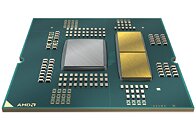
 The Olympic Ridge generation will be a chiplet-based processor, similar to all AMD Ryzen desktop chips since the Ryzen 3000 series. These processors are anticipated to feature Zen 6 cores within CPU complex dies (CCDs) manufactured using TSMC's 2 nm N2 process. For the first time in these generations, AMD is expected to increase the CPU core counts per CCD. The chip is also likely to introduce a new client I/O die (cIOD), probably built on TSMC's 4 nm N4P node. This new cIOD is expected to have a significantly lower TDP compared to the current version built on 6 nm and will include an updated set of DDR5 memory controllers that support higher speeds.
Sources:
HXL, via HardwareLuxx
While companies have not been very clear about the reasons for this change, they often use marketing phrases like "Future CPU Ready" or "Ultimate Compatibility." Notably, ASUS mentioned "Zen 6" support in their materials for the X870 AYW GAMING WIFI W, which is intriguing since AMD has not officially confirmed Zen 6 compatibility with AM5. Over the weekend, a well-known hardware leaker, HXL, confirmed that both 600 and 800-series boards will support Zen 6, regardless of whether they have 32 MB or 64 MB BIOS chips. This is reassuring news. However, a lingering question remains: will manufacturers start dropping Zen 4 support on those 32 MB boards to make room, similar to what happened with first-generation Zen when Zen 3 launched on 16 MB boards? This is likely a significant concern for those purchasing motherboards now, and planning an upgrade later on when Zen 6 CPUs arrive.


53 Comments on Support for AMD "Zen 6" Confirmed on AM5 Motherboards With 32 MB and 64 MB BIOS Chips
16 MB AM4 boards ran into this problem when the fourth generation Ryzen CPU's were planned to be released. Even fifth if you count Piledriver CPU's or whatever they were..
Now we have 32 MB minimum AM5 boards, and we're talking about the third Ryzen generation being launched.
So storage has doubled, which means the space available for microcode have more than doubled. We're 1-2 generations behind the last time this happened, and this time AMD knows this can happen. No I'm not saying the needed storage space stays exactly the same.
I'm pretty sure AMD knows a whole lot more now compared to 2014-15, in the years before the AM4 launch (2016), and the Ryzen launch (2017).
am5 motherboards have to support usb firmware flashes
is the problem using a smartphone or any usb device with storage to flash newer firmware?
i highly doubt a single cpu series needs more than 8mib flash, e.g. 9000 ryzen series only.
There are far fewer of those now.
277 models have 32 MB
8 models have 64 MB
I'm smelling FUD..
geizhals.eu/?cat=mainboards&promode=true&hloc=at&hloc=de&hloc=eu&hloc=pl&hloc=uk&preset=249
If yes, I will be curious to see the idle power on these. May be the first chiplet Ryzens that don't have complete trash idle power usage.
There might be some cases where it is relevant, but honestly, once you complete your system it is rarely modified for a couple of years. Even so, update the bios and switch the CPU. It's still better than replacing half the system because the socket changed, like Intel does.
You didn't even check the whole chart. It shows that while power draw is pretty bad for a lot of AMD chips, it's not because of chiplets:
- The 3900X platform uses about the same W as Intel's. CUltra 200 is a few W lower than that.
- The dual chiplet 3900X platform uses less power in idle than the single chip 8500G platform. We can blame DDR5 all we want, but that chip is still made for laptops and should do better than that. Dual PCH doesn't help here.
I remember an old MSI B450 motherboard I had, it once got a BIOS update to support newer CPUs, and after that, the interface looked a lot more “rugged,” almost primitive if you will. It reminded me of those old blue and gray BIOS screens, just with a bit more color. The fan curve customization options also became much more limited, it lost the modern graphical interface and went back to a more text-based one.
Meanwhile, I went from a 3600 to a 5600G on the exact same platform: same motherboard, same memory, same cooling. The 3600 idled at ~32W and the 5600G was at ~25W, measured from the wall.
When I checked the internal sensors with HWInfo, it showed that the SoC power usage was ~11W on the 3600 and ~4W on the 5600G. So there is a correlation between the measured-from-wall power and the internally reported power figures. Meaning that the SoC power reporting is accurate, and what it measures is the cause of one chip having worse idle power. And the SoC power measures the "uncore" or the IOD, and the chiplet interconnects. This is further evidenced by high SoC power usage being a staple of EVERY chiplet based Ryzen from the 3600 to the 9600, while every monolithic die like the 5600G and 8600G always shows 1-5W SoC usage for everyone. Go and look up HWInfo screenshots for different Ryzen chips, for different people - the APUs will always use single digit watts for the SoC/IOD power, and double digit ones for chiplet based Ryzens (by that I mean 3xxx and above - the 1/2xxx chips are worse for even more reasons).
So my point stands: the current chiplet IOD Ryzen design sucks and it is very wasteful with power. There's a reason they are testing a new type of interconnect with Strix Halo and planning on using it with normal desktop chips as well. I think even Intel is ahead of them in that regard with Arrow Lake, but I didn't deep dive into that, I just saw that it uses chiplets/tiles.
The current AM5 Ryzen IOD also sucks for memory support too. The maximum officially supported speed is 5200/5600 only, and down to 3600 with four modules. Sure they can do better in high end tinkered gamer setups if you tweak things and use the right modules and so on, but it's not guaranteed to work for any chip + memory. They absolutely do need a newer, better IOD.
In reality it's higher because AMD introduced a dual chip high end chipset, which is what every publication uses to test. Willing to bet the single chip solutions are more energy efficient at idle.