Tuesday, October 21st 2025

AMD Could Launch 16-Core Ryzen 9 9950X3D2 CPU with 192 MB L3 Cache and 200 W TDP
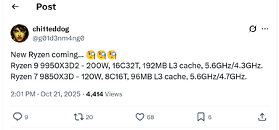
AMD seems to be preparing an update to its "Granite Ridge" Ryzen 9000 X3D series, introducing two new chips targeted at high-performance gamers and creators. Among the two, a new SKU type has appeared, carrying the "X3D2" suffix. Leaks suggest a new flagship model, the Ryzen 9 9950X3D2, featuring 16 cores and 32 threads. This chip reportedly includes 3D V-Cache on both chiplets, totaling approximately 192 MB of L3 cache. It is said to operate at a base frequency of 4.30 GHz, with a boost up to around 5.6 GHz, and has a TDP of about 200 W. The 9950X3D2, with its new naming convention, suggests a tradeoff of slightly lower peak boost speeds (-100 MHz) compared to the single-stack X3D Ryzen 9 9950X3D model, but offers significantly increased cache capacity. This combination could be a sweet spot for cache-sensitive workloads and certain games.
The expanded cache and increased thermal headroom may necessitate more attention to cooling and VRM design for system builders, potentially leading AMD to price these chips at a premium or adjust current MSRPs. A companion model, the Ryzen 7 9850X3D, is expected to follow a similar design with eight cores, 96 MB of L3 cache, and a boost up to 5.6 GHz, with a 120 W power envelope. The 9850X3D appears to be a refined, higher-clocked (+400 MHz) alternative to existing 8-core Ryzen 7 9800X3D models, offering improved single-thread performance that is highly valued by gamers, while maintaining a relatively modest TDP.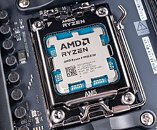
 Both processors are linked to AMD's next-generation V-Cache technology, which reportedly offers better thermal performance and is more conducive to overclocking. These advancements could explain the feasibility of dual-cache retail SKUs. However, these details are still unconfirmed, so they should be considered preliminary. If accurate, AMD's strategy would maintain competitive pressure on Intel's upcoming desktop refresh by emphasizing cache-driven performance rather than solely increasing core counts. Intel's "Arrow Lake Refresh" is on the horizon, but it lacks a 3D V-Cache equivalent until "Nova Lake."
Sources:
chi11eddog on X, via VideoCardz
The expanded cache and increased thermal headroom may necessitate more attention to cooling and VRM design for system builders, potentially leading AMD to price these chips at a premium or adjust current MSRPs. A companion model, the Ryzen 7 9850X3D, is expected to follow a similar design with eight cores, 96 MB of L3 cache, and a boost up to 5.6 GHz, with a 120 W power envelope. The 9850X3D appears to be a refined, higher-clocked (+400 MHz) alternative to existing 8-core Ryzen 7 9800X3D models, offering improved single-thread performance that is highly valued by gamers, while maintaining a relatively modest TDP.


93 Comments on AMD Could Launch 16-Core Ryzen 9 9950X3D2 CPU with 192 MB L3 Cache and 200 W TDP
Didn't AMD park for gaming one of the chiplets in their Ryzen 9 chips, precisely for this reason?
My point: A 9900X3D2 is unlikely at this point in time.
A 6-core CCD+vCache w/ elevated clocks could/would likely be 'salvaged' out of these CCDs.Fair enough to perceive it that way.
The way I see this, it was not possible/economical to build these, prior. a +400Mhz binning on the vCache CCD is notable and indicative of changes under the hood or behind-the-scenes.This. The past several days, I'd been on/off hovering over the Checkout button on a 9800X3D.
TBH, I'd assumed we'd not see dual-vCache CCD Ryzen until Zen6, so I was going to 'settle' on a 9800X3D. Now, I'm stoked for the 9950X3D2; a much more fitting "Upgrade" from my 5800X3D*
*Win10-> Builds:
i7 3770k 4c8t
R5 3600 6c12t
R5 5600 6c12t
R7 5800X3D 8c16tThe distinction mattered with the asymmetric 9900X3D and 9950X3D. This 9950X3D2 is symmetrical.
Core Parking was to keep gaming loads away from the non-X3D cores. That should be a non-issue w/ the 9950X3D2.
What I'm particularly curious about, is how the extra memory bandwidth of the dual-CCD dual-vCache CPU will/will not be utilized. Previously, the extra RAM bandwidth from dual-CCD Ryzen was completely overshadowed Single-CCD X3D. Even though X3D CPUs 'hit RAM' less, I wonder if there'll be any tasks where the improvements will be noticable?
:roll:
Besides Ford bringing back the "Pinto" namesake, I cannot think of a more-unlikely to return branding, than AMD FX.The dual-vCache CCD part, yes. However, AMD's been pretty open about how it was just not an economical product (at the time).
These rumored new Ryzens, are clocked higher than any vCache SKU prior, in a still-manageable TDP range. Absolutely, these would better-binner or revised 9800X3D dies.
Looking back towards AM4 and a then-prospective 5950X3D, clocks would've had to be reduced so much to stay within power/thermal envelope, it wouldn't have performed competitively.
Basically,
How/why is AMD now finding it economical to put 'Enterprise grade' silicon in a consumer product?
IMO,
Moving the vCache underneath the CCD made this rumored 9950X3D2 possible.
The 9800X3D was the top economical consumer-marketable binning for a Zen5X3D CCD.
Market pressures and/or production improvements have now allowed/encouraged an even higher-binning to be consumer-marketed.That's been a key part of Zen5 X3D, in general. The 9850X3D, is more like the 9800X3D getting the "XT" treatment, while adding a new halo-tier SKU to the lineup with the 9950X3D2.
5xxx Series IO Die would have been such a bottleneck it wouldnt have been funny
7xxx series had to give up too much clock speed due to the cache CCD being an insulator affecting thermals
9xxx series still has "issues" around the IO die and cross CCD communication but I bet yields have got to the point of "why not" and certain work loads will get a benefit. I still think games are going to be an issue in the majority of time just due to the nature of how games are extremely latency sensitive.
This is what scalable architectures do.
Correction: I believe the stack would still have to be at the bottom. TSV'd up through each cache stack to the CCD.