Tuesday, October 21st 2025

AMD Could Launch 16-Core Ryzen 9 9950X3D2 CPU with 192 MB L3 Cache and 200 W TDP

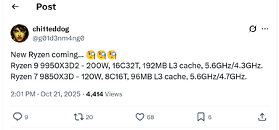
AMD seems to be preparing an update to its "Granite Ridge" Ryzen 9000 X3D series, introducing two new chips targeted at high-performance gamers and creators. Among the two, a new SKU type has appeared, carrying the "X3D2" suffix. Leaks suggest a new flagship model, the Ryzen 9 9950X3D2, featuring 16 cores and 32 threads. This chip reportedly includes 3D V-Cache on both chiplets, totaling approximately 192 MB of L3 cache. It is said to operate at a base frequency of 4.30 GHz, with a boost up to around 5.6 GHz, and has a TDP of about 200 W. The 9950X3D2, with its new naming convention, suggests a tradeoff of slightly lower peak boost speeds (-100 MHz) compared to the single-stack X3D Ryzen 9 9950X3D model, but offers significantly increased cache capacity. This combination could be a sweet spot for cache-sensitive workloads and certain games.

The expanded cache and increased thermal headroom may necessitate more attention to cooling and VRM design for system builders, potentially leading AMD to price these chips at a premium or adjust current MSRPs. A companion model, the Ryzen 7 9850X3D, is expected to follow a similar design with eight cores, 96 MB of L3 cache, and a boost up to 5.6 GHz, with a 120 W power envelope. The 9850X3D appears to be a refined, higher-clocked (+400 MHz) alternative to existing 8-core Ryzen 7 9800X3D models, offering improved single-thread performance that is highly valued by gamers, while maintaining a relatively modest TDP.
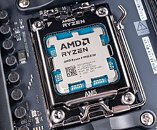
Both processors are linked to AMD's next-generation V-Cache technology, which reportedly offers better thermal performance and is more conducive to overclocking. These advancements could explain the feasibility of dual-cache retail SKUs. However, these details are still unconfirmed, so they should be considered preliminary. If accurate, AMD's strategy would maintain competitive pressure on Intel's upcoming desktop refresh by emphasizing cache-driven performance rather than solely increasing core counts. Intel's "Arrow Lake Refresh" is on the horizon, but it lacks a 3D V-Cache equivalent until "Nova Lake."
Sources: chi11eddog on X, via VideoCardz
Add your own comment

93 Comments on AMD Could Launch 16-Core Ryzen 9 9950X3D2 CPU with 192 MB L3 Cache and 200 W TDP

#26
Wirko
LabRat 891The distinction mattered with the asymmetric 9900X3D and 9950X3D. This 9950X3D2 is symmetrical.
Core Parking was to keep gaming loads away from the non-X3D cores. That should be a non-issue w/ the 9950X3D2.
It's also necessary to keep the gaming load (the process in the OS) from being spread across both chiplets. The interconnect is relatively weak, with a high latency. So core parking might still be useful. It's a dumb technique but works if the OS scheduler is even more dumb.
Posted on Reply
#27
ZoneDymo
weird, why not just move that to the next gen?
Posted on Reply
#28
Wirko
LabRat 891So, you're saying there might be an "X3D Sandwich" CCD? :laugh:
Correction: I believe the stack would still have to be at the bottom. TSV'd up through each cache stack to the CCD.
Yeah. Pizza, really.
Posted on Reply
#29
mrnagant
BlosteEach chiplet will have their own 3D cache, so you don't have 16 cores with 192MB of L3 cache, you'll have 8 cores with 96MB and another 8 cores with 96MB.
Didn't AMD park for gaming one of the chiplets in their Ryzen 9 chips, precisely for this reason?
Man. Can you imagine. The Epyc 9965. It isn't 192 cores with 384MB of cache, but rather it is "16 core with 32MB and 16 core with 32MB and 16 core with 32MB and 16 core with 32MB and 16 core with 32MB and 16 core with 32MB and 16 core with 32MB and 16 core with 32MB and 16 core with 32MB and 16 core with 32MB and 16 core with 32MB and 16 core with 32MB."

Yeah... Don't do that.

Also, cores are getting more "fancy" so scheduling and even parking has to be looked at a lot more tightly, even with cores on the same die. Intel not only has E-Cores, but they also now how LP-Cores. It would be terrible for a game to start up and get parked/scheduled to run on only the LP-cores. Caches between P, E and whatever other core you have are not always shared. If you have a quad threaded application, you don't want 1 core to hit the P core and the other 3 on the E cores if they all benefit from P cores on top of not having shared cache. AMD is doing the same thing with their C cores. AMD even had issues on early Ryzen with 2 CCXs on the same CCD. If an application was running on both CCXs you'd get increased latency and decreased performance compared to running all on the same CCX.
Posted on Reply
#30
Vayra86
BlosteEach chiplet will have their own 3D cache, so you don't have 16 cores with 192MB of L3 cache, you'll have 8 cores with 96MB and another 8 cores with 96MB.
Didn't AMD park for gaming one of the chiplets in their Ryzen 9 chips, precisely for this reason?
I really don't think this CPU is being released for gamers though. Its for that dual use situation where you want an X3D and the core count all on vcache. Nobody needs 16 physical cores for gaming and by the time you might, this gen is ancient. So you might still just see some way to assign a single CCD to gaming applications.
Posted on Reply
#31
Nostras
That's odd. I definitely recall AMD saying some time ago the reason they did not do this was simply because 3d-cache does not properly work in practice as relevant workloads get killed by the inter-CCD latency. I wonder if they've identified some relevant workloads that do work or if they've fixed this problem in some kind of way.
Posted on Reply
#32
LastDudeALive
kondaminThat’s about time, also will there be a 2x6 core version with that cache ?
No, the 12-core X3Ds have always been the weakest SKUs. The 16-core ones sell as a flagship, and the 8-core single-CCD ones sell as the best pure gaming CPUs. There's just absolutely no reason to buy a 2x6 core X3D CPU. You get worse gaming performance and worse multi-core performance. It pretty much only sells in prebuilts where people don't understand the consequences.
WirkoIt's also necessary to keep the gaming load (the process in the OS) from being spread across both chiplets. The interconnect is relatively weak, with a high latency. So core parking might still be useful. It's a dumb technique but works if the OS scheduler is even more dumb.
Yeah, that's why I'm skeptical of this news. Keeping the 3D cache on a single chiplet wasn't just to preserve boost clocks, that was solved with Zen 5. IIRC, there was news that AMD did test it, but found significantly worse gaming performance because of the interconnect latency. If a game thread gets assigned to CCD1, but necessary information is in the oversized cache of CCD2, it's a long trip to get that info. Much better to just keep all the game threads and info on one CCD and its 3D cache.

Alternatively, you'd need MUCH better scheduling for games that scale beyond 8c/16t, letting games use cores on both CCDs but keeping the relevant information for game threads in a particular CCD's 3D cache.
Posted on Reply
#33
Vayra86
mrnagantMan. Can you imagine. The Epyc 9965. It isn't 192 cores with 384MB of cache, but rather it is "16 core with 32MB and 16 core with 32MB and 16 core with 32MB and 16 core with 32MB and 16 core with 32MB and 16 core with 32MB and 16 core with 32MB and 16 core with 32MB and 16 core with 32MB and 16 core with 32MB and 16 core with 32MB and 16 core with 32MB."

Yeah... Don't do that.
But this isn't an Epyc, this is just a 16c CPU :)
LastDudeALiveAlternatively, you'd need MUCH better scheduling for games that scale beyond 8c/16t, letting games use cores on both CCDs but keeping the relevant information for game threads in a particular CCD's 3D cache.
This ain't happening, it never has because there's just no point to it. Game framerates are still limited by the weakest link and that is sequential game logic, waiting for player input, etc. And you can do all of that just fine on 6-8 cores, what really makes gaming CPUs faster is not core count but IPC and frequency, simply because it speeds up that weakest link; the whole reason vCache works for gaming is because it picks up that sequential call faster than anything else. Its a tiny bit of data. It just needs to be moved instantly. And it can do that efficiently because it doesn't lean on cpu clock frequency to do that work.
Posted on Reply
#34
anonuser57
Dual X3D ccds doesn't make much sense for general consumers. For Epyc 4000 series server it would be great. The extra cache helps make up for low memory clocks on systems with two dimms per channel. Plus it's great for databases and you no longer have to fight with the hypervisor to get the right workloads on the right CCD.
Posted on Reply
#35
LastDudeALive
Vayra86I really don't think this CPU is being released for gamers though. Its for that dual use situation where you want an X3D and the core count all on vcache. Nobody needs 16 physical cores for gaming and by the time you might, this gen is ancient. So you might still just see some way to assign a single CCD to gaming applications.
The 3D cache does have benefit for a lot of professional tasks (it originated in EPYCs, after all), but are there really that many desktop power users who will upgrade for this to make it worth it? I can't imagine there's more than maybe a few dozen people who are doing professional workloads that benefit from the 3D cache, and who will benefit enough from this to upgrade, but who are using a consumer Ryzen setup instead of a Threadripper or EPYC workstation or rackmount workstation.

AMD markets its X3D Ryzen CPUs almost exlusively to gamers.
Posted on Reply
#36
Vayra86
LastDudeALiveThe 3D cache does have benefit for a lot of professional tasks (it originated in EPYCs, after all), but are there really that many desktop power users who will upgrade for this to make it worth it? I can't imagine there's more than maybe a few dozen people who are doing professional workloads that benefit from the 3D cache, and who will benefit enough from this to upgrade, but who are using a consumer Ryzen setup instead of a Threadripper or EPYC workstation or rackmount workstation.

AMD markets its X3D Ryzen CPUs almost exlusively to gamers.
Your guess is as good as mine, but I am not holding my breath on them having fixed the inter CCD latency hit for gaming, or some magical way to schedule threads to get more performance out of gaming, quite simply because the heaviest thread in the game was already boosted by vCache.
Posted on Reply
#37
LabRat 891
mrnagantMan. Can you imagine. The Epyc 9965. It isn't 192 cores with 384MB of cache, but rather it is "16 core with 32MB and 16 core with 32MB and 16 core with 32MB and 16 core with 32MB and 16 core with 32MB and 16 core with 32MB and 16 core with 32MB and 16 core with 32MB and 16 core with 32MB and 16 core with 32MB and 16 core with 32MB and 16 core with 32MB."

Yeah... Don't do that.
Agreed, but. Even AMD's own early EPYC marketing kinda-sorta supports their peculiar PoV. 1P or 2P EPYC was compared to 4P and 8P Xeon platforms.
So, looking at a Ryzen chiplet product as 'multi-socket system, on a chip' isn't entirely unreasonable (from a pedantically technical PoV).

Really, though:
Vayra86But this isn't an Epyc, this is just a 16c CPU :)
LastDudeALiveAlternatively, you'd need MUCH better scheduling for games that scale beyond 8c/16t, letting games use cores on both CCDs but keeping the relevant information for game threads in a particular CCD's 3D cache.
I believe AMD's been working w/ MSFT to do just that. As I recall, MCM Ryzen had huge performance problems on early W11 (v. then-contemporary W10).
Posted on Reply
#38
evernessince
LabRat 891Fair enough to perceive it that way.
The way I see this, it was not possible/economical to build these, prior. a +400Mhz binning on the vCache CCD is notable and indicative of changes under the hood or behind-the-scenes.
It was entirely possible for them to do so earlier, they just decided to allocate as many of the higher binned chips to servers as possible. People seem to forget that one of the big benefits of chiplets is the degree to which they let you bin them. You can pick and choose the quality of each chiplet put into a product.

The 5950X for example consumed less power than the 5900X entirely due to binning and that chip released on the same day as the 5700X. AMD stopped doing that because they no longer needed the advantage it imparted. Those higher quality chips instead go to the enterprise. I really wish AMD continued to have binned flagship processors, as the efficiency was amazing. I can only image if they did that and X3D cache but they don't need to as Intel is not competitive enough.
Vayra86Your guess is as good as mine, but I am not holding my breath on them having fixed the inter CCD latency hit for gaming, or some magical way to schedule threads to get more performance out of gaming, quite simply because the heaviest thread in the game was already boosted by vCache.
AMD is moving away from SerDes to a "Sea of Wires" approach for core to core traffic on Zen 6, so there's likely to be a reduction in interchip latency. It will also consume less power as a result. Scheduling tasks on the same chiplet will still be important but the impact of cross CCD latency will be less.
Posted on Reply
#39
Wirko
LastDudeALiveAlternatively, you'd need MUCH better scheduling for games that scale beyond 8c/16t, letting games use cores on both CCDs but keeping the relevant information for game threads in a particular CCD's 3D cache.
That would mean splitting the game runtime into two processes, both very demanding on the CPU cores and L3 but not depending on super-fast synchronisation between them. Each process has its own memory space, so if they're scheduled to run on different CCDs, they don't peek into each other's L3.

But doing that, and optimising the whole setup to really gain something, doesn't seem an easy task, not at all.
Posted on Reply
#40
LastDudeALive
WirkoThat would mean splitting the game runtime into two processes, both very demanding on the CPU cores and L3 but not depending on super-fast synchronisation between them. Each process has its own memory space, so if they're scheduled to run on different CCDs, they don't peek into each other's L3.

But doing that, and optimising the whole setup to really gain something, doesn't seem an easy task, not at all.
Yeah. IIRC, Intel tried to do something similar, leverage their unique architecture for better gaming performance. They worked with the Hitman developers to have the NPC logic run on the e-cores to improve performance. But that kind of "tech demo" game implementation obviously didn't plan out. It doesn't make sense for a game developer to put a ton of work into a rather niche scenario. Much better for Intel to improve the thread assignment so games just run on the P cores.

There'd be even less incentive for game devs to do this for this extremely niche double-flagship CPU that maybe 0.01% of the market will use.
Posted on Reply
#41
Dyatlov A
So no chance now to buy a good 9800X3d, because the better pieces binned out for these higher models.
Posted on Reply
#42
evernessince
MysteoaI can see that, but they would need time to get enough high clocking dies. Which makes the late release reasonable.
This isn't the era of monolithic dies anymore, Chiplets allow AMD to pick and choose the best CPU chiplets for the best products, hence why CPUs like the 5950X were able to have lower power consumption and higher clocks on the same launch day as the 5700X.

The University of Toronto did a paper on the subject of chiplets including their improvements to binning. The smaller size of the die means you yield a lot more and can bin the quality of the core to a far greater degree than you can with monolithic. With monolithic, you can have the world's best core section of the die but it's trash if there's an imperfection somewhere critical. Chiplets don't have that issue, the best CPU dies will always make it into a functioning product.
Dyatlov ASo no chance now to buy a good 9800X3d, because the better pieces binned out for these higher models.
That could be the case. It could also be they just have an excess of higher binned chips that would otherwise go to enterprise. Enterprise is typically where all the best chips go but if they can already fill their orders, might as well put them to use in the consumer market with a higher margin product.
Posted on Reply
#43
Dr. Dro
Panther_SeraphinCombination of things.

5xxx Series IO Die would have been such a bottleneck it wouldnt have been funny

7xxx series had to give up too much clock speed due to the cache CCD being an insulator affecting thermals

9xxx series still has "issues" around the IO die and cross CCD communication but I bet yields have got to the point of "why not" and certain work loads will get a benefit. I still think games are going to be an issue in the majority of time just due to the nature of how games are extremely latency sensitive.
This is an attempt to rationalize and justify a corporate decision, guided by a belief that they are a company that will always act in good faith and with our interests at heart. They could have always released these CPUs. With high margins, too. Just not as high a margin as they would get by using the same silicon wafers on their 5 figure+ Epyc chips.

No Ryzen 9 since the original Zen 2 chips allows for the resources of both CCDs to be utilized to their fullest extent, and this includes the 9950X and 9950X3D today. No first, or even second generation product is perfect. It doesn't mean that releasing them is futile. AMD, as a multi-billion-dollar global conglomerate of several multi-million-dollar corporations, does not always act in the interests of end-user customers, they are a profit-driven enterprise.
LabRat 891The dual-vCache CCD part, yes. However, AMD's been pretty open about how it was just not an economical product (at the time).

These rumored new Ryzens, are clocked higher than any vCache SKU prior, in a still-manageable TDP range. Absolutely, these would better-binner or revised 9800X3D dies.

Looking back towards AM4 and a then-prospective 5950X3D, clocks would've had to be reduced so much to stay within power/thermal envelope, it wouldn't have performed competitively.

Basically,
How/why is AMD now finding it economical to put 'Enterprise grade' silicon in a consumer product?
It wasn't economical (to them). The 5800X3D also had reduced clock speeds and that didn't stop it from being a killer chip that stood the test of time. I don't give AMD the benefit of the doubt and I presume hostile, corporate behavior by default, so my answer to that question is: To stay two steps ahead of Intel, who may very well be cooking. Companies have intel (pun not intended) that we outside do not, and plan accordingly.

See why I take issue with this problem: if they had released the 5950X3D, I'd have one. Likely to this day. If they had released the 7950X3D, heck, I'd probably have bought the AM5 motherboard instead of the 13900KS. The 9950X3D came, and nothing changed despite early rumors. I want this large dual CCD CPU pretty much more than any other upgrade right now.
Dyatlov ASo no chance now to buy a good 9800X3d, because the better pieces binned out for these higher models.
Wait until there is concrete evidence of their release. If you don't hear a peep from AMD within a month (just ready for the holiday season), they're likely not going to come out.
Posted on Reply
#44
GhostRyder
This looks sick, I would love to see some numbers from this chip especially on the overclocking front. I wonder how well it will handle heat?
Posted on Reply
#45
ymdhis
Dear AMD: please put x3d cache on the APUs, specifically for use by the iGPU. How sweet would that be.
Posted on Reply
#46
Geofrancis
I still highly doubt the dual x3d2 will launch as a Ryzen, its far more suited to an EPYC chip.
Posted on Reply
#47
Fatloader
200W on AM5. Sheesh, my PC is about to catch on fire. Alternatively, I could invest $3000+ in one of those fancy immersion cooling systems or liquid nitrogen :laugh:
Posted on Reply
#48
Geofrancis
Fatloader200W on AM5. Sheesh, my PC is about to catch on fire. Alternatively, I could invest $3000+ in one of those fancy immersion cooling systems or liquid nitrogen :laugh:
A standard 7950x is 230w.
Posted on Reply
#49
Rulumi
Regarding the discussion here, AMD could have just released dual CCD 3D V-Cache processors before, they just didn't want to. They already have multiple 3D V-Cache CCDs EPYC products, they already shown dual CCDs consumer CPUs prototypes and the lower clocking problem wasn't a problem for AMD to release Zen 3 and Zen 4 X3D products.

AMD probably just did out of profit driven decissions, because most games would end up in one CCD anyway. Either they could have offered a dual 3D V-Cache CCD product for a premium price that will probably not benefit anything extra for games (while not really harming them) but give you benefits in some various other applications and uses, or sell you one with the 3D V-Cache in only one CCD with a cache disparity that will make you lose the benefits outside games, costs less for them and will still sell to customers with that premium price.

Of course they chose what was better for their profits, some people have some idea that AMD is some kind of in always high ethics, good faith and friendly towards their customers entity; but at the end of the day they are a corporation operating as a for profit business and as such had, have and will take some decissions to benefit their profts at the cost of benefits of their customers, like any other for profit driven company.
mrnagantAlso, cores are getting more "fancy" so scheduling and even parking has to be looked at a lot more tightly, even with cores on the same die. Intel not only has E-Cores, but they also now how LP-Cores. It would be terrible for a game to start up and get parked/scheduled to run on only the LP-cores. Caches between P, E and whatever other core you have are not always shared. If you have a quad threaded application, you don't want 1 core to hit the P core and the other 3 on the E cores if they all benefit from P cores on top of not having shared cache. AMD is doing the same thing with their C cores. AMD even had issues on early Ryzen with 2 CCXs on the same CCD. If an application was running on both CCXs you'd get increased latency and decreased performance compared to running all on the same CCX.
That's what Thread Director deals with in part. LP E-cores themselves aren't a bad idea, if Intel manages to execute the cores and scheduling of those well in coming and future products, those could be good and useful for mobile parts.
Posted on Reply
#50
AVATARAT
This isn't serious, this milking rumor again...

Posted on Reply
Add your own comment
Nov 21st, 2026 07:28 PST change timezone

New Forum Posts

Popular Reviews

TPU on YouTube

Controversial News Posts