Tuesday, October 21st 2025

AMD Could Launch 16-Core Ryzen 9 9950X3D2 CPU with 192 MB L3 Cache and 200 W TDP
AMD seems to be preparing an update to its "Granite Ridge" Ryzen 9000 X3D series, introducing two new chips targeted at high-performance gamers and creators. Among the two, a new SKU type has appeared, carrying the "X3D2" suffix. Leaks suggest a new flagship model, the Ryzen 9 9950X3D2, featuring 16 cores and 32 threads. This chip reportedly includes 3D V-Cache on both chiplets, totaling approximately 192 MB of L3 cache. It is said to operate at a base frequency of 4.30 GHz, with a boost up to around 5.6 GHz, and has a TDP of about 200 W. The 9950X3D2, with its new naming convention, suggests a tradeoff of slightly lower peak boost speeds (-100 MHz) compared to the single-stack X3D Ryzen 9 9950X3D model, but offers significantly increased cache capacity. This combination could be a sweet spot for cache-sensitive workloads and certain games.
The expanded cache and increased thermal headroom may necessitate more attention to cooling and VRM design for system builders, potentially leading AMD to price these chips at a premium or adjust current MSRPs. A companion model, the Ryzen 7 9850X3D, is expected to follow a similar design with eight cores, 96 MB of L3 cache, and a boost up to 5.6 GHz, with a 120 W power envelope. The 9850X3D appears to be a refined, higher-clocked (+400 MHz) alternative to existing 8-core Ryzen 7 9800X3D models, offering improved single-thread performance that is highly valued by gamers, while maintaining a relatively modest TDP.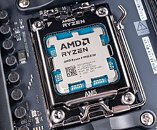
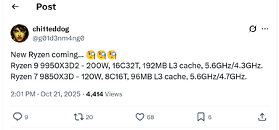 Both processors are linked to AMD's next-generation V-Cache technology, which reportedly offers better thermal performance and is more conducive to overclocking. These advancements could explain the feasibility of dual-cache retail SKUs. However, these details are still unconfirmed, so they should be considered preliminary. If accurate, AMD's strategy would maintain competitive pressure on Intel's upcoming desktop refresh by emphasizing cache-driven performance rather than solely increasing core counts. Intel's "Arrow Lake Refresh" is on the horizon, but it lacks a 3D V-Cache equivalent until "Nova Lake."
Sources:
chi11eddog on X, via VideoCardz
The expanded cache and increased thermal headroom may necessitate more attention to cooling and VRM design for system builders, potentially leading AMD to price these chips at a premium or adjust current MSRPs. A companion model, the Ryzen 7 9850X3D, is expected to follow a similar design with eight cores, 96 MB of L3 cache, and a boost up to 5.6 GHz, with a 120 W power envelope. The 9850X3D appears to be a refined, higher-clocked (+400 MHz) alternative to existing 8-core Ryzen 7 9800X3D models, offering improved single-thread performance that is highly valued by gamers, while maintaining a relatively modest TDP.


93 Comments on AMD Could Launch 16-Core Ryzen 9 9950X3D2 CPU with 192 MB L3 Cache and 200 W TDP
I’m amazed people are participating in this nonsense topic once again. How many more times does it have to be discussed…
Plus, even when there's been little-to-no immediate benefit, more cache has allowed aged/aging CPUs to remain relevant, for longer.
P4 EE Gallatin, A64X2/FX Toledo, i7c Broadwell-DT, etc.
Towards that point, if this rumor were for an EPYC 4585PX2 instead of Ryzen 9 9950X3D2, there'd be no controversy. Most Gamers would immediately understand "Oh, this (rumored) CPU isn't really meant for me", and the technical discussion(s) could carry-on.
Like what critical, money making, workloads is this going to improve that are actually realistic? I don’t get why we’re still beating this dead horse, it’s not rocket science. The trade offs are STILL not worth it, thus we have no dual vcache consumer part.
Most gamers know to avoid the 9900X3D, and only consider the 9950X3D if they're also doing 'workstation things' (content creation, development, etc.).
For those game+workstation folks, the rumored 9950X3D2 would be a +1 over the 9950X3D and EPYC 4585PX.I was talking about AM5 EPYC, not SP3/5/6.
MSRP v. MSRP, there's not a huge premium for EPYC 4004 over Ryzen 7000 or, EPYC 4005 over Ryzen 9000.
Also, that was basically my point:
If the rumor was for an Embedded Server / Desktop-Workstation AM5 "EPYC" dual-ccd dual-vCache SoC, there'd be much less controversy. The (prospective) dubiously excessive technical capabilities and price would be justifiable, as a Pro-market product.
Regardless, a 16c/32t 192MB L3 AM5 SKU would fill a hole that Server and Workstation parts (Skt. SP EPYC and Skt. TR ThreadRipper) don't really address. Anywhere around/under $1K would still be a 'cost-cut, deep-budget option' over, whatever AMD calls the Zen5 version of the Zen4 EPYC 9184X.I'm not 100% sure but, I've gathered that-
Software development/compiling, physics simulations, virtualization-parallelization, LLMs/AI/MI, Software Encode/Decode/Rendering, Unreal Engine development and content creation, Parallel Instancing/Gaming+MultiTasking, etc.
-might benefit.
Theoretically, If I were spend well over $700* (*9950X3D current MSRP, IIRC) on this rumored 9950X3D2, it'd probably be my primary PC's CPU until 'AM6' is a generation-or-3 into its lifespan. Then, turn that build into a Virtualization-box/homeserver/gameserver.
Short of a yet-unknown time-dependent outside-of-warranty flaw in Zen5+vCache, I'd get my money's worth, even as a non-professional user.
does anyone know if the new ZEN6 interconnect goes between the CCDs or is it all routed via the IO like ZEN5.
Xeon an epyc parts get wildly expensive very fast $3000+ for comparable parts, sort of a non factor vs the two lower core count TR parts.
A dual vcache consumer cpu is simply a non viable product. They make vastly more money manf. Epyc parts instead, and there is miniscule performance to be gained in the consumer space. To continue to beat the dead horse bloody…
A Xeon w5-3525 costs $1339 and a EPYC 9135 costs $1214, that Xeon W has an 8 channel interface and the EPYC a 12 channel one.
There's the cost of the platforms and LGA 4677 and SP5 of course, but even so the sTR5 isn't that much cheaper even in the TRX50 parts and while the TRX50 supports both Threadripper and Threaripper PRO compatible CPUs, it'll limit the PRO connectivity and features. To get full connectivity and some of the certifications and server management features the mentioned Xeon and EPYC platforms have by default one will need a WRX90, which not only increases the cost by a lot, it only supports Threadripper PRO CPUs and even like that the maximum memory quantity supported is less than on that Xeon W and EPYC.
The LGA 4677 motherboard prices aren't very different from a lot of sTR5 motherboards and have additional professional and server features certifications, some WRX90 boards can even be more expensive. In the case of the EPYC considering the higher memory channel interface and certifications, a somewhat higher cost isn't either unreasonable.
Probably just the state of things since AMD is alone in that HEDT market right now.
Coupled with some older ones and tied with Nova Lake and what comes after.
It makes sense that there could be a chance these Zen5 ultimate chips could still trade punches with Nova Lake in gaming, being cheaper would obviously make them preferable for gamers.
And help delay Zen6, which (the X3D variants) is going to beat Nova Lake (bLLC variants) in gaming.
And if Zen6 can beat Nova Lake in gaming, and be at least on par in MT on the same node (but possibly on a slightly less advanced and cheaper one) then AMD can bleed Intel out, which would have to rely on nVidia sponsorships to stay on course until it somehow manages to be competitive.
The first two LGA1954 gens will have Celestial, only after that we will see nVidia iGPUs enter the stage. That's quite a while away, Intel needs to be competitive ASAP. Even if those iGPUs are amazing if they're paired with mediocre CPUs then I don't see a reason for excitement here.
So at this point AMD seems to have the high ground.
How about AMD Ryzen 9 9950x3D or Ryzen 9 9950X3D2