Tuesday, October 21st 2025

AMD Could Launch 16-Core Ryzen 9 9950X3D2 CPU with 192 MB L3 Cache and 200 W TDP
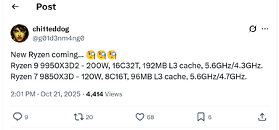
AMD seems to be preparing an update to its "Granite Ridge" Ryzen 9000 X3D series, introducing two new chips targeted at high-performance gamers and creators. Among the two, a new SKU type has appeared, carrying the "X3D2" suffix. Leaks suggest a new flagship model, the Ryzen 9 9950X3D2, featuring 16 cores and 32 threads. This chip reportedly includes 3D V-Cache on both chiplets, totaling approximately 192 MB of L3 cache. It is said to operate at a base frequency of 4.30 GHz, with a boost up to around 5.6 GHz, and has a TDP of about 200 W. The 9950X3D2, with its new naming convention, suggests a tradeoff of slightly lower peak boost speeds (-100 MHz) compared to the single-stack X3D Ryzen 9 9950X3D model, but offers significantly increased cache capacity. This combination could be a sweet spot for cache-sensitive workloads and certain games.
The expanded cache and increased thermal headroom may necessitate more attention to cooling and VRM design for system builders, potentially leading AMD to price these chips at a premium or adjust current MSRPs. A companion model, the Ryzen 7 9850X3D, is expected to follow a similar design with eight cores, 96 MB of L3 cache, and a boost up to 5.6 GHz, with a 120 W power envelope. The 9850X3D appears to be a refined, higher-clocked (+400 MHz) alternative to existing 8-core Ryzen 7 9800X3D models, offering improved single-thread performance that is highly valued by gamers, while maintaining a relatively modest TDP.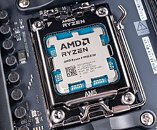
 Both processors are linked to AMD's next-generation V-Cache technology, which reportedly offers better thermal performance and is more conducive to overclocking. These advancements could explain the feasibility of dual-cache retail SKUs. However, these details are still unconfirmed, so they should be considered preliminary. If accurate, AMD's strategy would maintain competitive pressure on Intel's upcoming desktop refresh by emphasizing cache-driven performance rather than solely increasing core counts. Intel's "Arrow Lake Refresh" is on the horizon, but it lacks a 3D V-Cache equivalent until "Nova Lake."
Sources:
chi11eddog on X, via VideoCardz
The expanded cache and increased thermal headroom may necessitate more attention to cooling and VRM design for system builders, potentially leading AMD to price these chips at a premium or adjust current MSRPs. A companion model, the Ryzen 7 9850X3D, is expected to follow a similar design with eight cores, 96 MB of L3 cache, and a boost up to 5.6 GHz, with a 120 W power envelope. The 9850X3D appears to be a refined, higher-clocked (+400 MHz) alternative to existing 8-core Ryzen 7 9800X3D models, offering improved single-thread performance that is highly valued by gamers, while maintaining a relatively modest TDP.


93 Comments on AMD Could Launch 16-Core Ryzen 9 9950X3D2 CPU with 192 MB L3 Cache and 200 W TDP
Let me know when more than 1% of use cases would actually end up faster on a dual vcache zen5 part vs a 9950x3d if it’s ever released.
End of the day, the lesson to learn here is that if there is a market, supply that demand, lest your competition does.
Similar phenomenon occurs in a much smaller scale here compared to how core to core latency works on servers, but the concept is the same. Good read:
chipsandcheese.com/p/core-to-core-latency-data-on-large-systems
We want this product. It can exist, it's not at all like willing another Navi4x (or GDDR7 Navi 48) into existence.
The components that make up these rumored CPUs, already factually exist.
IMHO, the "rumor milking" is appropriate. AMD needs to know the market craves this, even if AMD knows (better than anyone) that we're stupid for it. :laugh:
TBF, Salivating over the lab-only 5950X3D was probably stupid but, we still want dual vCache dual CCD MCM SoCs in the consumer-enthusiast marketspace.
For example,
the attention Silverstone got for their "April Fool's Day Prank" of a case, alerted them of the demand.
It now exists, and has a 'sequel' model en route to retailers, today.
www.silverstonetek.com/en/product/info/computer-chassis/flp01/
www.silverstonetek.com/en/product/info/computer-chassis/flp02/
The new interconnect is higher bandwidth, lower latency, more flexible, frees up valuable die space currently occupied by the SerDes, and can be up to 10 times more efficient to transfer data.
www.techpowerup.com/341445/amd-d2d-interconnect-in-zen-6-gets-sea-of-wires-upgrade
With the new design, no longer is there a need to convert the format of the data in order to transmit it. It is now transferred similar to as if it was one chip. It will be interesting to see the impact this has not just on the CPU dies but the IO die as well. Intel added two cores to it's IO die to improve latency and efficiency but with this tech that seems entirely pointless outside of ultra low power applications (less than 5w).
ie: TSMC have had to ramp up those facilities and can now offer more consumer priced production as a result.
www.techpowerup.com/342077/nvidias-arizona-made-blackwell-gpus-must-travel-back-to-taiwan-for-packaging
Capacity is not a matter of whether you can or cannot do it, its whether you have the hands to do it.Holy shit I need this for the new HTPC build downstairs. This is hilarious
They rushed to satisfy the government's demand of chips diffused in the USA, but the part of making them usable in American soil as well was conspicuously absent.
Tom's Hardware