Thursday, December 25th 2025

Microsoft's Hardware-Accelerated BitLocker Brings Massive Performance Gains
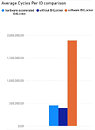
Microsoft has unveiled a new hardware-accelerated BitLocker encryption system for Windows 11, which shifts cryptographic operations from software to dedicated accelerator units integrated into future CPU microarchitectures. Historically, software-based BitLocker in Windows 11 has caused massive performance degradation. For example, in Windows 11 going from no BitLocker to software-based BitLocker has caused average number of cycles per I/O to skyrocket from roughly 400,000 cycles to about 1.9 million cycles. This is a 375% increase in cycles per I/O, and can cause significant storage performance degradations. However, Microsoft is finally bringing hardware-based encryption to solve this.
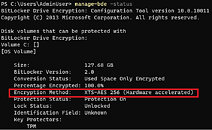
The new hardware acceleration, announced at Ignite 2025 in November, is now available in Windows 11 version 25H2 and Windows Server 2025 with the September update. Early testing shows that some workloads experience double the storage performance while reducing CPU usage by over 70%. The system offloads AES-XTS-256 encryption processing from the main processor to a fixed-function cryptography engine embedded within the SoC. Encryption keys are hardware-wrapped to enhance security against memory-based attacks. The initial rollout will target Intel vPro platforms with the upcoming Core Ultra Series 3 "Panther Lake" processors, but Microsoft plans to extend support to other vendors as well.
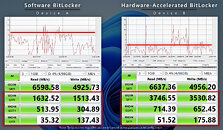
 Performance data indicates that sequential read and write speeds are similar between software and hardware approaches. However, random 4K operations show significant improvements with hardware acceleration. In the RND4K Q32T1 read and write tests, hardware-accelerated BitLocker is 2.3 times faster. For single-queue random reads, hardware-based encryption is approximately 40% faster, and for single-queue random writes, it is about 2.1 times faster. These results demonstrate that hardware-based acceleration significantly enhances small-block random performance. These random access patterns are crucial for modern multitasking, which explains why the previous software-only implementation experienced the most significant slowdowns.
Source:
Microsoft
The new hardware acceleration, announced at Ignite 2025 in November, is now available in Windows 11 version 25H2 and Windows Server 2025 with the September update. Early testing shows that some workloads experience double the storage performance while reducing CPU usage by over 70%. The system offloads AES-XTS-256 encryption processing from the main processor to a fixed-function cryptography engine embedded within the SoC. Encryption keys are hardware-wrapped to enhance security against memory-based attacks. The initial rollout will target Intel vPro platforms with the upcoming Core Ultra Series 3 "Panther Lake" processors, but Microsoft plans to extend support to other vendors as well.


62 Comments on Microsoft's Hardware-Accelerated BitLocker Brings Massive Performance Gains
Personally I'm not too keen on trusting Microsoft Pluton 2.0 (or whatever it will be rebranded to) with it and will continue to use software BitLocker which on processors with AES-NI and V(ector)AES is plenty fast for my use cases.
As expected wiht windows 11 pro, it does not use the hardware cpu instructions. Why else would windows run according to some posters on intel 3rd generation intel core cpus.
I put in a few hours ago a ryzen 7700x. The build in benchmark shows here.
aes-xts is the default for many things. There was a light impact with my previous obosleted Asus g75vw with intel i7-3610qm, the ryzen 3 3100 or 5800x or 7600x, or now 7700x does not show any impacts in user experience. Maybe Microsoft will now also discover a better file system with binary trees and customiseable selection on different compression rates.
When your main concern is not security, you usually run a benchmark first to decide on which cipher to use. e.g.
I see the only issue when micrisoft is stupid enough to use any TPM1 or TPM2 hardware functionality.
a modern cpu has lots of cpu instructions which should be used, tpm2 module is not something which should be used.
Microsoft discoveres stuff which is very long in use.
I put in a few hours ago a ryzen 7700x.
The build in benchmark shows here.
As expected wiht windows 11 pro, it does not use the hardware cpu instructions. Why else would windows run according to some posters on intel 3rd generation intel core cpus.I hope microsoft solves the long term issue, the key is in DRAM. I highly doubt they can do it.
"What do you mean you auto-encrypted my drives without fucking thinking whether I might be interested in accessing them outside of Windows?!"