Thursday, December 25th 2025

Microsoft's Hardware-Accelerated BitLocker Brings Massive Performance Gains
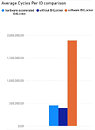
Microsoft has unveiled a new hardware-accelerated BitLocker encryption system for Windows 11, which shifts cryptographic operations from software to dedicated accelerator units integrated into future CPU microarchitectures. Historically, software-based BitLocker in Windows 11 has caused massive performance degradation. For example, in Windows 11 going from no BitLocker to software-based BitLocker has caused average number of cycles per I/O to skyrocket from roughly 400,000 cycles to about 1.9 million cycles. This is a 375% increase in cycles per I/O, and can cause significant storage performance degradations. However, Microsoft is finally bringing hardware-based encryption to solve this.
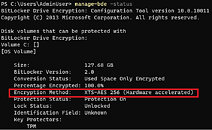
The new hardware acceleration, announced at Ignite 2025 in November, is now available in Windows 11 version 25H2 and Windows Server 2025 with the September update. Early testing shows that some workloads experience double the storage performance while reducing CPU usage by over 70%. The system offloads AES-XTS-256 encryption processing from the main processor to a fixed-function cryptography engine embedded within the SoC. Encryption keys are hardware-wrapped to enhance security against memory-based attacks. The initial rollout will target Intel vPro platforms with the upcoming Core Ultra Series 3 "Panther Lake" processors, but Microsoft plans to extend support to other vendors as well.
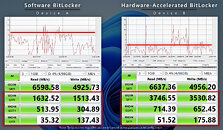
 Performance data indicates that sequential read and write speeds are similar between software and hardware approaches. However, random 4K operations show significant improvements with hardware acceleration. In the RND4K Q32T1 read and write tests, hardware-accelerated BitLocker is 2.3 times faster. For single-queue random reads, hardware-based encryption is approximately 40% faster, and for single-queue random writes, it is about 2.1 times faster. These results demonstrate that hardware-based acceleration significantly enhances small-block random performance. These random access patterns are crucial for modern multitasking, which explains why the previous software-only implementation experienced the most significant slowdowns.
Source:
Microsoft
The new hardware acceleration, announced at Ignite 2025 in November, is now available in Windows 11 version 25H2 and Windows Server 2025 with the September update. Early testing shows that some workloads experience double the storage performance while reducing CPU usage by over 70%. The system offloads AES-XTS-256 encryption processing from the main processor to a fixed-function cryptography engine embedded within the SoC. Encryption keys are hardware-wrapped to enhance security against memory-based attacks. The initial rollout will target Intel vPro platforms with the upcoming Core Ultra Series 3 "Panther Lake" processors, but Microsoft plans to extend support to other vendors as well.


62 Comments on Microsoft's Hardware-Accelerated BitLocker Brings Massive Performance Gains
First, since my accounts have two factor, they cant get into things anyway. I would change my passwords and remove my laptop as a trusted device. Now they cant do much to any of my accounts. I dont save my passwords on my laptop in the first place, that is only done on my desktop at home, so they're not getting much anyway.
None of this justifies forcing a measure on people who did not ask for it. Fundamentally that action is flawed.
We don't use bitlocker, we aren't even allowed to. I use opal solutions from an approved vendors list. It's honestly not a lot better, but it is faster at least.
Still needs work on random read and write , read and write are normal .
Its pretty amazing how little people weigh those two up against each other, but I do, on everything I am supposed to 'buy' or 'install'. Most people don't even get to this dilemma because they have no fucking clue what's happening on their system, and they can't assess the risk either.
What's most striking about all those things big tech say we 'need' is that it happily coincides with their business agenda and agile way of working. 'Oh, we pooped out this update, way beyond the moment we already told you to install this essential stuff, and now its REALLY essential'. How on earth did we ever survive without this essential update/app/insert favorite POS... Case in point being this Bitlocker shit, so we actually had a brutally underperforming application on every PC, and now we have to thank MS for making it less shit AND believe it 'was just fine' prior?
btw both your tables are samethats on uname -a
Linux nobara 6.17.12-200.nobara.fc43.x86_64 #1 SMP PREEMPT_DYNAMIC Fri Dec 12 21:00:50 UTC 2025 x86_64 GNU/Linux
EDIT: Add my own cryptsetup benchmarks:
06:46:27 admin@lunarflare-fedora ~ → cryptsetup benchmark
# Tests are approximate using memory only (no storage IO).
PBKDF2-sha1 5282498 iterations per second for 256-bit key
PBKDF2-sha256 11848316 iterations per second for 256-bit key
PBKDF2-sha512 3758336 iterations per second for 256-bit key
PBKDF2-ripemd160 1555750 iterations per second for 256-bit key
PBKDF2-whirlpool 1103764 iterations per second for 256-bit key
argon2i 14 iterations, 1048576 memory, 4 parallel threads (CPUs) for 256-bit key (requested 2000 ms time)
argon2id 14 iterations, 1048576 memory, 4 parallel threads (CPUs) for 256-bit key (requested 2000 ms time)
# Algorithm | Key | Encryption | Decryption
aes-cbc 128b 1571.6 MiB/s 4266.0 MiB/s
serpent-cbc 128b 166.5 MiB/s 1069.5 MiB/s
twofish-cbc 128b 327.8 MiB/s 603.2 MiB/s
aes-cbc 256b 1208.2 MiB/s 4010.0 MiB/s
serpent-cbc 256b 166.6 MiB/s 1069.3 MiB/s
twofish-cbc 256b 326.9 MiB/s 603.9 MiB/s
aes-xts 256b 5741.7 MiB/s 5766.6 MiB/s
serpent-xts 256b 976.9 MiB/s 964.4 MiB/s
twofish-xts 256b 631.7 MiB/s 640.2 MiB/s
aes-xts 512b 5546.7 MiB/s 5536.4 MiB/s
serpent-xts 512b 974.0 MiB/s 964.8 MiB/s
twofish-xts 512b 632.8 MiB/s 642.8 MiB/s
There is one thing I'd note though; even with hardware acceled cryptsetup, there is still significant drop in encrypted write performance on a nvme drive (~45%) unless the drive's native hardware-encryption (OPAL) is used. At least that's what appeared on benchmarks, but usual day-to-day usage doesn't seem so.
For those guys who did not use code tags: when you want to put code, it is the same forum syntax, just replace quote tags with code tags.
Before moderators delete stuff we should discuss this in the linux section. I agree stuff needs to be deleted but i hate it.
I wanted to show different ciphers have different speed. I do not see any impact on a daily usage.
I do not agree with encryption has massive impact, I use it for years. KC3000 2TB, ~2.5 years old vs Crucial BX300 120GB SATA SSD bought second same drive in 2017. So most likely a drive which orignated from 2015. that 2017 bought SATA SSD drive is a bit slower, it seems past weeks btrfs etc improved it a bit. The intial setup was a bit slow for only 50% of fill rate for that drive