Friday, March 13th 2026
Global Top Five Enterprise SSD Vendors Post Over 50% QoQ Revenue Growth in 4Q25, with SK Group Leading Growth
The widespread adoption of AI inference workloads in 4Q25 significantly raised requirements for data storage systems, according to TrendForce's latest findings on the enterprise SSD market. Meanwhile, enterprises accelerated upgrades to their general-purpose servers, while shortages in HDD supply pushed some demand toward SSD solutions. These factors together drove combined revenue for the world's top five enterprise SSD vendors up 51.7% QoQ to more than US$9.9 billion.
Among leading vendors, Samsung retained its top position, reporting nearly $3.66 billion in revenue in 4Q25, up 49.7% QoQ. The company demonstrated the strength of its vertically integrated business model. As concerns grew over potential DRAM shortages, many customers turned to Samsung because it can rely on its own DRAM and NAND Flash production to ensure stable SSD supply.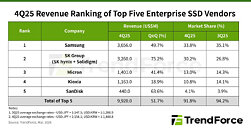 Samsung has now fully rolled out its 176-layer QLC enterprise SSD lineup, which is expected to see significant shipment growth in 2026.
SK Group (including SK hynix and Solidigm) ranked second. Solidigm has long focused on high-capacity QLC SSDs, and demand for these products accelerated in 4Q25. As a result, the group's total revenue rose more than 75% QoQ to $3.26 billion—the fastest growth among the top vendors—while its market share climbed to 30.2%.
SK Group has developed a clear product roadmap that differentiates its technology and strengthens its position in the enterprise SSD market. This will address the shift in generative AI workloads from training toward inference.
Micron ranked third, with revenue exceeding $1.4 billion in 4Q25, representing 41.4% QoQ growth. The company deliberately reduced the share of consumer SSD products in its portfolio and concentrated on the higher-margin enterprise SSD segment, allowing it to maintain strong revenue momentum.
Micron is developing SLC SSDs with high drive-writes-per-day (DWPD) ratings to support AI workloads, particularly key-value (KV) cache operations. These products are expected to become an important part of its strategy in the AI storage market.
Kioxia generated $1.16 billion in revenue in 4Q25, up 18.9% QoQ. Although its growth lagged behind some competitors, the company continues to invest in long-term opportunities related to AI storage. Its current strategy focuses on expanding its portfolio of high-speed and high-endurance SSD products to meet future demand from KV cache workloads and AI training.
Sandisk reported revenue of $440 million, rising 63.6% QoQ. While its revenue base remains smaller than its peers, the strong growth rate is noteworthy. The company is expected to significantly increase the share of QLC-based SSD shipments in 2026, which should drive a meaningful rise in the contribution from enterprise products.
TrendForce notes that PCIe 5.0 will become the mainstream interface in 2026, while the number of enterprise SSD bits shipped to the market will continue to rise. This means that overall enterprise SSD revenue could potentially double in the coming year.
Competition among suppliers will not be determined solely by NAND layer counts. Instead, leadership will increasingly depend on which companies can deliver stable PCIe 6.0 solutions first and develop SSD products optimized specifically for AI workloads.
Source:
TrendForce
Among leading vendors, Samsung retained its top position, reporting nearly $3.66 billion in revenue in 4Q25, up 49.7% QoQ. The company demonstrated the strength of its vertically integrated business model. As concerns grew over potential DRAM shortages, many customers turned to Samsung because it can rely on its own DRAM and NAND Flash production to ensure stable SSD supply.

SK Group (including SK hynix and Solidigm) ranked second. Solidigm has long focused on high-capacity QLC SSDs, and demand for these products accelerated in 4Q25. As a result, the group's total revenue rose more than 75% QoQ to $3.26 billion—the fastest growth among the top vendors—while its market share climbed to 30.2%.
SK Group has developed a clear product roadmap that differentiates its technology and strengthens its position in the enterprise SSD market. This will address the shift in generative AI workloads from training toward inference.
Micron ranked third, with revenue exceeding $1.4 billion in 4Q25, representing 41.4% QoQ growth. The company deliberately reduced the share of consumer SSD products in its portfolio and concentrated on the higher-margin enterprise SSD segment, allowing it to maintain strong revenue momentum.
Micron is developing SLC SSDs with high drive-writes-per-day (DWPD) ratings to support AI workloads, particularly key-value (KV) cache operations. These products are expected to become an important part of its strategy in the AI storage market.
Kioxia generated $1.16 billion in revenue in 4Q25, up 18.9% QoQ. Although its growth lagged behind some competitors, the company continues to invest in long-term opportunities related to AI storage. Its current strategy focuses on expanding its portfolio of high-speed and high-endurance SSD products to meet future demand from KV cache workloads and AI training.
Sandisk reported revenue of $440 million, rising 63.6% QoQ. While its revenue base remains smaller than its peers, the strong growth rate is noteworthy. The company is expected to significantly increase the share of QLC-based SSD shipments in 2026, which should drive a meaningful rise in the contribution from enterprise products.
TrendForce notes that PCIe 5.0 will become the mainstream interface in 2026, while the number of enterprise SSD bits shipped to the market will continue to rise. This means that overall enterprise SSD revenue could potentially double in the coming year.
Competition among suppliers will not be determined solely by NAND layer counts. Instead, leadership will increasingly depend on which companies can deliver stable PCIe 6.0 solutions first and develop SSD products optimized specifically for AI workloads.
15 Comments on Global Top Five Enterprise SSD Vendors Post Over 50% QoQ Revenue Growth in 4Q25, with SK Group Leading Growth
Example: During cryptomadness Nvidia sold their gaming cards to miners for inflated prices (usually inflated "only" by 100%, amateurs were far from RAM scalpers of today). When the crypto burst and revenue from that evaporated, Nvidia didn't "finally focus back on gaming", but instead tried to rake extra revenue from gamers that were desperate from months of unavailability, and increased the prices of next generation by more than performance increase - we saw $700 RTX 3080 turn into $1200 RTX 4080.
You can be sure that if AI somehow collapsed today, the number pushers of storage, memory, GPU makers would quickly calculate how much they have to increase the prices to at least partially rake in the lost revenue of AI. And the longer this state exists where people are basically postponing their upgrades, the higher they can set the prices in the new, post AI reality.
But the sad thing is, I don't think we need to worry about that. AI isn't going anywhere, they will brute force it into working, even if it means destroying everything else in tech world - already it is the only thing that's driving the economy upwards, and by tying economic, military security to it there is no end to how much we have to invest into it.
It's a business, and if other corps are throwing $ at you, do you expect them to say no?
there isn't a magic switch that they can pull to make more factories, they have to be very careful, to make sure there is still going to be enough demand to recoup the costs associated with building more factories
en.wikipedia.org/wiki/DRAM_price_fixing_scandal
Or absolute TLDR:
go look at the factory output, they are running max, and that is still not enough to meet all the demand, and I know that this is artificial demand, since all this RAM is being stockpiled in warehouses since they can't actually use it now, but that isn't the fault of the DRAM makers, this is all because of the massive amounts of $ being thrown at them by the AI companies
for this to be actual price fixing, then you would need to actually prove it via communications between all the companies, and that they all colluded together to artificially up the prices
if the AI companies went bust, then those prices will nose dive pretty darn fast
How exactly do you explain the fact that production capacity of DRAM / NAND has proceeded at a normal pace despite the fact that the market has been facing an AI crunch for years now at this point? How do you explain the fact that we are still not seeing a rapid push towards expanding production.
As Nvidia put it t hey love it when there are shortages. They get maximum value while everyone else suffers and of course this applies to the DRAM / NAND industry as well. In a functioning market, competitors would rush to meet demand. This isn't a healthy market though and there are large barriers to entry.Correct, but this isn't mutually exclusive with what others are putting forward.
why else do you think they are now bypassing the DRAM guys and are going straight to the wafer guys to buy up all that they can make, so that they can control everything?
it takes 2-5 years at minimum to make new factories, and a ton of $nobody saw that the AI companies would do what they did, and that's why they can't keep up with the artificial demand
there is also no way to "rush" to meet demand here, this has created supply chain shortages of pretty much everything, they can't just snap their fingers, order all the machines necessary, ASML can't build enough EUV machines to meet demand either, and then you have all the red tape for the factory permits, and then you need electrical/grid, water and so many other things
all this stuff takes time
*Because I still count Kioxia and SanDisk as one
This isn't a case of people expecting supply to suddenly instead to meet demand, this is a case of 3 years of memory manufacturer's ignore the added supply of the AI market to protect their margins in case the market doesn't pay out.
These same companies that receive public money specifically to ensure stable supply. It's entirely disingenuous to imply DRAM manufactures couldn't do anything, they had years to increase production and choose to ignore it.
Memory went up 400, 500%, in comparison. We all know that’s stores and sellers speculating with trying to milk the poor people that are forced to buy as much as they can with the stock they got for much less. But they were really successfully in ensuring they don’t run out of stock - you can still get memory kits everywhere (with even a bit of falling prices) - even if there’s very little supply, with prices like these there’s also very little demand. So you could argue that the situation is stable! Public money well spent, Oh, you also meant stable prices? That’s communism.
:P
Memory Suppliers Are Actually Worried the Demand Boom Won’t Last ‘Too Long’, and Are Already Rethinking Expansion Plans
So the factory expansions that would be too little too late if the AI bubble wouldn’t pop might not happen, to keep the prices inflated if the demand doesn’t increase, but to ensure stratospheric prices if AI demand remains…