Monday, April 6th 2026

Steam Will Estimate Game FPS Before Purchase to Show Expected PC Performance
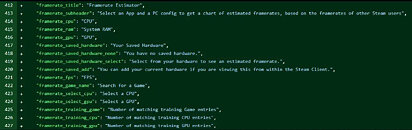
Steam is reportedly in the process of adding a "Frame Estimator" tool that can estimate your PC's performance before you purchase a game. As you know, Valve's Steam platform is the largest gaming platform in the world, with access to millions of PCs. The Steam Client application offers an option to include your PC in Valve's telemetry system, which processes data such as your PC's specifications and game information, including your library. Using these data points, Steam will estimate how many frames per second your PC can generate in any game, depending on your configuration. For example, for a specific CPU, GPU, and available system memory, the Steam Client will indicate whether a game can reach 60 FPS at 1440p using high settings, or whatever your preference is. We can only speculate at this point about what the feature will look like, as Steam is still refining it before the public beta release.
Additionally, Valve has already started asking users for anonymous FPS data collection about a month ago whenever they run a game. With this data pool, likely involving millions of participants, Valve aims to build a system that estimates your FPS output based on your specific PC configuration, without needing to run a game first. Reportedly, this feature will appear in the Steam Client and show how much performance your PC can deliver before you even purchase a game. This is a classic recommendation system that will indicate what your configuration typically delivers at specific game settings and resolutions.
 In the world of DIY PC building, there are countless configurations gamers can choose from. Starting with the CPU, options diverge into AMD and Intel, each with numerous models over many generations. Then there are GPUs from AMD, Intel, and NVIDIA, which also vary across generations and configurations, each running with specific drivers on different operating systems. To add to the diversity, systems have different types of DDR memory like DDR3, DDR4, and DDR5, all installed in various capacities and running at different timings, depending on the CPU host. This variance in configurations makes it almost impossible to get an accurate system performance estimation without the resources of Valve to create a system, likely similar to AI recommendation engines, to estimate your PC's performance accurately within a margin of error.
Source:
u/dex3108 on Resetera
Additionally, Valve has already started asking users for anonymous FPS data collection about a month ago whenever they run a game. With this data pool, likely involving millions of participants, Valve aims to build a system that estimates your FPS output based on your specific PC configuration, without needing to run a game first. Reportedly, this feature will appear in the Steam Client and show how much performance your PC can deliver before you even purchase a game. This is a classic recommendation system that will indicate what your configuration typically delivers at specific game settings and resolutions.


33 Comments on Steam Will Estimate Game FPS Before Purchase to Show Expected PC Performance
That`s if they even decide to launch it which I doubt because it can decrease sales.
720P user A B C D E F G lets say all have similar configurations Steam can already tell if your using upscalers or not. So all those users have GPUs in similar performance tier with various CPUs some using upscaling others not. Valve can basically glean the information that you will get 30+ FPS at 720P based on your system specs. or 60+ FPS at 1080P
They have the hardware surverys they rolled out the ability to detect "fake" frames this just expands upon that. If steam for instance reads the ini-settings files for various games as well Valve can further glean how things play out. Since it already stores data on the cloud for you for saves etc. I imagine the next step would be that they snoop around the ini files to check system settings which would then compile the settings vs specs vs recorded FPS. Feed into an AI model and it spits out an estimate based on the users system.
Bins are often more practical and useful than absolute values.
Also, performance, even in the fragmented mess that makes up modern PC market, is nicely normally distributed*. Just see 3D Mark's results. They even draw the graphs for each CPU+GPU combo.
Random example:
All valve needs to do is pick a probability a random user would get more (or less) than whatever estimate for FPS is, then compute the estimate that -depending on said probability- covers most users. Then bin the results as said.
* I would guess the prevalence of vsync would greatly skew the curve to the left, but the principle still applies. The only real limitation vsync imposes is that it makes data for >60fps cases limited.
cfg hacks / mods / changed graphic requirements because they updated for free certain games like subnautica.
i try to force the amd gpu driver to use only 45 fps works sometimes but not often. the freesync range of the monitor is afaik 37 to 75 hz. 45 is a bit above, thats it
so will valve than read out that all my games struggle with a radeon 7800xt a ryzen 7700x and 2x32gib hynix a die?
i m not sure how worse windows 11 pro is these days with a gaming installation and bad storage. dram less pcie 3.0 nvme storage or sata ssds.
even when steam would claim my box will run 100hz it is wrong as i force the gpu driver to 45HZ and the display can only render whqd up to 75hz.
i m waiting to see how they implement it.
My second instinct is that it ought to be possible to also log CPU and GPU utilisation percentages, which would make it trivial to see that someone's framerate data is not representative of their system pushing itself to its limits