Thursday, May 14th 2026
AMD FSR Upscaling 4.1 Officially Arrives to Radeon RX 7000/6000 GPUs

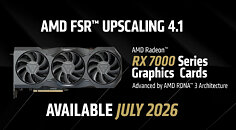
AMD has responded to what gamers have been most vocal about: bringing its FSR 4.1 upscaling technology to older RDNA 3 and RDNA 2 GPUs. Today, we learn that this dream is becoming a reality, as AMD is officially introducing its FSR Upscaling 4.1 technology to millions of Radeon RX 7000 Series graphics cards worldwide. Arriving this July, millions of RDNA 3 gamers will enjoy official support for FSR Upscaling 4.1 in over 300 supported games. This means that, just like the latest RDNA 4-based Radeon RX 9000 Series, RDNA 3 gamers will also benefit from the upscaling algorithms based on various machine learning techniques without needing to upgrade to the latest Radeon RX 9000 GPUs if their current GPU performs adequately.

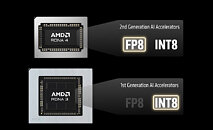
Interestingly, the FSR Upscaling 4.1 will use the same underlying model on RDNA 3 as it does on RDNA 4. However, differences in hardware create some background variations, as RDNA 4 has FP8 processing units and INT8, whereas RDNA 3 only has INT8. AMD explains that the company has developed FSR Upscaling 4.1 with the FP8 format in mind, while the latest ML algorithm has been optimized and ported for the INT8 data format to work with RDNA 3. This difference in hardware support delayed AMD's port of FSR technologies to RDNA GPU IP below version four, but it is now finally making an appearance.
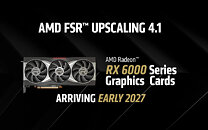
Finally, FSR Upscaling 4.1 is also coming to older RDNA 2 GPUs, but that port will have to wait until early 2027. This indicates that AMD is doing additional optimization for RDNA 2 cards, as it is challenging to port this upscaling algorithm to hardware that isn't optimal for the latest techniques. However, it is promising that it is possible, and RDNA 2 gamers will just have to wait a bit longer.
Source: Jack Huynh on X
Add your own comment

252 Comments on AMD FSR Upscaling 4.1 Officially Arrives to Radeon RX 7000/6000 GPUs

#226
Tek-Check
JustBenchingYou are more than happy to jump onto bandwagon of bashing Sony etc
Hahaha. More nonsense from you. Problems with basic comprehension?
I said that Sony protected their console gaming interest by investing into Mark Cerny's team that codeveloped graphics technologies with AMD. If you were Sony, you would never allow those technologies to get to anyone else for free and at the same time.
RinSenpaiEven by supposing this is true, that means Sony may have some ground for a lawsuit for "breach of contract" and potentially "intellectual property violation" as well, supposing AMD has no rights to use PSSR implementation for their PC GPU architecture, at which point AMD will need to pay for that (anything from contractual penalties [which can be made public or not depending on the situation] to a simple public lawsuit).
Yep, this is entirely possible. At the end of the day, the technology came first to PS5 Pro, and there is no accident about this basic fact. Not to XboxX console and not to other AMD graphics. Sony having an upper hand in being the first to roll out the upscaler cannot be brushed away as if nothing really happened. It's important in trying to understand the whole saga.
RinSenpaiThe only reasonable argument here would be about a "Timed exclusivity", but making RDNA 3 and 2 users wait that much time in order to get FSR4, when FSR5/RDNA5 will be around the corner in 2027/2028, makes it a somewhat bullshit reasoning.
Supposing any of this is true, that would also mean AMD could be that powerless in the current market, to the point nobody cared about FSR4 (outside of AMD GPU owners and people who want AMD as competition for whatever reason thet have), until this announcement.
I also think that the time exclusivity is the key to understanding the sequence of events.
At the end of the day, leaked FSR4 files for older dGPUs were ready last year already, just a few months after the launch on RDNA4 cards, but AMD couldn't release it officially. This was another symptom that Sony must have locked the technology under time exclusivity or whatever the conditions of contract were.

It doesn't really matter when new cards could arrive. This is an unchartered territory and it has no influence on current affairs linked to INT8 implementations. RDNA5 cards will not be running the upscaler on INT8, so there are no links here. However, without the role of Sony's PS5 Pro, we cannot understand current reality. There's no doubt about it.

"Caring" about FSR4 can mean several things to different people. Some may care to get the technology and use it, some may care to seek scapegoats for the delay, and some may care maliciously, to point out failure and spread negativity. It's all about who shapes the narrative and for what reasons. There are both bright and dark motives behind caring, if you see what I mean.

The main thing I was missing in this thread was a genuine effort to care to understand the saga and sequence of events. I don't care about using FSR4. I don't need it. I do care to understand the events and I do care not to cast the blame at a wrong address.
RinSenpaiThat's why I currently don't like AMD's way of proceeding in the current market. They rely almost entirely on their community working for free (or not but with huge caveats) to just try to be on par against Nvidia.
Optiscaler, UXTU (Ryzen Master for older/unsupported Ryzen CPUs), Lossless Scaling or even 2015-2020 Optifine Mod for Minecraft and others such tools wouldn't have to exist if AMD poured a minimal amount of effort for supporting their own products in the first place.
Community works on some features and projects, that's true, such as helping to enable HDMI 2.1 FRL and VRR, despite unsuccessful ban from HDMI Forum..., and things that you mentioned. However, it's not correct to say that AMD rely almost entirely on their community. It is AMD folks that commit open source drivers for Linux users for years. It was also AMD that introduced FreeSync for all, nomen omen, showing just how absurd was Nvidia's proprietary solution of G-Sync module that made monitors way more expensive for users. Nvidia caved in and cancelled this solution many years ago. They never released an updated module that would support Sync technology either over HDMI 2.1 or DP 2.1. It was a solution that got the label R.I.P. at the end. This topic is compex and goes way beyond the scope of this thread, so let's leave it there.
Posted on Reply
#227
Dukenukemx
PierreJGKinda feel like they were force to do this because of DLSS broad support. Never force your customer to upgrade. Their attitude was, buy our new parts to get the latest tech. Nvidia said here is DLSS use it from x parts to the latest. They tried to make people believe it cannot work on older hardware. Obviously their supporters also forced them to make this decision. I will try it once it comes to the 6xxx series as I only have an RX6600XT. I play forza 6 with raytracing and fsr quality and I will be honest, I really need to focus to see the difference but I do not focus to much on graphics. I am an old school gamer so my eyes are set to older games -_-
AMD's backlash for FSR4 is huge because FSR was always open source and always working on their older GPU's. Nvidia's DLSS3 was exclusive to RTX-40 series cards and everyone hated them for it. Then DLSS4 turns out to work on any RTX GPU, even to a fault. Comes back down to who offers the better value proposition between AMD and Nvidia, and the answer is still Intel because their XeSS upscaler also works on any GPU. Also, you can still buy an Arc B580 for $300 during these dark times.
Posted on Reply
#228
Tek-Check
zusWell, Xbox uses RDNA2 but 2027 will be at the end of the generation already, so Xbox will barely benefit from it since everyone will be waiting for Project Helix and PS6 at this point.
Barely? There are millions upon millions of Xbox users who will benefit from the upscaler once it's available to them. It doesn't really matter that the console will be replaced at some point. Besides, the new console will be very expensive, indeed. Current XboxX will continue to entertain millions of families for years to come just like the previous generation did when current consoles arrived in 2020.
zusSony probably didn't want it at all but AMD was pressured to do something due to backlash. It kinda makes sense to me, but I didn't see any sources confirming that Sony was trying to block FSR 4 on RDNA3/2.
What are you rambling on? Sony purposefully assembled a team around Mark Cerny to codevelop several technologies with AMD for PS5 Pro. This was before AMD even released RDNA4 cards and FSR4. You have a lot of catching up though do, to get rid off cheap conspirapies based on ignorance. Here, a few interviews with relevant people, to get your sense of timelines more accurate.

www.digitalfoundry.net/articles/digitalfoundry-2024-ps5-pro-deep-dive

www.digitalfoundry.net/news/2025/10/mark-cerny-talks-project-amethyst-future-sony-hardware-you-have-indeed-spotted-the-win

www.digitalfoundry.net/news/2026/03/the-big-pssr-interview-with-mark-cerny

Besides, you will never see any official sources ever confirming that Sony was trying to block FSR4 on older cards. Jesus... the industry doesn't work like that. Sony and AMD are deep partners. They don't wash dirty laundry or slap each other via tech media. If they have disagreements, they will sort it out between themselves. In this case, Sony could have pushed for some time exclusivity, say 6 months or so, and that's about it. Let's not be consoiratorial.
Posted on Reply
#229
JustBenching
And then there is the newer xbox that uses RDNA 3, that's why RDNA 3 didn't get access to FSR 4 either. Oh wait... im telling you, at this point it's more believable that it's aliens than sony. But we can all agree, it's totally not amds fault. They would never do such a thing
Posted on Reply
#230
Rulumi
The idea of Sony blocking AMD to release has always seemed very conspiracy like and more of an idea formulated by people to shift fault and responsability from AMD, in my view.

If it even were to be true, but I really doubt it is, it would be another showing or the current very sad state of Radeon and AMD not really caring to improve and remedy the division current situation.
Posted on Reply
#231
zus
Tek-CheckBarely? There are millions upon millions of Xbox users who will benefit from the upscaler once it's available to them. It doesn't really matter that the console will be replaced at some point. Besides, the new console will be very expensive, indeed. Current XboxX will continue to entertain millions of families for years to come just like the previous generation did when current consoles arrived in 2020.
I think it matters. Imagine if Xbox got FSR 4 INT8 right when it first leaked, at this point we would have many games running better on Xbox than on base PS5, that could mean less sales on PS Store since the Xbox version would be the preferable version. This year we're also getting GTA 6, and if Xbox had FSR 4 support at the game's launch it would mean that Xbox Series X plays GTA 6 better than base PS5, and I think that would hurt PS5's GTA sales too. By delaying it to 2027, Xbox will barely have any time to enjoy its advantage, and devs probably won't waste their time patching games for a platform that is soon to be replaced by Project Helix. Bringing FSR 4 support at the very end of the generation makes it very unnapealing to developers in my opinion.
Tek-CheckWhat are you rambling on? Sony purposefully assembled a team around Mark Cerny to codevelop several technologies with AMD for PS5 Pro. This was before AMD even released RDNA4 cards and FSR4. You have a lot of catching up though do, to get rid off cheap consirapies based on ignorance. Here, a few interviews with relevant people, to get your sense of timelines more accurate.

www.digitalfoundry.net/articles/digitalfoundry-2024-ps5-pro-deep-dive

www.digitalfoundry.net/news/2025/10/mark-cerny-talks-project-amethyst-future-sony-hardware-you-have-indeed-spotted-the-win

www.digitalfoundry.net/news/2026/03/the-big-pssr-interview-with-mark-cerny
I know that FSR and PSSR were co-developed by Sony and AMD, but that alone doesn't explain why AMD was withholding FSR 4 INT8 for so long despite having a perfectly functional leaked version. These links only explain that PSSR and FSR indeed share the same core technology, with PSSR being an INT8 variant given that the PS5 Pro doesn't support FP8.
Tek-CheckBesides, you will never see any official sources ever confirming that Sony was trying to block FSR4 on older cards.
So we cannot blame Sony for the delay, we don't know for a fact if they were involved. AMD withheld FSR4 INT8 for many months and now put a stupid one year delay for RDNA2 even though the damn thing already works through Optiscaler, that is the official story. Anything else is conjecture.
Tek-CheckSony could have pushed for some time exclusivity, say 6 months or so, and that's about it. Let's not be consoiratorial.
That's what I meant by blocking, that they put some exclusivity contract.
Posted on Reply
#232
Tek-Check
zusSo we cannot blame Sony for the delay, we don't know for a fact if they were involved. AMD withheld FSR4 INT8 for many months and now put a stupid one year delay for RDNA2 even though the damn thing already works through Optiscaler, that is the official story. Anything else is conjecture.
Only those who try to understand things without judgemental attitude can resist low temptations to use the label of "blame". Putting the label of "blame" on AMD or anywhere else has not brought you to understanding of what actually happened, has it?

No one rational can place any blame anywhere until we actually finds out what and how it happened. It's unhelpful. Even if Sony had the right of timed primacy for the upscaler written in a contract, they wouldn't be blamed.

What are you going to do if there is no one to blame? Could you live your life in peace and harmony without having to place blame somewhere?
RulumiThe idea of Sony blocking AMD to release has always seemed very conspiracy like and more of an idea formulated by people to shift fault and responsability from AMD, in my view.
What if there is no fault anywhere to be found? Would you be happy with it?
RulumiIf it even were to be true, but I really doubt it is, it would be another showing or the current very sad state of Radeon and AMD not really caring to improve and remedy the division current situation.
Nonsense. Microsoft and Sony didn't trust either Intel or Nvidia to design an APU for their new consoles.
JustBenchingAnd then there is the newer xbox that uses RDNA 3, that's why RDNA 3 didn't get access to FSR 4 either.
How about you learn and check which technologies XboxX supports?
www.techpowerup.com/gpu-specs/xbox-series-x-6nm-gpu.c4240
JustBenchingOh wait... im telling you, at this point it's more believable that it's aliens than sony. But we can all agree, it's totally not amds fault. They would never do such a thing
Embarrassing and meaningless stuff. Word salad. Zero reasoning.
Posted on Reply
#233
JustBenching
Amd decided to block fsr 4 so you can upgrade cause they are greedy. That's all there is to it, no need for 10 pages of excuses. If you want longevity out of your card buy Nvidia, if you want your driver support to stop 2 years after release buy amd. Uh yes, I forgot, Sony forced them to stop driver support for rdna 2 😁
Posted on Reply
#234
Tek-Check
JustBenchingAmd decided to block fsr 4 so you can upgrade cause they are greedy. That's all there is to it, no need for 10 pages of excuses. If you want longevity out of your card buy Nvidia, if you want your driver support to stop 2 years after release buy amd. Uh yes, I forgot, Sony forced them to stop driver support for rdna 2 😁
You have nothing meaningful to contribute. Boring.
zusBringing FSR 4 support at the very end of the generation makes it very unnapealing to developers in my opinion.
You can complain to Microsoft for not investing one single cent into the upscaler development. That decision costed them dearly, as Sony did exactly the opposite, co-invested with AMD and they sell way more consoles.
Posted on Reply
#235
zus
Tek-CheckOnly those who try to understand things without judgemental attitude can resist low temptations to use the label of "blame". Putting the label of "blame" on AMD or anywhere else has not brought you to understanding of what actually happened, has it?

No one rational can place any blame anywhere until we actually fins out what and how it happened. It's unhelpful.
We do know what happened: AMD made an upscaler that runs on RDNA2/3 and refused to launch it for many months. Since they didn't provide any justification, the blame lies with them by default. They are responsible for their own products and decisions, and they chose not to support their own customers, so they bear the blame for this. Not blaming them for their own decisions exempts AMD from their own responsibility toward the customer. Sony may or may not share part of the blame, that's the part I don't know. AMD should at least clarify the reason for the delay, the paying customer deserves that much I'd say.
Tek-CheckEven if Sony had the right of timed primacy for the upscaler wrotten in a contract, they wouldn't be to blame.

What are you going to do if there is no one to blame? Could you live your life in peace and harmony?
What happened: AMD made an upscaler that runs on RDNA2/3 and refused to launch it for many months
Assumption: Sony made a timed exclusivity contract that prevents AMD to launch FSR4 on RDNA2/3
Why wouldn't Sony share part of the blame in this situation? What's wrong with holding companies accountable when they hurt customers with their practices?
Tek-CheckYou can complain to Microsoft for not investing one single cent into the upscaler development. That decision costed them dearly, as Sony did exactly the opposite, co-invested with AMD and they sell way more consoles.
I could BLAME Microsoft, dare I say.
Posted on Reply
#236
jnv11
wolfIt's a fantastic outcome! But, I'm not sure about "The shouters have lost their ammunition".... The shouters firing at AMD got this done, they didn't lose their ammunition, the ammunition pounded the target over and over until it succumbed. We should all be thanking the "shouters".
I think that you are confusing two sets of shooters here. One set of shooters hammered AMD to get FSR 4.x INT8 released for RDNA 3 and then RDNA 2. Another set of shooters is the group of those who say that this is why AMD deserves no money for not supporting older hardware that could have used the support. That second set lost its ammo. The first set won.
Posted on Reply
#237
Tek-Check
zusI know that FSR and PSSR were co-developed by Sony and AMD, but that alone doesn't explain why AMD was withholding FSR 4 INT8 for so long despite having a perfectly functional leaked version. These links only explain that PSSR and FSR indeed share the same core technology, with PSSR being an INT8 variant given that the PS5 Pro doesn't support FP8.
Yes. In this thread, attempts have been made to try to understand why AMD was not in a position to officially release sooner what had been leaked last year. It would have been insane to wilfully withhold the technology after the leaked injection files emerged. I don't see any reason why AMD would ever do such a thing, so searching for more plausible explanations, we come across Sony trying to keep competitive advantage after investing time and money into the upscaler.

I have argued that there is one viable explanation, namely that Sony negotiated a timed exclusivity for PS5 Pro, 6 months or similar, before wider roll out. Imagine Microsoft doing the same thing. They would have invested into development and they would for sure ask for some exclusivity before Sony's console could enjoy the same.

No one else has been able to provide more plausible reasoning, despite a lot of noise in several comments. I only hear blame, finger-pointing and more noise. A few members tried good arguments and I acknowledged it.
jnv11I think that you are confusing two sets of shooters here. One set of shooters hammered AMD to get FSR 4.x INT8 released for RDNA 3 and then RDNA 2. Another set of shooters is the group of those who say that this is why AMD deserves no money for not supporting older hardware that could have used the support. That second set lost its ammo. The first set won.
I'd go even further, to say that even the shouters who wanted the upscaler finally released got it not because of their shouting, but because it was planned anyway, after timed exclusivity deal with Sony. When you take Sony into account, it occurs that they could not have legally blocked the tech forever from a wider roll out, as it was co-developed and co-invested into with AMD. The best Sony could do to protect their competitive edge was to ask for 6 months or so of exclusivity, before AMD rolls this out to all engines, including to Sony's competitor, Microsoft.
zusWe do know what happened: AMD made an upscaler that runs on RDNA2/3 and refused to launch it for many months. Since they didn't provide any justification, the blame lies with them by default. They are responsible for their own products and decisions, and they chose not to support their own customers, so they bear the blame for this. Not blaming them for their own decisions exempts AMD from their own responsibility toward the customer. Sony may or may not share part of the blame, that's the part I don't know. AMD should at least clarify the reason for the delay, the paying customer deserves that much I'd say.
The world doesn't work like that. Sometimes it's more complex and you need to try to keep several conflicting perspectives in your mind at the same time, each one of them valid on thier own. The word 'refused' is not appropriate here either. If they had signed a contract with Sony that there would be no public comments on their deal, then there was nothing to justify, clarify or announce, until there was. There is no blame by default here, as no cause of any fault was established. There is a thing called patience and everybody needed to wait until things were ready and lined up for different products.

The leaked FSR4 injection files clearly signalled that the work was done to support older cards. We are also not able to say whether they chose not to support officially older cards at that time or they couldn't do it due to an agreement with Sony. It's an unknown at the moment. That's why I always advise caution in such situation when we, the public, simply do not possess enough of information to make an informed judgement. We can feel disappointed, angry, etc., but those are feelings. Just because you or I feel something, it doesn't mean we need to cast the blame onto someone or something for our feelings. Understanding a situation dispassionately while dealing with own thoughts and emotions about it are two different realities.
zusWhy wouldn't Sony share part of the blame in this situation? What's wrong with holding companies accountable when they hurt customers with their practices?
Sony protected their platform users, which is dozens of millions of players. That was their duty towards their users. You can certainly ask a wider question, namely was Sony to co-blame for slowing down a wider adoption for non-PS5 Pro users. I guess that's the side effect of a contract they signed with AMD. When bigger corporate play legal games, an average consumer often loses. However, Microsoft was the most passive player in this game. See below.
zusI could BLAME Microsoft, dare I say.
You could, of course. They have been passively waiting for others to do the upscaler job for them. That's one of reasons why Xbox didn't sell as well as PS5 did. Mark Cerny and his team from Sony worked with AMD tirelessly to get this done for PS5 Pro and then for other lines of products.
Posted on Reply
#238
RinSenpai
Tek-CheckYes. In this thread, attempts have been made to try to understand why AMD was not in a position to officially release sooner what had been leaked last year. It would have been insane to wilfully withhold the technology after the leaked injection files emerged. I don't see any reason why AMD would ever do such a thing, so searching for more plausible explanations, we come across Sony trying to keep competitive advantage after investing time and money into the upscaler.

I have argued that there is one viable explanation, namely that Sony negotiated a timed exclusivity for PS5 Pro, 6 months or similar, before wider roll out. Imagine Microsoft doing the same thing. They would have invested into development and they would for sure ask for some exclusivity before Sony's console could enjoy the same.

No one else has been able to provide more plausible reasoning, despite a lot of noise in several comments. I only hear blame, finger-pointing and more noise. A few members tried good arguments and I acknowledged it.
We still don't have any proof though that it was Sony holding the exclusivity. It's already a farfetched argument, and not the most likely one. I'm not attacking AMD without proof about that, but I don't excuse them for that either. In a sector that tries to move that fast with Nvidia, any wrong move will have very big consequences and Nvidia isn't what Intel was a decade ago (or at least not yet on that level).

The initial debate had no solid fact and you all managed to turn this into a 10-page back-and-forth, which is really impressive.
Like a wise youtuber said: "[I'm talking about] people who seriously make theories out of thin air, and it often results in huge debates within the comments... despite the base assumption just being completely baseless." (the video of said youtuber was about Dark matter if you wonder)

The theory I explained earlier is only working when taken with another theory, which tries to respond to a base assumption that we still can't prove now.
It may have just happen AMD was slow at it. Maybe they were just trying to make it work and it happened to take a year before being able to give us a release date.
Given their experience with the OpenGL stack on Windows, that wouldn't surprise me at all, as it took them about 8 years to fix OpenGL compatibility on Windows as it was completely broken during the Polaris era.
Posted on Reply
#239
zus
Tek-CheckYes. In this thread, attempts have been made to try to understand why AMD was not in a position to officially release sooner what had been leaked last year. It would have been insane to wilfully withhold the technology after the leaked injection files emerged. I don't see any reason why AMD would ever do such a thing, so searching for more plausible explanations, we come across Sony trying to keep competitive advantage after investing time and money into the upscaler.

I have argued that there is one viable explanation, namely that Sony negotiated a timed exclusivity for PS5 Pro, 6 months or similar, before wider roll out. Imagine Microsoft doing the same thing. They would have invested into development and they would for sure ask for some exclusivity before Sony's console could enjoy the same.

No one else has been able to provide more plausible reasoning, despite a lot of noise in several comments. I only hear blame, finger-pointing and more noise. A few members tried good arguments and I acknowledged it.


I'd go even further, to say that even the shouters who wanted the upscaler finally released got it not because of their shouting, but because it was planned anyway, after timed exclusivity deal with Sony. When you take Sony into account, it occurs that they could not have legally blocked the tech forever from a wider roll out, as it was co-developed and co-invested into with AMD. The best Sony could do to protect their competitive edge was to ask for 6 months or so of exclusivity, before AMD rolls this out to all engines, including to Sony's competitor, Microsoft.
Despite my judgmental tone in the last comments, I actually think your hypothesis is pretty fair. We don't have proof that Sony was involved in the decision, and probably never will unless some sort of leak happens, but it's not that crazy to think that Sony didn't want to give Xbox a brand new upscaler. Sounds like a plausible explanation to me.

It's hard to imagine why they would refuse to launch FSR4 INT8 otherwise. Maybe they were afraid of people complaining about the performance penalty between FSR3 and FSR4, but the community reaction was quite positive when FSR4 INT8 leaked, so it would be a pretty silly decision in my opinion. Maybe they were afraid of FSR4 on RDNA3 hurting RDNA4's sales. Doesn't make much sense to me either, why would they even waste efforts making FSR4 INT8 if that was the case? Was it some sort of PSSR prototype that wasn't intended to run on RDNA3? I don't know, the Sony exclusivity hypothesis is the one that makes most sense to me so far.
Posted on Reply
#240
Dukenukemx
RulumiThe idea of Sony blocking AMD to release has always seemed very conspiracy like and more of an idea formulated by people to shift fault and responsability from AMD, in my view.

If it even were to be true, but I really doubt it is, it would be another showing or the current very sad state of Radeon and AMD not really caring to improve and remedy the division current situation.
People are reading too much into this. AMD didn't release FSR4 on RDNA2+3 because AMD wanted to promote RDNA4 cards. People forget that FSR4 was working on RDNA3 in Linux through fp16 running fp8. FSR4 would have been working on older AMD cards, one way or another. AMD just woke up to the backlash from this, and decided to actually release FSR4 on older cards. AMD wasn't even going to support RDNA1+2 cards.
zusI think it matters. Imagine if Xbox got FSR 4 INT8 right when it first leaked, at this point we would have many games running better on Xbox than on base PS5, that could mean less sales on PS Store since the Xbox version would be the preferable version.
Average gamer doesn't even know about FSR and DLSS, let alone cares to know. What matters for consoles are exclusives. Xbox Series X could be running Vega graphics and nobody would care if the games were good.
This year we're also getting GTA 6, and if Xbox had FSR 4 support at the game's launch it would mean that Xbox Series X plays GTA 6 better than base PS5, and I think that would hurt PS5's GTA sales too.
No it won't. It matters more that GTA6 has a bigger pool of players to play with, which PS5 will have.
By delaying it to 2027, Xbox will barely have any time to enjoy its advantage, and devs probably won't waste their time patching games for a platform that is soon to be replaced by Project Helix.
Xbox is a waste of time. Has been since 2014.
Posted on Reply
#241
Tek-Check
RinSenpaiWe still don't have any proof though that it was Sony holding the exclusivity. It's already a farfetched argument, and not the most likely one. I'm not attacking AMD without proof about that, but I don't excuse them for that either. In a sector that tries to move that fast with Nvidia, any wrong move will have very big consequences and Nvidia isn't what Intel was a decade ago (or at least not yet on that level).
It was already said that there was no proof of exclusivity.
It was already said that there was no proof of no exclusivity either.
In addition, you are really not able to estimate on what is more or less likely in this case, as you don't have an access to more information. We don't have it either. It is what it is.

AMD secured next-gen big contracts for major consoles, yet again. This means business until at least 2035 with consoles alone. Neither Intel nor Nvidia signed deals with Microsoft and Sony. Intel lost the pitch, Nvidia didn't even try. They are moving nowhere here and they don't exist in this space of 4K home gaming consoles. They could attempt to sign a deal for next-next gen, beyond 2035, if interested, and if Microsoft and Sony would ever want them. It's not a surprise that the upscaler came out first on a console. Sony co-invested into it. So, I am not sure what kind of 'very big consequences' you are talking about?

If you meant desktop GPUs, AMD is a small player there anyway. They don't have much to lose, as Nvidia dominates this space. If they hypothetically exited desktop GPUs tomorrow, nothing much would happen to AMD, as they have also pivoted to data centre and majority of their revenues come from there. You need to be able to see a wider picture too, namely that the desktop space is currently dying by slow death ever since RAMpocalypse and SSDisaster kicked in. Watch a new investigative PC documentary by Gamers Nexus to find out more about this trend. It's fresh, from today, amd it paints a grim picture on DIY space. I am actually sad about this, as current PC crisis goes way beyond petty issues about a single feature such as upscaler, and this new crisis has far more serious consequences for DIY space and low ownership of devices in future.
RinSenpaiThe initial debate had no solid fact and you all managed to turn this into a 10-page back-and-forth, which is really impressive.
Like a wise youtuber said: "[I'm talking about] people who seriously make theories out of thin air, and it often results in huge debates within the comments... despite the base assumption just being completely baseless." (the video of said youtuber was about Dark matter if you wonder)
Thank you. I genuinely want to understand what happened behind the curtain, despite the fact that I don't use the upscaler in gaming. I am not impressed at all by blame game narrative and finger-pointing. That's for children and tribalists.
RinSenpaiThe theory I explained earlier is only working when taken with another theory, which tries to respond to a base assumption that we still can't prove now.
It may have just happen AMD was slow at it. Maybe they were just trying to make it work and it happened to take a year before being able to give us a release date.
Given their experience with the OpenGL stack on Windows, that wouldn't surprise me at all, as it took them about 8 years to fix OpenGL compatibility on Windows as it was completely broken during the Polaris era.
Yes, this and many other factors. The fact that leaked FSR4 injection files for older GPUs were already ready amd available to anyone under the Sun last year, just a few months after regular launch on RDNA4 cards, clearly suggests that they were not slow with it and there must have been something else out there that did not allow them to officially release it at that time. This something, in my humble view, was Sony having timed exclusivity, as a co-developer of the upscaler who paid millions to get it done. If so, their voice about the roll out segments and timing must have been important and AMD would not have been able to act on their own on other product lines, until recently. It's the only explanation that really makes sense. No one else presented to me any viable and coherent alternative.
zusDespite my judgmental tone in the last comments, I actually think your hypothesis is pretty fair. We don't have proof that Sony was involved in the decision, and probably never will unless some sort of leak happens, but it's not that crazy to think that Sony didn't want to give Xbox a brand new upscaler. Sounds like a plausible explanation to me.
Exactly. Why would you give a free tool to your competitor who did not invest one single penny or man-hour to develop it? So, Sony must have placed some time restrictions on AMD for rolling the upscaler out to other platforms.

Also, we neither have an evidence that Sony was involved nor that they were not involved. Companies don't usually talk to the public about such matters. All we can do is give our best to reason, connect the dots and try to understand it on the face value.
zusIt's hard to imagine why they would refuse to launch FSR4 INT8 otherwise. Maybe they were afraid of people complaining about the performance penalty between FSR3 and FSR4, but the community reaction was quite positive when FSR4 INT8 leaked, so it would be a pretty silly decision in my opinion. Maybe they were afraid of FSR4 on RDNA3 hurting RDNA4's sales. Doesn't make much sense to me either, why would they even waste efforts making FSR4 INT8 if that was the case? Was it some sort of PSSR prototype that wasn't intended to run on RDNA3? I don't know, the Sony exclusivity hypothesis is the one that makes most sense to me so far.
It does. And you are asking really important questions. Tested leaked files from last year showed good performance gains overall, but not consistently good in all scenarios. There were penalties too in some games that looked better, but generated less fps. Hardware Unboxed and ComputerBase have great graphs and pictures to show this.

The injection files were a fork of FSR4 suite for desktop GPUs, but essentially the same core technology like the one for PS5 Pro. It was definitely easier to package it for one single and standardised platform, on console APU system, than to package it for diverse DIY desktop configurations with many combinations of hardware and OS versions. Hence the console version is more consistent and better optimised. Which version would you release first?
DukenukemxPeople forget that FSR4 was working on RDNA3 in Linux through fp16 running fp8.
The article does actually mention a few serious caveats for performances that don't make it a viable option. This release is about INT8 support.
DukenukemxFSR4 would have been working on older AMD cards, one way or another. AMD just woke up to the backlash from this, and decided to actually release FSR4 on older cards.
The backlash explanation makes little sense when we consider a single digit market share in discrete GPUs and just a few more percentages on handheld APUs. It's a smaller community relative to non-AMD gamers, and yet the 'backlash' idea is portrayed as something punching way beyond its actual size. Besides, the injection files were available to anyone interested in using the upscaler if they wanted to. Finally, the 'backlash' could have simply coincided with time when AMD was able to announce the support. You know, correlation never means causation.
Posted on Reply
#242
wolf
Better Than Native
jnv11That second set lost its ammo. The first set won.
I wasn't aware of the second sets existence I guess, but I agree on the set I describe getting it done.

While there may have been obligations to Sony directly tied to INT8 FSR4 (yet to be convinced this was the case), I sincerely doubt AMD ever planned to bring it to RDNA 2-3.5 without the community pressure.

It's fascinating to me that it's such a heated topic of discussion, and that despite the great outcome, there is so much stigma attached to the perceptions of who/why etc campaigned for it.
Posted on Reply
#243
Tek-Check
wolfI sincerely doubt AMD ever planned to bring it to RDNA 2-3.5 without the community pressure.
This perspective needs to explain the existence of leaked injection files, ready for older cards last year already. If they had not planned to bring the support, why would they ever create FSR4 files for older cards? There was no community pressure before or at the time of leaks.
Posted on Reply
#244
wolf
Better Than Native
Tek-CheckThis perspective needs to explain the existence of leaked injection files
Plenty of possibilities there, including but not limited to; perhaps INT8 was the originally planned acceleration for their new gen FSR before RDNA4 shaped up. Perhaps they had intended for it to span multiple generations before pivoting to FP8 for better performance and visuals and being happy to lock it to RNDA4 and incentivise sales of their latest and greatest. Maybe they did want to give it to RDNA2-3.5 but feared the hit to performance and visuals would be counter productive to the features marketing and successes, at least more so than what they believed they stood to gain. Maybe it was one developers/engineers pet project and was just there in the files as they'd done considerable work to develop it and that work was still useful to leverage.

I've just not seen enough evidence to suggest that if INT8 was tightly co-developed with Sony and there were obligations/timed exclusivity of code or product support and so on, that AMD was always planning to give it to RDNA2-3.5 when those obligations expired.

I appreciate that the discussion isn't rude or personal, but I think there's nothing we're both saying now we haven't already said to each other in this thread about this specific nuance of the topic. I can't disprove you, nor you me, nor can either of us prove our belief of how this situation is definitely what happened. So perhaps in terms of you and I, we're best off agreeing to disagree?
Posted on Reply
#245
Visible Noise
JustBenchingAmd decided to block fsr 4 so you can upgrade cause they are greedy. That's all there is to it, no need for 10 pages of excuses. If you want longevity out of your card buy Nvidia, if you want your driver support to stop 2 years after release buy amd. Uh yes, I forgot, Sony forced them to stop driver support for rdna 2 😁
Dude. You need to get with the program.

It’s never AMD’s fault.
Never.
Posted on Reply
#246
Tek-Check
wolfI can't disprove you, nor you me, nor can either of us prove our belief of how this situation is definitely what happened.
I agree wih this. We don't have enough information.
wolfSo perhaps in terms of you and I, we're best off agreeing to disagree?
We fundamentally agree, as mentioned above. We only see divergence in opinions as to plausibility of different scenarios.
Visible NoiseIt’s never AMD’s fault.
Never.
A desperate cry for making noise visible.
Posted on Reply
#247
JustBenching
Visible NoiseDude. You need to get with the program.

It’s never AMD’s fault.
Never.
Sure, I have no trouble accepting it's not amds fault. But im convinced it was aliens. There is 0 evidence to suggest it was sony.
Posted on Reply
#248
Dukenukemx
Tek-CheckThe backlash explanation makes little sense when we consider a single digit market share in discrete GPUs and just a few more percentages on handheld APUs. It's a smaller community relative to non-AMD gamers, and yet the 'backlash' idea is portrayed as something punching way beyond its actual size. Besides, the injection files were available to anyone interested in using the upscaler if they wanted to. Finally, the 'backlash' could have simply coincided with time when AMD was able to announce the support. You know, correlation never means causation.
It's something Moore's Law is Dead mentioned.
Posted on Reply
#249
AusWolf
Fellas, what's the point in arguing about AMD's past intentions?
Maybe they ran into complications implementing FSR4 with INT8. Maybe they were just greedy. Who knows. Shouldn't we all agree that FSR4 coming to RDNA2-3 is a good thing?

It seems like nothing bad or good can happen without some people being angry about it. :confused:
Posted on Reply
#250
Tek-Check
It's important to examine intentions of any company, but this needs to be honest, informed and open-minded. I have seen so much bashing for the sake of bashing, which is brain rot.

Of course, the upscaler is good for those who would use it. Before it was announced, many of ill-wishers shouted betrayal of customers, etc. Now, the same people are saying too little, too late. Sometimes, no matter what happens, there will be ill-wishers and angry armchair warriors trying to spoil for others good developments. Also, the anonymity of internet allows some cowards to be loud.
Posted on Reply
Add your own comment
Nov 13th, 2026 09:19 PST change timezone

New Forum Posts

Popular Reviews

TPU on YouTube

Controversial News Posts