Thursday, May 14th 2026
AMD FSR Upscaling 4.1 Officially Arrives to Radeon RX 7000/6000 GPUs
AMD has responded to what gamers have been most vocal about: bringing its FSR 4.1 upscaling technology to older RDNA 3 and RDNA 2 GPUs. Today, we learn that this dream is becoming a reality, as AMD is officially introducing its FSR Upscaling 4.1 technology to millions of Radeon RX 7000 Series graphics cards worldwide. Arriving this July, millions of RDNA 3 gamers will enjoy official support for FSR Upscaling 4.1 in over 300 supported games. This means that, just like the latest RDNA 4-based Radeon RX 9000 Series, RDNA 3 gamers will also benefit from the upscaling algorithms based on various machine learning techniques without needing to upgrade to the latest Radeon RX 9000 GPUs if their current GPU performs adequately.
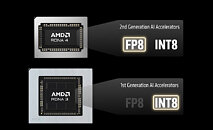
Interestingly, the FSR Upscaling 4.1 will use the same underlying model on RDNA 3 as it does on RDNA 4. However, differences in hardware create some background variations, as RDNA 4 has FP8 processing units and INT8, whereas RDNA 3 only has INT8. AMD explains that the company has developed FSR Upscaling 4.1 with the FP8 format in mind, while the latest ML algorithm has been optimized and ported for the INT8 data format to work with RDNA 3. This difference in hardware support delayed AMD's port of FSR technologies to RDNA GPU IP below version four, but it is now finally making an appearance.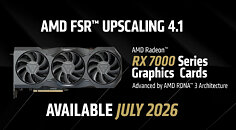
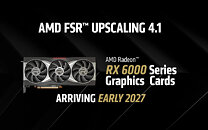
 Finally, FSR Upscaling 4.1 is also coming to older RDNA 2 GPUs, but that port will have to wait until early 2027. This indicates that AMD is doing additional optimization for RDNA 2 cards, as it is challenging to port this upscaling algorithm to hardware that isn't optimal for the latest techniques. However, it is promising that it is possible, and RDNA 2 gamers will just have to wait a bit longer.
Source:
Jack Huynh on X
Interestingly, the FSR Upscaling 4.1 will use the same underlying model on RDNA 3 as it does on RDNA 4. However, differences in hardware create some background variations, as RDNA 4 has FP8 processing units and INT8, whereas RDNA 3 only has INT8. AMD explains that the company has developed FSR Upscaling 4.1 with the FP8 format in mind, while the latest ML algorithm has been optimized and ported for the INT8 data format to work with RDNA 3. This difference in hardware support delayed AMD's port of FSR technologies to RDNA GPU IP below version four, but it is now finally making an appearance.


252 Comments on AMD FSR Upscaling 4.1 Officially Arrives to Radeon RX 7000/6000 GPUs
It's their strategy to make cards outdated 3 years after launch.
You bought 780 Ti? Too bad, in 2016 3GB is not enough!
You bought RTX 3080? Too bad, in 2023 10 GB is not enough!
You bought RTX 5080? Too bad, in 2028 16 GB is not enough!
You bought RTX 6080? Too bad in 2030 24 GB is not enough!
RTX 3080 10 GB is still a powerful GPU, but its 10 GB VRAM is no longer enough for reliable 2160p / Ultra textures / RT / PT / frame generation in modern 2025–2026 games. 12 GB is now often the practical floor, and 16 GB is the safer target.
Alan Wake II with RT pushes VRAM above 10 GB even at 1080p, needs 12 GB at 1440p. Hogwarts Legacy RT ON in 4K Ultra needs 16 GB. With RT, 8 GB fails even at 1080p, 1440p RT needs 12 GB minimum. Ratchet & Clank: Rift Apart uses around 11.2 GB at 1080p Very High + RT, more than 12 GB are necessary with frame generation on. Avatar: Frontiers of Pandora requires ~12.6 GB at 1440p Ultra and 16 GB cards have much better 1% lows.
Tom’s Hardware found that RTX 5060 Ti 8 GB is 39.6% behind the 16 GB version in 1440p with turned on ray-tracing.
5060 Ti 16 GB is much more future-oriented than 8 GB version which is going to gradually fall behind more and more often.
source link: www.computerbase.de/artikel/gaming/indiana-jones-und-der-grosse-kreis-benchmark-test.90500/seite-22006 → 2016 : 512 MB → 8192 MB = 16× in 10 years
2016 → 2026 : 8192 MB → 16384 MB = 2× in 10 years
www.techpowerup.com/gpu-specs/geforce-7900-gtx.c154 <---- 512 MB VRAM
www.techpowerup.com/gpu-specs/geforce-rtx-5070-ti.c4243 <--- 16384 MB VRAM
*RTX 5090 should not be counted for this argument, because it is a halo/luxury product, not the normal high-end baseline.
We see this every single day, namely that increasing number of games are completely broken on 8GB cards and 10GB cards. You can't have your cake and eat it meaningfully with low VRAM an using other features at the same time.
You have to remember that game alone may consume 9,2GB, but the OS and other programs also consume VRAM.
Games do not run in a vacuum.
For example i have 1,3GB VRAM used now on a debloated Win11 25H2 with Firefox (53 tabs, 1 window) and 9 smaller programs (like HwInfo64 etc) running in the background.
If i had a 10GB card and i started FH6 at 1080p medium settings then i would not be so sure it wouldn't spill over.
In fact last year i already felt that on my 11GB card at 1440p. With 16GB i can hopefully ride it out until around 2030.
Hopefully by then 16GB will be the low end option already and midrange cards have moved to 24GB (and not cost 1000+ in the process).
Im mean sure, i hope that Windows is intelligent enough to reduce the VRAM consumption of itself and background programs when im running a foreground 3D application, but with MS these days my faith is not high on that.
It's not cherry picked, latest reviewed game.
Very Low > Extreme > Extreme+RT > Extreme+RT+FG
Make it make sense. Plus there are other games where 10GB struggles at 1080p medium.
But typical Nvidia apologists claim these are just "badly coded" or whatever their latest excuse it.
Running at over 90% memory usage for the game alone is not "fine". It's a hair breath a way from trashing to RAM and stuttering issues.
The point I'm making is your assertion it couldn't run 1080p medium is categorically wrong. It struggles with 4K Ultra, everything below is fine.Seems clear enough to me.
RT+FG (which 30 series can't even do), obviously add load on VRAM.
Pull up the test yourself and check out the charts. of course we can figure out certain cases you need something else. the same wahtaboutism about those few pieces of software which benefit from the big x3d cache of rzyen cpus. i think it is time to limit the use case or viewpoint to what 80% of the software need, that is most likely not a x3d cpu and most likely a 8gib vram gpu is enough.
<- Someone who had a 780 Ti and was happy with it till it kicked the bucket in 2017.
3GB in 2016 was certainly not enough, unless you only played old games or exclusively at the lowest settings.
I used an 2GB from 2012 to 2016 when in moved to 8GB. 8GB became a problem for me in 2021 when i moved to 11GB.
For example, Mirror’s Edge Catalyst was a clear case - the GTX 1060 3 GB collapsed badly compared to the 6GB version. DOOM 2016 required 5 GB VRAM for Nightmare textures. Shadow of Mordor’s Ultra HD texture pack wanted 6 GB. Rise of the Tomb Raider’s Very High textures were also clearly aimed at cards with more than 3 GB. Gears of War 4 recommended 4GB VRAM for its normal recommended spec and 6 GB+ for the higher-end experience.
So yes, a 3 GB card could still run many 2016 games well, especially at 1080p. But for a former "high-end" card, 3 GB was already becoming a real limitation.
DOOM: The Dark Ages with path-tracing at 3840x2160 native with frame generation has VRAM usage at around 20 GB. With upscaling, it can fit much better, but once frame generation is added, it can still sit at 15 to 16 GB.
Now imagine games adding in-game LLM AIs to to have fully dynamic NPCs. 24 GB for graphics + 16 GB for AI models = 40 GB of VRAM in total needed in some newest games by 2029 and this is very likely in my opinion. That is why PS6 needs 40 GB, or it will become obsolete by 2031.
The 780 Ti’s GK110 would have been brought to its knees long before it became starved for memory in that game.You mean like those released around the time the card we’re talking about itself was?
If im saying "old games" in the context of 2015-2016 i obviously mean pre-2010's
The best card AMD had can't do 1440p with RT in 2018 games my man, and you want the cheaper lower end 3080 to do that in 2025-2026 game, else nvidia is "greedy". Ok, makes sense
Fair enough, Witcher 3 was not the best VRAM-pressure example. I mentioned it in a quick post while saying I was too tired to search properly. I mistook base Witcher III game for a modded one.
But I already gave cleaner examples later: Mirror’s Edge Catalyst at "Hyper" settings, DOOM 2016 with Nightmare textures, Shadow of Mordor Ultra HD texture pack, Rise of the Tomb Raider with Very High textures, and Gears of War 4 with higher settings.
The point is that by 2016 there were already enough newer PC games/settings where 3GB was no longer comfortable for a former high-end card.
A GTX 780 Ti could still run many games well, especially at 1080p with reasonable settings. I’m not denying that. I’m saying 3GB had already become a real limitation in some newer titles/settings, so calling it simply “enough” in 2016 is too generous.
In addition, you should know that testing GPUs in variety of laptops is notoriously unreliable, unless there are two identical machines with different GPUs, as various vendors implement different power envelops with the same GPUs and implement silicon hardware in different chassis design. This often leads to many performance anomalies and bizarre measurements, such as the ones below:
1. M5070Ti is both faster and slower than M5070 in different laptops
2. M5070 is slower than M5060 in different laptops
A few more examples. I won't spam the thread with even more examples. A few is enough to show the flavour of limits.
Even in 1080p, 8GB quickly becomes a problem the moment you want to use more technologies, so heavily advertised to mainstream gamers by Nvidia and AMD alike. Let's not be naive and blind to where limits of 8GB cards are. When I play Flight Simulator in 4K, with additional 3D building packages loaded over densely populated urban areas, my card uses more than 16GB and often commits more than 18GB, so it's always good to have a few extra GB as a headroom. And this is in pure raster, without turning on additional technologies that consume more VRAM.Lol! It's today-proofed already, as the screenshot clearly showed that 8GB model was broken in this game.Nothing to worry about. They have officially moved gaming revenue into 'edge computing' section on their latest earning call. It clearly shows the direction of travel.