Thursday, May 14th 2026
AMD FSR Upscaling 4.1 Officially Arrives to Radeon RX 7000/6000 GPUs
AMD has responded to what gamers have been most vocal about: bringing its FSR 4.1 upscaling technology to older RDNA 3 and RDNA 2 GPUs. Today, we learn that this dream is becoming a reality, as AMD is officially introducing its FSR Upscaling 4.1 technology to millions of Radeon RX 7000 Series graphics cards worldwide. Arriving this July, millions of RDNA 3 gamers will enjoy official support for FSR Upscaling 4.1 in over 300 supported games. This means that, just like the latest RDNA 4-based Radeon RX 9000 Series, RDNA 3 gamers will also benefit from the upscaling algorithms based on various machine learning techniques without needing to upgrade to the latest Radeon RX 9000 GPUs if their current GPU performs adequately.
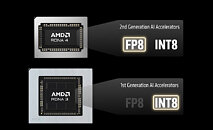
Interestingly, the FSR Upscaling 4.1 will use the same underlying model on RDNA 3 as it does on RDNA 4. However, differences in hardware create some background variations, as RDNA 4 has FP8 processing units and INT8, whereas RDNA 3 only has INT8. AMD explains that the company has developed FSR Upscaling 4.1 with the FP8 format in mind, while the latest ML algorithm has been optimized and ported for the INT8 data format to work with RDNA 3. This difference in hardware support delayed AMD's port of FSR technologies to RDNA GPU IP below version four, but it is now finally making an appearance.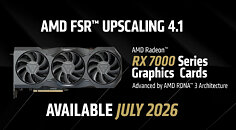
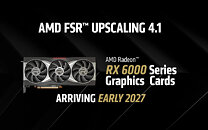
 Finally, FSR Upscaling 4.1 is also coming to older RDNA 2 GPUs, but that port will have to wait until early 2027. This indicates that AMD is doing additional optimization for RDNA 2 cards, as it is challenging to port this upscaling algorithm to hardware that isn't optimal for the latest techniques. However, it is promising that it is possible, and RDNA 2 gamers will just have to wait a bit longer.
Source:
Jack Huynh on X
Interestingly, the FSR Upscaling 4.1 will use the same underlying model on RDNA 3 as it does on RDNA 4. However, differences in hardware create some background variations, as RDNA 4 has FP8 processing units and INT8, whereas RDNA 3 only has INT8. AMD explains that the company has developed FSR Upscaling 4.1 with the FP8 format in mind, while the latest ML algorithm has been optimized and ported for the INT8 data format to work with RDNA 3. This difference in hardware support delayed AMD's port of FSR technologies to RDNA GPU IP below version four, but it is now finally making an appearance.


252 Comments on AMD FSR Upscaling 4.1 Officially Arrives to Radeon RX 7000/6000 GPUs
I also used a search engine to verify that the numbers for PS5, PS5 Pro, Xbox X, and 7900XTX were accurate. In the case of the base PS5, we are comparing FP16 with INT8, but I think that further reinforces the point on why Sony probably won't/can't bring PSSR2 to the base model.
If that's the case why is the 6000 range delayed to next year ?.
www.nvidia.com/en-us/products/workstations/rtx-5000/Sure. That's exactly why I don't buy it. Nvidia is free to dictate to consumers what they think it's enough. You and I are free to accept or reject such proposition.
These charts are more what I mean, where the generation on the whole determines (first party) feature support, and within that generation you can pick the level of compute, VRAM etc you desire.
The 7900 XTX which was/is a 4080/4080 Super competitor has 24GB vs 16GB.
The 7900 XT which was/is a 4070 Ti Super competitor has 20GB vs 16GB.
The 7900 GRE which was/is a 4070 Super competitor has 16GB vs 12GB.
The 7800 XT which was/is a 4070 competitor has 16GB vs 12GB.
For example, im trying to play bannerlords right now and im consistently running out of vram and crashing on my 4090. It doesn't matter that the X card has more than Y card, I need more than 24 and only nvidia offers that. I'm not even sure if 32 will be enough though to be fair, might need more than that.
If you needed 24GB back in 2020 for games, you were in less than 1% of gaming population who would buy a halo card. That's how 'widespread' that need was. You were right in this particular case, but it's so niche that makes your text petty, fringe and cringe.The "problem" of less than 1% of people in the first world countries. Your voice truly represents gamers' VRAM needs. What a nonsense and waste of debate time.
We have seen time and again just how broken increasing amount of games are with insufficient VRAM, especially when users turn on those other features
Just recently Hardware Unboxed showed, yet again, how broken 8GB cards are, especially when upscaler, RT and other features are engaged. Have a watch.
In this instance, we could confidently say that:
8GB is NO level of capability in growing number of games, and
more VRAM is YES level of capability. It becomes a feature, not only specification, when people find it broken or a limiting factor. Planned obsolescence is a carefully crafted product strategy.Not really. Twisting words is not going to work either. You could do much better than this.
I'm not too interested to go down a VRAM rabbit hole in this thread, though, despite varying amounts of agreement and disagreement I think it's increasingly off topic.
Like usual (for my commentary at least), product buying decisions are a multivariate assessment of all available information including but not limited to, my performance and productivity needs, specs (amounts of onboard hardware), local price, features, support and expected lifecycle, power consumption, size, efficiency and more.
I sincerely hope this situation factors into AMD's future feature support decisions, or at least how they handle potential leaks and PR blunders that lead them to situations like this. How they handled the Starfield DLSS fiasco was far from great at the time, but it appears since then they didn't land themselves in the very same hot water, and that's the sentiment I hope for out of this at least.
I didn't really know or care about 'frame generation' at the time. Of course things change and DLSS, XeSS, and FSR is something I would learn more about. Throw in AI, which of course, I had head about and curiosity began to make me wonder what it took to get either working on this GPU. Eventually AMD released an AI 'package' that I installed and found interesting since I didn't have to connect to some AI server to utilize. Also there were ways to enable FSR on older cards but took some leg work. The forums were awash with ridicule and moaning about this 'missing' feature which was amusing and now this is coming our way.
I have noticed in a couple of games I have that they already have FSR 4 on my 7900xtx working in them that I assume is what the game developers did on their own dime.
This is just my experience with the situation. Cheers.
Thou AMD introducing their solution is better than nothing. Unreal Engine example is so horribly experience without optimization. That upscaler type of solutions are just needed sadly. Rare are those developers who these days have actually time to optimize their games.
1. FSR4 is coming
2. You need to be willing to see the world more broadly and ask yourself why did Sony invest resources and manpower to develop PSSR for their console only, in collaboration with AMD folks. They did not do it to prop-up competitor's Xbox console, which also runs on AMD hardware. Just stop for a moment and think about it.
This looks like an actual porting effort is needed.