Thursday, May 14th 2026
AMD FSR Upscaling 4.1 Officially Arrives to Radeon RX 7000/6000 GPUs
AMD has responded to what gamers have been most vocal about: bringing its FSR 4.1 upscaling technology to older RDNA 3 and RDNA 2 GPUs. Today, we learn that this dream is becoming a reality, as AMD is officially introducing its FSR Upscaling 4.1 technology to millions of Radeon RX 7000 Series graphics cards worldwide. Arriving this July, millions of RDNA 3 gamers will enjoy official support for FSR Upscaling 4.1 in over 300 supported games. This means that, just like the latest RDNA 4-based Radeon RX 9000 Series, RDNA 3 gamers will also benefit from the upscaling algorithms based on various machine learning techniques without needing to upgrade to the latest Radeon RX 9000 GPUs if their current GPU performs adequately.
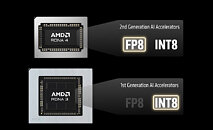
Interestingly, the FSR Upscaling 4.1 will use the same underlying model on RDNA 3 as it does on RDNA 4. However, differences in hardware create some background variations, as RDNA 4 has FP8 processing units and INT8, whereas RDNA 3 only has INT8. AMD explains that the company has developed FSR Upscaling 4.1 with the FP8 format in mind, while the latest ML algorithm has been optimized and ported for the INT8 data format to work with RDNA 3. This difference in hardware support delayed AMD's port of FSR technologies to RDNA GPU IP below version four, but it is now finally making an appearance.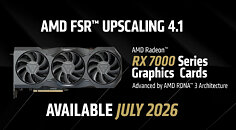
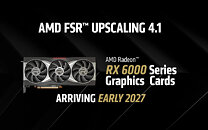
 Finally, FSR Upscaling 4.1 is also coming to older RDNA 2 GPUs, but that port will have to wait until early 2027. This indicates that AMD is doing additional optimization for RDNA 2 cards, as it is challenging to port this upscaling algorithm to hardware that isn't optimal for the latest techniques. However, it is promising that it is possible, and RDNA 2 gamers will just have to wait a bit longer.
Source:
Jack Huynh on X
Interestingly, the FSR Upscaling 4.1 will use the same underlying model on RDNA 3 as it does on RDNA 4. However, differences in hardware create some background variations, as RDNA 4 has FP8 processing units and INT8, whereas RDNA 3 only has INT8. AMD explains that the company has developed FSR Upscaling 4.1 with the FP8 format in mind, while the latest ML algorithm has been optimized and ported for the INT8 data format to work with RDNA 3. This difference in hardware support delayed AMD's port of FSR technologies to RDNA GPU IP below version four, but it is now finally making an appearance.


252 Comments on AMD FSR Upscaling 4.1 Officially Arrives to Radeon RX 7000/6000 GPUs
Not to mention that we don't know if the rest of FSR Redstone technologies will reach all RX 7000/Rx 6000 GPUs. There's only talk of the FSR upscaler (FSR 4.1), but not of the AI-powered FPS multiplier. Nor of ray regeneration.
And of Radian cache when it's implemented in a game.
Xx
As for AI frame gen, ray regeneration and radiance caching, I don't know if RDNA3 has the the instructions to support them, and no one knows if AMD has any version of these features that runs on RDNA3, so it's not the same situation, I don't even know if it's possible to backport these things. And even if it was, I don't think these features were as crucial as the upscaler. FSR and XeSS frame gen are acceptable, RT was never a big selling point for RDNA3, and radiance cache is nowhere to be seen yet. Among all these features, I believe upscaling was way more popular among RX 7000 owners.
Anyway, I'm glad to hear these news. The RX 7600 has just become much more compelling in the budget segment. I wonder if Xbox can benefit from this too.
But by any objective measure AMD has done an absolute dogshit job communicating their intentions in a market where AMD cannot afford to make simple unforced errors and has to execute at 110% to have a prayer keeping up with the Nvidia juggernaut. Tech Media will report what AMD says, and they kept saying "no comment". It isn't the tech media's job to run interference for AMD when AMD could have easily provided a simple "hang tight, we're working on it" response.
And before I'm accused of being some NV fanboy or something, I'm running two full AMD systems right now that I'm broadly very happy with, but I can approach this issue with open eyes and a critical mind.
People can bark on AMD's GPU division communication skills as much as they want. I have never thought that those skills were stellar in the first place, but you never asked me about it. You just made assumptions. If I disagree with you or with others on a specific matter, why would you default to thinking about me having an "emotional bond"? Utter nonsense. Accept that there are several possible perspectives and view points to consider. Ask for more information, to find out, to understand better why someone thinks the way they are, even if you disagree. Don't box them into convenient cathegories that do not require you to stretch your mind and practice giving others a benefit of a doubt.I literally gave you the link to an article in previous posts.You don't need to put any qualifiers. I don't really care what kind of systems people run at home or at work. Irrelevant for this matter. Drinking your favoutire brand of milk every day does not make you more or less critical or blinkered.
It's however disappointing that in the wake of this great news that community pressure has certainly aided in coming to fruition, some still have nothing better to comment about than petty us vs. them shenanigans, assumptions of motive, and still somehow attempt to gatekeep who is allowed an opinion on the subject based on irrelevant circumstances and logical fallacies. I am glad to see that pointed out, and rejected.
I buy hardware with the bundled software. These days amd quality do not justify prices over 250€ for any amd consumer graphic card.
I would not say complaining. It is more stating facts.
i used coding libraries which allowed mathematics on 8 bit integer ucontrollers. these are special libraries. so the argument, from the embedded system viewpoint, not from the windows graphical userinterface bloatware developer standpoint is, you do not need floating point in hardware.
Amd should not expect customers who had several amd cards to buy another amd graphic card when the older graphic card barely got any driver updates, operating system support or bug fixes.
it shall not matter if a nvidia or intel graphic card owner writes a statement about amd graphic cards.
mathematics is quite often an approximation. u search for a way or model to come closer to the use case you need. regardless if it is mathematics, coding or other tasks.
you need first the software so games can implement it. it is amd fault to not offer earlier proper software.
just to have the excuse of 8bit floating point or integer numbers is really LOL from the embeddes sytem viewpoint. some ucontroller in todays world, which you use and do not even see only have Bytes of sram, not kilobytes.
Many of the journalists in this space are hardware enthusiasts, and the lack of proper support pissed a LOT of them off, just like it pissed off their consumers.
A rare exemption is a great job on this done by GamersNexus and TechReport outlets, but tech media would need to be more vocal and inquisitive about real, negative impact of tech companies on real daily life of people.I accept that people felt disappointed and are free to voice it.