Thursday, May 14th 2026
AMD FSR Upscaling 4.1 Officially Arrives to Radeon RX 7000/6000 GPUs

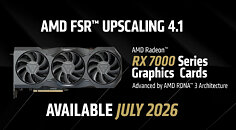
AMD has responded to what gamers have been most vocal about: bringing its FSR 4.1 upscaling technology to older RDNA 3 and RDNA 2 GPUs. Today, we learn that this dream is becoming a reality, as AMD is officially introducing its FSR Upscaling 4.1 technology to millions of Radeon RX 7000 Series graphics cards worldwide. Arriving this July, millions of RDNA 3 gamers will enjoy official support for FSR Upscaling 4.1 in over 300 supported games. This means that, just like the latest RDNA 4-based Radeon RX 9000 Series, RDNA 3 gamers will also benefit from the upscaling algorithms based on various machine learning techniques without needing to upgrade to the latest Radeon RX 9000 GPUs if their current GPU performs adequately.

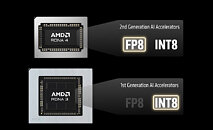
Interestingly, the FSR Upscaling 4.1 will use the same underlying model on RDNA 3 as it does on RDNA 4. However, differences in hardware create some background variations, as RDNA 4 has FP8 processing units and INT8, whereas RDNA 3 only has INT8. AMD explains that the company has developed FSR Upscaling 4.1 with the FP8 format in mind, while the latest ML algorithm has been optimized and ported for the INT8 data format to work with RDNA 3. This difference in hardware support delayed AMD's port of FSR technologies to RDNA GPU IP below version four, but it is now finally making an appearance.
Finally, FSR Upscaling 4.1 is also coming to older RDNA 2 GPUs, but that port will have to wait until early 2027. This indicates that AMD is doing additional optimization for RDNA 2 cards, as it is challenging to port this upscaling algorithm to hardware that isn't optimal for the latest techniques. However, it is promising that it is possible, and RDNA 2 gamers will just have to wait a bit longer.
Source: Jack Huynh on X
Add your own comment

252 Comments on AMD FSR Upscaling 4.1 Officially Arrives to Radeon RX 7000/6000 GPUs

#101
jnv11
lambdaWill this work with their iGPUs? Not sure if the overhead is worth it on those small chips.
Yes. It will boost their iGPUs which are a mix of RDNA 2, 3, 4, 3.5, and whatever else starting with RDNA 2 and onwards.
Posted on Reply
#102
Lew Zealand
LOL I just remembered I have a Radeon 780m RDNA3 iGPU in my MiniPC, so I'll have something to test in July! The lower end the GPU the more games go from unplayable to playable with better quality upscaling.
Posted on Reply
#103
dgianstefani
TPU Proofreader
Lew ZealandLOL I just remembered I have a Radeon 780m RDNA3 iGPU in my MiniPC, so I'll have something to test in July! The lower end the GPU the more games go from unplayable to playable with better quality upscaling.
This was the great crime of continuing to use GPU architectures from 2022 and older in 2026 APUs, being stuck with the worst upscaler on the market.
jnv11Yes. It will boost their iGPUs which are a mix of RDNA 2, 3, 4, 3.5, and whatever else starting with RDNA 2 and onwards.
What iGPU has RDNA 4?
Posted on Reply
#104
JustBenching
Tek-CheckRight... I love when people paint meaningless pictures with a broad brush. Perhaps you could ask others why they make purchase choices they do, to be able to understand. My last Nvidia desktop GPU was a passive 1050Ti for a no-fan system. After that, I moved to class 80 cards, for 4K gaming on a big OLED TV. When I saw what Nvidia was doing their class 80 cards, from Ampere onward, I never wanted to buy one offering ridiculously low amount of VRAM. Instead, I went for 6800XT and then 7900XTX. Both served me really well.
Well okay, but that was irrelevant to my point. I explained why people don't complain about pascal and you answered me "yes but I wanted vram".
Posted on Reply
#105
Tomorrow
dgianstefaniWhat iGPU has RDNA 4?
None yet, but there was a leak a while back alluding to RDNA4 based iGPU's existing. Im sure AMD has something in their labs. The question is whether they'll release it. Considering the tougher competition i think they have to. They cant wait all the way to RDNA5.
Posted on Reply
#106
AusWolf
zusFSR4 INT8 was made by AMD themselves, they just leaked it accidentally. Modders just compiled the leaked files into a DLL and shipped it on Optiscaler. I think the Optiscaler team did some optimizations for RDNA2 later on too. But the code was originally from AMD. FSR 4.1 is probably better than the leaked version, but the leaked version was already a big improvement over FSR 3.
radeon/comments/1nhkkr8/fsr_sdk_leak_contained_fsr_4_files_that_work_on
That's the official story, but I don't understand how a piece of software can be "leaked" and used without any legal consequence.
Posted on Reply
#107
jnv11
dgianstefaniThis was the great crime of continuing to use GPU architectures from 2022 and older in 2026 APUs, being stuck with the worst upscaler on the market.


What iGPU has RDNA 4?
I was trying to say iGPUs starting with RDNA 2 onwards to include future iGPUs because FSR 4.1 will boost them. My sinus infection is messing me up. Sorry about my unclear language.
Posted on Reply
#108
Dr. Dro
jnv11I was trying to say iGPUs starting with RDNA 2 onwards to include future iGPUs because FSR 4.1 will boost them. My sinus infection is messing me up. Sorry about my unclear language.
AMD has been known to disable features on iGPUs due to market segmentation reasons, and this might be one of them. Just saying. Not that you'll run FSR 4 on a single workgroup iGPU with 2 CUs. You won't, really, unless you're applying the algorithm on a GBA emulator.
Posted on Reply
#109
Warigator
The leaked INT8 path and OptiScaler already showed that FSR4 could run on RDNA 2/3, so I understand why people are annoyed that official support took so long. But “it can run” and “it is ready for official support across many games and GPUs” are not exactly the same thing.

Raw TOPS matter, but so do data formats, driver work, memory bandwidth, VRAM capacity and actual runtime overhead. This matters even more for weaker GPUs and iGPUs. This is complicated.

The technical limitations are real, but AMD’s poor communication still made the whole thing look worse than it needed to.

FSR 4.1 may technically run across RDNA 2/3, but practical usefulness will probably vary a lot. High-end RDNA 2 and most RDNA 3 cards seem like much more realistic targets for a good experience, while low-end 4 GB cards and iGPUs may be much more limited by overhead, bandwidth or VRAM.

I am happy that I've got RDNA4 with lots of TOPS and 16 GB, so updates keep coming and will probably be fully supported. I would say that RDNA4 is roughly on a similar feature-set level as Nvidia Lovelace.
Posted on Reply
#110
qlum
Considering fsr 4 and 4.1 already work on rdna3 on linux just by emulating the instructions and perform well enough on my 7900xt to be useful any excuse on amd's end why it takes so long is just that.

Sure it may not make sense for every gpu and every situation but it's still just stupid segmentation not to release it. Even if it can be optimized to perform better.

Same could have been said about ray tracing on older amd cards, rdna2 barely made it better from a hardware standpoint for it. RTG's leadership really should get a big shakeup.
Posted on Reply
#111
wheresmycar
Good news! Its never too late for some added extra performance features. I’m still not fully sold on upscaling tech but definitely useful if you're playing at 4K or with recent improvements its definitely starting to look more promising.

What scares me is the focus shifting from brute force raster gains to smarter rendering tricks and AI. If each new gen delivers solid native perf and holsters upscaling tech like an extra tool in the box, I'm all for it. What won't wash well is eventual next gen 10% uplift cycles (raw perf) paired with upscaling + x8 FG to compensate, unless these SMART techniques pull it off by mirroring native rendering.
Posted on Reply
#112
Warigator
I don't have anything against additional optional "fake performance" gimmicks, when it is happening alongside real raw specs improvement in stuff like fp32 flops, memory capacity, memory bandwidth, memory latency, cache capacity, cache bandwidth, cache latency, number of cores and performance per clock.
lambdaWill this work with their iGPUs? Not sure if the overhead is worth it on those small chips.
Could work on Strix Halo for sure. Maybe also some other higher-end AMD iGPUs. Probably not on the other ones.
Posted on Reply
#113
Lew Zealand
WarigatorFSR 4.1 may technically run across RDNA 2/3, but practical usefulness will probably vary a lot. High-end RDNA 2 and most RDNA 3 cards seem like much more realistic targets for a good experience, while low-end 4 GB cards and iGPUs may be much more limited by overhead, bandwidth or VRAM.
This will be a very interesting balance as I have:

RX 6400
RDNA2, 768 Cores @2300 MHz
4GB VRAM at 128 GB/s

RX 780m
RDNA3, 768 Cores @2700 MHz
8GB shared VRAM at 89 GB/s

In practice the 6400 is about 20% faster but with only 4GB this needs to be carefully managed in some games. Also the 780m can be configured to 4 or 16GB if needed but 8GB is ideal. It'll be interesting to see if and how INT8 works differently on these GPUs should both get the option.
Posted on Reply
#114
chrcoluk
Dr. DroSony has no such power over AMD, never has and never will.
It will now raise questions why the standard PS5 isnt getting the new scaling tech.
Posted on Reply
#115
Dr. Dro
chrcolukIt will now raise questions why the standard PS5 isnt getting the new scaling tech.
AFAIK, the PS5's GPU's instruction set is largely the same as RDNA 1, with a few RDNA 2 features backported onto it. That might be why - similarly the PS5 Pro's GPU must have some features backported into that while largely retaining the same instruction set as before. AMD are masters at semicustom, after all
Posted on Reply
#116
Event Horizon
chrcolukIt will now raise questions why the standard PS5 isnt getting the new scaling tech.
Could be due to the huge AI TOPS gap between the base and pro consoles.

Posted on Reply
#117
Dukenukemx
chrcolukIt will now raise questions why the standard PS5 isnt getting the new scaling tech.
The PS5 doesn't have Int8 which is needed for FSR4. This is probably one of the reasons why AMD was so hesitant to give RDNA2 and RDNA3 users FSR4, because it would make the PS5 look like it hasn't aged well. FSR4 for RDNA4 uses FP8 which gives it an extra performance boost. Int8 even exists on Vega56/64 cards, and yes FSR4 does work on them, but on Linux only. Int8 version of FSR4 was almost not a thing until it was leaked and Optiscaler made it usable on RDNA2+3.

Posted on Reply
#118
Vayra86
JustBenchingNo, the reason nvidia doesn't and will never get any criticism for not backporting dlss to Pascal (or the Geforce 256 for that matter) is that their competitors at the time don't offer anything that Pascal doesn't. Neither Vega or Polaris got something that Pascal doesn't. That is not the case with rdna 1, 2 and 3. These severely lack in features that the most basic, cheapest entry level Turing card from 2018 has. These are really not the same.

FG is the feature they are blocking (whether for actual technical reasons or otherwise) but that isn't as popular or useful as upscaling is. Not to mention I wouldnt think it's positive if they suddenly decided to give FG to ampere. It would only mean they were fooling us all this time pretending it wasn't possible.
Truth. Being first has many advantages
Posted on Reply
#119
vacsati
AusWolfThere's always something to be unhappy about, I guess.
Why would someone be happy for stg that not work with most games? Its the same when you give laptops to african tribes…its nice, but they dont have electricity and internet.,
Posted on Reply
#120
AusWolf
vacsatiWhy would someone be happy for stg that not work with most games?
Because 1. It doesn't hurt you in any way, and 2. Game support will come if/when hardware support is there.

Just because something doesn't affect you in a meaningful way (for now), you don't have to be negative about it.
vacsatiIts the same when you give laptops to african tribes…its nice, but they dont have electricity and internet.,
No, it's not like that at all.
Posted on Reply
#121
jnv11
vacsatiMost game not support it so whatever..
That might be because AMD refused to confirm official support for it for a long time on GPUs other than RDNA 4. Developers probably felt that supporting a minority of a minority of GPUs (RDNA 4, which is a minority of AMD GPUs, which themselves are a minority of GPUs of all brands of PC GPUs sold in today's market) was not worth their time and effort. Backporting RDNA 4.1 to FSR 2 and 3 makes it much more worth their time and effort to get FSR 4.1 supported.
Posted on Reply
#122
Tek-Check
dgianstefaniThis was the great crime of continuing to use GPU architectures from 2022 and older in 2026 APUs, being stuck with the worst upscaler on the market.
'Great crime'? Right... The 'crime' is so 'great' that buyers of APUs increased their market share by 6% in the last year alone. Such a 'great crime'. Oh boy... You must admit that millions of buyers were so gullible that they willingly ended up with the worst upscaler on the market.
Event HorizonCould be due to the huge AI TOPS gap between the base and pro consoles.
Where does this table with AI TOPS come from? There's something odd about it. Would you, kindly, post a link?
Posted on Reply
#123
Visible Noise
jnv11Yes. It will boost their iGPUs which are a mix of RDNA 2, 3, 4, 3.5, and whatever else starting with RDNA 2 and onwards.
Link?

The announcement doesn’t say a thing about integrated graphics. It specifically calls out 6000 and 7000 series discrete GPUs.
Posted on Reply
#124
Tek-Check
JustBenchingWell okay, but that was irrelevant to my point. I explained why people don't complain about pascal and you answered me "yes but I wanted vram".
Not really. You said more than that, quote: "These [RDNA 1,2,3] severely lack in features that the most basic, cheapest entry level Turing card from 2018 has". If you want to look at it that way, you could also say that even 5080, and for that matter all previous class 80 cards, severely lack in features, basic hardware features such as enough VRAM for the class of cards and their price. It's the main reason I have never bought class 80 card from Nvidia. They destroyed this class of cards by restricting VRAM. Such as shame.
Posted on Reply
#125
Visible Noise
DukenukemxThe PS5 doesn't have Int8 which is needed for FSR4. This is probably one of the reasons why AMD was so hesitant to give RDNA2 and RDNA3 users FSR4, because it would make the PS5 look like it hasn't aged well. FSR4 for RDNA4 uses FP8 which gives it an extra performance boost. Int8 even exists on Vega56/64 cards, and yes FSR4 does work on them, but on Linux only. Int8 version of FSR4 was almost not a thing until it was leaked and Optiscaler made it usable on RDNA2+3.
Mark Cerny has said instruction support doesn’t matter, software architecture is what’s important.

The PS5 Pro has 300% of the TOPS performance of a 7900XT.
Posted on Reply
Add your own comment
Nov 13th, 2026 08:27 PST change timezone

New Forum Posts

Popular Reviews

TPU on YouTube

Controversial News Posts