Thursday, May 14th 2026
AMD FSR Upscaling 4.1 Officially Arrives to Radeon RX 7000/6000 GPUs
AMD has responded to what gamers have been most vocal about: bringing its FSR 4.1 upscaling technology to older RDNA 3 and RDNA 2 GPUs. Today, we learn that this dream is becoming a reality, as AMD is officially introducing its FSR Upscaling 4.1 technology to millions of Radeon RX 7000 Series graphics cards worldwide. Arriving this July, millions of RDNA 3 gamers will enjoy official support for FSR Upscaling 4.1 in over 300 supported games. This means that, just like the latest RDNA 4-based Radeon RX 9000 Series, RDNA 3 gamers will also benefit from the upscaling algorithms based on various machine learning techniques without needing to upgrade to the latest Radeon RX 9000 GPUs if their current GPU performs adequately.
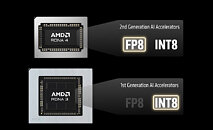
Interestingly, the FSR Upscaling 4.1 will use the same underlying model on RDNA 3 as it does on RDNA 4. However, differences in hardware create some background variations, as RDNA 4 has FP8 processing units and INT8, whereas RDNA 3 only has INT8. AMD explains that the company has developed FSR Upscaling 4.1 with the FP8 format in mind, while the latest ML algorithm has been optimized and ported for the INT8 data format to work with RDNA 3. This difference in hardware support delayed AMD's port of FSR technologies to RDNA GPU IP below version four, but it is now finally making an appearance.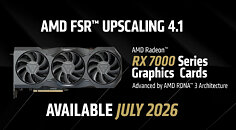
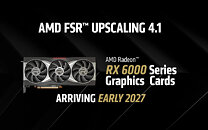
 Finally, FSR Upscaling 4.1 is also coming to older RDNA 2 GPUs, but that port will have to wait until early 2027. This indicates that AMD is doing additional optimization for RDNA 2 cards, as it is challenging to port this upscaling algorithm to hardware that isn't optimal for the latest techniques. However, it is promising that it is possible, and RDNA 2 gamers will just have to wait a bit longer.
Source:
Jack Huynh on X
Interestingly, the FSR Upscaling 4.1 will use the same underlying model on RDNA 3 as it does on RDNA 4. However, differences in hardware create some background variations, as RDNA 4 has FP8 processing units and INT8, whereas RDNA 3 only has INT8. AMD explains that the company has developed FSR Upscaling 4.1 with the FP8 format in mind, while the latest ML algorithm has been optimized and ported for the INT8 data format to work with RDNA 3. This difference in hardware support delayed AMD's port of FSR technologies to RDNA GPU IP below version four, but it is now finally making an appearance.


252 Comments on AMD FSR Upscaling 4.1 Officially Arrives to Radeon RX 7000/6000 GPUs
I do agree, AMD ought to fire their PR team! Really, all they had to do was put the word out that the tech would be coming to RDNA2 and RDNA3, but there might be a delay. But it's nothing new, they kept quiet because they wanna sell more RDNA4 GPUs....so, I guess I can't blame them.
Since RDNA and CDNA are separate products (unlike Nvidia, where datacenter and consumer use the same architecture), the client gaming segment is much more subject to the whims of their major customers. If either Xbox or Sony decide to go with an Intel or Intel+Nvidia APU for their console, AMD's gaming segment loses a huge chunk of revenue. If Nvidia lost every AIB partner tomorrow, it wouldn't hurt their GPU segment one bit because they'd still be selling a bazillion Blackwell GPUs to datacenters.
So yes, Sony was likely a huge factor in why FSR 4 rollout has been so slow. It was released an entire year after PSSR, and it took another year to get it onto cards that should have had it day 1.
AND Valve has a strong hand in the continued development of both, with the incentive of bringing Day 1 support to the Steam Machine, whenever they release it
Native Vulkan version still lacks FSR4 support. But most games are done via DX12 anyways that usually needs the FSR4 most. FSR3 works with Vulkan well.
This whining has to stop. I mean, get a grip, get a life and most importantly: get over it.
This is imo Sony doing sony things
Seems like they're both selling as many discrete gaming GPUs as they're willing to build. Their focus seems to be on pumping out high margin AI gpus.
"Sparse" or eliminating all the impossible math is what allows is a 3X performance increase for essentially free in most matrix workloads, which in years past at lower resolution the "Full Fat" matrix math was fast enough for 30FPS to 60FPS frame doubling at 1080P www.cyberlink.com/support-center/faq/content?id=29859 This technology or like it has been around for years, before that it was motion vector adaptive de-interlacing using shaders which back in the the day VLIW shaders (vertex processors) were essentially programmable matrix math, so we have almost come full circle.
graphics.stanford.edu/projects/shading/pubs/hwws2001-regcomb/regcomb.pdf
This paper is about the ability to use data other than color data in vertex processors as math accelerators, and is the foundation of what became GPU accelerated Folding @ Home. October 2006 the first GPU client was released for ATI only as Nvidia was clipping bits off their color data for better performance, also why ATI/AMD had slower performance in those years many times, also why they had better image quality. Now its tit for tat.
Never mind that owning said product wouldn't have helped in this situation because the criticism was about a feature they don't have. Nvidia owners commenting on a lack of better upscaling on 1 gen old AMD cards is valid criticism because they know precisely what those people are missing. Ditto goes for current gen AMD owners. You don't need to own either frankly, because we can all see the many many deep dives on the newer FSR vs the older FSR.
If you can present an actual logical reason for why people can't comment on this instead of merely trying to dismiss their comments for no valid reason, I'd like to hear it.Please explain how your comment, being bereft of any actual argument, isn't "whining" as you put it in your own words?
Please explain why you don't "get over it"?
You see, if your own words disarm themselves, they never held much value in the first place.
And this FSR thing will be considered next time I upgrade.
Anyway, maybe invest your time and effort writing directly to Amd. Or go to reddit, where all of gen-z goes to whine. Might work much better on behalf of your 23 customers.
Could have fooled me, with the deafening silence...Nvidia users were not complaining because they love competition or because they want older AMD card owners to have better upscaler.
Nvidia users were complaining as a way to dunk on AMD as they view AMD themselves as substandard. At least the Radeon division.
It was malicious, not based on good will.
Lord have mercy on the people that have to buy a PC from you, attitude for no reason. Building PCs isn't my profession, it's something I do for friends and family. I actively decline all other requests because it isn't worth the time. Good for you that you are fine doing entry level work.Nvidia owners are not a mono-culture. There will always people saying things without thinking but that doesn't mean all of them are.
All this noise is just distracting from the facts:
- FSR 4 works relatively well on last gen AMD cards.
- Nvidia supports the latest version of DLSS on multiple prior generations.
Who owns what is irrelevant, bad actors existing is irrelevant. Cut through the BS and look at the facts.
“It is possible we can optimize it to make it work in RDNA 3 arquitecture, we are on it and we want to do it, but we need to work it”
Source: VideoCardz.com
videocardz.com/newz/amd-radeon-rx-9070-series-to-have-balance-of-power-and-price-similar-to-the-rx-7800-xt-and-rx-7900-gre
Maybe they should have dropped Frank Azor's line at least a few more times since checks notes January 2025.