Tuesday, August 11th 2026

NVIDIA RTX 50 Series Median Prices Jump Up to 41% in August, with MSRP Now a Distant Dream
NVIDIA's GeForce RTX 50 series of "Blackwell" graphics cards has seen significant price increases over the past few months, with a particularly notable jump between July and August. On Newegg, one of the largest computer hardware retailers in the United States, there has been a noticeable change in the median listed price for each GeForce RTX 50 model. For instance, the entry-level GeForce RTX 5050 had a median price of $300 in June, which rose by 5% to $315 in August. Moving up the range, the GeForce RTX 5060 was listed at an average of $370 in July, but this increased by 27% to $470 in August, marking a $100 difference. However, this is just the beginning.
The 8 GB edition of the RTX 5060 Ti was priced at $470 and has now risen to $530, reflecting a 13% increase. The most significant change occurred with the 16 GB version of the RTX 5060 Ti, which jumped from $570 in July to $805 in August, a 39% increase. The RTX 5070 experienced a similar percentage rise of 36%, going from $660 to $900. The RTX 5070 Ti remained steady at $1100, while the RTX 5080 saw a modest 3% increase from $1462 to $1500. The flagship GeForce RTX 5090 recorded a 9% increase, moving from $4300 to $4700.
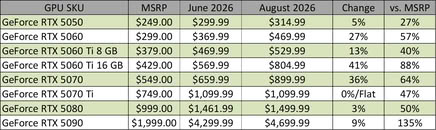 When compared with the manufacturer's suggested retail price (MSRP), the situation becomes even more striking. As indicated by the table, the RTX 50 series is now selling significantly above the MSRP that NVIDIA still officially lists on its website, with the flagship GeForce RTX 5090 commanding a median price that is a staggering 135% above MSRP. Much of this discrepancy is due to significant pricing adjustments by memory manufacturers, which are being passed on to add-in board partners. Since higher-end cards use more VRAM, the price differences are more pronounced.
Sources:
Tom's Hardware, VideoCardz
The 8 GB edition of the RTX 5060 Ti was priced at $470 and has now risen to $530, reflecting a 13% increase. The most significant change occurred with the 16 GB version of the RTX 5060 Ti, which jumped from $570 in July to $805 in August, a 39% increase. The RTX 5070 experienced a similar percentage rise of 36%, going from $660 to $900. The RTX 5070 Ti remained steady at $1100, while the RTX 5080 saw a modest 3% increase from $1462 to $1500. The flagship GeForce RTX 5090 recorded a 9% increase, moving from $4300 to $4700.


195 Comments on NVIDIA RTX 50 Series Median Prices Jump Up to 41% in August, with MSRP Now a Distant Dream
In five years, AI will be able to reduce work necessary to produce a good game by a great margin, and new fabs will be ready to mass-produce millions of good enough wafers for computer chips. Next generation of consoles can start at $1,000, but over the next few years, it's likely to reduce price by two times. So we can end up with $500 PlayStation 6 and Xbox Helix by 2032 or 2033.
Sure is a good time to be occupied with your backlog.
So, those "much better prices" will never be as good as they would have been without this AI craze. I mean, we might be lucky to be able to buy 32GB for $100 again in 2030, but without this AI boom, in 2030 we would be probably paying $70 for 64GB.
So yea, i should be happy i got an RTX 5080 for 600 euro, when i sold my RTX 3070. Atm, the cheapest i can get is 1500 and the most pricy one is 2100.
Just cope harder, its ok that you can't afford to buy anything, just dont be so stupid and bitter about it.
First, it was obviously going to happen sooner or later. This sort of GPU pricing isn't even new; we saw similar numbers for most of the launch-era Ada lineup. Let's not even discuss the scalping on Ampere and RDNA 2. Anyone who's shocked to see Blackwell prices go vertical must have been living under a rock.
Second, we were already screwed on storage and memory, which are more fundamental both for the economy at large and the individual user. If you have data that you care about, or a use case that encourages X amount of RAM, you have no choice but to bend over and pay to replace your storage/memory, at a comparable capacity, when it fails.
GPU horsepower requirements are typically much more forgiving. Usually it's a matter of making do with medium/low settings instead of Ultra, or 60 FPS instead of 100. Or of playing games with lower requirements. Sure, I don't like the idea that a direct GPU replacement might cost 2x, but I don't really need a direct replacement. I could do just fine with a 3060-tier card. Or even less, these days. The AAA gaming industry is in the process of immolating itself, anyway. Good riddance. I do enjoy tinkering with local inference on occasion, but I'd have to be pretty goofy to complain about a lack of AI tinkering options: AI is the reason we're in this pricing mess to begin with.
I'm not defending AMD either if it's carp it will be said out loud like here. I never understood those weird creatures fanboys. nVIDIA that's a real threat to pc gaming etc. where you will overpay a lot even if you don't use Nvidia at all. For example building a new non nvidia gaming pc and will overpay let's say 650$ like an absalute idiot for nvidia tax only. (RAM, NVMe, GPU price hike due to nvidia AI plague)
As always the tech media and influencers go easy on Nvidia increasing prices, which I think is about the 4th price increase now, but when AMD makes a low end card for the OEM market, everyone acts like AMD is ruining PC gaming for serving a market people ironically complain AMD wasn't making a card for. We even have a certain person on the 1st page trying to defend the pricing while even a lower end 5070 is $800USD, absolutely nuts. People argued that PC gaming could never die out, but we're seeing the hobby being priced out for a majority of gamers.For a gaming card the 9070XT is more than close enough, in the US a 5070Ti is about 70% more expensive than a $700 9070XT. Yet I'm sure people will still pay 70% more.
The second reason was that 4000 cards feature old DP 1.4 ports. Nvidia decided to go cheap on all cards, including super expensive 4090 cards, and they did not update video ports. They reused the same video ports from 3090. It was ironic to see that the then most expensive gaming card in the world could not properly drive new monitors such as 57-inch Samsung 8K/2K/240Hz display. 4090 could not connect to it at 240Hz, but only 120Hz due to restricted bandwidth and number of display heads (two) used with DSC.
As a reminder:
www.tomshardware.com/news/geforce-rtx-4090-cannot-handle-samsungs-odyssey-neo-g9-240hz-monitor-limited-to-120-hz
So when I paid MSRP for my 4090, I was an idiot?
So when I paid MSRP in July 2025 for my 5090 I was an idiot?
So explain again how I'm the idiot for purchasing cards that suit my exact needs?
If I need cuda support and lots of Vram....tell me what AMD offers? And no a 7900XTX was not an option either, the 9070XT is meh and so far behind in performance, sad to say it AMD does not have anything high end in the GPU market, and news flash some of us require high end GPUS.
is it that you are jealous, or just plain stupid and can't think of anything else to say other than Nvidia bad?