Tuesday, August 11th 2026

NVIDIA RTX 50 Series Median Prices Jump Up to 41% in August, with MSRP Now a Distant Dream
NVIDIA's GeForce RTX 50 series of "Blackwell" graphics cards has seen significant price increases over the past few months, with a particularly notable jump between July and August. On Newegg, one of the largest computer hardware retailers in the United States, there has been a noticeable change in the median listed price for each GeForce RTX 50 model. For instance, the entry-level GeForce RTX 5050 had a median price of $300 in June, which rose by 5% to $315 in August. Moving up the range, the GeForce RTX 5060 was listed at an average of $370 in July, but this increased by 27% to $470 in August, marking a $100 difference. However, this is just the beginning.
The 8 GB edition of the RTX 5060 Ti was priced at $470 and has now risen to $530, reflecting a 13% increase. The most significant change occurred with the 16 GB version of the RTX 5060 Ti, which jumped from $570 in July to $805 in August, a 39% increase. The RTX 5070 experienced a similar percentage rise of 36%, going from $660 to $900. The RTX 5070 Ti remained steady at $1100, while the RTX 5080 saw a modest 3% increase from $1462 to $1500. The flagship GeForce RTX 5090 recorded a 9% increase, moving from $4300 to $4700.
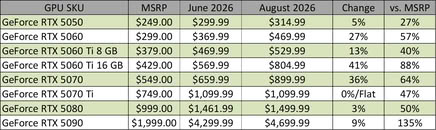 When compared with the manufacturer's suggested retail price (MSRP), the situation becomes even more striking. As indicated by the table, the RTX 50 series is now selling significantly above the MSRP that NVIDIA still officially lists on its website, with the flagship GeForce RTX 5090 commanding a median price that is a staggering 135% above MSRP. Much of this discrepancy is due to significant pricing adjustments by memory manufacturers, which are being passed on to add-in board partners. Since higher-end cards use more VRAM, the price differences are more pronounced.
Sources:
Tom's Hardware, VideoCardz
The 8 GB edition of the RTX 5060 Ti was priced at $470 and has now risen to $530, reflecting a 13% increase. The most significant change occurred with the 16 GB version of the RTX 5060 Ti, which jumped from $570 in July to $805 in August, a 39% increase. The RTX 5070 experienced a similar percentage rise of 36%, going from $660 to $900. The RTX 5070 Ti remained steady at $1100, while the RTX 5080 saw a modest 3% increase from $1462 to $1500. The flagship GeForce RTX 5090 recorded a 9% increase, moving from $4300 to $4700.


195 Comments on NVIDIA RTX 50 Series Median Prices Jump Up to 41% in August, with MSRP Now a Distant Dream
Nvidia are no.1 chip makers for AI and company who started it. Because of nvidia we are suffering massive RAM shortages and extreme prices for RAM, VRAM, SSD, Consoles, Steam Machine etc.....
I followed open Ai since 2016 because they were involved with dota 2. They made Ai bots for the game that beat the best dota 2 team at the time. They didn't use nvidia hardware back then but Microsofts cloud servers. But why let reality and facts get in the way of making stuff up against nvidia? Sorry, I meant ngreedia.
Why leave out a meager 5060ti is faster and uses 80w less power than a 2080ti?
Again we get it, you worship AMD they can do no wrong and somewhere along the line Nvidia hurt you, but your facts and comparisons are just outrageous and incoherent
I just picked up two new 7900XTX 24GB reference cards for $900 each. Usually paying almost MSRP for a 3 year old GPU would be odd but these are insanely powerful cards that are competitive with the 5070 Ti in gaming and have much more VRAM. So whether you're gaming or doing self-hosted AI it's all-around better. It's a bit less power efficient but there's always a trade-off to everything.
And if you want 32GB of VRAM at the expense of raster/gaming/raw compute the R9700 32GB is an excellent choice for self-hosting AI. But even for gaming if you need high VRAM it is readily available at MSRP of around $1400. Nothing in the NVIDIA camp offers that price to memory ratio. Hence why I have three of them.
If you're willing to deal with Intel's compatibilty and driver issues the Arc B series (both BXXX gaming and BXX Pro) offer an even better value.
A 7900xtx "competitive" with a 5070ti, so 25-30% slower while consuming 20-30% more power. Yes it has 8gb more ram and you specifically mention gaming, but why does the 5070ti crush the xtx in games despite less ram?
Why did you completely ignore what I said?
4700USD for a card which will burn your house down? A box of matches costs few cents and does the same job.