Tuesday, August 11th 2026

NVIDIA RTX 50 Series Median Prices Jump Up to 41% in August, with MSRP Now a Distant Dream
NVIDIA's GeForce RTX 50 series of "Blackwell" graphics cards has seen significant price increases over the past few months, with a particularly notable jump between July and August. On Newegg, one of the largest computer hardware retailers in the United States, there has been a noticeable change in the median listed price for each GeForce RTX 50 model. For instance, the entry-level GeForce RTX 5050 had a median price of $300 in June, which rose by 5% to $315 in August. Moving up the range, the GeForce RTX 5060 was listed at an average of $370 in July, but this increased by 27% to $470 in August, marking a $100 difference. However, this is just the beginning.
The 8 GB edition of the RTX 5060 Ti was priced at $470 and has now risen to $530, reflecting a 13% increase. The most significant change occurred with the 16 GB version of the RTX 5060 Ti, which jumped from $570 in July to $805 in August, a 39% increase. The RTX 5070 experienced a similar percentage rise of 36%, going from $660 to $900. The RTX 5070 Ti remained steady at $1100, while the RTX 5080 saw a modest 3% increase from $1462 to $1500. The flagship GeForce RTX 5090 recorded a 9% increase, moving from $4300 to $4700.
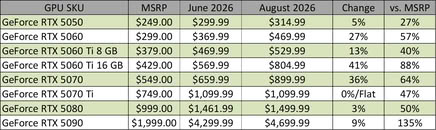 When compared with the manufacturer's suggested retail price (MSRP), the situation becomes even more striking. As indicated by the table, the RTX 50 series is now selling significantly above the MSRP that NVIDIA still officially lists on its website, with the flagship GeForce RTX 5090 commanding a median price that is a staggering 135% above MSRP. Much of this discrepancy is due to significant pricing adjustments by memory manufacturers, which are being passed on to add-in board partners. Since higher-end cards use more VRAM, the price differences are more pronounced.
Sources:
Tom's Hardware, VideoCardz
The 8 GB edition of the RTX 5060 Ti was priced at $470 and has now risen to $530, reflecting a 13% increase. The most significant change occurred with the 16 GB version of the RTX 5060 Ti, which jumped from $570 in July to $805 in August, a 39% increase. The RTX 5070 experienced a similar percentage rise of 36%, going from $660 to $900. The RTX 5070 Ti remained steady at $1100, while the RTX 5080 saw a modest 3% increase from $1462 to $1500. The flagship GeForce RTX 5090 recorded a 9% increase, moving from $4300 to $4700.


195 Comments on NVIDIA RTX 50 Series Median Prices Jump Up to 41% in August, with MSRP Now a Distant Dream
I mean I can play the same game. Nvidia 5000 have very decent drivers. Albeit, funny you didn't mention RDNA 2 though :D
Edit - that applies to everyone.
Edit 2 - if anyone talks about AMD and drivers here, I'll bench Krit and JustBenching. /jk
But seriously. Please stop with the performative brand loyalty. It's getting old now.
The 279 USD Radeon 9050 8GB is probably 3.5x faster with 2x more VRAM. The 4GB variant is useless, for obvious reasons, and anyone buying a PC with it inside is a moron (if you are ok with such a card, then you don't need a desktop, use a freaking laptop!!).
As you can see, prices of every tier have gone up (by approximately 2x).
Regarding the 9050 with its 4GB, tech sites and YouTube channels had a absolute field day. They were practically hurling curses at AMD for ruining gamers with that model. Have you seen a similar reaction to Nvidia's price hikes? And especially one so widespread that it looks almost coordinated? Personally, I haven't. I've seen wishful thinking, I've seen observations, I've seen excuses, but nowhere—absolutely nowhere—does anyone dare to use harsh language against Nvidia. And please, don't point me to the 2–3 videos from Gamers Nexus—the channel that established "user error" as the only reason 16-pin connectors catch fire. Too little, too late, Steve.
Transistors, fillrates, not much of that matters anymore. If you compare say, a great GPU of old like the Radeon HD 4890, it's unable to produce 1% of the performance of an RTX 5090. In any case, no use musing over prices or the progress of tech, these are clearly abnormal market conditions and there is very little shelter from the elements left.
My advice? Buy whatever you need now. Cancel any future plans and build what you can now, with room to upgrade in mind in case we return to calmer waters.
Even back then people still bought Nvidia. That would be like today 9070 XT being 98% performance of the 5090 and people would still invent excuses to buy Nvidia and grow their market share.Only if used properly. AI is a tool in a toolbox of tools. It's not the toolbox itself.
And currently the companies are not investing in AI. They're going into severe debt. For all our sake i hope most of them will survive (otherwise we will have consolidation and new monopolies) when the bubble bursts and it will. Just as people who denied there's a bubble during the peaks of the latest mining craze. The bill comes due, always.
As for superintelligence? Please. No one who's alive now will live to see it.
What we have now and what will will have for the foreseeable future is not even AI, much less superintelligence.
What we have now is a VI - Virtual Intelligence. Tho it can mimic human behavior, it is not sentient and never will be.
RTX 2080 Ti was not great way worse than GTX 1080 Ti but still it was better than RTX 4080 msrp 1000€ vs 1200€ or true high end vs low high end and massive die size difference 754 mm² vs 379 mm² RTX 2080 Ti was way, way more expensive to produce than small tiny RTX 4080 but it has still 200€ lower price msrp at way, way higher production cost. Even way overpriced RTX 5090 has smaller die size of only 750 mm².
The RX 9050 may be its direct competitor, it's releasing too late, with too high of a price tag (after conversion), disappointing performance overall, and as a bonus you get a 4GB OEM-only variant which will be sold under the same name. All GPUs are going up in price yet the RX 9050 is already a bad choice on release day for anyone building at such budget without buying used parts.
This reminds me about...
The RX 9050 with the 4GB of VRAM, an OEM part, was used to paint a picture where AMD was destroying gaming and scamming consumers. While someone can say that those 4GB of VRAM are a scam in 2026, the GPU itself is so underpowered that isn't made for AAA 2026 gaming anyway. So the question here is, can it play eSport titles and older games that either had 4GB VRAM as a minimum or even as a recommended capacity? If yes, the next question is how much cheaper the prebuild PCs using this GPU are compared to 8GB models. If the answer is $50-$100 cheaper, then the price is probably OK for some people trying to find a cheap solution.
EVERYONE remembers the RX 6500XT because tech sites and Youtubers again jumped on the opportunity to make AMD look as the enemy. No one back then was saying the obvious. We where in a mining craze period and every card out there was overpriced, scalped and used for mining. A card like the 6500XT was still overpriced for it's performance, but because it was a cut down chip, no one was trying to buy it to use it for mining, meaning the price remained close to MSRP. That card probably helped people to save money by offering an option that wasn't ridicoulusly bad. Just bad. But everything GPU was really bad back then, like what is happening with RAM today.
Now, NO ONE remembers GTX 1630 because most tech sites chose to shut the f up, probably because Nvidia asked them to. A card that was released after RX 6500XT, was performing much worst even compared to the RX 6400 and the perf/$ value of that card was a real insult to gamers. But NO ONE remembers that card. Probably even you.
These are all from the 1st page of a simple google search. I can find more but it proves the point. Either google is lying and these reviews do not exist, or someone else is.
In any case, if you want to see nvidia’s shenanigans with pricing:You can see how they pushed and pulled the pricing, normalizing it a higher and higher levels. The only saving grace is that the cards have higher tdp, thus extracting more from the chip and they last longer because improvements are slower and slower. The rnd is higher too but they sell more so it’s difficult to assess without numbers.
I just looked up several back ups of LDLC website (largest tech retailer in France) through the WayBack Machine for fun, and they had only a single model of the GTX 1630 3 weeks after its release and 8 models after 6 months. I don't remember it as anything else other than a paper launch with absolutely zero announcement, it started disappearing by Q3 2023 and was no longer sold by Q1-Q2 2024. It was also not sold through major OEMs for whatever reason. So it's normal nobody remembers it: it disappeared as fast as it appeared (lack of stock or seized by cryptobros), nobody cared about it, and ironically its price went skyhigh as well so no sane person bought it after end 2022 (like the 6500 XT).
I went from a 1080Ti to a 2080Ti early at MSRP (on one of my machines) and 6 weeks later it was 50% more - and sorry if you don't think so but the 2080Ti kicked the 1080Ti's butt. :D
This approach has already led to many discoveries and will lead to vastly more, of greater and greater significance. Current capabilities are nothing compared with what will exist in seven years. Video games are ultimately entertainment. It is very consoling that finally there are ways to get out of this restrictive predicament in which we exist because of the limitations of human cognition and foresight.
And intelligence does not require sentience. Whether a model is conscious has little to do with whether it can reason, discover things, design something better than humans can, or solve problems humans couldn't solve. Calling current systems VI instead of AI doesn't change what they are increasingly capable of doing.
AI is getting real, more capable and more general with each year. Superintelligence is on the horizon. Not a fantasy, but an actual technological direction in which enormous amounts of money, hardware, energy and human effort are now being invested.
None of this means that current GPU prices are OK, or that Nvidia's treatment of the consumer market should be defended. AI being genuinely important and the current consumer hardware situation being terrible are perfectly compatible statements. I don't like paying twice as much for a tier of hardware either.
Is that the only thing a 2080ti does better than a 1080ti though? Like is the disparity in raster performance the only defining difference today and for the past several years, or is there more to it that makes a 2080ti more relevant, performant, and useful today than a 1080ti?
You know I know the answer, I just want to hear how you would represent it.
GTX 1080Ti was the last gpu generation that has no RT hardware on it that's way after four years it's starts to show it's age more. RTX 2080Ti is the first RT generation still weak for RT but it's aging better than GTX 1080Ti. For first ~3-4 Years GTX 1080Ti was good enough 2017-2021 after that RT crap kicked in more Unreal Engine 5 etc. marketing nonsense.