Tuesday, August 11th 2026

NVIDIA RTX 50 Series Median Prices Jump Up to 41% in August, with MSRP Now a Distant Dream
NVIDIA's GeForce RTX 50 series of "Blackwell" graphics cards has seen significant price increases over the past few months, with a particularly notable jump between July and August. On Newegg, one of the largest computer hardware retailers in the United States, there has been a noticeable change in the median listed price for each GeForce RTX 50 model. For instance, the entry-level GeForce RTX 5050 had a median price of $300 in June, which rose by 5% to $315 in August. Moving up the range, the GeForce RTX 5060 was listed at an average of $370 in July, but this increased by 27% to $470 in August, marking a $100 difference. However, this is just the beginning.
The 8 GB edition of the RTX 5060 Ti was priced at $470 and has now risen to $530, reflecting a 13% increase. The most significant change occurred with the 16 GB version of the RTX 5060 Ti, which jumped from $570 in July to $805 in August, a 39% increase. The RTX 5070 experienced a similar percentage rise of 36%, going from $660 to $900. The RTX 5070 Ti remained steady at $1100, while the RTX 5080 saw a modest 3% increase from $1462 to $1500. The flagship GeForce RTX 5090 recorded a 9% increase, moving from $4300 to $4700.
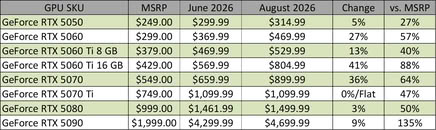 When compared with the manufacturer's suggested retail price (MSRP), the situation becomes even more striking. As indicated by the table, the RTX 50 series is now selling significantly above the MSRP that NVIDIA still officially lists on its website, with the flagship GeForce RTX 5090 commanding a median price that is a staggering 135% above MSRP. Much of this discrepancy is due to significant pricing adjustments by memory manufacturers, which are being passed on to add-in board partners. Since higher-end cards use more VRAM, the price differences are more pronounced.
Sources:
Tom's Hardware, VideoCardz
The 8 GB edition of the RTX 5060 Ti was priced at $470 and has now risen to $530, reflecting a 13% increase. The most significant change occurred with the 16 GB version of the RTX 5060 Ti, which jumped from $570 in July to $805 in August, a 39% increase. The RTX 5070 experienced a similar percentage rise of 36%, going from $660 to $900. The RTX 5070 Ti remained steady at $1100, while the RTX 5080 saw a modest 3% increase from $1462 to $1500. The flagship GeForce RTX 5090 recorded a 9% increase, moving from $4300 to $4700.


195 Comments on NVIDIA RTX 50 Series Median Prices Jump Up to 41% in August, with MSRP Now a Distant Dream
however, the good news is that the game devs have to optimize their games now, instead of telling people to keep buying the latest and greatest GFX cards or their games won't sell
A couple of weeks ago we had the leak of AMD's 4GB RX 9050 that is an OEM card, so probably something that OEMs demanded. There are dozens or even hundreds of videos and articles about AMD <<BEEP!>> gamers.
Then when it is about pricing, no one is really talking about, because that's something that makes Nvidia look worst. RX 9070 series maintains a price close to MSRP if I am not mistaken, Nvidia prices have gone to the roof, but known youtube channels for example with millions of subscribers try to hide the price increases using percentages instead of dollars/euros, compare not with MSRP in most of their articles/videos, but with pricing a couple of months ago and while I haven't read the thread here, I am pretty sure that the usual people will start talking about RAM pricing that seems to not apply to RX 9070 series.
It is not really complicated to calculate one AI datacenter operational costs, compare it to earnings and seethat something is fishy.
Consequences, especially on highly developed countries where digitalization has already took off in many parts of industry and administratikn, will be severe and will last decade at least.
The only one I can think about, from graphics only perspective is Avatar: Frontiers of Pandora, and Indiana Jones and the Great Circle, which both have PERFECT, beautiful graphics. But they work just fine with lower settings on medium tier cards, so....
But today, the only thing AMD can really do is to change it's logo into a green one, resembling Nvidia's logo, change Radeon to Rvideon and hope that most consumers wouldn't notice. Because consumers buy the logo. I am pretty sure that if we where going to a physical store where the price of RX 5060 Ti 16GB was the same with RX 9070's and sitting there all day watching what people buy, 5060 would outsell 9070 5 to 1 or something.Here we are, AMD keeping prices down, Nvidia increasing prices to the roof, that "copy NVIDIA and make it 50€ cheaper" resembling more to "copy NVIDIA and make it 250€ cheaper" for probably any model over 500 and we keep saying the same.
Insane.
Boy am I glad I've had a 5080 this long, these prices are silly on top of already not great value at MSRP, desperation and FOMO is a hell of a drug for some though.
C'mon who's willing to pay 800 bucks for xx60 class GPU?:kookoo: