Tuesday, August 11th 2026

NVIDIA RTX 50 Series Median Prices Jump Up to 41% in August, with MSRP Now a Distant Dream

NVIDIA's GeForce RTX 50 series of "Blackwell" graphics cards has seen significant price increases over the past few months, with a particularly notable jump between July and August. On Newegg, one of the largest computer hardware retailers in the United States, there has been a noticeable change in the median listed price for each GeForce RTX 50 model. For instance, the entry-level GeForce RTX 5050 had a median price of $300 in June, which rose by 5% to $315 in August. Moving up the range, the GeForce RTX 5060 was listed at an average of $370 in July, but this increased by 27% to $470 in August, marking a $100 difference. However, this is just the beginning.

The 8 GB edition of the RTX 5060 Ti was priced at $470 and has now risen to $530, reflecting a 13% increase. The most significant change occurred with the 16 GB version of the RTX 5060 Ti, which jumped from $570 in July to $805 in August, a 39% increase. The RTX 5070 experienced a similar percentage rise of 36%, going from $660 to $900. The RTX 5070 Ti remained steady at $1100, while the RTX 5080 saw a modest 3% increase from $1462 to $1500. The flagship GeForce RTX 5090 recorded a 9% increase, moving from $4300 to $4700.
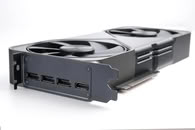
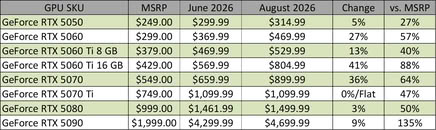
When compared with the manufacturer's suggested retail price (MSRP), the situation becomes even more striking. As indicated by the table, the RTX 50 series is now selling significantly above the MSRP that NVIDIA still officially lists on its website, with the flagship GeForce RTX 5090 commanding a median price that is a staggering 135% above MSRP. Much of this discrepancy is due to significant pricing adjustments by memory manufacturers, which are being passed on to add-in board partners. Since higher-end cards use more VRAM, the price differences are more pronounced.
Sources: Tom's Hardware, VideoCardz
Add your own comment

195 Comments on NVIDIA RTX 50 Series Median Prices Jump Up to 41% in August, with MSRP Now a Distant Dream

#126
Hecate91
WarigatorThe point of powering up technology is to solve problems better. Human minds haven't been able to really solve many of our problems, only mitigate them. We are too limited. That is why clusters consisting of large numbers of data-center racks with thousands of GPUs and CPUs are linked together to perform increasingly capable reasoning, research and problem-solving for us.

This approach has already led to many discoveries and will lead to vastly more, of greater and greater significance. Current capabilities are nothing compared with what will exist in seven years. Video games are ultimately entertainment. It is very consoling that finally there are ways to get out of this restrictive predicament in which we exist because of the limitations of human cognition and foresight.

And intelligence does not require sentience. Whether a model is conscious has little to do with whether it can reason, discover things, design something better than humans can, or solve problems humans couldn't solve. Calling current systems VI instead of AI doesn't change what they are increasingly capable of doing.

AI is getting real, more capable and more general with each year. Superintelligence is on the horizon. Not a fantasy, but an actual technological direction in which enormous amounts of money, hardware, energy and human effort are now being invested.

None of this means that current GPU prices are OK, or that Nvidia's treatment of the consumer market should be defended. AI being genuinely important and the current consumer hardware situation being terrible are perfectly compatible statements. I don't like paying twice as much for a tier of hardware either.
Instead of mitigating problems, as humans have done and have been fine with, let's just power up a bunch of datacenters to cause even more problems such as polluted water, air, and possibly crash the entire worlds economy when the promises made of AI magically making everything better aren't possible because the circular economy keeping AI companies afloat isn't sustainable.

AI in specialized fields like medical science, or logistics is important, but it isn't to the degree that people like scam altman and the leather jacket man are telling us it is.
Posted on Reply
#127
Dr. Dro
ThunderslatAh yes, the RTX 2080 Ti. Remember how the Editor in Chief of a website said to "Just But It" before there were even any 3rd party reviews?
I mocked Avram Piltch's infamous "Just Buy It" article just as relentlessly as most folks did back in the day. His sales pitch was lunacy at the time, there was simply no context to justify it. It was a bold statement to make just as his company had recently taken over Tom's Hardware - that earned them a lot of ill will at the time, in fact if I remember correctly, this article was one of the reasons that Igor Wallossek decided to return the rights to the Tom's Hardware Germany name and founded his own website, Igor's Lab.

Eight years later, I must concede that I find his take vindicated. The GPU I've opted for, AMD's contemporary Radeon VII, has been out if driver support for more than a few years now, its performance is... well, how should I put it? Sorely lacking? Bugs that existed for over half a decade have never been resolved, and feature-wise, it's a time-capsule of a GPU owed to obsolete driver branch that goes no further than the tech available in mid-2023 minus all the optionals that AMD never supported.

In the meantime, Turing has outlasted RDNA 2, and continues to receive most of Nvidia's features with comprehensive care regarding API extensions, basically whatever it didn't get was purely over hardware limitations. The 2080 Ti is still a decent GPU today, Titan RTX is fancy and powerful enough to actually still earn a place in the middle of the pack without feeling too much shame. More importantly, midrangers like the RTX 2070 series have aged well enough to still comfortably fit in the entry range nowadays, a 2070 is more or less equal to the Steam Machine's GPU in terms of performance, with the added benefit it's actually still maintained.
KritIf you get lucky and get it at msrp 999 it was 39% faster @4k but 43% more expensive. So you just are paying for extra performance no free performance at all! In most cases is assume RTX 2080 Ti was over 1000€ not as close to MSRP as GTX 1080 Ti. Jump from GTX 980 Ti to GTX 1080 Ti was way better 85% performance boost for very similar price.
Moore's Law has slowed significantly since then. While there is still room for GPUs to grow, owed to ever faster memory and the high parallelism of the processor type, this has inevitably meant that in order to gain such drastic performance increases, the complexity of the hardware has also greatly increased alongside it.
KritToday after 9 years are you serious? How often do you replace gpus. For me it's ~ 1.5 to 2.5 years on average to this date. But right now i suppose it will be longer time to next upgrade for obvious reasons.


GTX 1080Ti was the last gpu generation that has no RT hardware on it that's way after four years it's starts to show it's age more. RTX 2080Ti is the first RT generation still weak for RT but it's aging better than GTX 1080Ti. For first ~3-4 Years GTX 1080Ti was good enough 2017-2021 after that RT crap kicked in more Unreal Engine 5 etc. marketing nonsense.
Technically, the last generation that lacks RT hardware is Volta, not Pascal, although the GV100 was an incredibly expensive data center grade chip that was never used in gaming segment GPUs. The R580 branch will be maintained until 2028, in a similar support scheme to AMD's 25.10 driver branch for RDNA/RDNA 2, with security and minor updates provided as the market demands.

AI is wrong here, btw, GP102 turned 10 years old last week.
Posted on Reply
#128
Thunderslat
Dr. DroI mocked Avram Piltch's infamous "Just Buy It" article just as relentlessly as most folks did back in the day. His sales pitch was lunacy at the time, there was simply no context to justify it. It was a bold statement to make just as his company had recently taken over Tom's Hardware - that earned them a lot of ill will at the time, in fact if I remember correctly, this article was one of the reasons that Igor Wallossek decided to return the rights to the Tom's Hardware Germany name and founded his own website, Igor's Lab.

Eight years later, I must concede that I find his take vindicated. The GPU I've opted for, AMD's contemporary Radeon VII, has been out if driver support for more than a few years now, its performance is... well, how should I put it? Sorely lacking? Bugs that existed for over half a decade have never been resolved, and feature-wise, it's a time-capsule of a GPU owed to obsolete driver branch that goes no further than the tech available in mid-2023 minus all the optionals that AMD never supported.

In the meantime, Turing has outlasted RDNA 2, and continues to receive most of Nvidia's features with comprehensive care regarding API extensions, basically whatever it didn't get was purely over hardware limitations. The 2080 Ti is still a decent GPU today, Titan RTX is fancy and powerful enough to actually still earn a place in the middle of the pack without feeling too much shame. More importantly, midrangers like the RTX 2070 series have aged well enough to still comfortably fit in the entry range nowadays, a 2070 is more or less equal to the Steam Machine's GPU in terms of performance, with the added benefit it's actually still maintained.


Moore's Law has slowed significantly since then. While there is still room for GPUs to grow, owed to ever faster memory and the high parallelism of the processor type, this has inevitably meant that in order to gain such drastic performance increases, the complexity of the hardware has also greatly increased alongside it.


Technically, the last generation that lacks RT hardware is Volta, not Pascal, although the GV100 was an incredibly expensive data center grade chip that was never used in gaming segment GPUs. The R580 branch will be maintained until 2028, in a similar support scheme to AMD's 25.10 driver branch for RDNA/RDNA 2, with security and minor updates provided as the market demands.

AI is wrong here, btw, GP102 turned 10 years old last week.
You're saying that as if he had 20/20 hindsight. He literally said "Just buy it" before there were benchmarks. Vega was garbage as far as a dGPU but fine for iGPU. No argument there. Vega VII IIRC wasn't even aimed towards gamers at the time.

AMD shot themselves in the foot when they said RDNA2 would be cut off (they're good at that), but even it will receive FSR4. Why it took so long to confirm that, I don't know. AMD's marketing is garbage. I'd hardly want a RTX 2000 series or any first gen tech. It aged poorly compared to 3000 onward. Same with RDNA1.

As far as Vega goes, I'd rather AMD have made the rumored "Big Polaris" instead. I honestly thought Polaris was better than Vega.

That's a long way of saying the EiC of a supposedly reputable site shouldn't be posting opinion pieces like that. Gamers Nexus ripped him a new one for that partly because he passive-aggressively went after the writer who wrote the opposite viewpoint.
Posted on Reply
#129
Krit
ThunderslatI'd hardly want a RTX 2000 series or any first gen tech. It aged poorly compared to 3000 onward.
That's true RTX 3080 was first serious gpu for RT.
Posted on Reply
#130
Dr. Dro
ThunderslatYou're saying that as if he had 20/20 hindsight. He literally said "Just buy it" before there were benchmarks. Vega was garbage as far as a dGPU but fine for iGPU. No argument there. Vega VII IIRC wasn't even aimed towards gamers at the time.

AMD shot themselves in the foot when they said RDNA2 would be cut off (they're good at that), but even it will receive FSR4. Why it took so long to confirm that, I don't know. AMD's marketing is garbage. I'd hardly want a RTX 2000 series or any first gen tech. It aged poorly compared to 3000 onward. Same with RDNA1.

As far as Vega goes, I'd rather AMD have made the rumored "Big Polaris" instead. I honestly thought Polaris was better than Vega.

That's a long way of saying the EiC of a supposedly reputable site shouldn't be posting opinion pieces like that. Gamers Nexus ripped him a new one for that partly because he passive-aggressively went after the writer who wrote the opposite viewpoint.
No, I'm not. What I'm saying is that while at the time his post could easily be seen as reckless shilling unfit for even an editorial, it wasn't entirely unfounded, and his predictions aged exceptionally well: Nvidia's technology was indeed years ahead of its time. As a hardware enthusiast, this is actually a reasonable position, making an investment on technology that will only be democratized in the years to come.

And wrong, VII was always marketed as a gaming GPU, and in fact even pitched to be a slightly higher end offering compared to the 5700 XT. From day one. It had pure gaming drivers (unlike Frontier), and it had no features from the Radeon Pro line. Eventually AMD released a Pro VII which is a completely different card, for example, gaming VII had PCIe Gen 4 disabled while Pro supports it. The only problem is that it was at the absolute limit of scaling, and given the radical differences between it and RDNA and the hardware occupation mess that affected GCN, AMD never invested fully into it, the product was quickly discontinued and driver support very lukewarm for the next couple of years. It went fully EOL in less than four years, from launch to the final driver branch release.

As for FSR 4 reaching RDNA 2? Too little, too late. It's by 2027, if they deliver on that promise. And that promise was only made because the community lashed out violently at them. AMD never had the intention of allowing FSR 4 on RDNA 2, even though everyone knew from day one that it worked.
KritThat's true RTX 3080 was first serious gpu for RT.
My reply to this actually bolts onto the original point: Turing actually could RT very well. TU102's RT performance was capable of roughly matching Navi 32's, a GPU a full four years newer. Let's use the latest TPU 7800 XT review as a benchmark, the 2080 Ti had 84-86% of an aftermarket 7800 XT's RT performance:


Consider that it is not the full core nor does it have full memory bandwidth available, let's add roughly 10% and go with the Titan RTX. While it was $2500 indeed, it still had more memory (24 GB) and roughly the same RT performance (~95%) as a 7800 XT. When it came down to it, Turing's high pricing is essentially the cost of early access into technology that would only be accessible years into the future. When Nvidia released the RTX 2080 and 2080 Ti, the best GPU AMD had on offer was still the RX Vega 64.

The RTX 5090, despite being a substantially cut down GB202, is proof that technology has advanced, it does provide twice the performance of the competition, after all. The catch is that Nvidia wasn't able to produce the enormous performance gains previously seen in earlier generations without creating a very complex, and very expensive product (even before the market went belly up), AMD on their side simply couldn't justify investing in this market given their low market share, and Intel's still technologically unable to create a product at that level.
Posted on Reply
#131
Thunderslat
Dr. DroNo, I'm not. What I'm saying is that while at the time his post could easily be seen as reckless shilling unfit for even an editorial, it wasn't entirely unfounded, and his predictions aged exceptionally well: Nvidia's technology was indeed years ahead of its time. As a hardware enthusiast, this is actually a reasonable position, making an investment on technology that will only be democratized in the years to come.

And wrong, VII was always marketed as a gaming GPU, and in fact even pitched to be a slightly higher end offering compared to the 5700 XT. From day one. It had pure gaming drivers (unlike Frontier), and it had no features from the Radeon Pro line. Eventually AMD released a Pro VII which is a completely different card, for example, gaming VII had PCIe Gen 4 disabled while Pro supports it. The only problem is that it was at the absolute limit of scaling, and given the radical differences between it and RDNA and the hardware occupation mess that affected GCN, AMD never invested fully into it, the product was quickly discontinued and driver support very lukewarm for the next couple of years. It went fully EOL in less than four years, from launch to the final driver branch release.

As for FSR 4 reaching RDNA 2? Too little, too late. It's by 2027, if they deliver on that promise. And that promise was only made because the community lashed out violently at them. AMD never had the intention of allowing FSR 4 on RDNA 2, even though everyone knew from day one that it worked.
Vega VII might have been marketing towards gamers in the way Titan was. At the time I believe it was used for crypto more than anything. RDNA1 was on par for gaming without being a power hog. Like I said, I was never a fan of Vega.

There is speculation FSR4 was being withheld because of Sony, for whatever that's worth. And it wasn't known from day one, it was known after the leak. The fact that it became available earlier than expected for RDNA3 because of the Steam Machine shows it wasn't a technical reason. Not a good look at all I agree.

Nvidia got it right by supporting FP8 earlier, while AMD was focusing on FP64 (and does well there). They seemed more focused on CDNA than RDNA and with regard to profitability that made sense. It did them no favors in market share though. Hell, it seems we are agreeing more than disagreeing. Hopefully AMD tries again on the high end next gen and we get some decent competition. With the demand for AI though, I doubt prices will lower much.
Posted on Reply
#132
Dr. Dro
ThunderslatVega VII might have been marketing towards gamers in the way Titan was. At the time I believe it was used for crypto more than anything. RDNA1 was on par for gaming without being a power hog. Like I said, I was never a fan of Vega.

There is speculation FSR4 was being withheld because of Sony, for whatever that's worth. And it wasn't known from day one, it was known after the leak. The fact that it became available earlier than expected for RDNA3 because of the Steam Machine shows it wasn't a technical reason. Not a good look at all I agree.

Nvidia got it right by supporting FP8 earlier, while AMD was focusing on FP64 (and does well there). They seemed more focused on CDNA than RDNA and with regard to profitability that made sense. It did them no favors in market share though. Hell, it seems we are agreeing more than disagreeing. Hopefully AMD tries again on the high end next gen and we get some decent competition. With the demand for AI though, I doubt prices will lower much.
I've actually been the type of customer to chase for these "prosumer" GPUs for power users. Nvidia changed the Titan strategy from "halo gaming" to "deep learning" by the time the Titan X Pascal came out in 2016, when they withdrew it from AIB distribution (which meant most of the world no longer had them available). Initially I was in the market for a replacement for the Titan Kepler I had (EVGA Signature, was my 20th birthday present to myself), but once I figured it was impossible to obtain, I actually switched sides and imported this baby (which I could afford, unlike the Titan V - I just managed to buy one a couple of weeks ago!):


Which was then upgraded to this:


Eventually Nvidia dropped the brand altogether beginning with Ampere, when they introduced the 90 tier. Which was just around the time I was becoming increasingly frustrated with AMD's handling of their drivers (at this point I had been a Vanguard beta tester for over two years - it's been eight now?). Then Adrenalin 2020 drivers happened, I threw the towel and that rig became this:


I've stuck to Nvidia since. Anyway, back on subject, 90 tier GPUs don't offer the "benefits" from Titan (which are basically just having some of the enterprise driver's optimizations for a few esoteric formats that will make some mostly GL applications run faster, even though they use GeForce drivers), so they had stopped being marketed for gamers a couple of years prior.

VII was indeed used a lot for crypto, because its memory was lightning quick. I sold mine to a guy that was probably doing crypto at nearly twice what I had paid for it a year earlier, I distinctly recall shipping it out to a guy who lived in a street that bore his own family's name in some ridiculously wealthy area, that stuck to me for years
Posted on Reply
#133
Thunderslat
Dr. DroI've actually been the type of customer to chase for these "prosumer" GPUs for power users. Nvidia changed the Titan strategy from "halo gaming" to "deep learning" by the time the Titan X Pascal came out in 2016, when they withdrew it from AIB distribution (which meant most of the world no longer had them available). Initially I was in the market for a replacement for the Titan Kepler I had (EVGA Signature, was my 20th birthday present to myself), but once I figured it was impossible to obtain, I actually switched sides and imported this baby (which I could afford, unlike the Titan V - I just managed to buy one a couple of weeks ago!):


Which was then upgraded to this:


Eventually Nvidia dropped the brand altogether beginning with Ampere, when they introduced the 90 tier. Which was just around the time I was becoming increasingly frustrated with AMD's handling of their drivers (at this point I had been a Vanguard beta tester for over two years - it's been eight now?). Then Adrenalin 2020 drivers happened, I threw the towel and that rig became this:


I've stuck to Nvidia since. Anyway, back on subject, 90 tier GPUs don't offer the "benefits" from Titan (which are basically just having some of the enterprise driver's optimizations for a few esoteric formats that will make some mostly GL applications run faster, even though they use GeForce drivers), so they had stopped being marketed for gamers a couple of years prior.

VII was indeed used a lot for crypto, because its memory was lightning quick. I sold mine to a guy that was probably doing crypto at nearly twice what I had paid for it a year earlier, I distinctly recall shipping it out to a guy who lived in a street that bore his own family's name in some ridiculously wealthy area, that stuck to me for years
I'm guessing that's a Vega VII? Maybe I'm lucky but I haven't had AMD driver issues. Other than one of them screwing up GZDoom where the monsters were invisible in OpenGL mode. I reported that and it was fixed. That was many years ago though. Going back to the early ATI days (Rage 128), yea the drivers weren't great. But I have been back and forth since (Geforce 3 Ti 200, Radeon 9800 Pro, etc) and rarely had issues.

Off topic, how do you like that sound card? It's been awhile since I've had a dedicated sound card and have been using onboard audio. I used to have one of those Audigy ones but it crapped out after 10 years or so.
Posted on Reply
#134
Dr. Dro
ThunderslatI'm guessing that's a Vega VII? Maybe I'm lucky but I haven't had AMD driver issues. Other than one of them screwing up GZDoom where the monsters were invisible in OpenGL mode. I reported that and it was fixed. That was many years ago though. Going back to the early ATI days (Rage 128), yea the drivers weren't great. But I have been back and forth since (Geforce 3 Ti 200, Radeon 9800 Pro, etc) and rarely had issues.

Off topic, how do you like that sound card? It's been awhile since I've had a dedicated sound card and have been using onboard audio. I used to have one of those Audigy ones but it crapped out after 10 years or so.
Blue one is a Frontier, silver one is VII. AMD actually entirely rewrote the OpenGL driver stack some time ago, it was the most requested feature for a long time since Nvidia's GL driver was in another realm altogether. This blog post is from a former Valve programmer, it was written in 2014, but it held water until about 2022 when they transitioned from the old driver code to an all-new one written for their then-new PAL layer.

richg42.blogspot.com/2014/05/the-truth-on-opengl-driver-quality.html

After OpenGL, then it was time for the DirectX 9-11 driver to be redone. AMD's gutted and replaced most of their proprietary driver code by now, the decision to split RDNA and RDNA 2 is because those were kept on an older base compared to the newer cards. That's why you're seeing massive increases in quality and performance as of late, baggage had to be dropped and I actually forgive them for the most part (not for RDNA 2, though). Unfortunately there are still many concerns with keeping compatibility which is why they've struggled to make progress on adding new features to the driver.

SB Z treated me well over the years, I passed it onto my brother 6 years ago and he still uses it in one of his machines. I retired it when I purchased the NU Audio. Shame EVGA stopped manufacturing them, they were great.
Posted on Reply
#135
Youseethis
Dr. DroBlue one is a Frontier, silver one is VII. AMD actually entirely rewrote the OpenGL driver stack some time ago, it was the most requested feature for a long time since Nvidia's GL driver was in another realm altogether. This blog post is from a former Valve programmer, it was written in 2014, but it held water until about 2022 when they transitioned from the old driver code to an all-new one written for their then-new PAL layer.

richg42.blogspot.com/2014/05/the-truth-on-opengl-driver-quality.html

After OpenGL, then it was time for the DirectX 9-11 driver to be redone. AMD's gutted and replaced most of their proprietary driver code by now, the decision to split RDNA and RDNA 2 is because those were kept on an older base compared to the newer cards. That's why you're seeing massive increases in quality and performance as of late, baggage had to be dropped and I actually forgive them for the most part (not for RDNA 2, though). Unfortunately there are still many concerns with keeping compatibility which is why they've struggled to make progress on adding new features to the driver.

SB Z treated me well over the years, I passed it onto my brother 6 years ago and he still uses it in one of his machines. I retired it when I purchased the NU Audio. Shame EVGA stopped manufacturing them, they were great.
Oh man, what you made me remember :toast:

The dx11 update was before open gl.

www.amd.com/en/resources/support-articles/release-notes/RN-RAD-WIN-22-5-2.html

www.amd.com/en/resources/support-articles/release-notes/RN-RAD-WIN-22-7-1.html

Like with fsr4 there was a bit of a fuss from 5000 series users and the optimizations came to those cards as well with this driver.

www.amd.com/en/resources/support-articles/release-notes/RN-RAD-WIN-23-7-2.html

As always Vega was left behind :(
Posted on Reply
#136
wolf
Better Than Native
KritToday after 9 years are you serious?
I did say today and for the past several years, and yes I'm serious. The 2080Ti has aged way better. Still currently supported, runs games the 1080Ti literally wont (eg hardware RT and Mesh Shaders), as fast as a 5060/3070/9060XT ballpark so still relevant performance and useable VRAM, and access to multiple generations of ML upscaling.
Posted on Reply
#137
Dr. Dro
YouseethisOh man, what you made me remember :toast:

The dx11 update was before open gl.

www.amd.com/en/resources/support-articles/release-notes/RN-RAD-WIN-22-5-2.html

www.amd.com/en/resources/support-articles/release-notes/RN-RAD-WIN-22-7-1.html

Like with fsr4 there was a bit of a fuss from 5000 series users and the optimizations came to those cards as well with this driver.

www.amd.com/en/resources/support-articles/release-notes/RN-RAD-WIN-23-7-2.html

As always Vega was left behind :(
It was in the works for a longer time, so that's probably why I switched it up. I was ecstatic when they broke the news.
Posted on Reply
#138
AleXXX666
Kritnow we have idiots who are buying RTX 5060 Ti 16GB for 550€ and RTX 5080 for 1200€
at the "mining era" I bough 3060 Ti for pretty same amount or slightly over, was me idiot? Maybe, but I enjoyed the gameplay I wanted.
Some people built their PCs this time (because they WANT AND/OR NEED one RIGHT NOW) and like it to be "good specs" and they can afford 1200 for GPU only. I really though call "idiots" these who got **90 series cards for solely gaming purposes.:)
Posted on Reply
#139
Krit
AleXXX666at the "mining era" I bough 3060 Ti for pretty same amount or slightly over, was me idiot? Maybe, but I enjoyed the gameplay I wanted.
Some people built their PCs this time (because they WANT AND/OR NEED one RIGHT NOW) and like it to be "good specs" and they can afford 1200 for GPU only. I really though call "idiots" these who got **90 series cards for solely gaming purposes.:)
RTX 5060 Ti 16GB 550€ does not makes sense when RTX 5070/RX 9070 and RX 9070 XT was only slightly more expensive (huge performance gap) RTX 5080 very clear performance stagnation after 4 years very small performance gain from RTX 4080/S who already was an artificially inflated joke for that price (scam on scam or empty air purchase)
Posted on Reply
#140
AleXXX666
Kritwhen RTX 5070/RX 9070 and RX 9070 XT was only slightly more expensive (huge performance gap
WAS is the key.
Posted on Reply
#141
JustBenching
AleXXX666WAS is the key.
The 5080 is only 15% faster than the 4080. That's stagnation. The 0% that the competition offers is much better. 0% > 15%. :D
Posted on Reply
#142
AleXXX666
JustBenchingThe 5080 is only 15% faster than the 4080. That's stagnation. The 0% that the competition offers is much better. 0% > 15%. :D
but the competition has shit "super sampling" tech (not talking shitgenerator!) or crap drivers etc.
Posted on Reply
#143
Krit
JustBenchingThe 5080 is only 15% faster than the 4080. That's stagnation. The 0% that the competition offers is much better. 0% > 15%. :D
Of course at least you have 300-350€ price drop with is very clear p/p improvement. 43%+ more expensive RX 7900 XTX 15% faster is not better.
Posted on Reply
#144
JustBenching
KritOf course at least you have 300-350€ price drop with is very clear p/p improvement. 43%+ cheaper is better than 15% faster.
How did you figure that? The 7900xtx was barely 100-150€ over 9700xt. Not to mention it had 50% more vram. And that it's still faster. Im out, this too crazy even for me.
Posted on Reply
#145
Krit
JustBenchingHow did you figure that? The 7900xtx was barely 100-150€ over 9700xt. Not to mention it had 50% more vram. And that it's still faster. Im out, this too crazy even for me.
I got my first Prime XT model for 670€ than later two XTs for ~ 575-590€ (SWIFT/Pure) Also compare first few month gpu prices for both not for one!
Posted on Reply
#146
Tyler-98-W68
KritI got my first Prime XT model for 670€ than later two XTs for ~ 575-590€ (SWIFT/Pure) Also compare first few month gpu prices for both not for one!
So its ok for you to spend lots of money on AMD cards but no one else can spend money on Nvidia cards? Got it makes all the sense in the world.....

So you bought what 3 gpus? At a total cost of what? I can't make sense of your rambling
Posted on Reply
#147
Krit
Tyler-98-W68So its ok for you to spend lots of money on AMD cards but no one else can spend money on Nvidia cards? Got it makes all the sense in the world.....
RTX 5070 12GB was decent purchase before price increase.
Posted on Reply
#148
BArms
Nvidia is kind of in a pathetic position, they can't even release ANY FE 5090 cards for months on end.
Posted on Reply
#149
Tyler-98-W68
BArmsNvidia is kind of in a pathetic position, they can't even release ANY FE 5090 cards for months on end.
AMD can't release any high end cards for years on end, kind of a pathetic position
Posted on Reply
#150
Hecate91
Uh, this is an Nvidia thread. But we get it, you have to deflect instead of accepting any objective criticism for your favorite brand.

FE cards always were artificially limited, still kinda pathetic since Nvidia could launch as many FE cards as they wanted, they could even buy a memory factory to alleviate the shortages they're making a significant contribution to with keeping the AI bubble going.
Posted on Reply
Add your own comment
Nov 14th, 2026 01:16 CST change timezone

New Forum Posts

Popular Reviews

TPU on YouTube

Controversial News Posts