Tuesday, August 11th 2026

NVIDIA RTX 50 Series Median Prices Jump Up to 41% in August, with MSRP Now a Distant Dream
NVIDIA's GeForce RTX 50 series of "Blackwell" graphics cards has seen significant price increases over the past few months, with a particularly notable jump between July and August. On Newegg, one of the largest computer hardware retailers in the United States, there has been a noticeable change in the median listed price for each GeForce RTX 50 model. For instance, the entry-level GeForce RTX 5050 had a median price of $300 in June, which rose by 5% to $315 in August. Moving up the range, the GeForce RTX 5060 was listed at an average of $370 in July, but this increased by 27% to $470 in August, marking a $100 difference. However, this is just the beginning.
The 8 GB edition of the RTX 5060 Ti was priced at $470 and has now risen to $530, reflecting a 13% increase. The most significant change occurred with the 16 GB version of the RTX 5060 Ti, which jumped from $570 in July to $805 in August, a 39% increase. The RTX 5070 experienced a similar percentage rise of 36%, going from $660 to $900. The RTX 5070 Ti remained steady at $1100, while the RTX 5080 saw a modest 3% increase from $1462 to $1500. The flagship GeForce RTX 5090 recorded a 9% increase, moving from $4300 to $4700.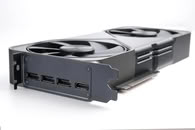
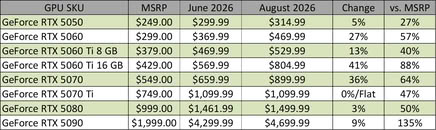 When compared with the manufacturer's suggested retail price (MSRP), the situation becomes even more striking. As indicated by the table, the RTX 50 series is now selling significantly above the MSRP that NVIDIA still officially lists on its website, with the flagship GeForce RTX 5090 commanding a median price that is a staggering 135% above MSRP. Much of this discrepancy is due to significant pricing adjustments by memory manufacturers, which are being passed on to add-in board partners. Since higher-end cards use more VRAM, the price differences are more pronounced.
Sources:
Tom's Hardware, VideoCardz
The 8 GB edition of the RTX 5060 Ti was priced at $470 and has now risen to $530, reflecting a 13% increase. The most significant change occurred with the 16 GB version of the RTX 5060 Ti, which jumped from $570 in July to $805 in August, a 39% increase. The RTX 5070 experienced a similar percentage rise of 36%, going from $660 to $900. The RTX 5070 Ti remained steady at $1100, while the RTX 5080 saw a modest 3% increase from $1462 to $1500. The flagship GeForce RTX 5090 recorded a 9% increase, moving from $4300 to $4700.


195 Comments on NVIDIA RTX 50 Series Median Prices Jump Up to 41% in August, with MSRP Now a Distant Dream
Enterprise market has grown so much that the end user market, meaning US the regular Joe is restricted to just a few products and that is the fault (and opportunity) of the producers (nvidia/amd/intel/ TSMC) that want the profit NOW, short term and "castrate" the long term buyers like us.
Ive also yet to see a 5090 burn down a house, or a box of matches render graphics, but such is the state of outrage engagement.
Just Buy It: Why the AMD Radeon RX 9050 4 GB Is Worth the Money
And yes this is in gaming, were you thinking of a different load?
AMD are even actively trying to stop it being reviewed, not just a quiet launch and not seeding samples, actively trying to stop it being reviewed.
Video Cardz article
Hardware Unboxed reviewed the 8GB model and said (transcript from their video):
I sure hope people vote with their wallet!
But no nvidia would never be so evil as to not send out review samples, oh wait they've done that before, by launching the 5060 quietly during Computex which is quite a bit more disingenuous as it's a card tier most people will buy. Although some like to act like Nvidia could never do that,but if they did it's no big deal.
Edit- I'm not arguing for the 9050, it's an overpriced turd, however thanks to the market leader who can price something at whatever they want and people refuse to vote with their wallets, of course AMD will unfortunately follow that pricing tactic. That's how competition works when we essentially only have two dedicated GPU companies, Intel seems to have suddenly given up on the gaming dGPU market right after they received funding from Nvidia.
This is not an argument for the 9050 as it's value still sucks. The problem is almost everything's value sucks a similar amount.
I'd love to hear how that maths, admitting the 9050 is bad value doesn't explain the mental gymnastics defence that Nvidia did it worse when they ostensibly didn't... tell me I'm wrong, I welcome a logical rationale.Coming from the forum's leading supplier of off-topic Nvidia criticism, the lack of self-awareness here is genuinely impressive. If irony consumed power, your PC would trip the breaker.
The evidence plainly says that people do indeed vote with their wallets, they just don't buy what you would buy, because news flash, they aren't you.
The difference between you and I is I am open to any brand as long as the product fits my buying need (see, specs, collection, previous GPU's, current purchase rationale), where you are tunnel visioned to exclude Nvidia because of some perceived moral high horse/hatred type complex, the sooner you get over it, the sooner you will be free of the grip it has on you.
The person allergic to buying anything but a single brand is you.
Stop projecting that onto others.In that screenshot the 7600 or 5050 make a decent chunk more sense.
9050 49fps average at 1080p $280
5050 59fps average at 1080p, $300 - 11% better value
7600 60fps average at 1080p, $300 - 12.4% better value
EDIT: missed the $260 RX7600, 24.3% better value, far out. Spend $20 less, get ~20% more performance. That value might not be amazing, but it sure doesn't suck compared to the 9050.
The 9060XT is also 18.6% better value, but given the price difference I can see how it sits in somewhat of a different category, where someone willing to spend $280 should absolutely be willing to stretch another $20 for the better products.
Why can't you accept that AMD does not offer a compelling product for a lot of people?
Maybe if AMD had something that fit my needs I'd buy it. But they don't so I don't buy their products, pretty simple. You mean to tell me everything and everyone must buy a 9070xt because its the bestest GPU ever and nothing Nvidia has is worthy. You mean to say Nvidia does not have a product at any price range for any consumers?So why isn't AMD the market leader? We jealous much here, ignoring the current AI bubble, you mean to say Nvidia has never had compelling MRSP for their products?
I'd love to hear your answer but I know it already.
1. People have too much money and waste it
2. Nvidia hurt your feelings
3. AI sucks
4. AMD is the greatest
5. NVIDIA sucks.
I think i got everything. Did I miss anything @Hecate91
20-30 years ago, you could have buy a video card at MSRP next day from the local store. The cards were available from day 1 and they were available in sufficient margins everywhere.
Nowadays they are just paper launches, with very scarce availability, and usually callously sold with up to 50% above MSRP by scalpers or greedy online retailer, in very limited quantities.
Of course there are people who are willing to pay the big bucks.
Now, if the cards would be available everywhere, on day 1, and on generous quantities, would you still think people would pay inflated prices anyways? ;)
If the 8 GB one is that bad though, the 4 GB one is going to be a problem... this thing is a masterclass on how not to release a product:
- Two different configurations (one being substantially worse) sold under the same name, then backtracking at the last minute and claiming it's "OEM only" after it clearly didn't pan out
- Performance promises that the product is clearly unable to keep
- Aggressive press control (as if the loyal fans didn't run defense for free already)
- Paper launch
- Dogshit pricing
It's extremely unfortunate, even with the current market conditions taken into account. If AMD was willing to give up on whatever margins, launch 4 GB at $99 and 8 GB at $149, nobody would complain. Not a soul. But it's "OEM" and $280 (street pricing: $350+), so there you have it
I'm too lazy to read if someone else already made this argument, but Nvidia would be doing AMD a huge favor here if ding-dong gamers didn't keep buying Nvidia anyway.
As someone who legitimately requires Nvidia hardware—AMD and Intel GPUs practically don't work—I'll just live with one 5080 plus older hardware until this blows over.
If it blows over, anyway...
You are massively exaggerating the downsides of data centers while simultaneously underestimating the development of AI itself. Yes, data centers consume electricity, water and physical resources. Nobody is denying that. But treating those costs as though they somehow invalidate the technology, while barely accounting for what increasingly capable AI systems can actually do, is an extraordinarily one-sided way of looking at this.
AI is not some static technology whose capabilities in 2030 or 2035 will look approximately like what we have today. The systems are becoming more capable, more general and more useful at an extremely rapid rate, while the amount of compute, investment, research effort and infrastructure being devoted to them keeps increasing. What we have now is the beginning, not the finished product.
And that is precisely what you seem to be missing. You are looking at the electricity and cooling requirements of today's data centers and projecting those costs forward, while effectively treating AI capabilities themselves as if they were barely going to change. That makes no sense.
This is potentially a much larger technological transition than the PC, the Internet or smartphones, because those technologies primarily gave humans better tools and better access to information. AI increasingly automates parts of cognition itself: programming, research, engineering, design, analysis, planning, scientific discovery and eventually an enormous range of intellectual work. Combine that with robotics and the effects extend into physical work as well.
Calling it a "scam" or assuming it is all a bubble because you dislike Altman, Huang or current corporate financing does not address any of that. Individual companies can absolutely be overvalued. Investments can be wasteful. Some AI companies will fail. There may even be a major market correction. None of those things would make AI itself a scam any more than the dot-com crash made the Internet a scam.
What is happening here is much bigger than a temporary stock-market cycle. We are entering a new chapter in technological and, ultimately, civilizational history. A transition in which machines become increasingly capable of performing cognitive tasks that until very recently could only be performed by human beings.
I don't think the scale of that change can easily be exaggerated. If anything, people who look at today's imperfect systems and conclude that AI is fundamentally overhyped are likely underestimating how radically different the situation can become as the technology continues to improve over the coming years.
Turns out that I was mostly correct many years ago about the coming wave of learning computers. But I did naively think that the situation today would be better overall than it is (I overestimated humans in younger years). Doesn't change the overall long-term trajectory though.
—————————————————————————————————————————————————————————————————————————————
Human civilization is constrained by human intelligence. We have had billions of human brains working for generations and there are still enormous numbers of problems we either cannot solve, solve extremely slowly, or merely learn to tolerate. Human cognition is limited in memory, speed, attention, coordination, foresight, lifespan and the number of variables it can meaningfully reason about at once.
So no, I do not think the answer is to simply remain at approximately human levels of intelligence forever and hope that the same limited minds will eventually fix everything. The way out is to scale intelligence far beyond the level available inside individual human brains.
That is why I consider the enormous investment in AI compute fundamentally justified. Not every company will succeed. Not every datacenter investment will be efficient. There will be waste, bad products, bubbles inside the larger trend and probably some spectacular failures. None of that changes the underlying necessity of building much more capable intelligence!
And the pace of development is exactly why judging this by the limitations of today's models makes so little sense. Claude Fable 5.1 was released this week. GPT-6 Astra has now been announced and is rolling out. There will be more models after them. Systems that seemed extraordinary three years ago are already obsolete. The limitations of AI in 2026 are not the limitations AI will have in 2029, 2032 or 2036.
Once intelligence itself can be scaled through compute, improved algorithms, larger systems, agents, robotics and automated research, it begins affecting the process by which nearly every other technology is developed. Better intelligence can design better chips, better robots, better energy systems, better materials, better medicine, better manufacturing, better software and eventually better AI systems.
I expect the next fifteen years to involve not merely better chatbots, but enormous numbers of increasingly autonomous robots, machines operating at scales humans cannot, AI-run laboratories and factories, far larger computing infrastructure, increasingly automated scientific and engineering research and intelligence in datacenters that vastly exceeds what any individual human being can do. Billions of humanoid general-purpose robots!
There will be computing infrastructure in orbit and on the Moon. There will be microscopic and nanoscale machines performing tasks that are impossible today. I am not claiming I can predict the exact year each particular technology becomes economical, but dismissing that direction because today's models are imperfect is an extraordinarily poor way of thinking about technological development.
The important variable is not whether an LLM or other type of AI in 2026 occasionally makes a mistake. The important variable is whether machine intelligence continues to improve, whether we can scale it, and whether it increasingly contribute to improving the next generation of science, engineering and technology (recursive improvement!!).
If the answer to those questions is yes, then this is vastly more consequential than whether a graphics card or a RAM kit costs a few hundred dollars more this year or also over the next few years.
Consumer GPU pricing matters to me and annoys me too (games can be demanding, you know). But on the scale of what is happening, it is not the most important thing. I would rather live through the disruption caused by humanity building intelligence orders of magnitude beyond its own than choose stagnation because building it requires electricity, water, datacenters and capital.