Thursday, October 22nd 2026

Micron Walks Away From 4F² DRAM After Two Decades of Research, Bets on 3D DRAM Instead
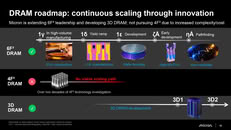
Micron has decided not to bring 4F² DRAM to market, even though it says it invented the cell design and has been researching it for around two decades. Scott DeBoer, Micron's President and Chief Technology and Products Officer, shared the decision during the company's technology webinar on October 21. On paper, 4F² uses vertical channel transistors to shrink each memory cell's footprint by about a third compared with the 6F² layout used in today's DRAM. However, DeBoer argued that real-world density is limited by how closely the capacitors can be packed, not by the cell's footprint, calling the density advantage over 6F² "a bit of a myth." He also said 4F² can be built, but at a higher cost and complexity, and that it runs into fundamental scaling problems at leading-edge nodes, which points toward 3D DRAM instead.
That puts Micron at odds with its rivals. Samsung and SK hynix are both developing 4F² designs, and China's CXMT says its first 4F² product will be a server DDR5 RDIMM due by the end of this year. Micron will keep scaling 6F² instead, with its 1-delta node set to ramp in Boise, Idaho, in the second half of 2027 and the 1-epsilon node after it moving to wafer bonding. 3D DRAM is being developed as a parallel path, but there's no timeline yet, and Micron says it will only switch once the economics make sense. It's a risky bet if rivals manage to make 4F² cheap at scale, especially with memory supply expected to get even tighter in 2027 and 2028, per Micron's own estimates.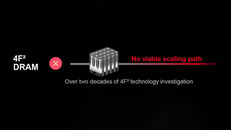

Sources:
Micron, via Tom's Hardware
That puts Micron at odds with its rivals. Samsung and SK hynix are both developing 4F² designs, and China's CXMT says its first 4F² product will be a server DDR5 RDIMM due by the end of this year. Micron will keep scaling 6F² instead, with its 1-delta node set to ramp in Boise, Idaho, in the second half of 2027 and the 1-epsilon node after it moving to wafer bonding. 3D DRAM is being developed as a parallel path, but there's no timeline yet, and Micron says it will only switch once the economics make sense. It's a risky bet if rivals manage to make 4F² cheap at scale, especially with memory supply expected to get even tighter in 2027 and 2028, per Micron's own estimates.


16 Comments on Micron Walks Away From 4F² DRAM After Two Decades of Research, Bets on 3D DRAM Instead
20 years of marketing without any real product. Or did i miss something in this news text?
That's changing now of course. Areal density has run out of puff so they're facing layering similar to Flash. In fact I would expect the areal density to be decreased when layers are added simply because it'll reduce crosstalk and its negative impacts.
Do your homework better, because I'm talking here about UltraRAM from Quinas.
The Chinese are likely pressing on with 4F2 due to its independence from Micron (read: US) supply chain and possibly also US government approval.
As you can see... here we are not dealing with usual flash memory:
the official scientific paper: quinas.tech/wp-content/uploads/research-article.pdf
I'll keep my eyes on it to see what happens, also because in their latest declaration they said to be ready for 2028.
Sure, Flash write endurance is only 10000, but if the new tech's, UltraRAM, write endurance is still only a few million then, when used as a RAM, it'll be worn out in seconds. Ergo, it's classed as a ROM. The primary use is as a backing store, ie: file storage, or as a firmware-like execute-in-place, which Flash and other ROM techs are also often used for.
There used to be a time, before Flash, when these types of rewritable memories were labeled according to class. Marketing, of course, tends to want to make believe instead.