News Posts matching #problem

Return to Keyword Browsing

OpenAI CEO Argues Home PCs Waste the World's Limited DRAM Supply

OpenAI CEO Sam Altman thinks the DRAM sitting inside personal computers would be better used in data centers. He made the comments on the Cheeky Pint podcast, hosted by Stripe co-founder John Collison, in an episode released on October 29. The two were discussing the memory supply chain when the topic turned to local inference, meaning running AI models on your own hardware instead of the cloud. Here's what Altman said, at roughly the 29-minute mark:


Sam Altman, OpenAI CEOA lot of people want local inference. And somehow, they assume that the problem is solved now. Because, we are going to have open-source models. We're going to be able to run them on our computers. And so we're not going to need all the stuff in the data center. But from a global allocation perspective, actually, it's quite terrible to have everybody have a bunch of the world's limited supply of DRAM sitting in their own computer. And, being used 5% of the time. You want maximum utilization in the cloud if you're trying to deal with this very supply constrained environment. And somehow everyone's... many people's intuition is the opposite of that.

Valve Enables CD Drive Support in Steam Frame Kernel After a Single Request

Valve has switched on optical drive support in the Steam Frame's Linux kernel, a day after one owner asked for it on the Steam Community forums. On October 18, user Aiodensghost posted that the Frame couldn't power their detachable disc drive and lacked the drivers to read a disc, which killed their plans to watch movies on the road and install the 2006 racing game Need for Speed Carbon from its disc. Valve developer Gabe Rowe replied on October 19 that the team would look into it, and apparently minutes later, a commit landed in a public mirror of the Frame's kernel sources. It adds CD drive support "for parity with steamdeck/machine."

Rowe enabled three existing options as loadable modules in the Frame's ARM64 kernel config: the generic CD-ROM layer, the SCSI CD-ROM driver that USB optical drives use, and generic SCSI device access. These drivers have been in Linux for decades, so nothing new had to be written. However, a commit isn't an update on your headset. The Frame runs on Valve's own downstream SteamOS kernel builds, and Valve hasn't said when this will reach owners. Power is still a problem too, since the 60 W USB-C hub the poster tried wasn't enough. The Frame is mainly built for streaming from a PC, but it can also play games standalone, so a directly connected drive makes the most sense there. Owners who paid $1,059 or more and want this today would likely have to build a custom kernel from the commit themselves.

Surface Laptop Ultra Gets Its First Firmware Fix for Flickering and Slow Reboots

Microsoft has rolled out the first firmware update for its RTX Spark-powered Surface Laptop Ultra, less than a week after the laptop started shipping on October 16. Listed in Windows Update as "System Hardware Update 200.0.7.0," the October 22 release fixes three problems spelled out in Microsoft's update history: extended reboot times, screen flickering, and unexpected restarts. It also bundles unspecified bug fixes and general performance improvements. The update is arriving in stages, so not every owner will see it right away, and like other Surface firmware, it can't be rolled back once installed.

These issues had already surfaced in early reviews and owner reports. Windows Central noted reboots long enough to roughly double the time it took to install updates, while some owners saw the Mini-LED panel flicker, in a few cases only when the display sat idle. However, the update doesn't address everything reviewers flagged. Notebookcheck measured a sluggish 57 ms black-to-white response time with visible ghosting, no local dimming, and a grayish 0.61-nit black level, and it seems unlikely that firmware can do much about those. Some owners have also reported the laptop running hot under light workloads, which Microsoft hasn't mentioned.

Micron Walks Away From 4F² DRAM After Two Decades of Research, Bets on 3D DRAM Instead

Micron has decided not to bring 4F² DRAM to market, even though it says it invented the cell design and has been researching it for around two decades. Scott DeBoer, Micron's President and Chief Technology and Products Officer, shared the decision during the company's technology webinar on October 21. On paper, 4F² uses vertical channel transistors to shrink each memory cell's footprint by about a third compared with the 6F² layout used in today's DRAM. However, DeBoer argued that real-world density is limited by how closely the capacitors can be packed, not by the cell's footprint, calling the density advantage over 6F² "a bit of a myth." He also said 4F² can be built, but at a higher cost and complexity, and that it runs into fundamental scaling problems at leading-edge nodes, which points toward 3D DRAM instead.

That puts Micron at odds with its rivals. Samsung and SK hynix are both developing 4F² designs, and China's CXMT says its first 4F² product will be a server DDR5 RDIMM due by the end of this year. Micron will keep scaling 6F² instead, with its 1-delta node set to ramp in Boise, Idaho, in the second half of 2027 and the 1-epsilon node after it moving to wafer bonding. 3D DRAM is being developed as a parallel path, but there's no timeline yet, and Micron says it will only switch once the economics make sense. It's a risky bet if rivals manage to make 4F² cheap at scale, especially with memory supply expected to get even tighter in 2027 and 2028, per Micron's own estimates.

Xbox Is Asking Inactive Owners to Sell Their Consoles to Best Buy

Microsoft is reportedly emailing Xbox Series X|S owners who haven't touched their consoles in a while, nudging them to trade those consoles in at Best Buy. The email, first shared by Nintendeal on X, opens with "Haven't played on your console in a while?" and tells owners who have moved to other platforms that they can get "up to $375 back." Per Gizmodo, Xbox has confirmed the email is genuine. That $375 applies to a Series X in good condition with its cables and controller, while a Series S apparently tops out at $200. Payment comes as a Best Buy eGift Card, and the campaign seems limited to the US for now.

It looks like this is the trade-in program Microsoft promised in June, when it announced another round of price hikes and said traded-in consoles would be resold at lower prices. Those hikes pushed the 1 TB Series X with a disc drive to $799.99, and the 512 GB Series S to $499.99. Unsurprisingly, Circana data later showed US Xbox hardware sales hit an all-time low through August. Stock is the other problem, as new units are reportedly scarce in mainland Europe, Asia, the Middle East, and South America, while GTA 6's November launch is expected to drain shelves even further. Owners thinking about trading in should note that used Series X consoles have recently sold for over $500 on eBay, so Best Buy's offer is more about convenience than value.

SEGA Pulls Total War: Shogun 2 Complete Edition After Player Complaints

Just 48 hours after the launch of the Total War Shogun 2: Complete Edition, the remake of the 2011 RTS classic, SEGA has announced that it will be pulling the game from all storefronts, at least temporarily. In the X post announcing the game's withdrawal from the market, SEGA acknowledges that the game has "fallen short of both your expectations and our own standards," citing poor reviews, comments, and player feedback following the launch of the game.

Shortly after the launch of Shogun 2 — Complete Edition, the game already has an abysmal review score of 15%. Most player complaints center on the game's exorbitant use of AI in unit cards, poor performance and graphical bugs, poorly thought out UI, and an apparent lack of care and polish in the game overall. After the game is removed from the relevant platforms, the original Total War: Shogun 2 will be reinstated and available to purchase and play, although existing owners will still be able to play the remaster. SEGA says that it is "investigating the issue," and will identify and correct the issues highlighted by Shogun 2 Complete Edition players.

Windows 11 is Phasing Out Classic Printer Drivers, Could Break Older Workflows

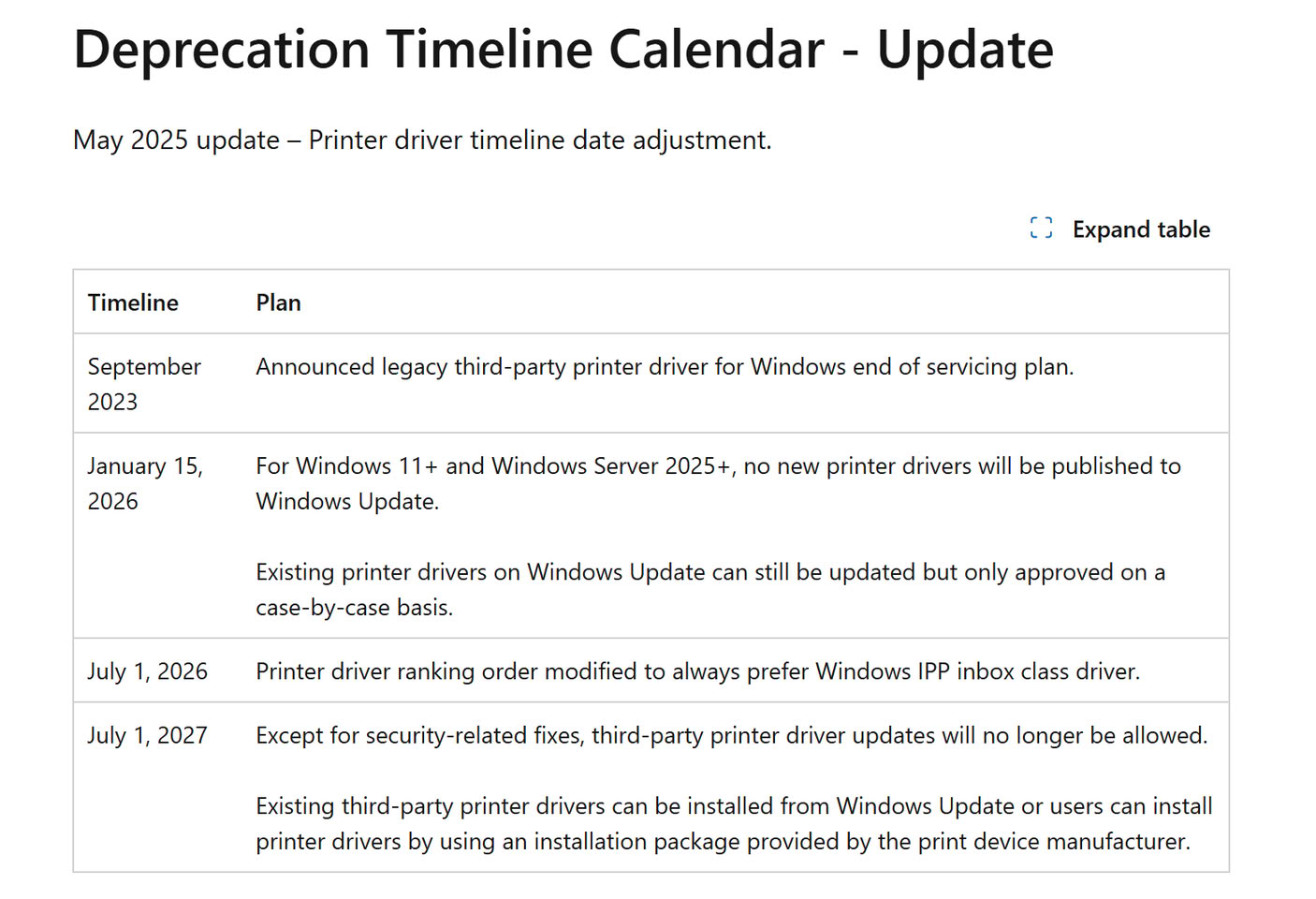
If you have any old printers in your office, updating Windows and the driver stack might become problematic in the future. Microsoft is slowly moving Windows 11 away from the traditional model of installing printer manufacturers' drivers, instead providing a unified base layer within the operating system itself for host-based compatibility. This change targets legacy v3 and v4 printer drivers and aims to make Windows printing more standardized, secure, and easier to maintain. The future vision is for plug-and-play functionality in the operating system, where every certified printer is compatible without the need for traditional driver installation. Existing drivers can still receive updates on a case-by-case basis. Since July 1, Windows has also changed its driver ranking so that compatible devices prefer Microsoft's built-in Internet Printing Protocol (IPP) Class Driver.

A final stage is scheduled for July 1, 2027, when third-party driver updates will be limited to security fixes. Existing drivers can still be installed manually using packages supplied by manufacturers, provided the manufacturers decide to continue supporting the older driver model. The foundation is Windows Ready Print, which uses standards including IPP and is designed around Mopria-certified devices. Instead of requiring a separate driver for every printer, Windows can handle compatible hardware through its own printing stack.

Modder Solders Dual 8-Pin Board to RTX 5090's 16-Pin Header, Wires Stay Below 40°C

Melting 16-pin connectors keep making headlines, and some RTX 5090 owners have started taking the protection of their expensive cards into their own hands. Reddit user DallasGrave has modified an MSI GeForce RTX 5090 with two extra 8-pin PCIe power inputs that work alongside the card's original 16-pin connector. According to their post on r/pcmasterrace, a small pickup PCB is soldered to the contacts of the 16-pin header, and that board feeds a second PCB carrying the two 8-pin sockets. The card then runs on three cables in total. DallasGrave says each conductor now carries roughly 3 A, and that the wires never crossed 40°C during a 48-hour run at 550 W, even at the joint. More test data is apparently on the way, so for now these are the modder's own numbers.

The 12V-2x6 revision was supposed to fix the melting power connector issues. In early 2025, NVIDIA said the 16-pin melting issues were over, pointing to the updated connector on the RTX 50-series. However, the first melted RTX 5090 Founders Edition was reported shortly after, in that case with a third-party cable. Since then, several RTX 5090 power connectors have reportedly melted, including one with an undervolt and a -100 W power limit. Moreover, last month Hardware Unboxed watched its RTX 5090 power cable reach 175°C with a single wire pulling around 22 A.

NVIDIA Files Patent for AI Tool to Help Developers Diagnose GPU Performance Issues

NVIDIA has filed a patent for an AI tool that could help developers diagnose and optimize GPU performance issues through a plain-language chat interface. The application, published September 17 and first spotted by Respawn First, describes a system connecting an LLM-based chat agent directly to GPU profiling tools, letting a developer ask about a performance problem and get back custom-generated code that digs through diagnostic data to find the answer. The patent describes separate agents for general GPU questions versus report-specific ones, with a router sorting each query. It's framed as a general GPU optimization tool rather than something built only for games, though the same approach would apply to frametime issues and stutter in PC titles.

In theory, a developer could ask something like why a specific scene is dropping frames, and the chat agent would write and run a script to pull relevant telemetry from a profiler, then use that data to flag bottlenecks and suggest fixes. This could, in theory, help with game optimization. As always, a patent filing is not a product, and companies file plenty that never go anywhere. Still, it's a decent hint at what NVIDIA is planning for the future. The company already ships Project G-Assist, its AI assistant for tuning GeForce RTX systems, and this reads like a developer-facing counterpart of that. Sony has been circling similar territory too, recently patenting a cloud AI system meant to diagnose and automatically write firmware fixes for PlayStation hardware. Both companies seem to be betting on AI to cut down the guesswork in finding what's broken.

Microsoft Patches Windows Defender Bug That Insisted Your Antivirus Was Off

Microsoft has fixed the bug that made Windows Security wrongly claim Microsoft Defender Antivirus was turned off. According to Windows Latest, the fix comes in Defender platform update 4.18.26080.4, which Microsoft released on September 17. No manual action is needed, and the update should arrive on its own unless you have blocked mandatory security updates through Group Policy or the Registry Editor. The false alert usually showed up when Windows booted up, then returned at random, even with notifications turned off. Apparently, clicking it only opened the Windows Security home tab, where everything showed as active.

Microsoft acknowledged the problem on August 28 and said it affected any supported version of Windows or Windows Server running the latest Defender updates. It never named the update responsible, and since Defender updates ship daily, there is no single KB to roll back to. Windows Insider users have apparently been seeing similar warnings since at least June. TechPowerUp covered the alert when it first surfaced, and several of our own staff ran into it too. Notably, almost three weeks passed between Microsoft's confirmation and the fix, which seems slow for a bug this visible.

NVIDIA RTX 5090 Shoots Past €5,000 in Germany, Prices Jump 73% Since January

GeForce RTX 5090 prices in Germany have now pushed past €5,000, with the cheapest listed model on Geizhals coming in at €5,242.94 for the INNO3D iCHILL Frostbite Pro. Hardwareluxx, which first flagged the price increase, reports that there isn't a single RTX 5090 currently listed below €5,200 in the German market, and several mainstream models are edging toward €5,500. The same card was going for around €3,029 back in January, so that's roughly a 73% jump in eight months. NVIDIA's Founders Edition RTX 5090, when it's actually in stock, is still priced at €2,099, meaning custom cards now cost well over double that.

Germany isn't alone in this crisis. RTX 5090 pricing in the US recently crossed $5,000 too, and NVIDIA hasn't addressed either situation publicly. Instead, the company appears to be leaning on event-based promotions, like the one it ran at PAX West, to hand out occasional MSRP units rather than dealing with the overall pricing problem. The rising cost of GDDR7 memory tied to AI demand appears to be the main driver, and board partners have apparently been passing those costs straight to consumers for months.

Modders Get RTX 5090 Running on 8-Pin Connectors, Ditching NVIDIA's Melting 16-Pin Design

Modders at the Brazilian YouTube channel TecLab have an RTX 5090 running on three standard 8-pin PCIe connectors instead of the 16-pin design that keeps melting on high-end NVIDIA cards. The team stripped a Galax GeForce RTX 5090D HOF OC LAB XOC down to the bare PCB, removed both native 16-pin inputs, and soldered three 8-pin connectors straight to the power regulators. Sense pins were rewired so the card would still request full power, with liquid cooling keeping temperatures in check.

During a livestream, the modders ramped the card from 400 W to 900 W across the three cables, pulling over 120 A while holding a 3,400 MHz clock. Two connectors still delivered 66 A at 3,200 MHz, and even a single 8-pin managed 65 A at 3,100 MHz. The mod stayed entirely at the hardware level, with no BIOS or software tweaks involved. Throughout the test, the modified RTX 5090 stayed within its power and thermal limits, and passed all tests with flying colors.

Steam Age Verification Causes Headaches in Some Regions

The recent trend of government-mandated online age verification to access certain online content appears to be throwing a proverbial spanner in the works for Steam gamers, as shown by a recent Reddit post by a Steam user, u/Zekromisblack, in r/Steam. The Australian Steam user was prompted to create the post when they were unable to view a game on Steam because their age had not yet been verified via Steam—a process now required to view age-gated content on the gaming platform.

The bigger issue at hand was that Steam had no way to verify their age, because the user did not have a credit card saved to their Steam account. When contacting Steam Support about the age verification process, Steam's official response was that credit card age verification was the only method available at the time of writing. As highlighted by the original post and echoed by many commenters, credit cards are becoming increasingly less common in certain countries, especially among younger consumers, which may present a problem when it comes to viewing game content online.

Hardware Unboxed Falls Victim to Melted RTX 5090 Power Connector as Cable Reaches 175°C

Hardware Unboxed has become the latest hardware channel to watch a 12V-2×6 connector melt on an RTX 5090 test bench. The setup paired an ASUS ROG Astral RTX 5090 with a be quiet! Dark Power 13 PSU, and host Steve reportedly only caught the fault after touching the cable and finding it hot enough to burn his hand. A thermal camera later confirmed readings above 150°C, climbing to roughly 175°C under load. A Thermal Grizzly WireView Pro caught the underlying problem immediately: a severe current imbalance where some pins carried almost nothing while a single wire was pulling around 22A. Oddly, the damage turned out to be worse on the PSU side rather than at the GPU.

The cable had fused inside the Dark Power 13's connector and needed pliers to remove, while the card's own connector escaped without visible marks. Hardware Unboxed says the cable was fully seated and isn't blaming the incident on installation. This is far from an isolated case, as this connector is notorious for melting. We have reported RTX 5090 connectors melting even after users apply undervolts and power limits, and reported on at least one instance where an ASRock PSU's thermal cutoff saved a card from a similar fate. Some frustrated modders have gone so far as to solder wires directly to the PCB just to sidestep the connector altogether.

Modders Bypass RTX 5090's Melting Connector Issue by Soldering Wires Directly to the PCB

Brazilian YouTube group TecLab has bypassed the RTX 5090's notorious melting problem in the most direct way possible. The group removed the 16-pin connector from the equation entirely and soldered power wires straight onto the PCB. The demonstration used a Galax RTX 5090D HOF OC LAB XOC, an extreme-overclocking variant with two 16-pin inputs and a custom BIOS rated for up to 2,000W, far above the 575W TDP of a standard RTX 5090. TecLab framed the mod as a sarcastic jab at NVIDIA, saying that enthusiasts are tired of hearing about connectors melting and that they wanted to show how it should have been done from the start.

The team stripped the card's stock cooler entirely, running the bare GPU under an industrial liquid chiller with two loosely mounted fans for extra airflow. Two adapters converted standard 16-pin PSU cables into bare wires, which were then soldered directly onto the connector traces on the board. No temperature readings were shared, but a roughly 50A draw on the 12V rail put the card at around 600W during testing, and it booted and ran benchmarks without issue.

Windows 11 August Update is Breaking Games, Microsoft Investigates

According to an updated Microsoft support document, the Windows 11 August update is causing problems with games, and the company has officially confirmed that an investigation is underway. The document states that games like ARC Raiders, MARVEL Tōkon: Fighting Souls, and The Finals are experiencing forced crashes, random freezing, errors, and unexpected device restarts due to the update. After receiving complaints from internal testing and gamers, gaming studios have started to acknowledge the issue and report that the Windows 11 August update is causing applications to crash. Microsoft has confirmed the problem and is actively investigating its cause.
MicrosoftFollowing the release of Windows updates on August 11, 2026 (KB5121003) and later, Microsoft received reports of issues involving inability to run games as expected. This issue has been reported for a limited number of games, including ARC Raiders, MARVEL Tōkon: Fighting Souls, and The Finals... If you are experiencing this issue, or a similar issue, please use Feedback Hub to file a report

NVIDIA Releases GeForce 610.82 Beta Driver Fixing Game Crashes

NVIDIA has released the GeForce 610.82 Hotfix Beta display driver to address a pair of issues affecting recent Game Ready driver releases. The update resolves stability problems in Halo: Campaign Evolved on GeForce RTX 50 series GPUs when using the 610.xx driver branch. It also fixes intermittent long pauses that could occur during extended Path of Exile 2 gameplay sessions running in DirectX 12 mode. As with all NVIDIA hotfix releases, this is a beta, optional driver. It undergoes a shortened QA cycle and will be pulled once its fixes are rolled into the next official WHQL-certified release. Users seeking maximum stability may prefer to wait for that broader driver update.

DOWNLOAD: NVIDIA GeForce 610.82 Beta Driver

AMD Radeon GPU Drivers 26.5.1 Break Blender Cycles Path-Tracing Engine

AMD's latest Adrenalin Edition 26.5.1 WHQL Drivers are causing problems for Blender users, according to the latest Blender issue tracker. Blender 5.1.1 is crashing with these drivers, particularly when using the Cycles path-tracing render engine. The issue appears to be a ROCm runtime mismatch. Blender 5.1.1 uses ROCm 6 runtimes, but the latest AMD driver 26.5.1 only includes ROCm 7, leading to compatibility issues that prevent the application from running smoothly. Multiple users have reported crashes, and we now understand the background.

Developer involved in AMD evosystem Sahar A. Kashi confirmed that when a factory reset is performed and the system is installed from scratch, the amdhip64_6.dll file is removed, causing Blender Cycles to attempt loading ROCm 7 kernels. However, since Blender version 5.1.1 is compiled only for ROCm 6, this runtime mismatch results in application crashes. To resolve this issue on AMD GPU systems, users should install the older 26.3.1 drivers and use them until Blender version 5.2 is released, and the Cycles path-tracing render engine achieves full ROCm 7 compatibility.

Microsoft Is Testing a Windows 11 Feature That Maxes Out CPU Speed for Faster App Launches

According to Windows Central, Microsoft is working on a new feature for Windows 11 called "Low Latency Profile," as part of the Windows K2 effort. This feature aims to make app launches noticeably faster by pushing the CPU core to its maximum boost frequency in very short bursts. Reportedly, this feature boosts the CPU to its maximum frequency for 1-3 seconds, resulting in noticeably smoother app launches during testing. When launching Microsoft applications like Edge and Outlook, known as "in-box" apps, the result is about a 40% faster application launch. Other applications, such as the Start Menu and context menus across the operating system, may be up to 70% faster. Overall, the Windows 11 operating system is expected to receive a significant performance boost, though at the cost of the CPU reaching its maximum frequency.

Currently, this feature within the Windows K2 effort is automatic, with no clear indication if it can be turned on or off. Running a CPU at its maximum frequency is somewhat unusual, as the purpose of an operating system is to minimize strain on the PC, leaving headroom for heavier applications to load. However, since the boost is only applied in short bursts of up to three seconds, it is expected that the performance benefits and overall smoothness will outweigh potential issues. These issues include elevated CPU frequency during lighter tasks and general OS usage, which could result in slightly higher temperatures overall. For laptop users, this might lead to faster battery drain, but it is likely that the Windows K2 effort will account for this, with minimal impact.

NVIDIA Releases GeForce 595.71 WHQL Game Ready Drivers

NVIDIA has released its latest GeForce 595.71 WHQL Game Ready Driver, addressing issues from the previous 595.59 WHQL version, which caused many headaches for gamers who installed it. With the new 595.71 WHQL, NVIDIA is providing support and optimizations for games such as Resident Evil Requiem and Marathon. Alongside these games, the new 595.71 WHQL fixes problems found in 595.59 WHQL, including a bug where one or more GPU fans stopped spinning after the update. Thankfully, this has been fixed, and gamers were spared the headaches of potentially damaging their expensive GPUs. Additionally, hardware monitoring utilities can now once again recognize all GPU fans, allowing users to continue monitoring and fine-tuning fan profiles without issues. Interestingly, this comes as another game ready driver release, and not a hotfix version. NVIDIA also fixed some game artifacts that were appearing specifically with the GeForce RTX 50 series, such as green artifacts in Total War: THREE KINGDOMS and black bars appearing in The Ascent.
DOWNLOAD: NVIDIA GeForce 595.71 WHQL

ASUS TUF GAMING X870-PLUS WIFI Board Seemingly Kills Owner's Ryzen 7 9850X3D & 9800X3D CPUs

Late last month, ASUS released an official statement regarding user reported discrepancies between AMD 800-series motherboards and highly popular "Zen 5" Ryzen 7 9800X3D desktop processors. At the time, the Taiwanese PC hardware manufacturer advised that customers immediately update relevant mainboard models with the latest BIOS revisions. Since the launch of Team Red's 3D V-Cache-augmented Ryzen 9000-series "Granite Ridge" CPUs, the majority of "killings" have been recorded on ASRock-made AM5 boards. Unfortunately, an increased number of processor failures—when platformed on ASUS designs—have been tracked in recent months. Yesterday, another puzzling case was presented on the official ASUS subreddit. Bizarrely, UniverseWillDecide's tale involved both of Team Red's 8-core gaming champion models, paired with an ASUS TUF Gaming X870-PLUS WIFI motherboard. The first build iteration was based around the Ryzen 7 9800X3D SKU.

UniverseWillDecide recounted a brief honeymoon period: "everything was working fine for a week or so, until my system started (going into) these weird freezes or locks ups, while booting into Windows or being idle. OCCT memory test passed without any errors, so memory was cleared, but it started crashing with AVX2. I got pissed off and decided to return it to Amazon, since it was still 30 day return window." The Australian PC enthusiast moved onto the recently released Ryzen 7 9850X3D model, purchased during AMD's official launch period. The unlucky owner enjoyed problem-free experience: "for (a) few weeks, (but) guess what. The chip is dead too. I am not blaming AMD directly, but I suspect...something related to the ASUS BIOS applying incorrect voltages. I am...above and beyond disappointed, and not sure what to do (next). I also have (an) ASUS TUF Gaming RTX 5090 (card)—I bought it because I believed this company builds quality products.

AppControl Launches New PC Monitoring Utility

AppControl, a user-friendly Windows system monitoring utility, today unveiled its industry-first application designed to make understanding your PC simple, visual, and stress-free. Built for everyday Windows users, AppControl shows exactly how your computer behaves so you can finally understand what's slowing it down, heating it up, or running in the background without your knowledge. AppControl is a certified member of the Intel Partner Alliance; the AppControl app requires no registration and is available as a free download directly from the AppControl website or via Softpedia.

Unlike traditional system tools that only show what's happening in the moment, AppControl delivers an easy-to-navigate historical timeline of CPU, GPU, memory, disk usage, and temperature. Users can scroll back in time to see what apps were running, what changed, when it changed, and why their PC behaved the way it did, turning confusing performance issues into clear, explainable events. AppControl also provides insights into privacy-relevant behavior, such as apps accessing the webcam, the microphone, or the user's location.

Gallop Innotek Unveils Innovative GTP160-NS Silicone-Free Thermal Gap Pad

GALLOP INNOTEK today unveiled a new generation of silicone-free thermal gap pad, the GTP160-NS. This GTP160-NS is engineered to solve silicone out-gassing or silicone bleeding in sensitive electronics, optical systems, satellite technology, and medical devices.

With the non-silicone formulation, GALLOP INNOTEK uses different materials like acrylic or urethane polymers to solve the siloxane compatibility problem. This marks a major milestone in GALLOP's efforts to provide thermally conductive pads for silicone-sensitive applications.

ASUS Addresses Reports of 800-series Motherboards Killing AMD Ryzen 7 9800X3D CPUs

We are aware of recent reports concerning AMD Ryzen 7 9800X3D CPUs and ASUS AMD 800-series motherboards, and we have initiated an immediate internal review. Our teams are conducting preventive checks on product compatibility and performance, working closely with AMD to validate reported cases and ensure ongoing stability and quality. We are looking to provide timely solutions to ensure our products and services meet expected standards.

Users are also advised to update their ASUS AMD 800-series motherboard to the latest BIOS via ASUS EZ Flash or BIOS Flashback to help ensure system stability; we provide an official technical support FAQ with detailed instructions. Customers who are affected or have concerns are encouraged to contact ASUS customer service for direct assistance. We take this matter seriously and value our customers' trust, and we remain committed to transparency and to ensuring our products can be used with confidence.

Poor Monster Hunter Wilds Performance Chalked Up to Aggressive DLC Checks

Monster Hunter Wilds has earned itself a reputation for poor performance and optimization, and, while successive post-launch updates have helped improve things somewhat, it appears as though part of the problem, especially when it comes to mid-range hardware, is related to how Monster Hunter Wilds checks for DLC content. According to Reddit user u/de_Tylmarande, after significant testing and comparing performance in two different Steam accounts, the user discovered that Capcom has a DLC ownership check constantly running in the background that accounts for at least some of the performance degradation. According to the redditor's testing, the more DLC registered to a user's account, the less performance degradation there is.

u/de_Tylmarande validated their testing by implementing a mod that disables the check. In their specific case, using the mod resulted in an astounding performance increase of upwards of 75%—26 FPS with the mod disabled and 46 FPS with the mod enabled in the same busy hub scene. Crucially, this mod and bug admittedly seem to have the biggest impact on performance when using mid-range hardware, since allowing for the extra CPU overhead seems to minimize the impact of the bug. It's unclear whether this is simply a bug, or if Capcom is deliberately being aggressive with the checks for some reason, but a number of performance-oriented patches have been issued for the game since its February 2025 launch, without any fixes for the aforementioned DLC check, so it seems unlikely that Capcom is unaware of a potential bug that was discovered by an enterprising redditor in their free time. More performance optimizations are promised for the game in 2026, and the Reddit user has promised to publish their mod that disables the DLC check if Capcom doesn't fix the performance problems related to the check.
Return to Keyword Browsing
Nov 11th, 2026 04:20 CST change timezone

New Forum Posts

Popular Reviews

TPU on YouTube

Controversial News Posts