Thursday, September 3rd 2026

CXMT Captures 10% of the Global DRAM Market Revenue Share
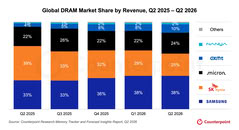
According to Counterpoint Research trackers, Chinese memory giant CXMT captured 10% of the global DRAM market share by revenue in Q2 2026, which is 150% more than the company had a year ago. On a quarterly basis, the company also experienced significant growth of 25%, as it increased its market share from 8% in Q1 to 10% in Q2. This is impressive considering the company managed to grow its revenue market share despite constrained access to advanced tooling, while established giants like Samsung, SK hynix, and Micron have undisputed access to all semiconductor manufacturing tools.
Among other DRAM makers, Samsung retains the number one spot with a 38% share, SK hynix holds 25%, and Micron is just behind at 24%. Interestingly, over the last few quarters, Samsung managed to maintain and grow its number one position, while SK hynix's share dropped from 39% a year ago to the current 25%. Micron fluctuated between 22% and the current 24%, while Nanya doubled its share from 1% to 2%.
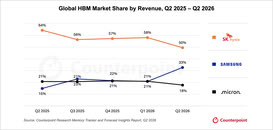
 Finally, Counterpoint also tracks global HBM market share by revenue, where only the big three memory makers participate. Among HBM shipments, now dominated by HBM3E and HBM4, SK hynix is the leading maker with a 50% share, while Samsung captures 33%. Micron, on the other hand, holds an 18% share and is on a downward trend. SK hynix used to capture 64% of the global spend on HBM memory but is now down to 50% as Samsung gains momentum. CXMT is not yet on this list as the company only recently started HBM3E risk production, meaning revenue is still a quarter or two away. Note that the percentages may not add up to 100% due to rounding.
Source:
Counterpoint Research
Among other DRAM makers, Samsung retains the number one spot with a 38% share, SK hynix holds 25%, and Micron is just behind at 24%. Interestingly, over the last few quarters, Samsung managed to maintain and grow its number one position, while SK hynix's share dropped from 39% a year ago to the current 25%. Micron fluctuated between 22% and the current 24%, while Nanya doubled its share from 1% to 2%.


19 Comments on CXMT Captures 10% of the Global DRAM Market Revenue Share
I would like to see and use a "free sample" myself for quite a while to see if it is really a replacement long term. Some stuff gets worse after a certain time period, we have enough hardware which gets faulty after a few years, e.g. intel cpus are rotten from inside and die, power connectors get hot, hp latops have dying storages with windows operating systems, etc.
For E-Waste grade devices like samsung smartphones or tablets i would not care if it had cxmt memory. For my desktop box i question if the dram is as durable as other common brands.
www.winbond.com/hq/about-winbond/news-and-events/news/2025_1203_winbond_8gb_ddr4_dram_16nm_industrial_embedded.html?__locale=en
www.gizmochina.com/2026/08/29/xiaomi-18-fold-confirmed-to-debut-with-cxmts-lpddr6-memory
They mainly specialise in memory for embedded devices.
Only PSMC owns fabs.
IMO, they should be banned from all markets outside of China, since it's stolen tech
look up the lawsuits, people did go to jail, but, just because RAM is a very much in demand, everyone should just close their eyes and pretend nothing happened?
this is no different than buying stolen merch from a guy in a van in some alley
Maybe Etron and ESMT too, but they're fabless so they probably just design specialty DRAM using one of the Taiwanese foundries I just mentioned, or Nanya.
Do you have any insights in technology restrictions, how the fab works? etc?. just asking. How DRAM is made or how DRAM in these Factories in China are made? Feel free to let me know here, not in personal messages of course.
I am sure this was well phrased, stop trolling, P L E A S E. "Congratulations. Well deserved with all the technology restrictions which some media report. " Do not beg for spot on my ignore list.
edit, it seems i have to epxlain it. Certain technologies, see techpowerup on a regular basis are import restricted to mainland china, afaik the company is called ASML, is afaik in netherlands based, and afaik it is about EUV how you make pattern on the wafers. It seems this common knowledge which i see here too often, needed to be repeated.
I am not an employee of ASML, CXMT, etc, therefore i have to believe those claims. Regardless if these are facts or not. Root cause, i do not have direct access to these informations.I'm not fond of DCMA etc and also not of patents.
And employers also took indirectly stuff from me, to make the point clear. That is the business world, in my biased view, at least for Austria, central europe. Some stuff can be sued by law, when you have the money for it and the time. Whataboutism vs whataboutism. Just do not, i can also go the whataboutism route. What about something else. I doubt DRAM is not open specified, else how should it work on Intel and AMD cpus what i read from time to time. I think techpowerup claimed some lenovo devices ship with these DRAM from CXMT in germany. When there is no law ruling it is not illegal at the end of the day. Schöllwart, said at oe24, an austrian online media, you can get a law ruling but you do not get law. in my own words, translated the german statement from a lawyer. that is also the business and legal way. i hope this makes it clear.
What I can see happening is similar to the LCD tech days, the leaders such as SK Hynix/Samsung etc start to abandon/defocus production of DRAM to people like CXMT while ramping up HBM etc which has a higher profitability in the near to mid term
Similar to how people like LG etc sold off their LCD tech to focus on OLED
Because DRAM IP is a mess between all of the companies, even CMXT has Qimonda IP access that when Micron bought it, by contract CMXT did not lose licensing.