Sunday, November 8th 2026
Dead Pixels Creep In Along the Edges of Older WOLED TVs, RTINGS Finds
Fourteen of the 16 WOLED TVs in RTINGS' 18,000-hour accelerated longevity test developed what the outlet calls "edge rot," meaning dead pixels and other damage creeping in along the panel edges. All of these sets use LG Display panels and were released between 2020 and 2023, and the test works out to roughly ten years of typical U.S. viewing. Older WBC panels fared worst, with nine of ten affected and five rated severe, while five of six newer WBE panels also showed it. Only the LG A2 and LG G3 came out clean. Meanwhile, the three QD-OLED TVs in the test, Samsung's S95B and S95C and Sony's A95K, didn't have a single dead pixel. However, RTINGS says three units are too few to call QD-OLED immune.
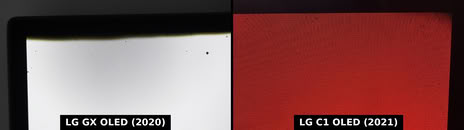
Unlike burn-in, edge rot doesn't depend on what you watch, so the usual advice of mixing up content won't help. RTINGS suspects contamination during manufacturing or flaws in the encapsulation layer that keeps moisture out, though confirming that would need proper failure analysis. Two staffers also found it on their own LG GX and C1 at home. In a statement to RTINGS, LG said the issue may appear in a very small number of products under prolonged heat, humidity or other harsh conditions, and isn't expected in normal use, which is interesting given that LG Display once argued QD-OLED was more prone to burn-in. RTINGS now rates WOLEDs slightly lower for expected reliability, including newer models as a precaution, though it still considers OLEDs more durable than LCDs. Its next planned test includes 2025 and 2026 models, some with LG's RGB Tandem panels, which should show if it's been fixed.

Sources:
RTINGS, via Videocardz
Unlike burn-in, edge rot doesn't depend on what you watch, so the usual advice of mixing up content won't help. RTINGS suspects contamination during manufacturing or flaws in the encapsulation layer that keeps moisture out, though confirming that would need proper failure analysis. Two staffers also found it on their own LG GX and C1 at home. In a statement to RTINGS, LG said the issue may appear in a very small number of products under prolonged heat, humidity or other harsh conditions, and isn't expected in normal use, which is interesting given that LG Display once argued QD-OLED was more prone to burn-in. RTINGS now rates WOLEDs slightly lower for expected reliability, including newer models as a precaution, though it still considers OLEDs more durable than LCDs. Its next planned test includes 2025 and 2026 models, some with LG's RGB Tandem panels, which should show if it's been fixed.


78 Comments on Dead Pixels Creep In Along the Edges of Older WOLED TVs, RTINGS Finds
This tech is still developing, the gen 4 panels should be able to last more than double than the originals.
You are waiting for the MicroLED technology to arrive, those will be as nice as OLEDs, but with little to no aging.
LED is a technology which degrades, irrespective of being organic or not.
I think that 18,000 Hours is still pretty good.
... because it was not made by LG.
While these issues suck, there is no display tech comparable in quality to OLED, especially at the high end (LG G or Z series, Samsung S95, etc.), the only non-OLED TV that does approach the level of visual fidelity of the highest end OLEDs is the Bravia 9 Mk. II with Triluminos WHVA True RGB panel, which is extremely expensive and only available in giant sizes (75-115 inches, reportedly there is a 65 inch too but it's not even listed at Sony's website anymore), each with a huge increase in its already high price. If that wasn't enough of a hurdle, Sony withdrew from the TV market in most of the world, so regional availability is very limited.
Overall, I suppose I am willing to chalk it down to early adopter issues and deal with it until it gets too bad to ignore.
I am getting another planned-obsolescence vibe.
Plain and simple things used to last much longer, most shit aint built to last these days and people keep buyin this junk all the time, keep buying in to shody tech don't help.
Of course no more warranty, so had to dump it...
Interestingly, my 55B8, wich is way older than that, has no problems ever since. Neither has my 3 years old 42C3.
The article discusses contamination or encapsulation defects as a possible explanation for the edge failures. That seems reasonable given that the failures appear concentrated near the panel perimeter.
What I don't see is how that leads to "carbon and carbon-based compounds physical degradation is little to none".
Organic chemistry tells us the opposite. Carbon-based compounds routinely degrade through oxidation, UV exposure, thermal stress and other chemical processes. Plastics, rubbers, dyes and polymers are obvious examples.
Likewise, OLED materials are known to degrade during operation. A recent review states:
"Organic light-emitting diodes (OLEDs) of all kinds inevitably undergo permanent performance degradation over time..."
Lifetime modeling for organic light-emitting diodes: a review and analysis
Contamination may explain the specific edge-rot failure being discussed.
That is a much narrower claim than saying carbon-based compounds generally experience little to no degradation.
If that's the rationale, then every display tech is fine lol... I think the bar should be a set a tad higher. Say 7-8 , to 10 years, I think is very reasonable for a TV or monitor.The type of issue is also in play.
For example, LCD has the tendency to color shift over time. But its so gradual, you only notice if you'd see the screen for the first time, or next to a newer one. But a slightly shifted panel remains usable for years. Similarly, backlight going dim or uneven: sure, its not super pretty, but you can use 100% of the screen real estate and you can fix a lot with display settings too.
OLED issues however... not so much. If you lose a percentage / area of real estate you simply miss information on screen. If the brightness is substantially lowered due to pixel refreshes, you'll be working at the panel's limitation for brightness sooner rather than later, possibly making it too dim for the room. Etc. Most of these issues are a definite trigger to replace the panel completely.
A family member also got one a few weeks before me and it's never off and it's pristine aswell.
I'll not buy another LG because of the stalking but the actual TV hardware has been/is great.
TikTok watching should burn all the phones, tablets and monitors out there if used more than 5 mins/ day.