News Posts matching #Memory

Return to Keyword Browsing

AI-Fueled Supercycle Propels Memory Market Revenue to More Than Twice That of Foundry Industry

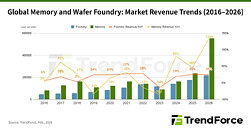
The current AI surge is anticipated to boost both the memory and wafer foundry sectors to record-breaking revenues by 2026, based on TrendForce's recent data. Limited supply and rapidly increasing prices are likely to grow the memory market's total worth to $551.6 billion. Meanwhile, the global foundry market is also expected to reach a new peak of $218.7 billion, but the memory industry's scale will have more than doubled that of wafer foundries.

A new memory supercycle: Demand resilience and pricing power far stronger than in 2017
The previous memory supercycle from 2017 to 2019 was primarily driven by cloud data center expansions and resulted in a significant gap between memory and foundry revenues.

AMD "Medusa Halo" APU to Use LPDDR6 Memory

The next major refresh of AMD's Ryzen AI MAX APUs is still far away, but now we are putting together the pieces of the "Medusa Halo" APU puzzle. According to a famous leaker, @Olrak29_ on X, AMD's next-generation "Medusa Halo" APU will be complemented by LPDDR6 memory. This is one of the first LPDDR6 memory SoCs we are learning about, making it unique. Based on previous rumors, the silicon could have a 384-bit bus powering LPDDR6 memory, which would translate into massive bandwidth powering the SoC's new CPU and GPU configuration. This includes up to 24 "Zen 6" CPU cores and 48 RDNA 5/UDNA compute units for the GPU configuration. Paired with the added bandwidth from LPDDR6 memory—which these APUs greatly benefit from—"Medusa Halo" will be one of the best-performing SoCs when it launches.

Interestingly, memory manufacturers like Samsung and Innosilicon are already supplying LPDDR6 modules to customers for validation. Innosilicon's LPDDR6 modules boast an impressive speed of 14.4 Gbps, significantly faster than Samsung's initial modules, which achieve 10.7 Gbps. Innosilicon's modules offer a 1.5x increase in IO speed capability compared to the 9.6 Gbps of LPDDR5X previously available, along with improved efficiency. The latest LPDDR6 also increases the number of bits per byte of IO from 8 to 12. This results in LPDDR6's bandwidth at a single-channel 24-bit I/O speed being double that of LPDDR5X at a 16-bit single-channel. The company is reportedly collaborating with TSMC and Samsung to ensure sufficient production capacity for LPDDR6 IP, while Samsung relies on its own fabs for manufacturing memory.

Major PC OEMs Reportedly Exploring Chinese CXMT Memory Amid Shortages

According to Nikkei Asia, some of the biggest PC makers like ASUS, Acer, Dell, and HP are exploring alternative memory suppliers amid industry-wide memory shortages, which are forcing PC OEMs to seek supply even from Chinese memory maker CXMT. Late last year, CXMT unveiled its homegrown DDR5-8000 and LPDDR5X-10667 memory modules at the 2025 China International Semiconductor Expo. This has likely prompted many OEMs to start finding alternatives to the traditional triad of SK Hynix, Samsung, and Micron, whose supply has been very limited outside AI accelerator workloads.

CXMT offers 12 Gb and 16 Gb LPDDR5X capacities, while DDR5 scales to 16 Gb and 24 Gb module formats. The 16 Gb DDR5 chips from CXMT measure 67 square millimeters, with a density of 0.239 Gb per square millimeter. The G4 DRAM cells are 20% smaller than CXMT's previous G3 generation. Reportedly, CXMT manufactures these chips using a 16 nm node, which is three years behind Samsung, SK Hynix, and Micron in manufacturing capabilities. However, CXMT is progressing quickly, and its DRAM modules adhere to the official JEDEC specifications and even exceeding the specification, making them ideal for OEM PCs depending on the use case.

Forge Nano Transforms Advanced Semiconductor Chip Manufacturing with High-Speed 1000:1 Aspect Ratio Atomic Layer Deposition Coatings

Forge Nano, Inc., a technology company pioneering domestic battery and semiconductor innovations, today announced a breakthrough that fundamentally redefines the economics and architecture of advanced semiconductor manufacturing. The company has demonstrated high-speed, defect-free atomic layer deposition (ALD) coatings in semiconductor features at a 1000:1 aspect ratio. Conformality is maintained at production-scale while providing coverage on features 2 orders of magnitude greater than line-of-sight techniques.

This breakthrough removes the primary constraint that has limited 3D semiconductor scaling and enables architectures previously considered uneconomic or impossible. The demonstration was performed on production-representative wafers supplied by C2MI, a leading semiconductor process development and manufacturing innovation center in Canada, with conformality, defectivity and electrical performance independently validated through the partner's internal metrology and reliability testing.

Intel and SoftBank Subsidiary Saimemory Partner on Next-Gen Z-Angle Memory

Intel and SoftBank subsidiary Saimemory have signed an agreement to work together on developing and selling Z-Angle Memory (ZAM) technology aimed at AI and high-performance computing tasks. ZAM is described as a stacked DRAM architecture designed to go beyond current high-bandwidth memory (HBM) solutions. The goal is higher memory capacity and bandwidth at lower power. The name refers to vertical (Z-axis) stacking, according to reports from EE Times Japan. The project builds on Intel Next Generation DRAM Bonding (NGDB) work, developed under the U.S. government-backed Advanced Memory Technology (AMT) program in collaboration with Sandia, Lawrence Livermore, and Los Alamos national laboratories. Recent NGDB prototypes featuring eight vertically stacked DRAM layers have demonstrated full functionality using this new vertical stacking and bonding approach, as disclosed by Sandia in January.

According to reports from Nikkei and Wallstreet.cn, Saimemory is targeting two to three times the capacity of today's HBM, with 40-50% lower power consumption, while keeping costs competitive. Saimemory plans to have prototypes ready by early 2028, with commercial products following in 2029. SoftBank is said to be investing around ¥3 billion through the prototype phase. For Intel, the partnership marks a return to advanced memory technologies after exiting the DRAM market decades ago.

Memory Price Outlook for 1Q26 Sharply Upgraded; QoQ Increases of All Product Categories to Hit Record Highs

TrendForce's latest memory industry survey indicates that persistent AI and data center demands in 1Q26 are further worsening the global memory supply and demand imbalance, thereby increasing suppliers' pricing power. As a result, TrendForce has significantly raised its 1Q26 price forecasts for both DRAM and NAND Flash products. The quarter-over-quarter increase in conventional DRAM contract prices has been revised upward, from a previous estimate of 55-60% to now 90-95%. Similarly, NAND Flash contract prices are now expected to rise from 33-38% to 55-60%. Further upward adjustments may still occur.
TrendForce reports that PC shipments in 4Q25 exceeded expectations, resulting in a widespread shortage of PC DRAM. Even tier-1 PC OEMs with secured allocations from memory suppliers are experiencing declining inventory levels. In a market dominated by sellers, which is driving contract prices higher, PC DRAM prices in 1Q26 are projected to increase by over 100% QoQ, setting a new record for a quarterly surge.

Qualcomm and AMD to Adopt SOCAMM2 Memory in AI Products

Qualcomm and AMD are reportedly considering the integration of SOCAMM2 memory into their AI product lines to enhance memory capacity and speed. Following NVIDIA's "Vera" CPU, which features LPDDR5X memory on the SOCAMM factor, offering 1.2 TB/s of memory bandwidth and supporting up to 1.5 TB of LPDDR5X memory, Qualcomm and AMD aim to pursue a similar strategy to achieve high-speed, high-capacity AI systems. These systems require fast memory close to AI accelerators, and SOCAMM can complement the extensive HBM memory on the accelerators. It acts as a fast memory pool with sufficient capacity to store entire models in memory, reducing the need for data transfer to SSD flash storage.

NVIDIA's SOCAMM approach involves surrounding the CPU with multiple SOCAMM modules, a strategy Qualcomm and AMD are expected to adopt in their AI solutions. AMD's Instinct MI accelerators, paired with EPYC CPUs, might be the next candidates for this integration, or AMD may develop a completely new system. Qualcomm already offers AI solutions like the AI200 and AI250 inference accelerators, which include up to 768 GB of LPDDR5 per card. These could soon be complemented by SOCAMM, allowing for standardized memory expansion based on the SOCAMM standard rather than soldering individual memory modules. This approach would enable manufacturers to offer various system versions and solutions by simply adding or removing SOCAMM modules, without the need for extensive PCB soldering work.

Kioxia Launches UHS-II SD Memory Card Enhanced for 8K Video and Continuous Shooting

Kioxia Singapore Pte Ltd, a worldwide leader in memory solutions, today announced the EXCERIA PRO G2 SDXC UHS-II Memory Card Series, designed for 8K video recording and continuous shooting. This series features two models in the Video Speed Class: V90 and V60. The V90 is a model designed for professionals seeking performance in 8K video recording, while the V60 is a more economical model with a good balance between speed and cost for those looking for UHS-II performance.

The all-new EXCERIA PRO G2 SDXC UHS-II Memory Card V90 takes professional photography, filmmaking, and content creation to the next level. Designed for 8K video recording and continuous shooting, these cards provide seamless performance and ample storage space with capacities up to 512 GB and reads up to 310 MB/s and writes up to 300 MB/s for high-end 8K photo or video shoots. With their UHS-II rating, this series enhances workflows with faster file transfers and smoother editing.

Samsung Electronics Announces Fourth Quarter and FY 2025 Results

Samsung Electronics today reported financial results for the fourth quarter and the fiscal year 2025.

In the quarter ended December 31, 2025, the Company posted its highest-ever quarterly consolidated revenue at KRW 93.8 trillion, representing a quarter-on-quarter (QoQ) increase of 9%. Operating profit was also an all-time high, at KRW 20.1 trillion. For the full year, the Company reported KRW 333.6 trillion in annual revenue and KRW 43.6 trillion in operating profit.

DDR4 Prices Skyrocketing Amid DRAM Shortage Crunch

DDR4 RAM prices are apparently starting to show the ongoing effects of the current DRAM shortage. According to a recent analysis by Goldman Sachs (via Ctee), DDR4 spot prices are as much as 172% higher than contract prices. This suggests that demand for DDR4 is driving up prices for the older memory standard. The Ctee report also cites dramatic increases in DRAM exports out of Korea—up 72% year-over-year—and a 445% increase in Nayanke's annual revenue growth, primarily driven by DDR4 price increases. This drastic increase in DDR4 prices is also visible in regular consumer channels as well. In the last six months along, the price of a 32 GB kit of Corsair Vengeance LPX DDR4-3200 memory has increased from a low of $71.99 to $262.99.

There are a few reasons for the unexpected price increases for DDR4 RAM are likely due to do buyers instead opting for DDR4 instead of DDR5, in light of the news of the shortage caused by the AI industry's outsized demand for memory. This is a move that many saw coming, with ASUS announcing earlier in 2026 that it would be increasing its DDR4 motherboard production heading into the new year, explaining that it expected high DDR5 prices and low supply to continue.

NVIDIA "Vera" CPUs Contain PCIe Hardware Compatibility Flaw Impacting non-NVIDIA GPUs

NVIDIA recently released its "Vera" CPUs as standalone SoCs available to third parties, positioning them to compete with Intel's Xeon and AMD's EPYC processors. However, the "Vera" generation appears optimized specifically for NVIDIA GPUs, as the SoC contains a hardware bug that triggers errors when paired with non-NVIDIA graphics cards or accelerators. While CPUs traditionally function as general-purpose devices capable of connecting any third-party accelerator to the host platform, this does not appear to hold true for "Vera." Specifically, AMD GPUs and other third-party accelerators may cause issues, as the "Vera" CPU generation suffers from a major hardware flaw that prevents reliable operation and system installation. The issue stems from how the PCIe controllers in "Vera" CPUs generate memory addresses.

Under certain conditions, they produce invalid addresses that disrupt reliable communication with third-party accelerators. This occurs during PCIe Memory-Mapped I/O (MMIO) write operations when the CPU attempts to write with partial byte enable to MMIO regions. The issue intensifies particularly when these regions are mapped using Arm's Normal Non-Cacheable memory attribute "MT_NORMAL_NC," creating significant compatibility problems. Because Arm employs more relaxed memory ordering for normal non-cacheable attributes, this can trigger the erratum, resulting in erroneous address generation, data corruption, and even PCIe device failure during DMA-intensive workloads such as AI training or large-scale HPC simulations. NVIDIA GPUs are co-designed with "Vera" CPUs in mind and its specific memory ordering, so no issues are present when the two are running together.

Dual Pressure from Rising CPU and Memory Prices to Drive Global Notebook Shipments Down 14.8% QoQ in 1Q26

TrendForce's latest survey of the notebook industry reveals that global notebook brands have been grappling with sharp increases in memory prices since 2H25. Entering early 2026, they are now also facing a temporary CPU supply shortfall and price hikes. These challenges are compounded by rising costs for PCBs, batteries, and PMICs, which together are expected to drive global notebook shipments down 14.8% QoQ in 1Q26, falling below brands' original expectations.

TrendForce observes that, depending on the system setup, CPUs generally make up about 15-30% of a notebook's total BOM cost. Currently, most entry-level and mainstream notebooks mainly use Intel processors. However, Intel's recent price hikes on lower-end CPUs and ongoing supply shortages—expected to persist until after March—are adding pressure to product planning and shipment timing.

AI Architecture Evolution Set to Drive Memory Market Revenue to a New Peak in 2027, with Annual Growth Exceeding 50%

TrendForce's latest research indicates that AI innovation is causing a fundamental shift in the memory market. As data access volumes continue to grow, AI systems depend more on high-bandwidth, high-capacity, low-latency DRAM to handle large-scale model parameters, long-sequence inference, and multi-task parallel processing. Additionally, NAND Flash has become essential for fast data transfer, making memory a key component in AI infrastructure and a strategic focus for CSPs.

Memory prices have continuously increased due to limited capacity and rising demand for allocations, pushing industry revenue to new record levels. TrendForce projects the memory market to be worth $551.6 billion in 2026 and to surge to a peak of $842.7 billion in 2027, reflecting a 53% YoY growth.

Samsung Memory Distributor Reportedly Hikes Prices by 80%

Everyone is aware of the massive memory shortage the industry is currently experiencing, yet prices are reportedly still rising. According to an anonymous Samsung memory distributor, an immediate price hike of 80% has been applied. Later, an employee from the Device Solutions Campus in Giheung, located south of Seoul, confirmed this information. However, we still lack official confirmation from other third-party sources. If the 80% hike is accurate, it will likely apply to the latest batch of contract prices Samsung has imposed on its distributors. As new contract negotiations occur every quarter, it seems the 80% price increase is applied for Q1, given that the effect is noted as immediate.

The scope of this adjustment includes all Samsung memory products, which encompass a diverse range of offerings such as DDR, HBM, LPDDR, and GDDR solutions. These products are used in mobile devices, desktops, embedded systems, graphics cards, AI accelerators, and more. However, since some memory products are supplied directly to Samsung's customers without distributors, it is likely that only certain types of these products will experience a significant price increase, if the reports are accurate. We still have a few weeks left before the trickle-down economics of the supply chain start to manifest, so we will know for sure if these rumors are true.

Update 18:36 UTC: : According to UDN, Samsung has denied these price hikes, claiming that the company has not issued a comprehensive price increase across its memory products.

NVIDIA's GPU Memory Bundles Cost Less Than AMD's, Note AIB Partners

Taiwanese media outlet Benchlife has reportedly obtained information about the pricing of AMD and NVIDIA GPU and memory bundles shipped to their respective add-in-board partners. According to their findings, both AMD and NVIDIA have increased the prices of GDDR6 and GDDR7 memory to reflect the current industry-wide DRAM shortage. However, the report highlights that NVIDIA's pricing for GDDR6 and GDDR7 memory is significantly lower than AMD's. As AMD and NVIDIA bundle their GPU dies with GDDR6/GDDR7 memory, they can set the pricing of these bundles based on several factors. These factors include the cost at which they acquire the DRAM and the desired profit margin for the GPU dies. Typically, the memory is paired with the GPU die, which also influences the final pricing strategy.
BenchlifeOn January 16th, NVIDIA officially notified its AIC partners that all bundled GDDR6 and GDDR7 memory packages are now increasing in price. We have been informed of the price increase through familiar AIC partners, but we won't specify the exact price here. What we can say is that NVIDIA's new prices are still lower than those announced by AMD to its AIB partners.

NVIDIA Reportedly Cuts AIC Partner GPU Supply by up to 20%

NVIDIA's shipments to add-in-card (AIC) partners may be 15-20% smaller, according to MEGAsizeGPU on X, who has accurately predicted NVIDIA's lineups in the past. According to that information, NVIDIA's AICs will have to deal with a 15-20% supply cut coming from the mothership. GPU makers like AMD and NVIDIA supply their AICs with raw GPU dies packed with GDDR memory as a kit to put on a customized PCB. AICs are only responsible for engineering and integration, not sourcing these GPU dies, as GPU makers used to provide them in quantities they desired. However, it looks like NVIDIA has decided that the current volume is scheduled for a cut, as up to one-fifth of the AIC GPU shipment will be terminated.

As to why, how, and what of the situation, we only get the what. The reasoning behind the decision and the potential impact on aftermarket pricing is still unknown. Perhaps NVIDIA is reusing its TSMC capacity of consumer "Blackwell" and redirecting it into server-grade "Blackwell" chips like B200 and B300. Additionally, the post also notes that the single reassuring thing is that NVIDIA still bundles GDDR7 memory with its cards that it supplies to AICs, which was at one point a topic of consideration for a breakup. There was a rumor that manufacturers would have to source their own GDDR7 chips from SK Hynix, Samsung, and Micron, in hopes of getting sufficient capacity. However, that has been debunked, and thankfully NVIDIA still provides a GPU and memory kit.

SP Industrial Presents High-Speed DDR5-7200 64 GB CSODIMM & CUDIMM

SP Industrial, a global provider of industrial-grade memory solutions, presents an advancement within its high-performance DDR5 memory portfolio: 64 GB DDR5-7200 CSODIMM and CUDIMM modules. Designed to meet the growing demands of AI-driven workloads and next-generation industrial platforms, these modules deliver improved signal stability, data integrity, and system reliability for edge and high-performance computing environments.

Performance and Reliability for Demanding Systems
Built on the latest JEDEC-standard DDR5 architecture, the CSODIMM and CUDIMM modules provide 7200 MT/s bandwidth, 64 GB single-module capacity, and low-power 1.1 V operation, enabling faster data movement and more efficient processing for data-intensive applications. The design focuses on optimized clock, command, and control signal integrity, supporting stable operation in complex and demanding system architectures.

Cadence Unveils LPDDR5X Memory IP Supporting 9600 Mbps

Cadence (Nasdaq: CDNS) today announced the industry's first LPDDR5X 9600 Mbps memory IP system solution designed specifically for enterprise and data center applications with high reliability. This innovative solution integrates Cadence's production-proven LPDDR5X IP and Microsoft's advanced redundant array of independent double data rate (RAIDDR) error correction code (ECC) coding schema, delivering a powerful combination of high performance, low power consumption and robust reliability. Microsoft is the first customer to deploy the new system solution.

In the AI infrastructure build-out, LPDDR5X is gaining traction in the data center due to its ability to boost energy efficiency and performance for AI, HPC and other memory-intensive workloads. While LPDDR5X-based systems reduce power consumption and run times, hyperscalers have until now faced a tradeoff between power, performance and area (PPA) and the reliability, availability and serviceability (RAS) offered by DDR5 memory.

Novachips Launches CFA-Certified VPG 800 CFexpress 4.0 Memory Cards

Novachips, a global provider of professional flash storage solutions, today announced the launch of its latest CFexpress 4.0 memory cards in February 2026, officially VPG 800 certified by the CompactFlash Association (CFA). The new lineup is designed to meet the growing demands of professional photographers and video creators who require reliable, sustained write performance for high-bitrate recording and long-duration workflows.

The CFexpress 4.0 lineup is available in two series—Extreme and Express—each optimized for different professional use cases while complying with the same CFA-certified VPG 800 performance standard.

Gigabyte Announces Support for 256GB of DDR5-7200 CQDIMMs at CES 2026

Gigabyte, the world's leading computer brand, announces a breakthrough introduction of the world's first CQDIMM (Clocked Unbuffered Dual In-Line Memory Module) technology at CES 2026. By leveraging the CQDIMM-supported motherboard, Z890 AORUS Tachyon ICE CQDIMM Edition, and BIOS tuning technology, Gigabyte achieves the industry-first record DDR5-7200 without compromise at full capacity with two 128 GB memory modules.

Traditionally, increasing DDR5 memory capacity has required significant trade-offs in frequency and stability. Inherent in Gigabyte's expertise in hardware and firmware design, this critical compromise is conquered. On the hardware side, Gigabyte has optimized motherboard circuit layouts to significantly reduce memory channel loading, improving signal integrity and ensuring stable operation even under heavy workloads. Complementing the hardware advancements is Gigabyte's sophisticated BIOS tuning technology. Through an optimized clock driver architecture, Gigabyte's BIOS intelligently manages timing, signal synchronization, and voltage behavior to unleash extreme performance.

Lexar Shows SSDs, Memory, MicroSD Cards, and AI Vision at CES 2026

At CES 2026, the TechPowerUp team visited the Lexar booth to see what the company had to offer. Lexar was celebrating thirty years since helping to establish the CompactFlash card standard in 1996. Their anniversary showcase featured the new Professional SILVER PLUS microSDXC, which they claim is the world's fastest 2 TB UHS-I card, boasting read speeds of 255 MB/s and write speeds of 180 MB/s, with 4K60P recording capabilities for action camera users. The TouchLock Portable SSD also drew attention as the first NFC dual-encryption drive we've encountered, using a smartphone tap to unlock 128-bit AES hardware encryption. Meanwhile, the PLAY X PCIe 4.0 NVMe SSD promised impressive read speeds of 7400 MB/s and write speeds of 6500 MB/s for gaming and creative work. The company also showed its DDR5 UDIMMs running at up 8000 MT/s and capacities of up to 64 GB.
More images follow.

Origin Code Shows New Vortex DDR5 Modules With Vortex Triple-Fan Cooler at CES 2026

Origin Code, a new player on the memory market, has showcased its new Vortex series DDR5 memory modules at the CES 2026, including special packaging that comes with a triple-fan Vortex cooler for those same kits. To be available in various kit capacities, ranging from 32 GB to 256 GB, and in frequency reaching DDR5-6000 with CL 30-43-43-102 latencies, like the one we saw running at the CES show floor. We have been told that Origin Code will also have Mirrored Silver and Meteorite Black heatsink versions, where Meteorite Black will be focused on high-end performance systems.

Some of those kits will also come with a triple-fan Vortex cooler for those modules that is said to provide almost 40 percent higher heat dissipation when paired up with the patented "Scale Cut Cooling Fin" structure on the memory heatsink. Of course, it has RGB lighting as well if you are going to color match it to the rest of your system. Origin Code's new Vortex DDR5 kits should be available eventually, at least in a limited supply considering the situation on the market, and available to select partners (apparently some are already available in the Asian market). Hopefully, they will be able to push more to a wider market pretty soon, especially some of those high-performance kits.

SK Hynix Shows 16-Layer 48 GB HBM4 Memory Modules at CES 2026

SK Hynix has showcased its most advanced high-bandwidth memory, packaged as a 16-high 48 GB HBM4, designed for high-capacity AI and HPC accelerators that require lots of memory. This is the first time SK Hynix has shown a memory module more advanced than the 12-high 36 GB HBM4, which used to run at 11.7 Gbps. For the new 16-high HBM4, we don't have official data or any speed references, but we can assume SK Hynix managed to extract a bit more bandwidth from the four additional DRAM layers. Interestingly, the announcement was somewhat vague, possibly because Micron and Samsung are also enhancing their HBM4 modules before they become available to companies like AMD and NVIDIA, allowing for potential increases in speed if needed.

The company also demonstrated the custom base die HBM called cHBM. This includes a customized base die sitting at the bottom of the DRAM stack that includes some logic usually associated with the GPU/ASIC logic die, and not memory. For example, this could include HBM PHY and memory controllers that are usually embedded on the GPU die and occupy space, which could be used for more compute logic on the die and maximize performance. In SK Hynix's demonstration and illustration, this is manifested as die-to-die PHYs, embedded memory controllers, HBM PHY, and much more. Customers can basically choose whatever they want and can even embed processing logic inside the die area.

MSI Introduces a Breakthrough PC Building Ecosystem at CES 2026

This year at CES 2026, MSI proudly unveils a new generation of PC hardware designed to inspire industry professionals and enthusiasts with innovative solutions that make building, upgrading, and personalizing systems more accessible and exciting than ever before. From a new line-up of motherboards, brand new Power Supplies with exclusive features, a flagship triple-sided panoramic chassis paired with a curved OLED display liquid cooler, and two Dual-Tower Air Coolers making their debut, MSI aims to showcase its commitment to pushing boundaries. Let's take a quick look below at what you'll find at MSI's CES 2026 show floor.

Brand New AMD X870(E)/B850 MAX Series Motherboards - Engineered for Maximum Performance
MSI will showcase its latest AMD MAX series motherboards at CES, spanning X870(E) and B850 chipsets to cover a wide range of performance needs. Each MAX model features an integrated OC Engine that enables asynchronous BCLK control for precise frequency tuning, delivering up to 15% higher gaming performance in supported scenarios. Building on MSI's EZ DIY approach, the onboard Direct OC Jumper allows real-time BCLK adjustments directly in the operating system, and the new BCLK Booster adds a simple one-click option for quick overclocking. To support a more feature complete BIOS experience, all MAX motherboards also include an upgraded 64 MB BIOS chip, expanding ROM capacity for current and future AMD processors.

TRUSTA Showcases Its Full Enterprise Storage and Memory Solutions at CES 2026

TRUSTA, the enterprise storage brand launched by ADATA this year, showcased its full portfolio of products and solutions at CES 2026. Leading the line is the T7P5 PCIe Gen 5 x4 SSD series, in U.2, E3.5 and E1.5 form factors, offering storage capacities of 1.92 TB, 3.84 TB and 7.68 TB. The series uses 3D eTLC NAND memory and offers read speeds of up to 13,500 MB/s and write speeds of up to 10,400 MB/s, with 4K random IOPS of 3,200 K read / 470 K write.

TRUSTA also showcased solutions using SATA III and PCIe Gen 4 x4 interfaces. The TD5S30 series features 2.5" SATA III SSDs with maximum read/write speeds of 530 / 510 MB/s, 4 K random IOPS of 80 K / 50 K, and capacities of 400 GB, 960 GB, 1.92 TB, 3.84 TB, and 7.68 TB. The TB3S30 series also uses SATA III, this time in M.2 format, with storage capacities from 120 GB to 1.92 TB, read/write speeds of 560 / 490 MB/s, and 4 K random IOPS of 80 K / 70 K.
Return to Keyword Browsing
Nov 11th, 2026 03:59 CST change timezone

New Forum Posts

Popular Reviews

TPU on YouTube

Controversial News Posts