Monday, March 18th 2019

NVIDIA to Enable DXR Ray Tracing on GTX (10- and 16-series) GPUs in April Drivers Update
NVIDIA had their customary GTC keynote ending mere minutes ago, and it was one of the longer keynotes clocking in at nearly three hours in length. There were some fascinating demos and features shown off, especially in the realm of robotics and machine learning, as well as new hardware as it pertains to AI and cars with the all-new Jetson Nano. It would be fair to say, however, that the vast majority of the keynote was targeting developers and researchers, as usually is the case at GTC. However, something came up in between which caught us by surprise, and no doubt is a pleasant update to most of us here on TechPowerUp.
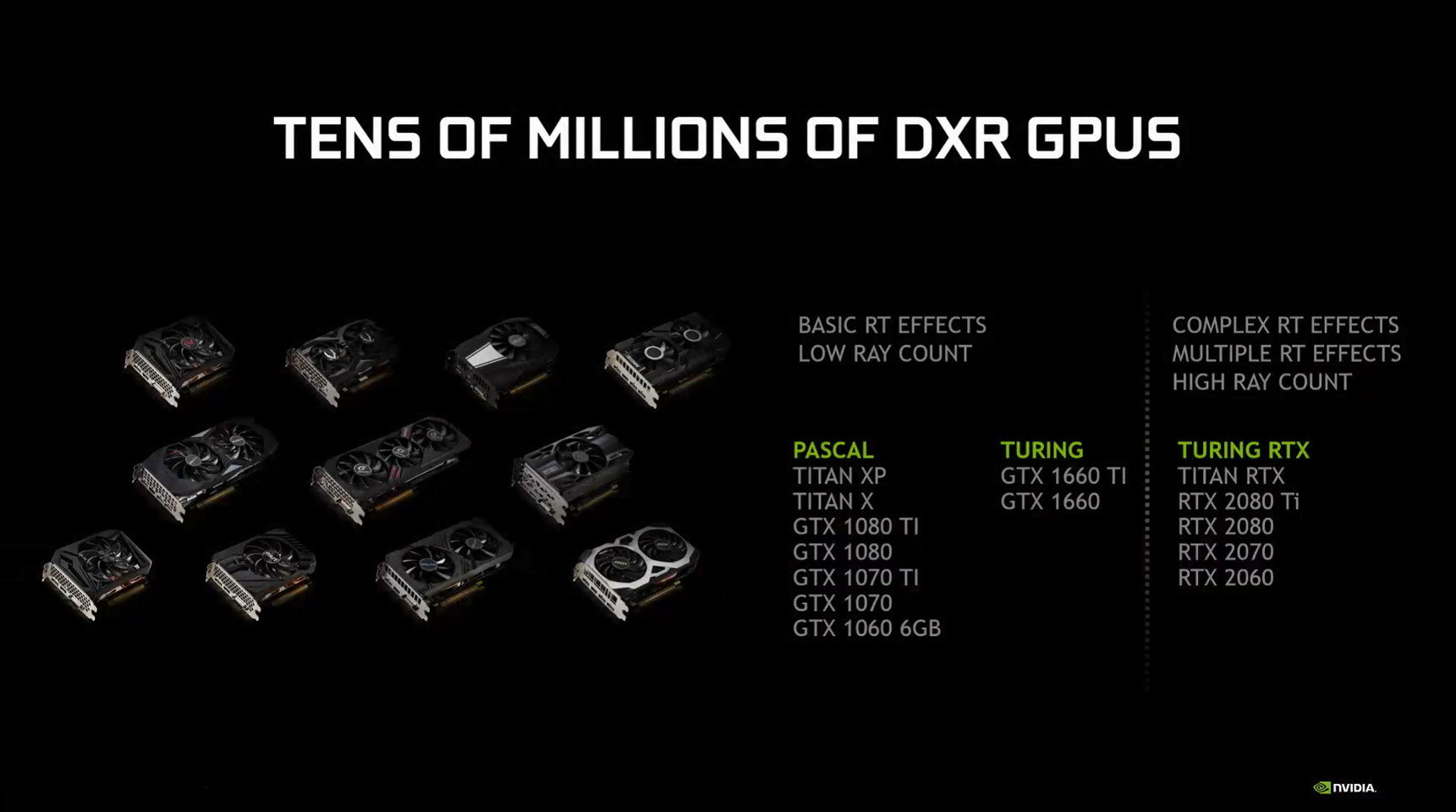
Following AMD's claims on software-based real-time ray tracing in games, and Crytek's Neon Noir real-time ray tracing demo for both AMD and NVIDIA GPUs, it makes sense in hindsight that NVIDIA would allow rudimentary DXR ray tracing support to older hardware that do not support RT cores. In particular, an upcoming drivers update next month will allow DXR support for 10-series Pascal-microarchitecture graphics cards (GTX 1060 6 GB and higher), as well as the newly announced GTX 16-series Turing-microarchitecture GPUs (GTX 1660, GTX 1660 Ti). The announcement comes with a caveat letting people know to not expect RTX support (think lower number of ray traces, and possibly no secondary/tertiary effects), and this DXR mode will only be supported in Unity and Unreal game engines for now. More to come, with details past the break.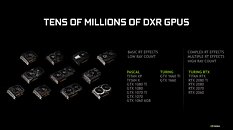
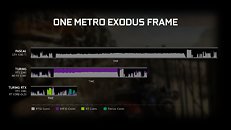
 NVIDIA claims that DXR mode will not run the same on Pascal GPUs relative to the new Turing GTX cards, primarily given how the Pascal microarchitecture can only run ray tracing calculations in FP32 mode, which is slower than what the Turing GTX cards can do via a combination of FP32 and INT32 calculations. Both will still be slower and less capable of hardware with RT cores, which is to be expected. An example of this performance deficit is seen below for a single frame from Metro Exodus, showing the three different feature sets in action.
 Dragon Hound, an MMO title shown off before by NVIDIA at CES, will be among the first game titles, if not the very first, to enable DXR support for the aforementioned GTX cards. This will be followed by other game titles that already have NVIDIA RTX support, including Battlefield V and Shadow of the Tomb Raider, as well as synthetic benchmarks including Port Royal. General incorporation into Unity and Unreal engines will help a lot coming forward, and NVIDIA then mentioned that they are working with more partners across the board to get DXR support going. Time will tell how well these implementations go, and the performance deficit coming with them, and we will be sure to examine DXR in the usual level of detail TechPowerUp is trusted for. But for now, we can all agree that this is a welcome move in greatly increasing the number of compatible devices capable for some form of real-time ray tracing, which in turn will enable game developers to focus on implementation as well now that there is a larger market.


Following AMD's claims on software-based real-time ray tracing in games, and Crytek's Neon Noir real-time ray tracing demo for both AMD and NVIDIA GPUs, it makes sense in hindsight that NVIDIA would allow rudimentary DXR ray tracing support to older hardware that do not support RT cores. In particular, an upcoming drivers update next month will allow DXR support for 10-series Pascal-microarchitecture graphics cards (GTX 1060 6 GB and higher), as well as the newly announced GTX 16-series Turing-microarchitecture GPUs (GTX 1660, GTX 1660 Ti). The announcement comes with a caveat letting people know to not expect RTX support (think lower number of ray traces, and possibly no secondary/tertiary effects), and this DXR mode will only be supported in Unity and Unreal game engines for now. More to come, with details past the break.


113 Comments on NVIDIA to Enable DXR Ray Tracing on GTX (10- and 16-series) GPUs in April Drivers Update
The only other reason would be a huge drop in CPU sales (compared to plans and production).
Here's an interesting graph. Inventory turnover is revenue / inventory.
finbox.io/AMD/explorer/inventory_turnover
Nvidia's is actually very stable. It's bad because they replace GPUs often and a big portion of this are Pascal chips made for miners (AFAIR they've confirmed this last year).
Pure speculation but if it isn't specific, some or all of that could also be "likely". ;)
@medi01Citation? It's part of MS DirectX, so it would be very odd if they locked out a vendor now after supporting multiple vendors throughout DX's history.
It's not like we have a choice of CPU/GPU manufacturers to compare or a mathematical theory that tells us how this should work.
The only thing we know is that Nvidia admitted they have some unsold mining products. And that... they kept a very similar inventory/revenue ratio for years of prosperity - even before hashing replaced gaming as a hobby. It turns out Nvidia's inventory turnover has stayed around 11% since 2011.
And back then AMD had a similar ratio (and at that point they were still pretty OK financially). Now, when AMD is coming back to the race, their inventory starts to grow.
So maybe 11% is the right level for these companies? Maybe we shouldn't worry about Nvidia so much?
RTX is a gimmick, nothing more. Here hoping NAVI helps push PC Gaming to the next level in the Mainstream, where it needs a nice push.
You should be greatful. RTRT will get some traction.
And when general computation (GPU or CPU) catches up, we'll not only have actual games that utilize it, but also a ton of know-how.
Just in case somebody asks.
Moreover, the current inventory level is actually appropriate for their revenue - assuming it'll stay so high in the future.
We have no proof that sales of Turing are bad. In fact, contrary to your theories, we have signs that RTX is in fact selling pretty well.
No offense, but you're acting a bit like political trolls on some forums - repeating on and on a fact you've read somewhere and it fits your agenda.
And look - FP16 is supported now, so indeed Vega will use it's 2:1 26.88 TFLOPS FP16 for better performance in DXR then old Pascal.
www.amd.com/pl/technologies/radeon-prorender-developers
It would be nice if we had some empirical observations that make this hypothesis more probable. For example: there aren't many RTX users among gaming forum peers, AIBs don't invest in making Turing cards, OEMs don't use them etc. But none of that is happening.
Turing launch looks exactly like every previous successful Nvidia launch did - with 2 major exceptions/circumstances:
1) It happens after the crypto mining collapse, so there are some question marks over Nvidia's financial situation (which can also be said about many other companies - including AMD and few graphics card AIBs)
2) Unlike previous generations, this one puts features before performance, so it's not as easy to evaluate. Obviously, people understand GPU fps graphs better than GPU technology*. And while performance is objective, image realism is not.
(*) which in case RTRT is still surprising. Ray Tracing is a very intuitive technology compared to what GPUs normally do. It's a much better model of what actually happens around us.
And, more importantly, it's been the dominating rendering method for decades.
For the last 2 years quite a few people on this forum have been raving about Zen rendering potential. But the RTX discussions have shown that some of them have no idea how rendering works.
I find this deeply disturbing.
One has to understand the numbers as well. ;-)Everything gaming-related you posted is related to mining. Today Nvidia is shipping roughly as many gaming GPUs as they did during 2017 - before the mining bubble.
Do you at least agree that the number of PC gamers hasn't gone up? :-)
That any growth potential is either in increasing GPU price or taking market share from AMD?
Q3 FY2019 was the last period boosted by mining. If criticizing Nvidia and getting likes from medi01 gives you pleasure, you have 3 more quarters to use the "poor sales" argument. Cherish the moment. :-)
Therefore, Turing units on hand is less than 10% of all of the stock on hand. So yes, his (Super XP’s) repeated posting that 1.57 billion units on hand is proof that Turing is a failure is trolling.Then, my friend, you are quite obviously delusional. You should see someone about that before it gets worse.
We all know you don't like RTX. You're allowed to have this kind of inclinations.
What I don't undertstand is why you're so actively fighting Nvidia. What's driving you? You want to save us from buying RTX? You want likes from NV haters?
For me you're actually a proof that Turing is a great release.
Performance is great, efficiency is great, new features are really interesting (at least for some), AIB cards are top notch, supply is OK.
Price is slightly higher than usual, but otherwise the cards are excellent.
I love the fact that you have to reach for Nvidia's financial figures, and interpret them in extremely negative way, to make Turing look remotely bad.
Still waiting for CryTek to provide all the details but it is highly likely Vegas 16-bit precision is used for RT.